- 01What is the difference between WLL, SWL and breaking load?
- WLL — working load limit — is the most the manufacturer rates a part to carry in service. SWL, safe working load, is the older term and is sometimes set lower for a particular installation. The minimum breaking load is what the part withstood in test, several times its WLL, and it is never a working figure.
- 02Can Grade 30, 43 or 70 chain be used for lifting?
- No. Proof coil (Grade 30), high test (Grade 43) and transport (Grade 70) chain are made for tie-down, towing and general duty. Overhead lifting with chain calls for alloy chain — Grade 80 or Grade 100 — with fittings of the same grade.
- 03Do the parts come with test certificates?
- Yes. Each consignment ships with the manufacturer's test certificate. If your site needs more — third-party certification or witnessed proof testing — say so on the RFQ and we will confirm what we can arrange.
- 04How do I read an Indus lifting part number?
- IH-LR, then the family code, then the size. Inch sizes are written in hundredths of an inch (075 is 3/4″, 025X200 is 1/4″ × 2″), metric sizes in millimetres (10MM, M16), and capacities in tonnes (0T5 is 0.5 t). A trailing -C or -A marks the carbon-steel and alloy-steel versions of the same hook or link.
- 05How often must lifting equipment be thoroughly examined in the UAE?
- It depends on the emirate and on whether the item is lifting equipment or a lifting accessory. In Abu Dhabi, Code of Practice 34.0 requires a thorough examination of lifting equipment every 12 months, and of lifting accessories and equipment for lifting people every 6 months, by a QCC-approved third party. In Dubai, Municipality guideline GU48 requires certification every 12 months by an EIAC-accredited third party, and EIAC's own requirements set 6-month intervals for accessories, manual equipment and people-lifting equipment. Daily and pre-use checks by the user apply everywhere, and an accessory without a legible WLL marking comes out of service.
- 06How much does the sling angle reduce what each leg can carry?
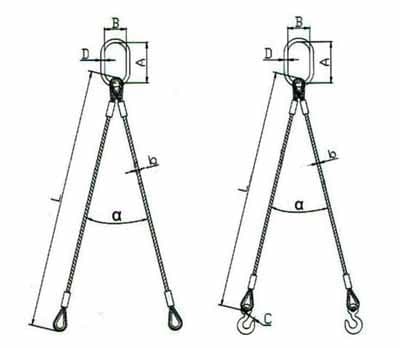
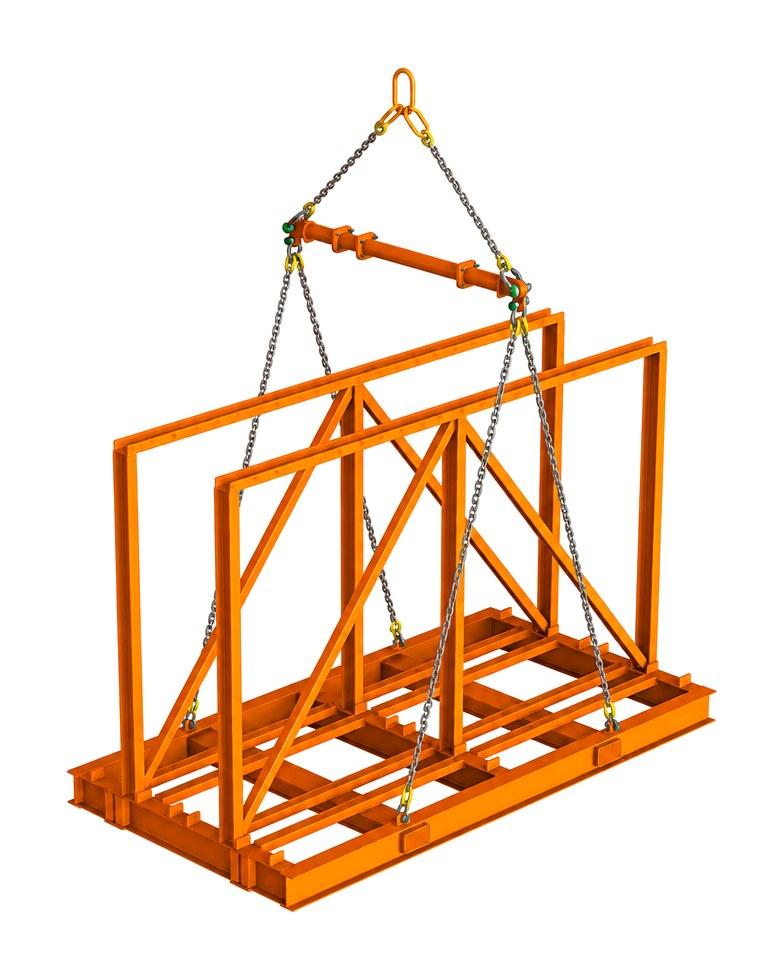
- The flatter the sling, the more load each leg carries. Measured from the horizontal, a leg at 90° carries its share of the load; at 60° it carries about 1.15 times that share, at 45° about 1.41 times and at 30° twice as much. Most lifting standards do not allow angles flatter than 30° from horizontal. Size every component — sling, shackle, master link and lifting point — for the tension in the worst-loaded leg, not for the weight of the load divided by the number of legs.
- 07Grade 80 or Grade 100 alloy chain — which should I choose?
- Both are alloy lifting chain rated at a 4:1 design factor. Grade 100 carries about 25% more working load than Grade 80 of the same size, so a smaller, lighter sling does the same lift. Grade 80 is the more widely used and stocked, and manufacturers generally allow it at higher service temperatures than Grade 100 — check the derating table for hot work. Whichever grade you choose, the fittings must be rated for it: a Grade 80 fitting sets the capacity of a Grade 100 sling.
- 08Can I send a full rigging list for one quotation?
- Yes. Send the list with the WLL, size, quantity and any certification each line needs, and we quote it line by line under IH-LR part numbers, with the manufacturer's rating against each item. Where a manufacturer does not publish a WLL for a part, or a line is ambiguous — a shackle pattern, a chain grade or a sling length — we say so on the quotation rather than guess.