
All three lift loads with a chain, and on a busy site they get used interchangeably. They should not be. Each one is built and rated for a particular way of working, and the standards that cover them say so.
The three at a glance.
| Aspect | Chain block | Lever hoist | Electric hoist |
|---|---|---|---|
| Direction | Vertical lifting only | Any position, straight pull hook to hook | Vertical lifting only |
| Operated by | Hand chain | Ratchet lever | Pendant control |
| Best for | Occasional lifts from a beam or gantry | Pulling, tensioning, positioning, short lifts | Frequent lifts at a fixed station |
| Covered by | ASME B30.16; EN 13157 | ASME B30.21; EN 13157 | ASME B30.16; EN 14492-2 |
What is the difference between a chain block and a lever hoist?
A chain block is operated by a hand chain and is made for lifting a freely hanging load vertically from an overhead point. A lever hoist is operated by a ratchet lever and can lift, pull and tension in any position, as long as the pull runs straight from hook to hook. Use a lever hoist for pulling and tensioning; use a chain block for overhead lifts.
Chain blocks.
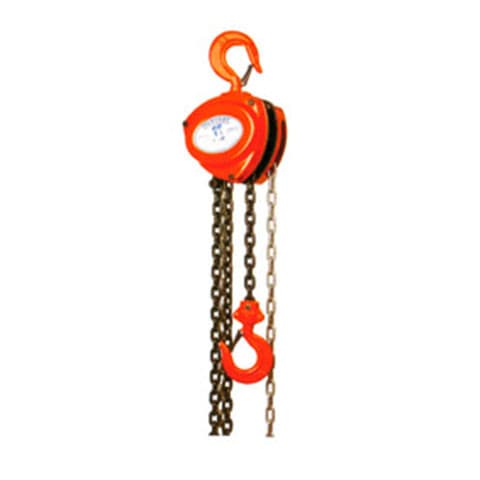
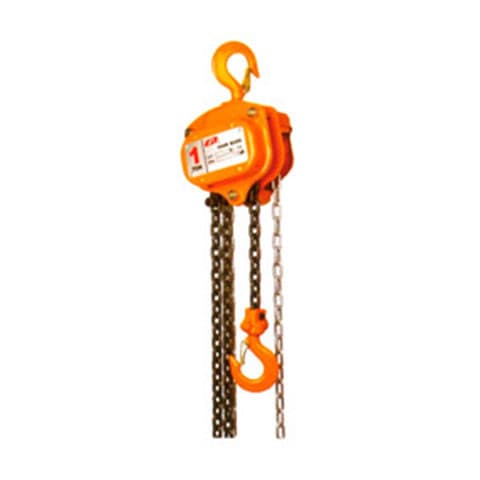
A chain block hangs from a beam, trolley or gantry and lifts the load straight up. Pulling the hand chain drives a gear train, so a modest hand pull lifts a heavy load. Our Type A chain block needs about 324 N on the hand chain to lift its 1 t rating, and about 504 N at 5 t. ASME B30.16 covers hand-chain hoists for the vertical lifting of freely suspended, unguided loads; tensioning and non-vertical lifting are outside it.
- Keep the load centred under the hoist; do not pull at an angle.
- Do not use the hoist chain as a sling, and never wrap it around the load.
- Do not support a load on the tip of the hook.
Lever hoists.
A lever hoist — also called a ratchet lever hoist or lever block — is worked by a short handle and can be used in any position: lifting, pulling a load across a floor, tensioning a line, or aligning flanges and machinery. ASME B30.21 covers lever hoists for lifting, pulling and tensioning. The condition is that the pull runs in a straight line from hook to hook, with the body free to swivel on its top hook.
We do not list lever hoists in the online catalogue. They are available on request; send the capacity, the chain length and the work.
Electric hoists.
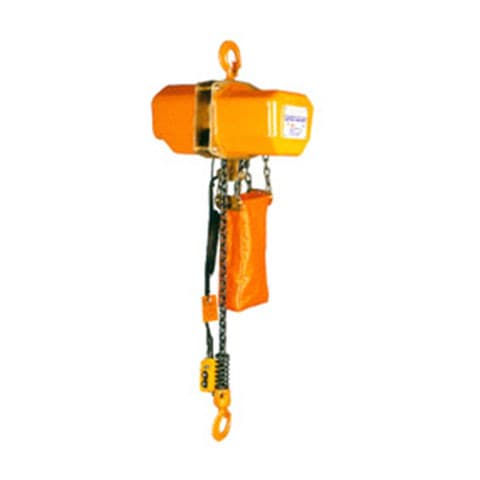
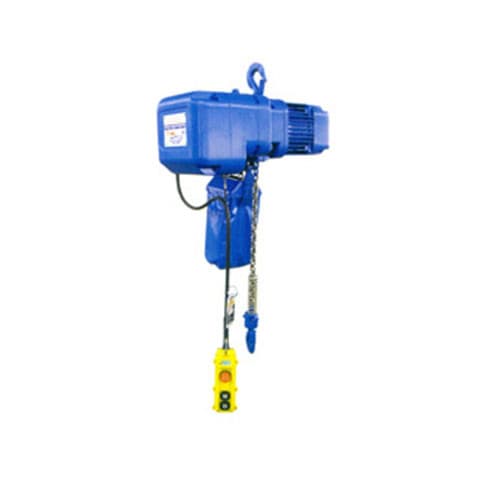
An electric chain or wire rope hoist lifts at the push of a button and suits a workstation where the same lift happens many times a day. Electric hoists are classed by duty as well as capacity — how long and how often they can run. Our Type B electric chain hoists are rated M4 or M5 under the ISO 4301 classification; one major maker states that an M5 hoist is designed for 1,600 hours of running at full rated load.
Duty class matters as much as capacity. A hoist with the right capacity but too low a duty class will overheat or wear out early on a busy line. Tell the supplier how many lifts an hour, at what fraction of the rated load, and over what height.
What every hoist shares.
- Rated by WLL. The nameplate states it; our chain blocks are proof-tested at 1.5 times WLL.
- Suspension rated too. The beam, trolley or anchor above the hoist must carry the load plus the hoist’s own weight.
- No chain slings. The load chain is not a sling; use a proper sling between hook and load.
- Hook in the bowl. Seat the load in the bowl of the hook with the latch closed — never on the tip.
- Inspected. Hoists are lifting equipment under the UAE inspection rules — see our guide to lifting inspection in the UAE.
Which hoist?
Start from the direction of the pull and how often you lift.
If · Occasional vertical lift from a beam
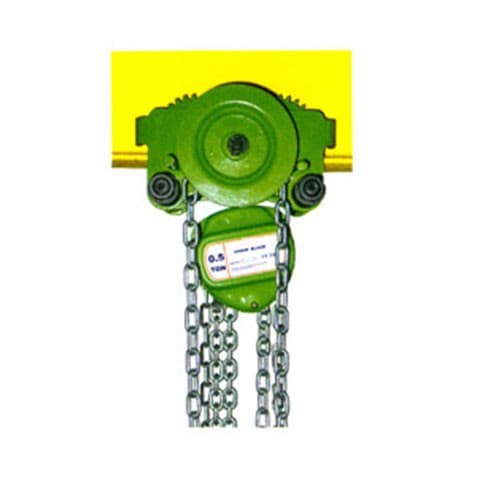
Manual chain block, on a beam clamp or trolley.
If · Pulling, tensioning or aligning sideways
Lever hoist, pulling straight hook to hook.
If · Repeated lifting at one station
Electric chain hoist, selected on duty class.
If · Low headroom under the beam
Close-headroom trolley hoist.
If · Long rope runs, pulling or lowering
Wire rope puller (rope-grip hoist).
Hoists in this guide
Common questions
Can I use a chain block horizontally?
No. Chain blocks are made for vertical lifting of a freely hanging load, centred under the hoist. For horizontal pulling or tensioning, use a lever hoist.
Can a lever hoist be used for lifting?
Yes. Lever hoists are made for lifting, pulling and tensioning, in any position, provided the pull runs straight from hook to hook.
Why can’t I put a pipe on a lever hoist handle?
Because the handle is sized so a person’s pull matches the rated load. If it will not move, the hoist is overloaded or jammed, and an extension can overload it.
What does M4 or M5 mean on an electric hoist?
It is the hoist’s duty classification under ISO 4301 — how much running it is designed for. Higher classes suit more frequent, heavier use. One maker rates an M5 hoist for 1,600 hours at full rated load.
Chain blocks and manual hoists
Manual chain blocks, close-headroom trolley hoists and wire rope pullers.
Electric hoists
Electric chain hoists and wire rope hoists, with duty class.
Beam trolleys
Push and geared trolleys to carry a hoist along a beam.
Figures verified · Standard scopes from ASME B30.16 and B30.21; operating rules from published Kito, CM and Yale manuals. Product figures from the linked size tables.
Choosing a hoist for a job?
Tell us the load, the lift height, how often you lift and what the hoist hangs from. We will quote the right hoist and suspension, with the manufacturer’s certificate.
Plant-down? Call +971 52 2477942 — 24/7