
Two chains of the same size can look identical and differ in strength by a factor of three. One may be rated to lift a load over people, and the other may not. The difference is the grade, and it is stamped on the links for a reason.
What a grade is.
A chain grade is a statement about the strength of the steel the links are made from. For alloy lifting chain the number is tied to the breaking stress: Grade 80 chain is designed to break at a mean stress of about 800 N/mm² in the link, and Grade 100 at about 1,000 N/mm². A higher grade therefore carries more at the same size, or the same load at a smaller and lighter size.
Grades 30, 43 and 70 are the North American carbon-steel grades, published by the National Association of Chain Manufacturers (NACM). They are sold as proof coil, high test and transport chain. They are made for lashing, towing, logging, fencing and general use, and they are not for overhead lifting.
Which chain grades can be used for overhead lifting?
Alloy chain only: Grade 80 and Grade 100 (and higher alloy grades from some makers), used as a chain sling or in a hoist with fittings of the same grade. Grade 30 proof coil, Grade 43 high test and Grade 70 transport chain are not for overhead lifting, whatever their breaking load.
The ladder, at one size.
Here is every grade at 3/8″ (10 mm), from the size tables on our product pages. The design factor column is breaking load divided by WLL, worked out from those rows.
| Grade | Sold as | WLL | Breaking load | Factor | Overhead lifting |
|---|---|---|---|---|---|
| 30 | Proof coil | 1,200 kg | 47.2 kN | 4:1 | No |
| 43 | High test | 2,450 kg | 72.1 kN | 3:1 | No |
| 70 | Transport, binder chain | 3,000 kg | 117.4 kN | 4:1 | No |
| 80 | Alloy lifting chain | 3,200 kg | 126 kN | 4:1 | Yes |
| 100 | Alloy lifting chain | 4,000 kg | 157 kN | 4:1 | Yes |
Two things stand out. Grade 70 transport chain breaks at nearly the same load as Grade 80 at this size — and it is still not lifting chain. And Grade 43 is rated at only 3:1. Breaking strength is not what separates lifting chain from the rest.
Each grade, and what it is for.
Grade 30 — proof coil
Low-carbon steel, the cheapest and weakest grade. Used for barriers, light towing, farm work and general fixing. Every length is proof-tested, which is where the name comes from — not because it is rated for anything demanding.
Grade 43 — high test
Higher-carbon steel, about twice the WLL of Grade 30 at the same size. Used in towing, logging and some tie-down work. Its 3:1 rating on breaking load is lower than the other grades here.
Grade 70 — transport chain
Heat-treated carbon steel, usually finished in yellow chromate. This is the chain in truck load binders: it lashes loads to trailers. It is strong, but it is made for load restraint, not lifting.
Grade 80 — alloy lifting chain
Quenched and tempered alloy steel, and the long-standing standard for chain slings. It is used with Grade 80 master links, hooks and connectors so that the whole sling carries one rating. In Europe it is specified to EN 818-2, and made into slings to EN 818-4.
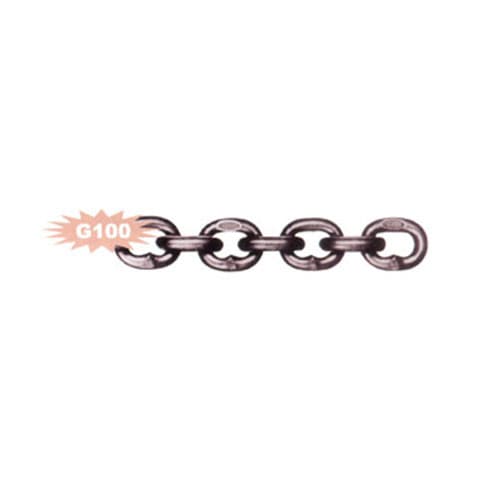
Grade 100 — alloy lifting chain
A higher-strength alloy that carries about 25% more than Grade 80 at the same size. That buys a lighter sling for the same load, which matters for riggers handling large slings by hand. It needs Grade 100 fittings; Grade 80 fittings on Grade 100 chain limit the whole sling to Grade 80.
Transport chain is rated differently.
Load-restraint chain is often rated in lashing capacity (LC) rather than WLL. Our Grade 70 chain to AS/NZS 4344 at 10 mm has a lashing capacity of 6,000 kg and a breaking load of 118 kN — so the LC is half the breaking load. That is a sensible margin for holding a load against a moving trailer. It is far too thin for lifting, and it is why an LC figure must never be read as a WLL.
The same logic runs through the hardware. Grade 70 binder chain, grab hooks and load binders are a lashing system. Grade 80 and 100 hooks, master links and connectors are a lifting system. Mixing the two produces a sling whose rating is set by its weakest part.
Other chain you will meet.
Several chains in the catalogue sit outside the grade ladder:
- Hoist chain to EN 818-7 is calibrated Grade 80 chain made to a tight pitch tolerance for the load wheel of a chain block. It is sold by size and pitch — our range runs from 3 × 9 mm to 22 × 66 mm — and it is not for making slings.
- DIN 763, DIN 764, DIN 766 and DIN 5685 link chains are general-purpose and conveyor chains. The current DIN 764 and DIN 766 are written for chain conveyors and forbid use as slings or lifting accessories; see our guide to DIN link chain.
- Stainless steel chain is chosen for corrosion. It is rated well below alloy chain of the same size, and much of it carries no lifting rating at all.
Identifying a chain you already have.
Look for the grade mark. Alloy lifting chain carries a grade mark and a manufacturer’s mark embossed on links at intervals along its length, and a chain sling carries a tag with its WLL. Grade 30, 43 and 70 chain is marked by grade in the same way under NACM practice.
Do not identify chain by colour. Yellow chromate is common on Grade 70 and painted or powder-coated finishes on alloy grades, but these are makers’ conventions, not a standard. A chain with no legible grade mark, or a sling with no tag, is treated as unrated and does not lift.
Choosing a chain grade
Start from what the chain will do, not from its size.
If · Lifting a load overhead, or as part of a sling
Grade 80 or Grade 100 alloy chain, with fittings of the same grade.
Choose Grade 100 where sling weight matters; the fittings must match.
If · Holding a load down on a vehicle
Grade 70 transport chain with load binders, rated in lashing capacity.
If · Towing, logging or general pulling
Grade 43 or Grade 70, sized on their WLL.
If · Barriers, fencing or light fixing
Grade 30 proof coil or general-purpose DIN chain.
If · Running over a chain block load wheel
Calibrated hoist chain to EN 818-7, matched to the block’s pitch.
The chains in this guide
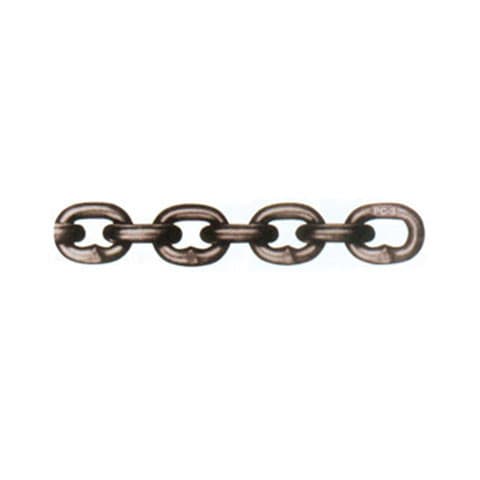
IH-LR-CH-G30A
Grade 30 Proof Coil Chain — Inch Sizes
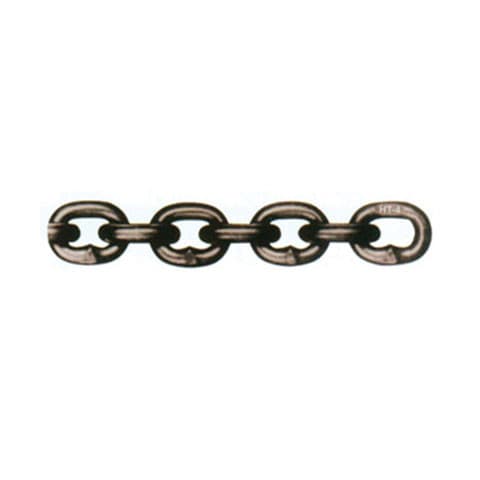
IH-LR-CH-G43A
Grade 43 High Test Chain — Inch Sizes
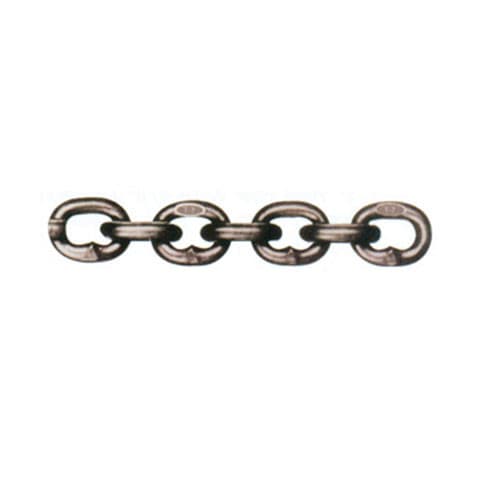
IH-LR-CH-G70A
Grade 70 Transport Chain — Inch Sizes
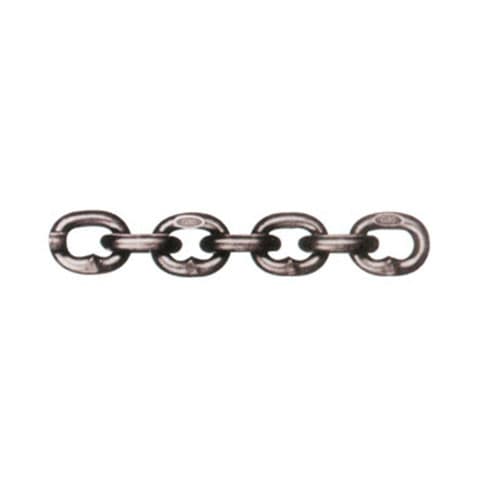
IH-LR-CH-G80
Grade 80 Alloy Lifting Chain
IH-LR-CH-G100
Grade 100 Alloy Lifting Chain
IH-LR-CH-80HCE8187
Grade 80 Hoist Chain — EN 818-7
IH-LR-CH-70CASN434
Grade 70 Chain — AS/NZS 4344
IH-LR-CH-BCH4370
Binder Chain with Hooks — Grade 43 and Grade 70
Common questions
Can I lift with Grade 70 chain?
No. Grade 70 is transport chain, made for tie-down. At 3/8″ its breaking load is close to Grade 80’s, but it is not made, tested or supported by fittings to a lifting standard. Use Grade 80 or Grade 100 alloy chain for any overhead lift.
What is the difference between Grade 80 and Grade 100 chain?
Grade 100 is a stronger alloy that carries about 25% more at the same size — 4,000 kg against 3,200 kg at 10 mm in our tables. Both are lifting chain at 4:1. Grade 100 chain needs Grade 100 fittings to keep its rating.
Can I mix Grade 80 and Grade 100 components in one sling?
The sling is then rated as the lowest grade in it, and the tag must say so. Most sites avoid mixing grades so that a Grade 100 tag can always be trusted.
Why is proof coil called proof coil?
Because every length is proof-tested before sale and it was traditionally sold in coils. The name says nothing about its fitness for lifting, and it is not lifting chain.
How do I tell what grade a chain is?
Read the grade mark embossed on the links, and the tag on a sling. Do not go by colour. If there is no legible mark, treat the chain as unrated.
Alloy lifting chain, Grade 80 and 100
WLL, breaking and proof-load tables for every size.
Commercial and transport chain
Grade 30, 43 and 70 chain, binder chain and connecting links.
Grade 80 chain fittings
Master links, hooks and connectors for building a Grade 80 chain sling.
Figures verified · WLL and breaking loads are taken from the size tables on the linked product pages. Design factors are calculated from those figures.
Building a chain sling?
Tell us the load, the number of legs and the headroom. We will quote Grade 80 or Grade 100 chain and fittings to suit, with the manufacturer’s test certificate.
Plant-down? Call +971 52 2477942 — 24/7