
DIN chain looks like lifting chain — round steel links, sold by diameter, often galvanized — and it is easy to buy by the metre for a job it was never meant for. The standards themselves are clear about what they cover, and lifting is not on the list.
The four standards.
| Standard | What it is | Intended use |
|---|---|---|
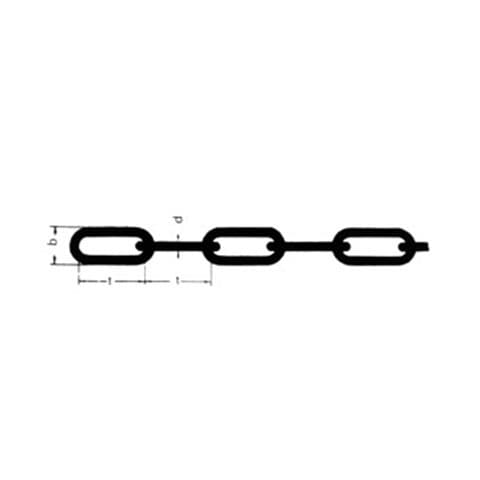
| DIN 763 | Long-link chain, tested, not calibrated | General purpose — not for slings or lifting accessories |
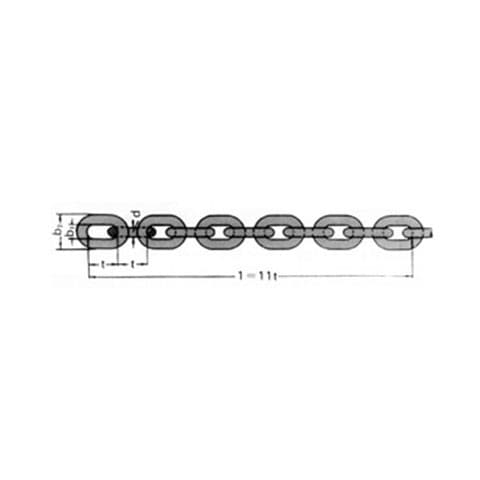
| DIN 764 | Medium-link chain (pitch 3.5 × d), calibrated and tested, grade 3 | Chain conveyors — not for slings or lifting |
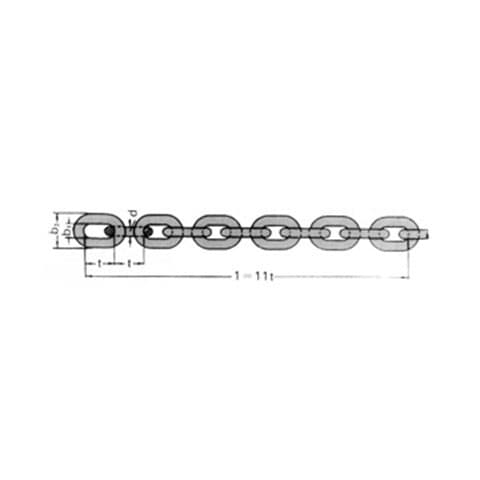
| DIN 766 | Short-link chain (pitch 2.8 × d), calibrated and tested, grade 3, quenched and tempered | Chain conveyors — not for slings or lifting |
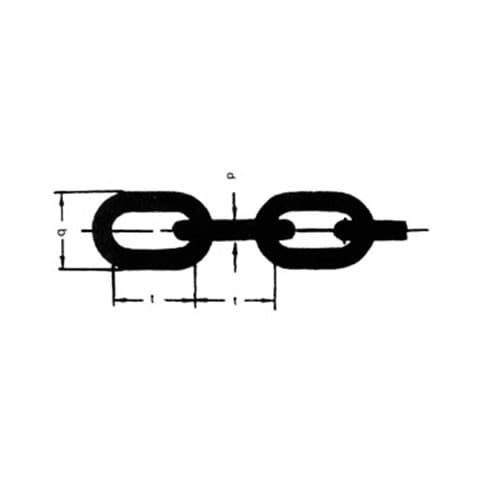
| DIN 5685 | Long, semi-long and short-link chain, not proof-loaded | Barriers, securing, light general use |
The current DIN 766 (2015) covers chain from 10 mm to 42 mm, for use from −20 °C to 400 °C, and states that it shall not be used as a lifting accessory, sling or load-bearing device with cranes or hoists. DIN 764-1 (2010) carries the same restriction. DIN 5685 chain is, by its own title, not proof-loaded at all.
Can DIN 766 chain be used for lifting?
No. The current DIN 766 is a standard for chain conveyors, and it states that the chain shall not be used as a lifting accessory, sling or load-bearing device with cranes or hoists. For lifting, use Grade 80 or Grade 100 alloy lifting chain with fittings of the same grade.
What “calibrated” means.
Calibrated chain is made to a tight tolerance on its pitch — the inside length of each link — so it engages a sprocket or pocket wheel link after link without riding up or jumping. Our DIN 764 medium-link chain, for example, is offered in more than one pitch tolerance at each size, down to ±0.2 mm on 4 mm and 5 mm chain. Uncalibrated chain such as DIN 763 has no such control and is not made to run on a pocket wheel.
Galvanized DIN 766-pattern chain is also sold as anchor chain for boat windlasses whose gypsy is made for that pitch. If you buy it for that, match the chain to the gypsy maker’s specification — the size and pitch both matter.
How they compare with lifting chain.
| Chain | Breaking load | Lifting? |
|---|---|---|
| DIN 766 short link | 50 kN | No |
| DIN 764 medium link | 50 kN | No |
| Grade 80 alloy lifting chain | 126 kN | Yes |
At the same size, Grade 80 chain breaks at about two and a half times the load of DIN conveyor chain — and it is made, tested and certified to a lifting standard, with a family of matching hooks and links. Our DIN 763 long-link chain carries a published WLL for general use (100 kg at 4 mm), but that is not a lifting rating. See our guide to chain grades for what lifting chain is.
Which chain?
Start from the job.
If · Lifting, slings or hoisting
Grade 80 or Grade 100 alloy lifting chain — not DIN link chain.
If · Running on a sprocket or pocket wheel
Calibrated DIN 766 or DIN 764 to the wheel maker’s pitch.
If · Barriers, fencing, securing light items
DIN 5685 or DIN 763.
If · Corrosive or marine service
Stainless DIN chain, with its own published rating.
Chain in this guide
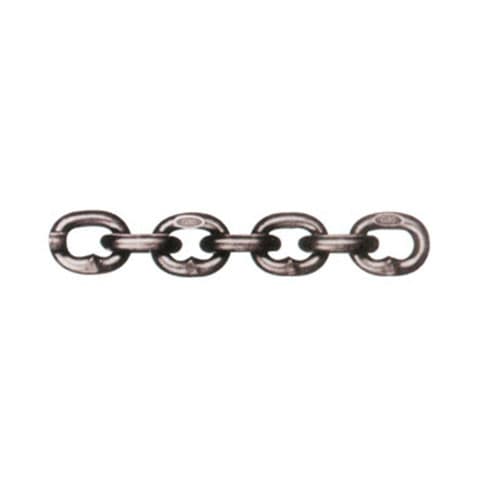
Common questions
What is the difference between DIN 764 and DIN 766 chain?
Link length. DIN 766 is short-link chain with a pitch of 2.8 times the wire diameter; DIN 764 is medium-link with a pitch of 3.5 times. Both are calibrated, tested chains written for chain conveyors.
Is DIN 763 chain tested?
Yes — DIN 763 is tested long-link chain, but it is not calibrated and it is not lifting chain. DIN 5685 chain, by contrast, is not proof-loaded.
Can I use DIN 766 chain as anchor chain?
Galvanized DIN 766-pattern chain is sold for boat windlasses whose gypsy matches its pitch. Match the chain size and pitch to the windlass maker’s specification.
Why can’t DIN chain be used for lifting?
Because it is not made or rated as lifting chain — the current DIN 764 and DIN 766 explicitly exclude use as slings and lifting accessories — and it is much weaker than Grade 80 chain of the same size.
DIN link chain
DIN 763, 764, 766 and 5685 chain for conveyors, barriers and general use.
Alloy lifting chain
Grade 80 and Grade 100 chain for lifting.
Figures verified · Standard scopes from DIN Media’s abstracts of DIN 764-1:2010 and DIN 766:2015 and the titles of DIN 763 and DIN 5685. Breaking loads from the linked size tables.
Need chain for a conveyor, windlass or barrier?
Tell us the job, the size and, for a sprocket or gypsy, the pitch. We will quote the right DIN chain — or lifting chain, if the job is a lift.
Plant-down? Call +971 52 2477942 — 24/7