
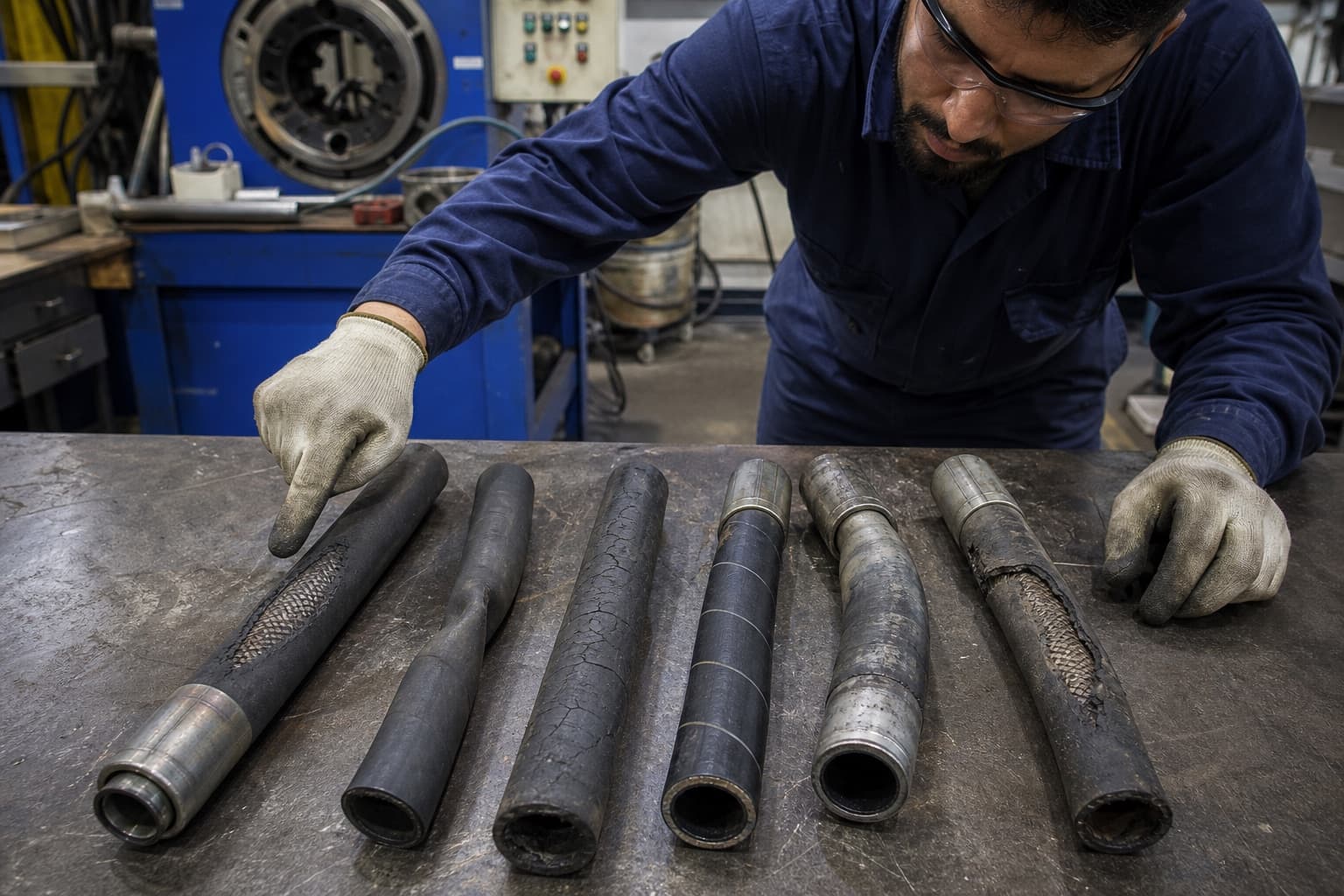
Pull a failed assembly off a machine and most of the diagnosis is already in your hand. Where it failed, what the cover looks like around the failure, and whether the reinforcement is corroded or clean will each point somewhere different — and somewhere different is the point, because the replacement will fail the same way if nothing else changes.
The six.
| Mode | What you see | What to change |
|---|---|---|
| Abrasion | Flat worn area on the cover, often with reinforcement showing. No burst. | Re-route, clamp, or sleeve the contact point. |
| Kinking / tight bend | Flattened or creased section, usually near a fitting. | Longer assembly, or an elbow fitting to take the turn. |
| Heat ageing | Hardened, often crazed cover. Hose has lost flexibility along its length. | Move it away from the heat source, or shield it. |
| Twist | Layline spirals instead of running straight. | Re-install without twist; clamp so it cannot rotate. |
| Fitting or crimp | Failure at the ferrule — hose pulled out, or weeping at the collar. | Check crimp specification and whether the fitting suits the hose. |
| Cover damage from outside | Cuts, gouges, corroded reinforcement under a broken cover. | Guard the run; a breached cover lets water reach the wire. |
The one worth dwelling on is abrasion, because it accounts for a large share of what comes off machines and it is almost entirely preventable. A hose rubbing on structure, or on another hose, wears through the cover, exposes the reinforcement, and from that point the wire corrodes and the assembly is on borrowed time. Nothing about the hose caused it.
Twist, and why it is invisible.
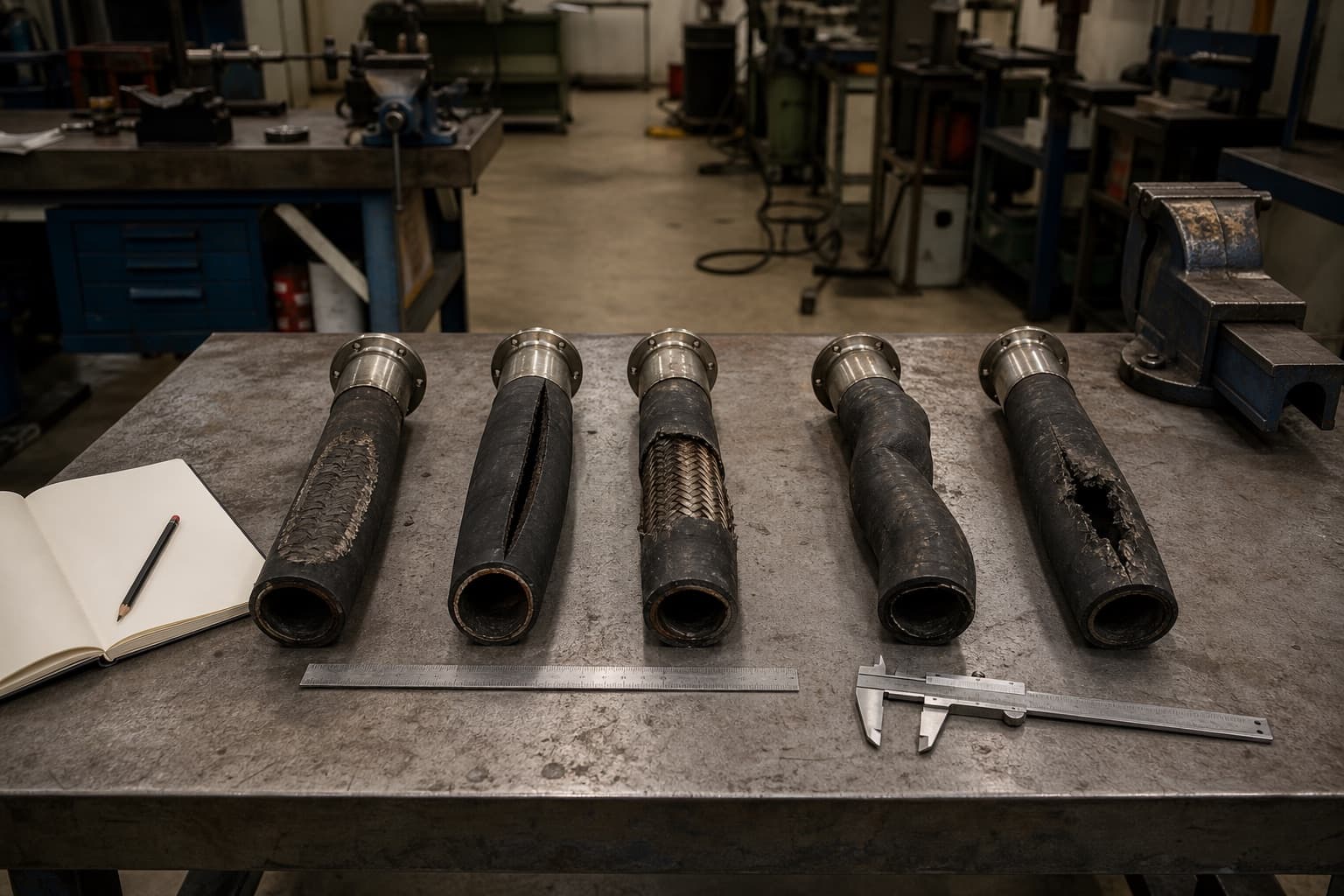
How much does twist reduce hydraulic hose life?
Substantially — a few degrees of twist is enough to matter, because pressure acts to unwind a twisted hose and that load goes into the reinforcement rather than around it. The practical guidance is simple: install so the layline runs straight, and check it after the machine has been through its range of movement.
Twist is hard to spot because a twisted hose looks like a hose. The layline — the printed stripe running along the cover — is the tell. If it spirals, the assembly is loaded in a way it was not designed for, and the failure when it comes will usually be blamed on the hose.
Gulf conditions make three of these worse.
Ambient temperature, airborne sand and UV all push in the same direction here. Heat accelerates the ageing of the cover and raises the fluid temperature the hose sees from the inside. Airborne sand turns any contact point into an abrasive one, so a rub that would take a year elsewhere takes less. And a cover already hardened by heat and UV cracks sooner when it is flexed.
The practical consequence is that inspection intervals set for a temperate climate are optimistic here, and that guarding a run against abrasion is worth more in this region than the same measure would be elsewhere. What this article will not do is give you a replacement interval in hours — that depends on the hose, the duty cycle and the installation, and the standards decline to give a single number for exactly that reason.
Common replacement grades

IH-HOSE-R1-1SC
R1 1SC Compact Single Wire Braid Hose
Indus Hydraulics
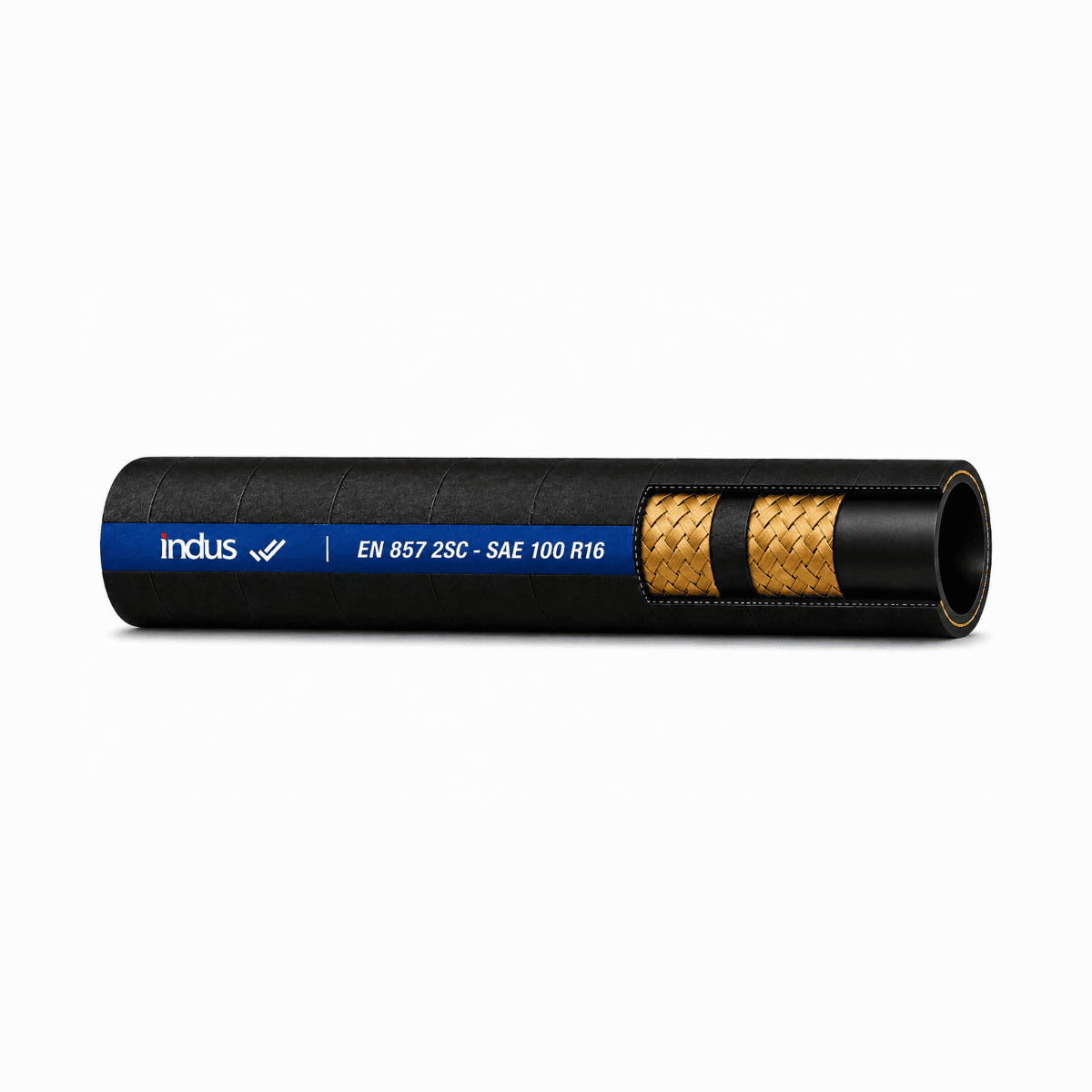
IH-HOSE-2SC
2SC Compact Two Wire Braid Hose
Indus Hydraulics
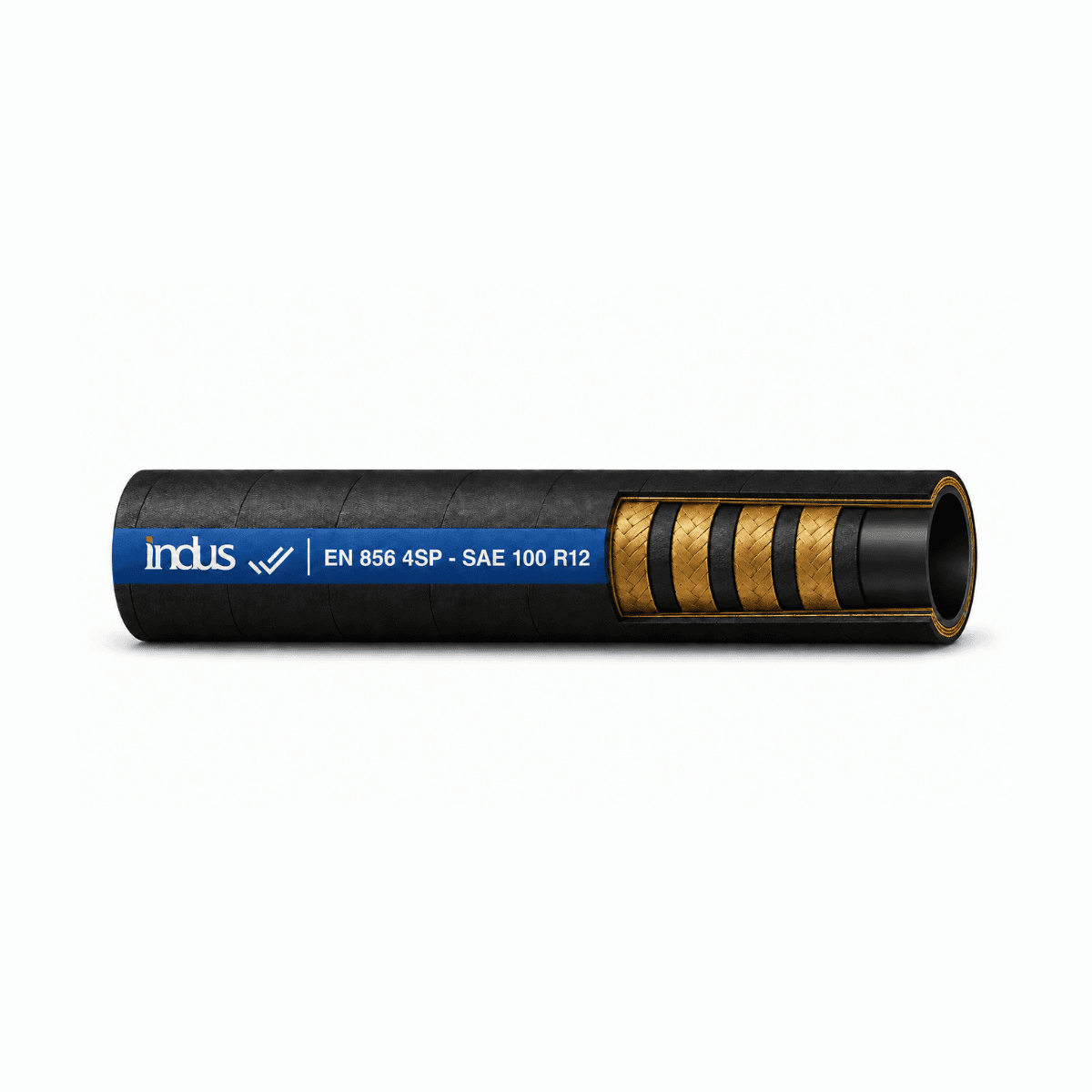
IH-HOSE-4SP
4SP Four-Spiral Hydraulic Hose
Indus Hydraulics
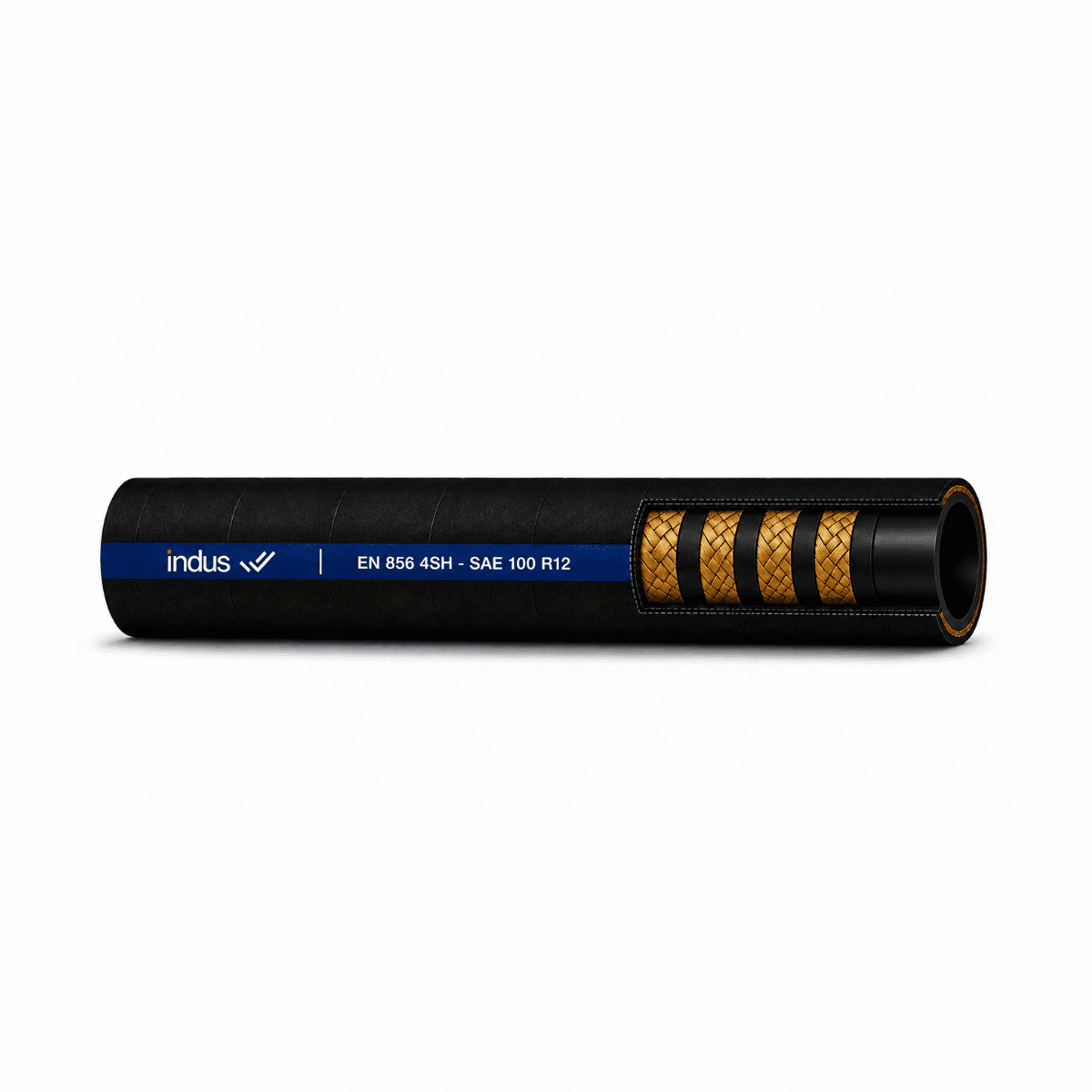
IH-HOSE-4SH
4SH Four-Spiral Heavy-Duty Hydraulic Hose
Indus Hydraulics
Grade selection follows the working pressure and the bend radius the installation actually needs — take both from the machine, not from what was fitted last time.
Common questions
The hose burst in the middle of a straight run. What causes that?
A burst away from any fitting or rub point usually points to pressure the hose was not selected for — a spike, or a grade below what the circuit sees — or to a cover breach that let the reinforcement corrode. Check the layline for the grade actually fitted before assuming the hose was faulty.
Should I sleeve every hose?
No — sleeve the runs that have a contact point or an abrasive environment. Sleeving everything adds cost and can trap moisture against the cover, which is its own problem.
The replacement failed in the same place. Why?
Because the cause was the installation, not the hose. A failure that repeats in the same location is routing, clamping or bend radius until proven otherwise.
Does a hardened, cracked cover mean the hose is unsafe?
It means the hose has aged and should be assessed. Cover cracking on its own does not tell you the state of the reinforcement, but it is a clear signal that the assembly is near the end of its useful life.
Hydraulic hose by grade
Single and two-wire braid, compact and four-spiral, in stock in Dubai.
Figures verified · Failure signatures and preventive measures only. No service-life or replacement-interval figures are published here.
Send us the failed assembly.
A photograph of where it failed and what the cover looks like is usually enough for our engineers to say what killed it and what to change.
Plant-down? Call +971 52 2477942 — 24/7