
Should you use sealant on hydraulic threads?
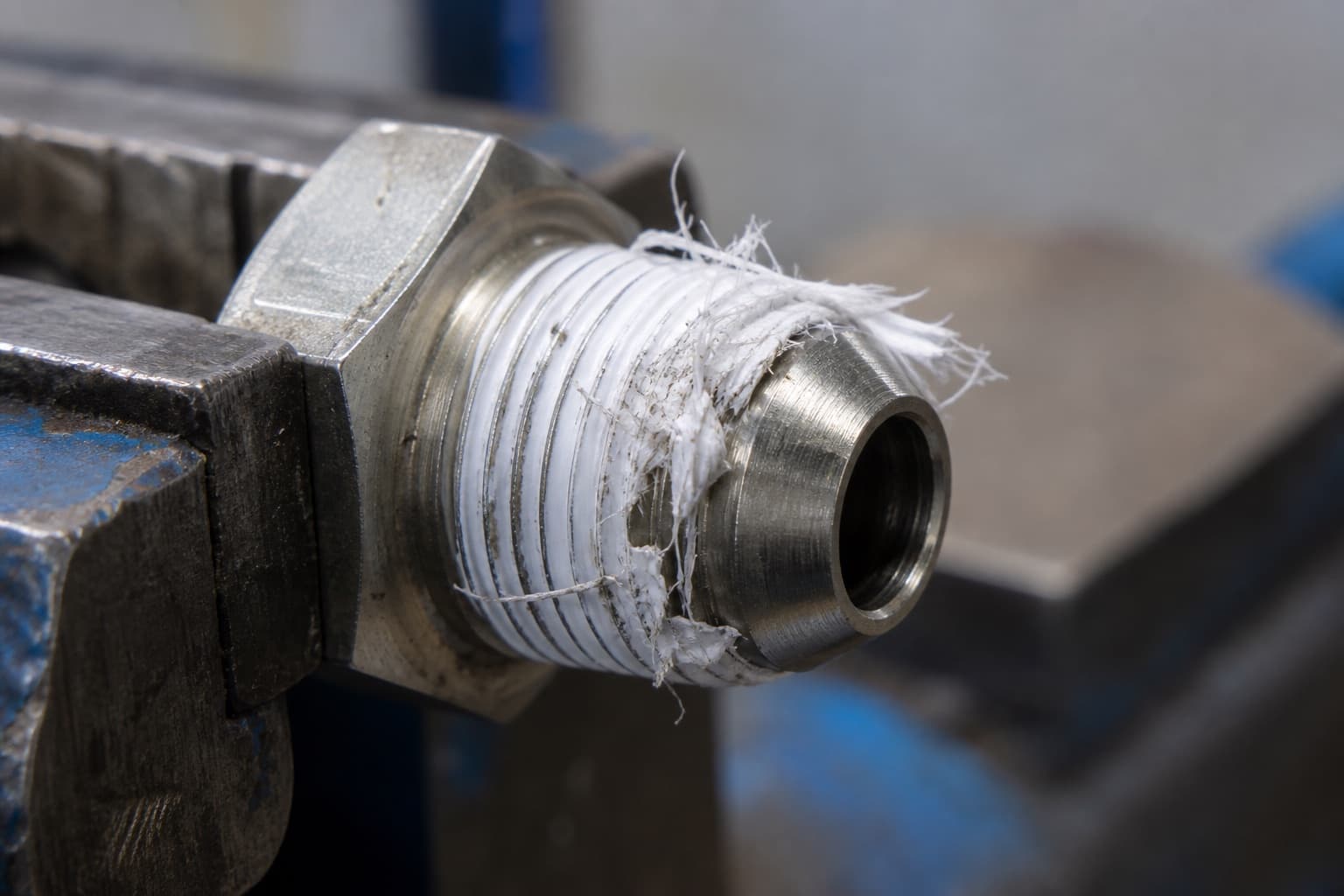
Only where the thread itself is the seal, which means tapered threads. On every straight-threaded family — JIC, ORFS, O-ring boss, BSP parallel, metric cone — the seal is made at a cone, a flat face or an elastomer, and sealant on the thread contributes nothing, masks a joint that is not seating, and can shed into the system. The rule is short: taper yes, straight no.
This is the habit that travels furthest from where it was learned. In pipework, wrapping a thread is simply what you do, and the practice is correct there. Carried into hydraulics it produces two failures at once — a joint that leaks for a reason nobody can find, and debris upstream of something expensive.
Family by family.
| Family | What seals | Sealant? |
|---|---|---|
| NPT and other tapered threads | The thread itself, wedging | Yes — an appropriate sealant, applied correctly |
| JIC 37° flare | The cone | No |
| ORFS | A flat face on an O-ring | No |
| SAE O-ring boss | An O-ring under the shoulder | No |
| BSP parallel | A 60° cone or a bonded seal | No |
| Metric 24° cone | The cone, or a cone with an O-ring | No |
The contamination half, which is worse.
Tape wrapped over the leading thread, or compound applied to the first two threads, ends up inside the system. A shred of tape reaches a valve spool or an orifice and produces a fault nobody connects back to a repair three weeks earlier. Where tape is correct — on a taper — it is started back from the leading thread and wrapped in the direction the thread turns, for exactly this reason.
Anaerobic thread sealants avoid the shredding problem and bring their own: they cure, and a joint that later needs to come apart on a remote site can be genuinely difficult to break. Neither is a universal answer; both are reasonable within their scope.
What to do when a straight joint still leaks.
Before anyone reaches for tape
If · Is the family what you think it is?
Check seat angle and thread pitch
A near-miss between families is the most common reason a joint will not seal at all.
If · Is the elastomer present, correct and undamaged?
Replace it as a matter of course
O-rings and bonded seals are single-use in practice and cost almost nothing.
If · Is the sealing face clean and unmarked?
Inspect under a light at an angle
A radial scratch is a leak path that no assembly method closes.
If · All three check out and it still weeps
Make-up, or the port
Correct make-up first; if it persists, the port is the next thing to inspect.
Why does the tape work then, when someone uses it on a JIC joint?
It usually does not — it slows the leak while the joint is cold and static. What changed is the diagnosis, not the joint. Under temperature and pressure cycling the original seating fault is still there.
Is PTFE tape ever right in hydraulics?
On tapered threads, applied correctly and started back from the leading thread, yes — it is normal practice. The error is applying it to the families where the thread is not the seal.
What about a fitting that arrived with sealant already on it?
Clean it and look at what family it is. Pre-applied compound on a straight-threaded fitting tells you something about where it has been, and it is worth checking the seat before assuming the part is sound.
Joint that will not seal whatever you do?
Photograph the seat and the thread and send the measurements. Most of these turn out to be a family mismatch rather than a sealing problem, and that is a five-minute answer rather than a day of tape.
Plant-down? Call +971 52 2477942 — 24/7