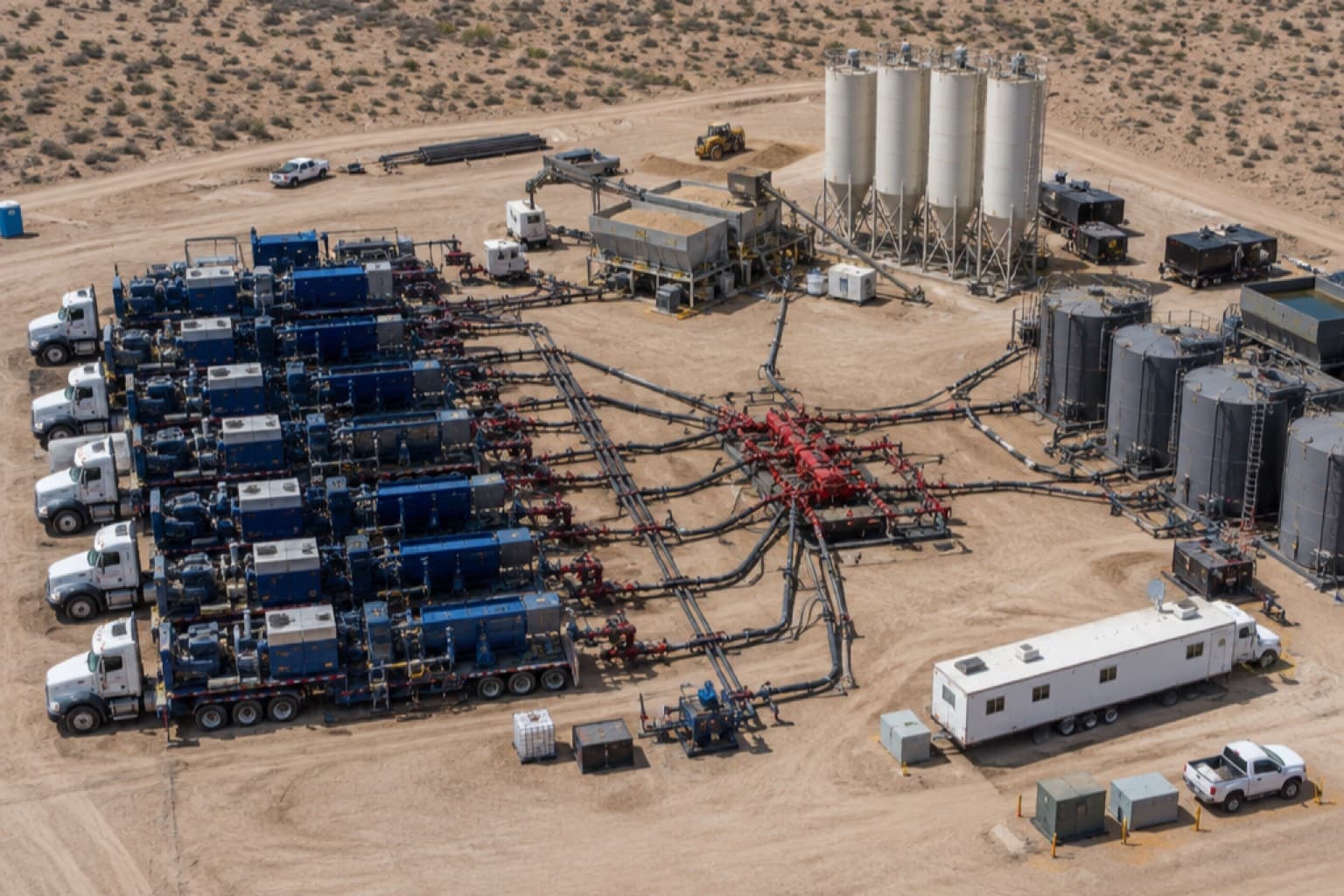
Hydraulic fracturing pumps fluid into a well faster than the rock can take it, cracking the formation and propping the cracks open with sand. Acidizing dissolves rock near the wellbore instead. Both are done by a spread of trailer- or skid-mounted units that each do one step, connected by low-pressure suction hose and high-pressure treating iron. For the hose and iron, see well service and stimulation hose and flow iron.
/01The frac spread.
| Unit | Job | Sized by |
|---|---|---|
| Frac tanks | Store water and base fluid | Barrels |
| Hydration unit | Mixes polymer into water to make gel on the fly | Tank size, barrels per minute |
| Liquid additive system (LAS) | Meters liquid chemicals into the blender | Number of chemical circuits |
| Sand silos and proppant | Store and feed sand to the blender | Tonnes |
| BlenderHighlighted | Mixes fluid, sand and chemicals into slurry and feeds the pumpers | Barrels per minute |
| Frac pumpersHighlighted | Raise slurry to treating pressure | Hydraulic horsepower |
| Frac manifold (missile) | Feeds every pumper from the blender and gathers their discharge into one treating line | Number of pumpers, pressure |
| Frac tree | Christmas tree for the frac job: master valves, flow cross, wing valves, goat head and swab valve | Bore and working pressure |
| Data van | Monitors and controls the whole spread | — |
NOV’s figures give the scale: frac pumps up to 3,000+ brake horsepower in triplex and quintuplex designs; blenders rated to 135+ BPM, twin designs to 150+, with automated density and chemical control and auger sand metering; hydration units with 90, 180 and 270 bbl tanks that hydrate fluid “on the fly” and avoid the cost of disposing of unused pre-gelled fluid; and liquid additive systems with up to 12 automated chemical circuits. The data van controls fracturing, acidizing, pump-down and cementing equipment from one station. Density is monitored constantly, especially when mixing slurries.
At the well, the treating line lands on a frac tree — in SLB’s definition a christmas tree installed for the fracturing process, typically with upper and lower master valves, a flow cross, wing valves, a goat head and a swab valve, and with larger bores and higher pressure ratings than a production tree to take frac rates and pressures. Our API 6A frac tree runs 5-1/8″ to 7-1/16″ bore at 10,000 to 20,000 psi. For the tree’s place on the wellhead, see wellhead components explained.
/02Acid and nitrogen.
- Acid tanks are lined (commonly FRP) so the acid does not attack the steel shell; transport tanks travel on the pump unit or as separate tanks.
- Batch mixers prepare treatment fluid in advance, with dry and liquid additive feed, agitation and a manifold to storage or the pumps.
- Pumping units for stimulation are usually triplex pumps — the most common pump configuration in drilling and well service — mounted in pairs on a trailer.
- Nitrogen pumping units store liquid nitrogen, pump it to pressure and vaporise it. NOV names its non-fired units by rate: the TR360NF delivers 360,000 scf per hour (6,000 scf/min) at 10,000 psi; its 90K unit reaches 15,000 psi. The highest pressures go with the smallest rate classes.
Common questions
- What equipment is on a frac spread?
- Frac tanks, a hydration unit, liquid additive system, sand silos, a blender, several frac pumpers, a frac manifold, treating iron and a data van.
- What does a frac blender do?
- It mixes base fluid, sand and chemicals into slurry at a controlled density and feeds it to the pumpers.
- What is a frac missile?
- The frac manifold: it distributes slurry from the blender to each pumper and gathers their high-pressure discharge into the treating line to the well.
- How is a frac tree different from a production tree?
- It is installed for the fracturing job and typically has larger bores and higher pressure ratings, with master valves, a flow cross, wing valves, a goat head and a swab valve.
- What does 360K mean on a nitrogen unit?
- Its pumping rate class — 360,000 standard cubic feet of nitrogen per hour.
- Why are acid tanks lined?
- So the acid does not attack the steel; FRP linings are common.
What we list
Frac and stimulation equipment:
- Frac Pumper, 2,500 HP, Trailer-Mounted, Fleet-Networked, DNV Optional
- Frac Blender MFR-50, 50 BBL/min, Auto Density Control, Chemical Additive System
- Frac Hydration Unit, 200 BBL, 12×12 Centrifugal, 90 BBL/min, SS316 Tote Tanks
- Frac LAS, 8-Tank, SS316 Tote Tanks, Mass Flowmeters, Trailer-Mounted
- Frac Missile (Manifold), 16-Pumper Capacity, 4-inch 1502, 15,000 psi Standard Service
- Frac Shunt (Zipper) Manifold, 15,000 to 20,000 psi
- High and Low Pressure Frac Manifold (Missile), 15,000 to 20,000 psi
- Universal (E-Type) Frac Manifold, 15,000 to 20,000 psi
- Frac Tree, API 6A, 5-1/8" to 7-1/16", 10,000 to 20,000 psi
- Frac Sand Silo (Sand Chief), Vertical Round, Hydraulic Tilt, 200 t Capacity, Knife-Gate Discharge
- Frac Tank, 500 BBL, Insulated, Trailer-Mounted, Road-Registered
- Frac Transfer Pump, Centrifugal 12×12, 300 HP, Diesel-Hydraulic Drive, Skid-Mounted
- Frac Data Van, Trailer-Mounted, Multi-Screen Fleet Control, HVAC + Pantry
- Stimulation Pumping Unit, Twin Triplex 1,000 HP, 15,000 psi, Trailer-Mounted
- Nitrogen Pumping Unit, 360K, 10,000 psi, Truck-Mounted, Modular
- Acid Tank, FRP-Lined Steel, ISO 20-ft Frame, 6,000 USG, Dangerous-Goods Certified
- Stimulation Batch Mixer, 2×100 BBL, FRP-Lined Steel, PTFE Butterfly Valves, ATEX
- Stimulation Transfer Pump, FRP-Lined Carbon Steel, Centrifugal Multistage, Hydraulic Drive
Frac and stimulation equipment
- IH-FP-2500-TRL-NETFrac Pumper, 2,500 HP, Trailer-Mounted, Fleet-Networked, DNV OptionalIndus Hydraulics
- IH-FB-MFR-50-ADC-CASFrac Blender MFR-50, 50 BBL/min, Auto Density Control, Chemical Additive SystemIndus Hydraulics
- IH-FHU-200-CP1212-90Frac Hydration Unit, 200 BBL, 12×12 Centrifugal, 90 BBL/min, SS316 Tote TanksIndus Hydraulics
- IH-FM-16P-4IN-15K-1502Frac Missile (Manifold), 16-Pumper Capacity, 4-inch 1502, 15,000 psi Standard ServiceIndus Hydraulics
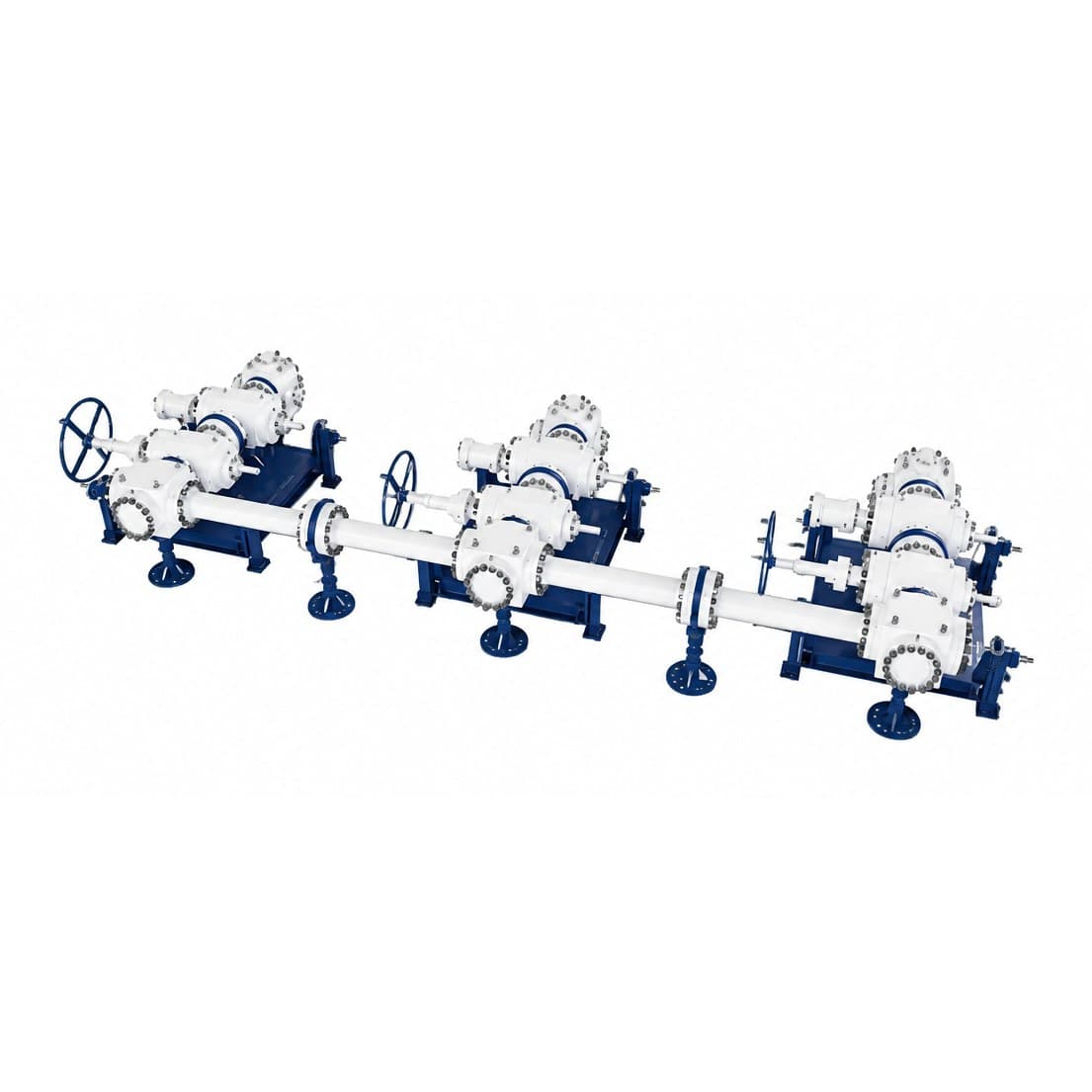 IH-OFE-FSMFrac Shunt (Zipper) Manifold, 15,000 to 20,000 psiIndus Hydraulics
- IH-N2-360-10K-TRKNitrogen Pumping Unit, 360K, 10,000 psi, Truck-Mounted, ModularIndus Hydraulics
- IH-SPU-T2X1000-15K-TRLStimulation Pumping Unit, Twin Triplex 1,000 HP, 15,000 psi, Trailer-MountedIndus Hydraulics
- IH-ATK-ISO20-FRP-6KGAcid Tank, FRP-Lined Steel, ISO 20-ft Frame, 6,000 USG, Dangerous-Goods CertifiedIndus Hydraulics