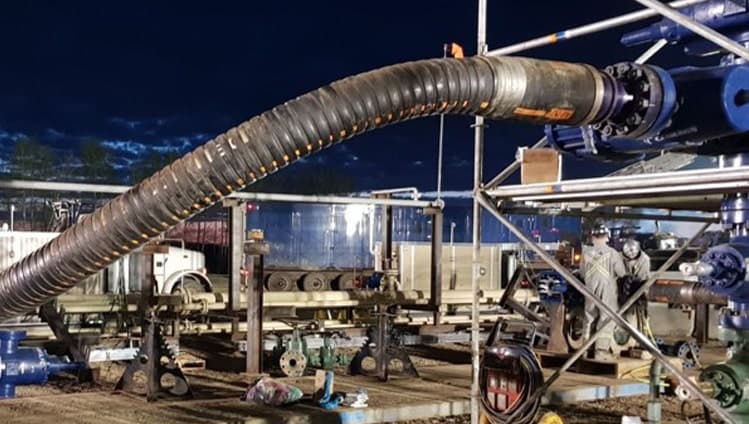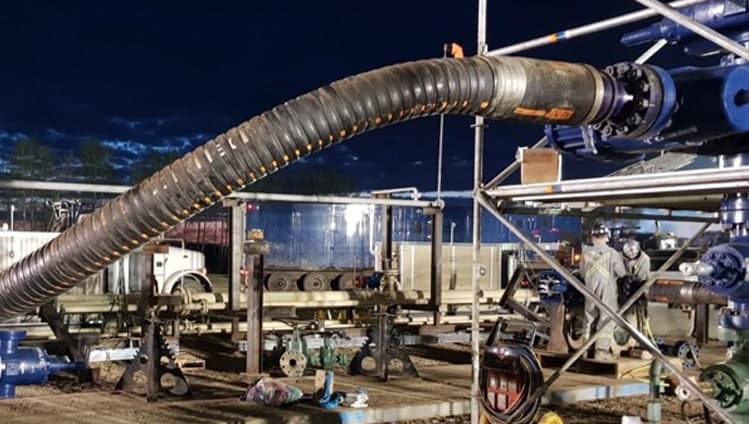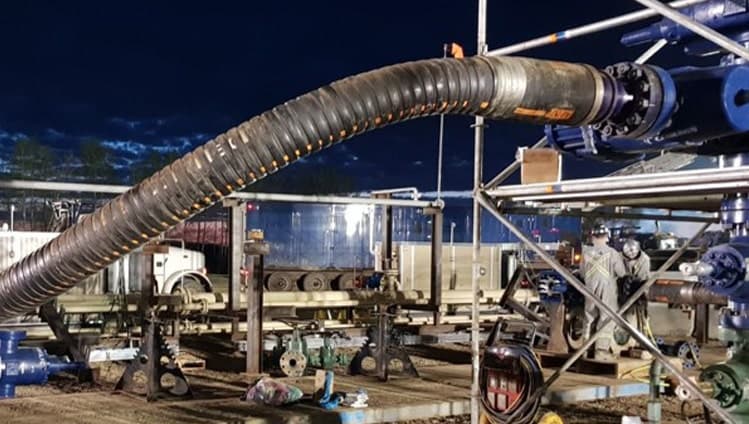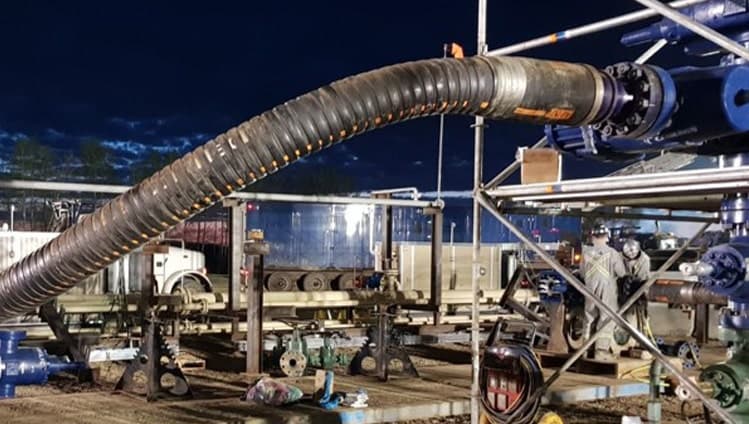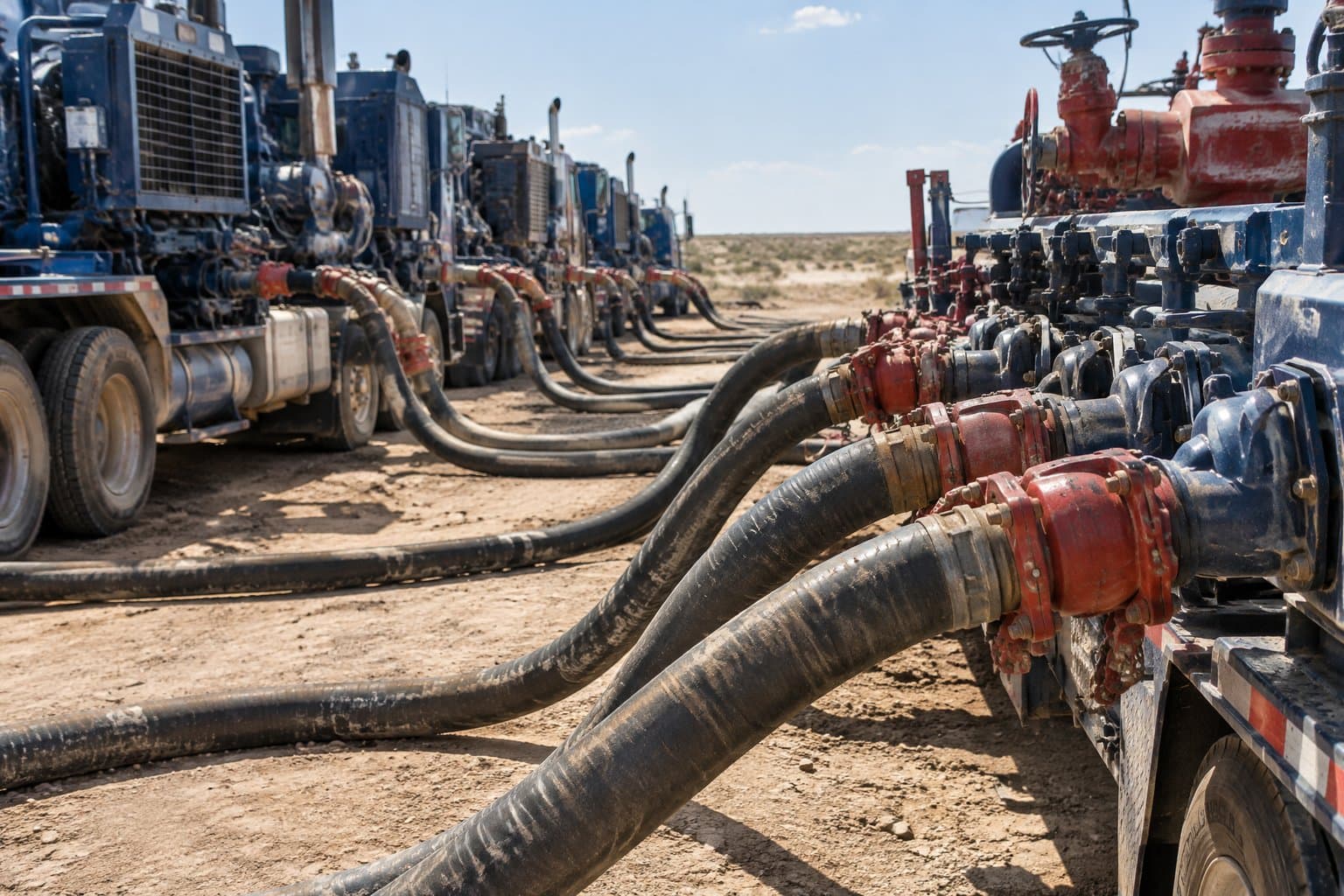
Well service hose works at the extremes of oilfield duty: frac and acid jobs at 15,000 psi, sour produced fluid during a well test, and hot hydrocarbons on the way to the flare. At those pressures every candidate hose has steel cable reinforcement, so the liner is the decision — it is the part that meets proppant, acid, H₂S and heat.
/01Four duties, four liners.
| Hose | Rating and bore | Liner | Temperature |
|---|---|---|---|
| Frac hose assembliesHighlighted | 15,000 psi WP; 3" – 5" | Abrasion-resistant rubber | −30 to +100 °C |
| Onshore well stimulation | 15,000 psi WP; 2" – 3" | Acid-resistant synthetic rubber | −30 to +100 °C |
| Offshore stimulation / intervention / acidizing | 15,000 psi WP; 2" – 3" | Acid-resistant FKM / fluoropolymer | −30 to +130 °C |
| Well test production | 10,000 psi WP, 15,000 psi MBP; 2" – 4" | HNBR / sour-service rubber | −30 to +100 °C |
| Burner / flare boom | 5,000 psi WP; 2" – 6" | Heat-resistant FKM / HNBR, heat-shielded | −30 to +200 °C |
/02Frac: abrasion at pressure.
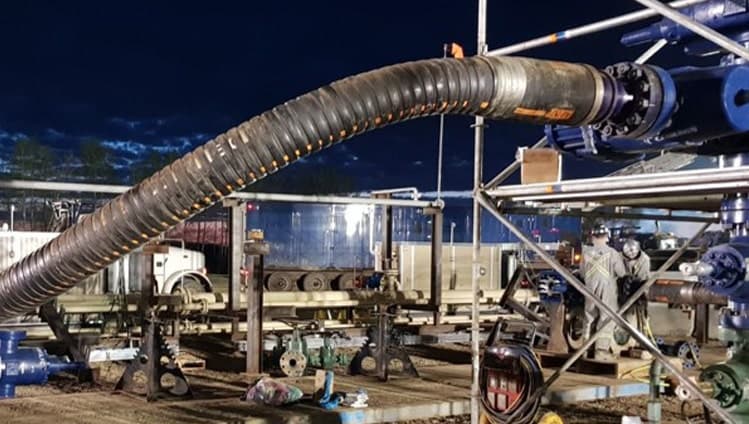
Frac fluid carries proppant at high velocity, so a frac hose wears from the inside as well as holding 15,000 psi. Ours has an abrasion-resistant liner over frac-rated steel cable plies, flanged at both ends, from 3" to 5", and is listed against API 7K with API 16C as a cross-reference. Frac sites also run large-bore water lines at far lower pressure; our frac water couplings and the three-segment clamps for them run from 8" to 16".
/03Stimulation and acidizing: the acid decides.
Acid stimulation puts hydrochloric and other acids through the hose at 15,000 psi. The onshore hose uses an acid-resistant synthetic rubber liner, listed against API Spec 7K and NACE MR-0175; the offshore stimulation, intervention and acidizing hose steps up to an FKM / fluoropolymer liner rated to +130 °C, listed against API 17J and NACE MR-0175. Specify the acid, its concentration and the treating temperature with the order — the liner choice follows from them.
/04Well test and flare: sour and hot.
During a well test the hose carries whatever the well produces, which may be sour. Our well test production hose is 10,000 psi working with a 15,000 psi minimum burst, HNBR or sour-service rubber liner, flanged, listed to API 16C and NACE MR-0175. Downstream, the burner and flare boom hose carries produced fluid out to the burner: 5,000 psi working, 2" to 6", a heat-resistant FKM or HNBR liner and heat shielding, rated to +200 °C. NACE applies to the whole assembly — flanges and ring gaskets included — not just the hose body.
/05Ends and documents.
All five of these hoses are flanged on our listings, which means the flanges and ring gaskets carry the same pressure and service class as the hose. Treating iron on the same job is joined with hammer unions — sour service unions for sour wells. The assembly ships with its certificates and NACE statement, which should be specified with the enquiry. See the oilfield hose guide and the oilfield hose document pack.
The frac water itself usually reaches the pad through large-bore TPU lay flat hose rather than rigid pipe. Our comparison of lay flat hose and HDPE pipe and the friction loss guide cover how those transfer lines are chosen and sized.
For sizing those water lines — flow in barrels a minute, friction per kilometre, pressure and couplings — see frac water transfer with lay flat hose.
Frequently asked questions
- What pressure is frac hose rated for?
- Our frac hose assemblies are rated 15,000 psi working, from 3" to 5", with an abrasion-resistant liner.
- What liner does an acidizing hose need?
- An acid-resistant one. Our onshore stimulation hose uses acid-resistant synthetic rubber; the offshore acidizing hose uses FKM / fluoropolymer, rated to +130 °C.
- Is well test hose suitable for sour service?
- Ours is: 10,000 psi working with an HNBR / sour-service liner, listed to API 16C and NACE MR-0175. The end connections must be sour-rated too.
- What temperature can flare boom hose handle?
- Our burner / flare boom hose is rated to +200 °C with a heat-resistant FKM / HNBR liner and heat shielding.