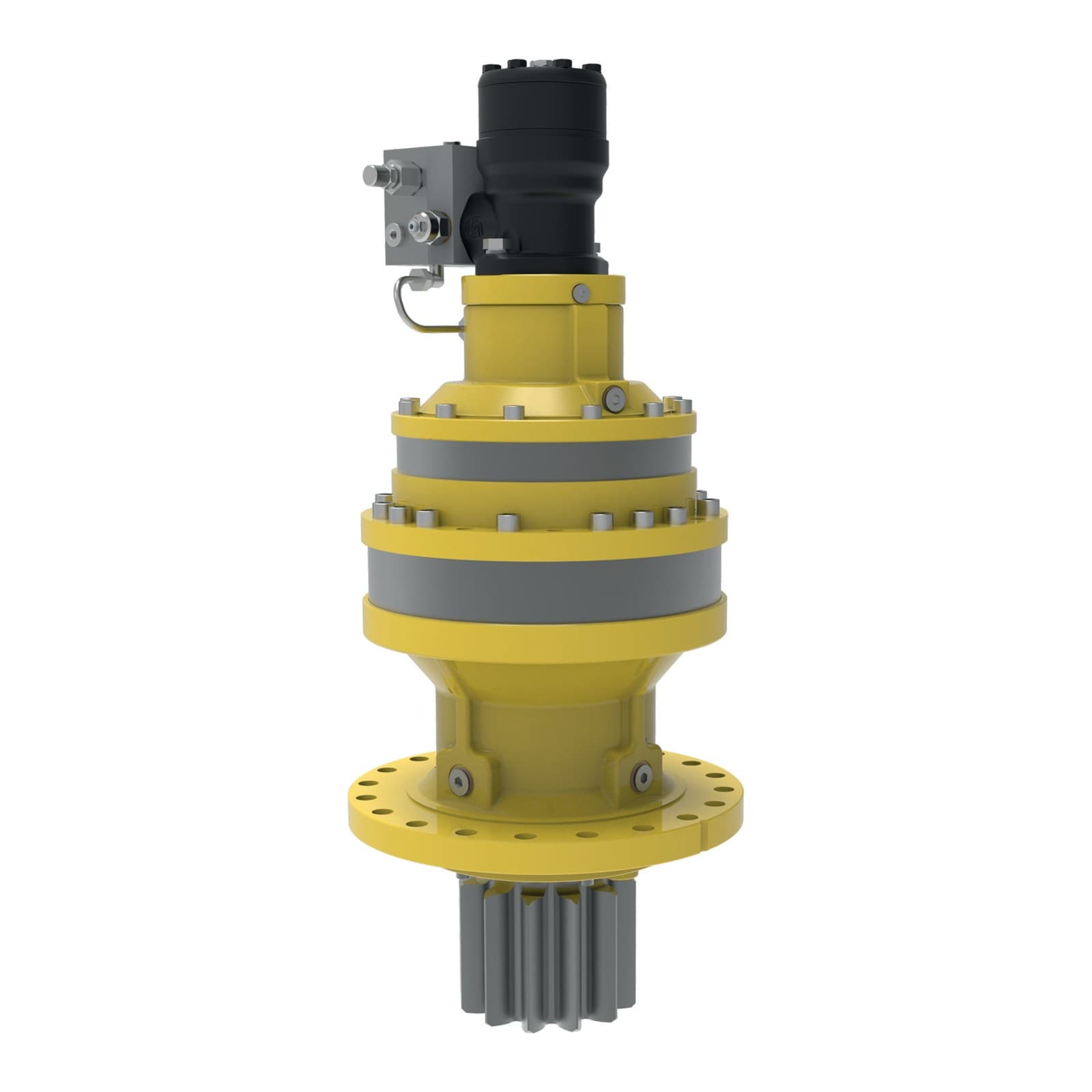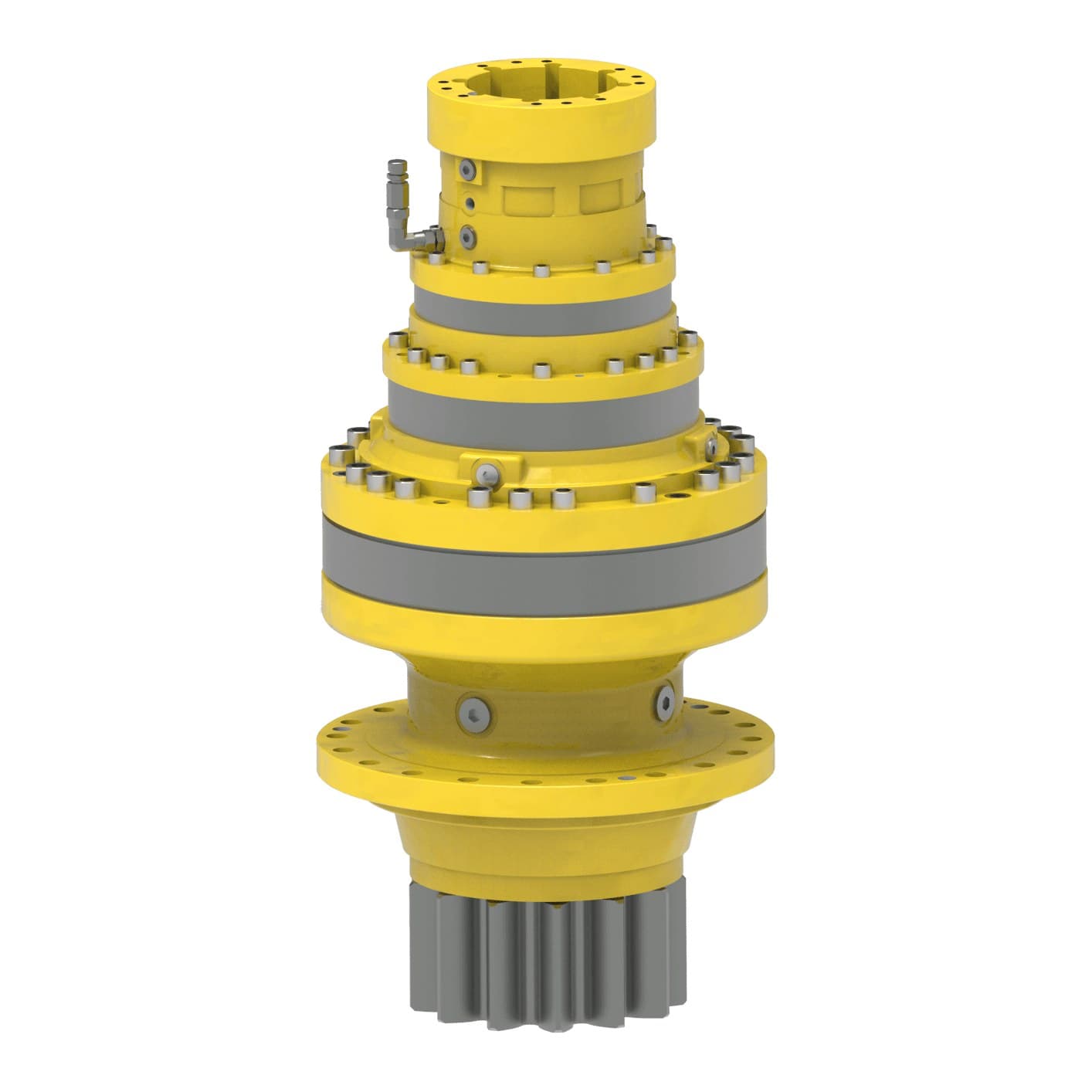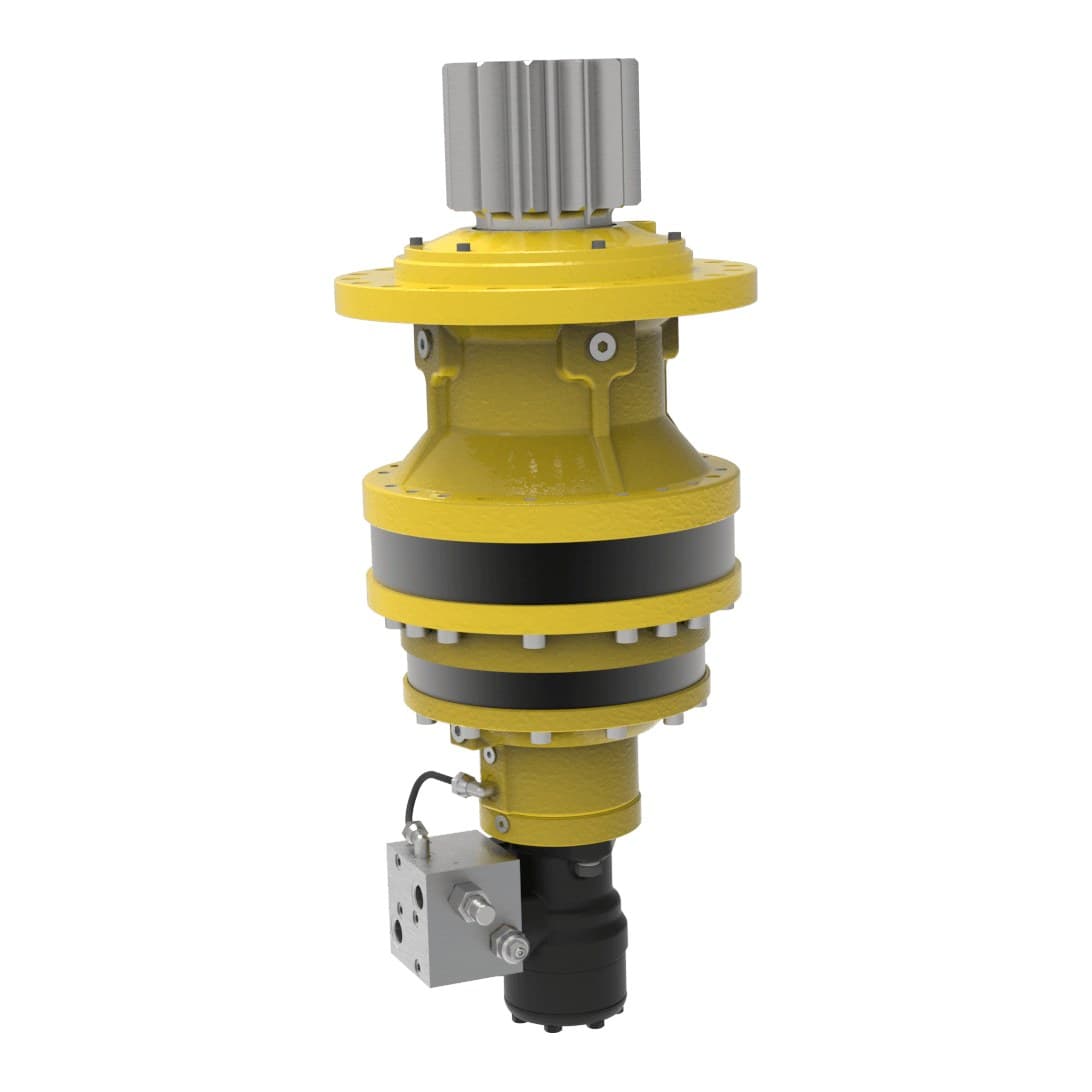
Slewing is where cranes, aerial platforms, excavators and thrusters take their highest shock loads: the start and stop of a heavy upper structure, wind on a boom, a vessel rolling. A slewing gearbox is a planetary gearbox with a reinforced output support built to take the radial load of a pinion meshing with a slewing ring. Selecting one means checking three things the gears alone do not tell you.
/01The torque.
Start from the torque needed at the slewing ring: the ring bearing’s friction torque, the wind load on the upper structure and the inertia torque to accelerate it, plus the effect of any heel or trim. Divide by the ratio between the ring gear and the pinion, and by the number of drives sharing the ring — large rings often use two or more. Compare the result with T2 FEM: Dinamic Oil’s nominal output torque for F.E.M. class M5 (L2-T5) at 15 rpm output. It is an indicative figure, confirmed by the maker for the actual duty.
/02Support limits.
The output support — the housing and bearings that carry the pinion — has its own maximum static and dynamic torques. They are a different limit from the gearset’s T2max: compare the two and use the lower. The static limit must never be exceeded for any reason; if it is, the gearbox must be inspected before it runs again. That is why emergency stops and slewing brakes are part of the selection, not an afterthought.
/03Pinion and backlash.
Pinions are either splined onto the output shaft and retained by end screws, or cut integral with the shaft. Each is defined by module, number of teeth, profile shift, tip diameter and face width, and its position from the support face — all of which must suit the slewing ring. For a ring outside the catalogue pinions, send the full ring-gear data and the pinion is made to match. Eccentric supports let the gearbox be turned in its seat to set the pinion-to-ring backlash on assembly; with a fixed support, the backlash depends on the ring and housing tolerances.
/04Brake and motor.
| Circuit | Brake | Why |
|---|---|---|
| Closed loop (hydrostatic)Highlighted | Low opening pressure | Releases from the charge pressure available in the loop |
| High-speed hydraulic or electric motor | Dry brake | Suited to high input speeds |
| Open loop | Standard negative multi-disc | Released by the slewing pressure through a shuttle |
For marine work, specific Dinamic Oil RE and RA builds with pinion output hold ABS product design assessments for azimuth-thruster steering, and design approval by DNV, ABS, RINA, Bureau Veritas, Lloyd’s Register or CCS is available on demand for other slewing drives.
Common questions
- How many drives does a slewing ring need?
- As many as the torque and the space allow. Sharing the load between two or more drives keeps each pinion smaller and balances the ring load.
- Oil or grease?
- Both are available, depending on the mounting and duty; Dinamic Oil specifies it with the order.
- What output speed is a slewing drive rated at?
- T2 FEM is quoted at 15 rpm output; at other speeds the maker corrects the rating.
- Can a slewing drive be electric?
- Yes. Inputs for electric motors are available as well as orbital and axial piston hydraulic motors.
- What sizes are available?
- Dinamic Oil’s RE slewing range runs from RE 240 to RE 8010, and the GB range from GB 12010 to GB 26000 at up to 460,000 Nm.