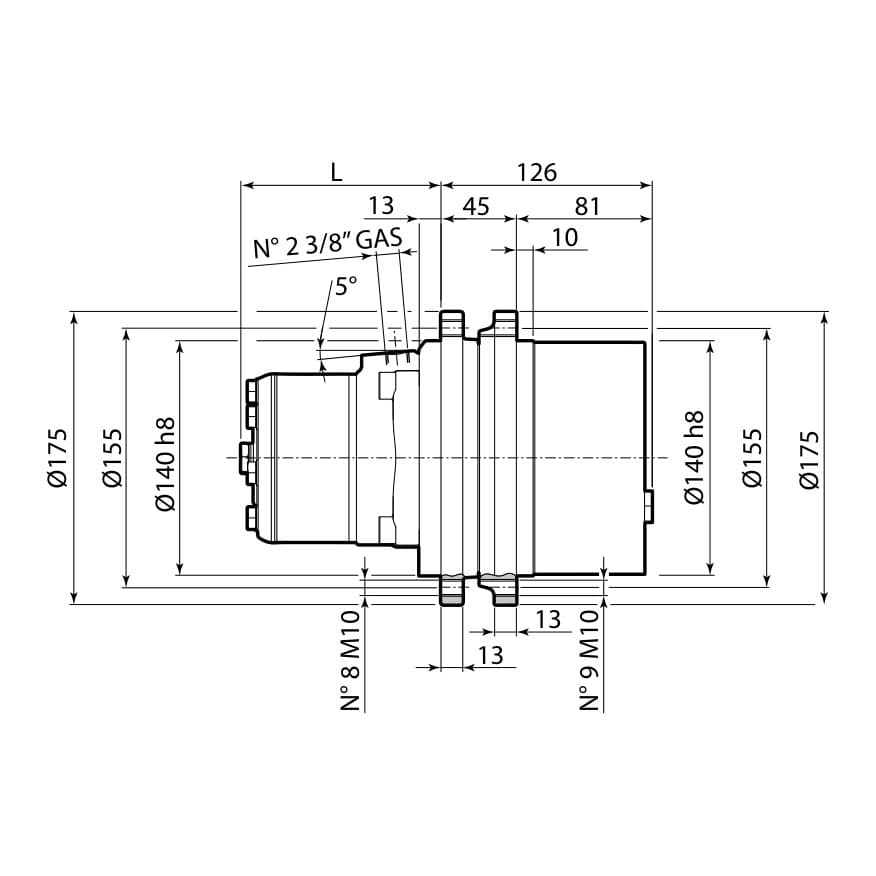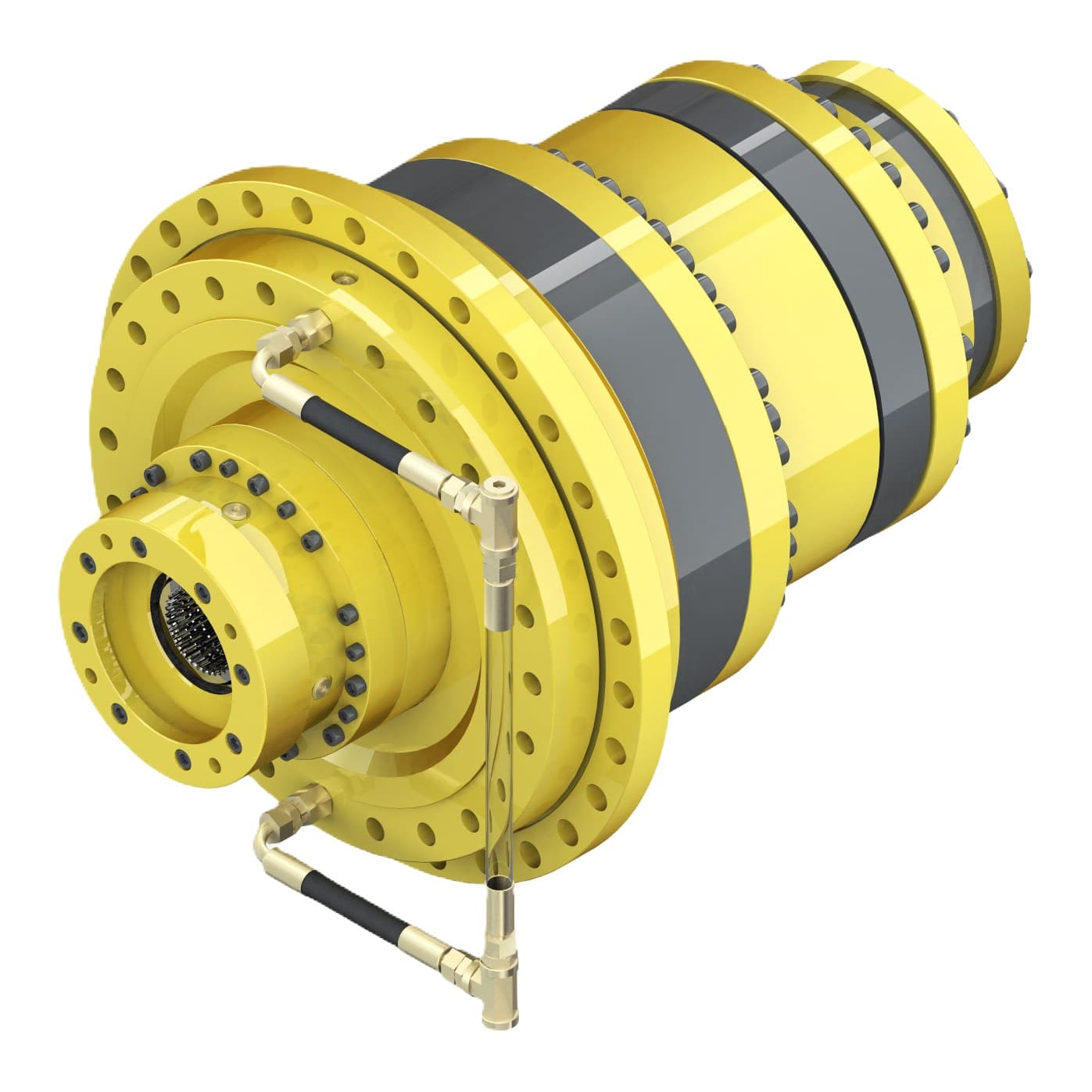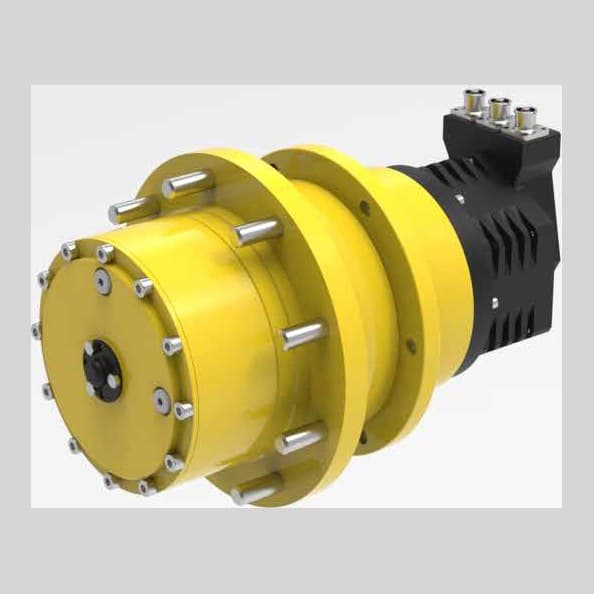
Scissor and boom lifts, skid-steer loaders, container AGVs and vineyard robots all move on hub drives: a planetary gearbox in the wheel, driven by a hydraulic or electric motor. They are small, but they carry the machine, start it on ramps and hold it on slopes. Selecting one is a short calculation and a few checks.
/01Torque from tractive effort.
Work out the tractive force each driven wheel must deliver: the weight on that wheel times the rolling resistance of the ground, plus the weight times the sine of the steepest gradient, plus the force to accelerate. Multiply by the wheel’s rolling radius to get the wheel torque. Then compare it with the drive’s ratings: continuous torque for steady travel, maximum intermittent for short manoeuvres, and peak for starting on the steepest slope. Dinamic Oil quotes each with the motor pressure drop it needs, so the same table tells you what the hydraulic circuit must supply.
/02Speed and wheel load.
The machine’s top speed divided by the wheel’s rolling circumference gives the output speed the drive must reach; check it against the maximum output speed, which on an integrated-motor drive depends on the motor fitted and the oil flow. Then check the wheel load: the drive’s output bearings carry the machine’s weight on that wheel, and their capacity — up to about 8,000 kg on Dinamic Oil’s EH models — is why the same drives also work as track drives.
/03Hydraulic or electric.
| Range | Motor | Torque | Notes |
|---|---|---|---|
| GR 80, GR 200 | Integrated orbital hydraulic motor | 470 to 1,600 Nm continuous, up to 2,500 Nm peak | Single ratio; motor displacement chosen by variant |
| EH 210, EH 240Highlighted | Orbital or axial piston motor, or electric | T2max 3,950 to 5,600 Nm | S, SC, PD output versions; release optional |
| EW 700 to EW 2500 | Orbital or axial piston motor, or electric | T2max 7,000 to 24,000 Nm | Mechanical release standard |
| EHe, EWe | PMSM electric, 48 V or 96 V DC | As EH / EW | Built-in negative electric brake |
Hydraulic drives suit machines that already have a pump for lifting or digging. For battery machines such as electric aerial platforms and AGVs, the EHe and EWe versions pair the same planetary stages with a permanent-magnet synchronous motor on a 48 V or 96 V DC bus, and a negative electric brake that holds the machine when power is off.
Common questions
- How many driven wheels do I need?
- Enough that the torque per wheel stays within the continuous rating on the steepest gradient; two-wheel drive suits flat floors, four-wheel drive rough sites and ramps.
- Can a wheel drive also be a track drive?
- Yes, where the bearing load allows: the EH models’ bearing capacity suits both.
- What does GR80-MR100 mean?
- The GR 80 drive with an orbital motor of about 100 cm³/rev; the motor sets the torque per bar and the top speed.
- Does the electric version need a separate brake?
- No. EHe and EWe drives have a built-in negative electric brake.
- What voltages are available?
- 48 V and 96 V DC as standard; other executions on request from Dinamic Oil.