Marine hose fails differently from industrial hose: a fuel leak in an enclosed bilge, an exhaust hose that lets cooling water and fumes into the engine room, a clear PVC hose below the waterline that splits and sinks the boat. Most of the rules that prevent these come from three sources — the US Coast Guard’s fuel system regulations, EPA permeation limits and ABYC standards — and the hose layline tells you which ones a hose meets.
/01Fuel hose: A1, A2, B1, B2 and “-15”.
| Type | Permeation (SAE J1527) | Fire test (183.590) | Use |
|---|---|---|---|
| A1Highlighted | Class 1 — ≤100 g/m² in 24 h | Yes | Fuel feed: tank to engine, pump to carburettor |
| A2 | Class 2 — ≤300 g/m² in 24 h | Yes | Fill and vent lines |
| B1 | Class 1 | No | Feed or fill only where the 5 oz / 2½ min spill test is met |
| B2 | Class 2 | No | Fill or vent only where the spill test is met |
The fire test is a free-burning heptane fire for 2½ minutes, reaching at least 648 °C near the hose. The B types are allowed in a fill, vent or tank-to-engine line only if no more than five ounces of fuel escapes in 2½ minutes with the hose cut at its lowest point. Fuel hose must be marked “USCG TYPE A1” (or A2, B1, B2), with the year and maker, in capitals at least 1/8 in high, at intervals of 12 in or less.
The “-15” suffix is an EPA mark: 40 CFR 1060 limits nonroad fuel lines on marine spark-ignition engines, including outboards and portable tanks, to 15 g/m² per day. So A1-15 is a USCG A1 hose that also meets EPA’s low-permeation limit; B1-15 is the common outboard supply line.
Scope matters: the Coast Guard fuel-system rules apply to boats with inboard gasoline engines, not to outboard engines or diesel-only boats — though ABYC standards cover both gasoline (H-24) and diesel (H-33) systems.
/02Clamps and fittings.
- Use hose designed for clamps, with clamps beyond the bead, flare or serrations of the fitting. The regulations require fittings with a bead, flare or annular serrations at least 0.015 in deep — a continuous thread or knurl does not count — and a clamp that does not rely only on spring tension.
- Fuel fill hose: ABYC requires at least two corrosion-resistant metal clamps at each connection, with bands at least ½ in (12.7 mm) wide.
- Exhaust hose: ABYC P-1 requires at least two non-overlapping clamps at each end.
- Do not add a second clamp to a barb designed for one — ABYC warns it can damage the hose and weaken the joint. Match hose ID to the fitting OD and do not overtighten.
/03Exhaust, heater, bilge and water hose.
| Hose | Construction | Use |
|---|---|---|
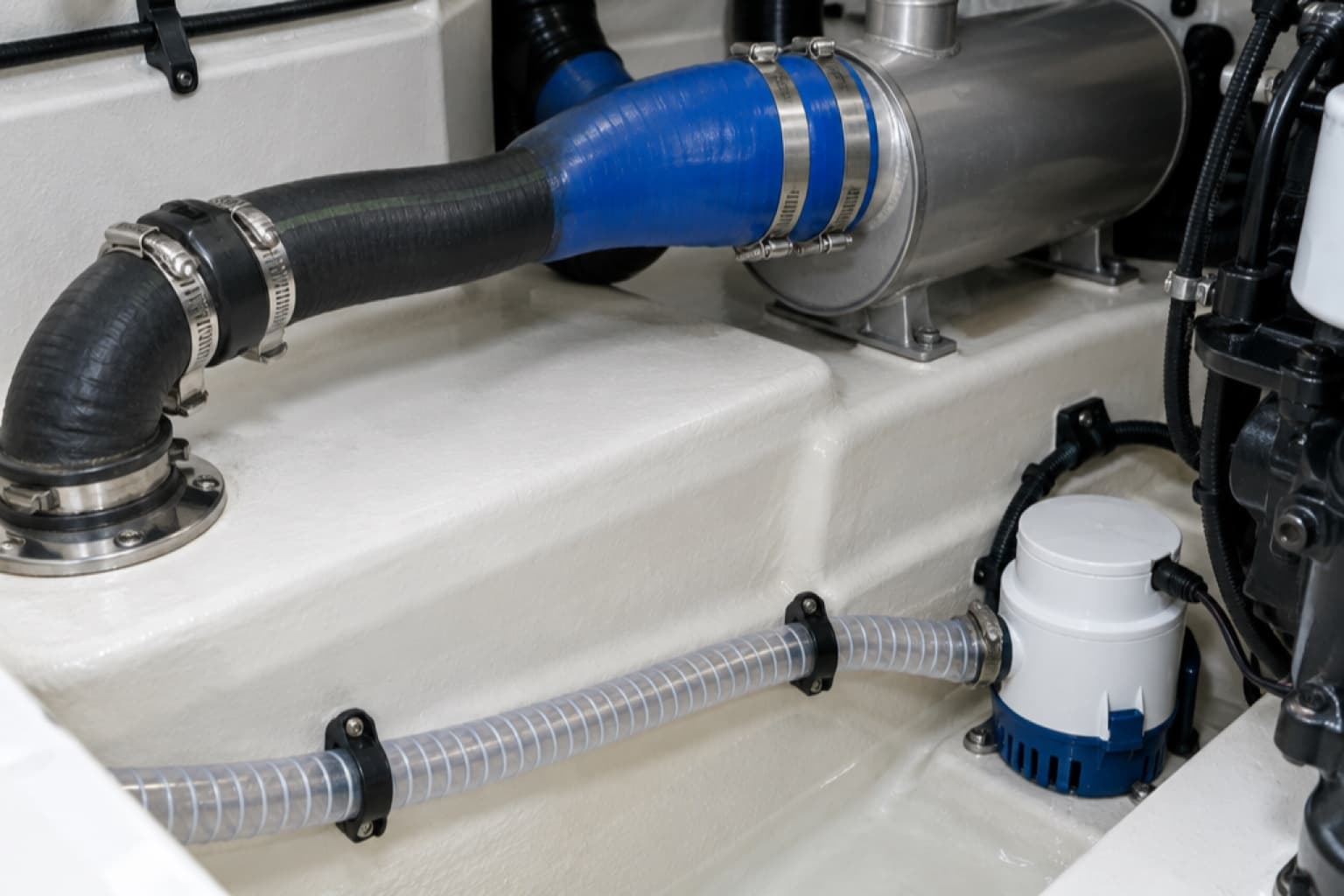
| Wet exhaust, soft wall (SAE J2006 R1)Highlighted | Rubber with fabric plies, no helix | Short, straight exhaust and raw-water connections |
| Wet exhaust, hard wall (SAE J2006 R2) | Wire helix between plies | Longer bent runs; resists collapse |
| Silicone wet exhaust | Silicone with polyester plies | Higher temperature — makers rate to about 350 °F |
| Heater hose (SAE J20R3) | Rubber with spiral polyester | Engine coolant and heater lines — typically 50 psi, 212 °F |
| Clear PVC bilge, live-well and water hose | PVC, often with a helix | Unpressurised water, drain and vent lines |
Wet exhaust hose is rated by temperature — makers rate common hard-wall rubber hose at 280 °F (138 °C) — because it relies on cooling water injected upstream. Clear PVC hose is light and cheap but makers mark many of them “not recommended for below-waterline through-hull connections”: use reinforced rubber hose on anything that can sink the boat if it fails. “FDA” on PVC water hose means the compound uses food-contact ingredients; it is not the same as NSF/ANSI 61 drinking-water certification.
Common questions
- What is the difference between A1 and A2 fuel hose?
- Both pass the USCG fire test; A1 has the lower permeation class (≤100 g/m²/24 h) and is required for fuel feed lines, A2 (≤300) is allowed for fill and vent lines.
- What does A1-15 mean?
- A USCG Type A1 hose that also meets EPA’s nonroad low-permeation limit of 15 g/m² per day.
- How many clamps on a marine exhaust hose?
- ABYC P-1 requires at least two non-overlapping clamps at each end.
- Can I use clear PVC hose below the waterline?
- Makers commonly say no for through-hull connections; use reinforced rubber hose rated for the duty.
- Soft-wall or hard-wall exhaust hose?
- Soft-wall for short straight runs; hard-wall with a wire helix for bends and longer runs.
What we list
Marine fuel, exhaust, heater, bilge and water hose:
- Barrier-Lined Marine Fuel Hose, Type A1-15
- Black PVC Bilge & Live-Well Hose, Hard PVC Helix
- Clear PVC Hose with Steel Wire Helix, FDA
- Clear PVC Water, Drain & Vent Tubing, FDA
- Clear Vinyl Bilge & Live-Well Hose, PVC Helix
- Corrugated Marine Fuel Fill Hose, Type A2, Steel Helix
- Corrugated Marine Wet Exhaust Hose, Hard Wall
- Corrugated Polyethylene Bilge Hose, Black or White
- EPDM Heater Hose, 2-Ply Polyester
- Extra-Heavy-Duty Clear Bilge & Live-Well Hose
- High-Temperature EPDM Water & Air Hose, 4-Ply
- Low-Permeation Outboard Fuel Hose, Type B1-15
- Marine Fuel Fill & Diesel Transfer Hose, Type A2
- Marine Fuel Fill Hose, Type A2, Cut Lengths with T-Bolt Clamps
- Marine Fuel Hose, Type A1-15, Nylon Barrier
- Marine Fuel Vent Hose, Type A2, 5/8"
- Marine Wet Exhaust & Water Hose, Hard Wall with Steel Helix (SAE J2006 R2)
- Marine Wet Exhaust & Water Hose, Soft Wall (SAE J2006 R1)
- Silicone Marine Wet Exhaust & Water Hose, Blue
- White Corrugated Water-Fill Hose, FDA Vinyl
Marine hose
- IH-MH-FUEL-365Barrier-Lined Marine Fuel Hose, Type A1-15Indus Hydraulics
- IH-MH-FUEL-327Marine Fuel Fill & Diesel Transfer Hose, Type A2Indus Hydraulics
- IH-MH-FUEL-305Low-Permeation Outboard Fuel Hose, Type B1-15Indus Hydraulics
- IH-MH-EXHT-250Marine Wet Exhaust & Water Hose, Hard Wall with Steel Helix (SAE J2006 R2)Indus Hydraulics
- IH-MH-EXHT-202VSilicone Marine Wet Exhaust & Water Hose, BlueIndus Hydraulics
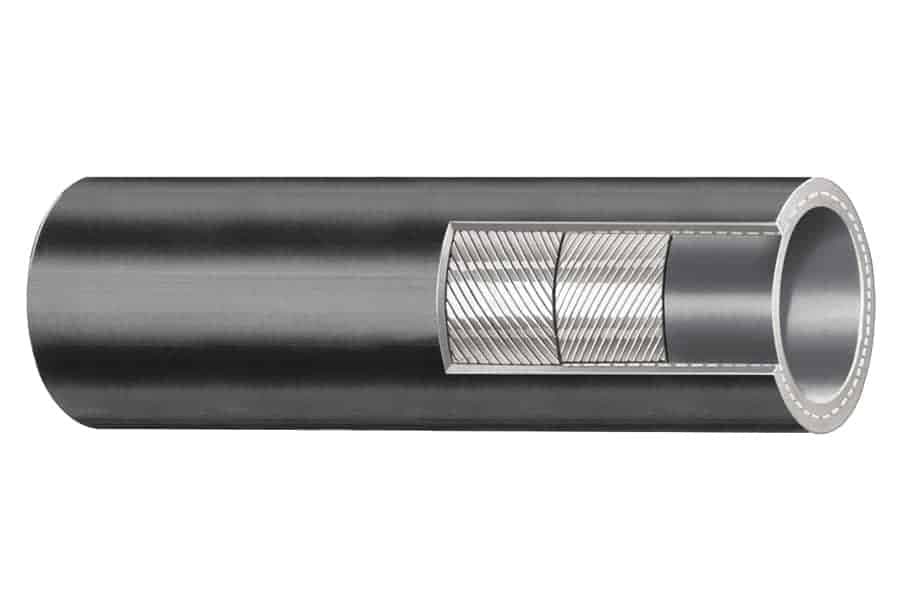 IH-MH-EXHT-130EPDM Heater Hose, 2-Ply PolyesterIndus Hydraulics
 IH-MH-BLG-147Extra-Heavy-Duty Clear Bilge & Live-Well HoseIndus Hydraulics
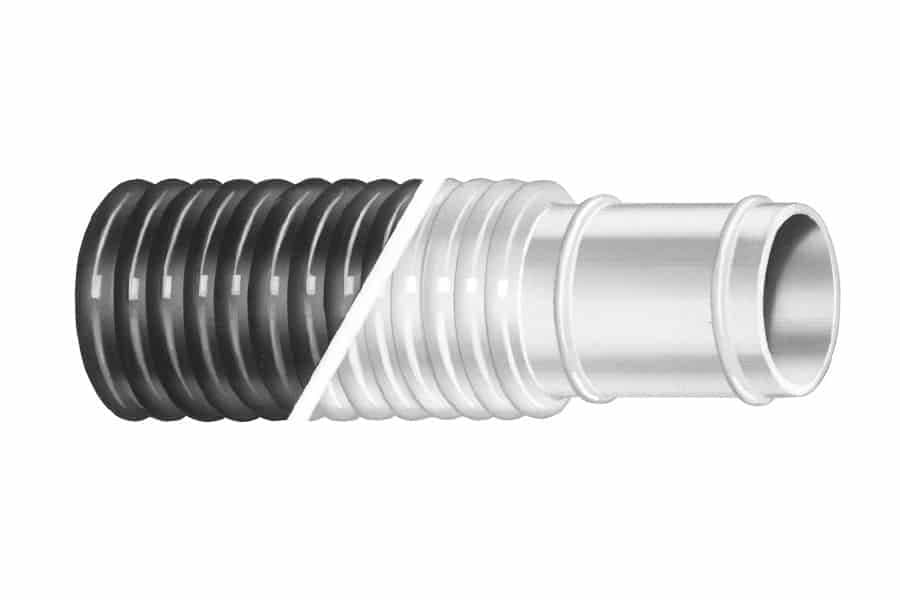 IH-MH-BLG-120Corrugated Polyethylene Bilge Hose, Black or WhiteIndus Hydraulics