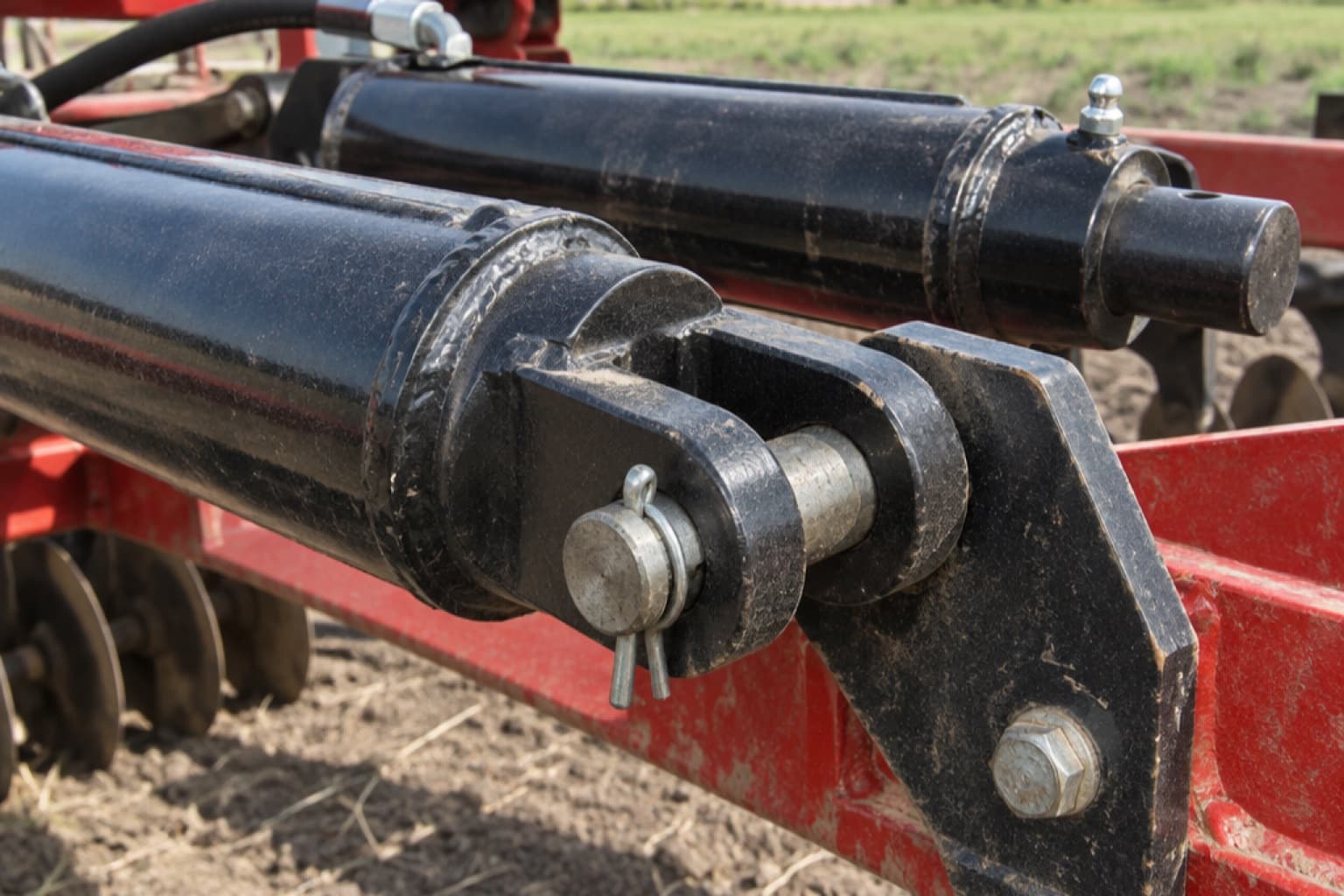
Two cylinders with the same bore, rod and stroke can be completely different parts. One has a clevis at each end; the other a cross tube and a threaded rod; a third is a tie-rod cylinder with a front flange. The mount decides whether the cylinder fits the machine, and whether it pushes along its own axis or takes a bending load that wears its seals out in a season.
/01Three groups of mount.
Parker’s cylinder guidance divides mounts into three groups, and the grouping explains most of the design rules:
- Fixed mounts that absorb force on the centreline — end flanges, extended tie rods, centreline lugs. The strongest mounts for straight-line work, because the force passes straight through the cylinder’s axis into the structure.
- Pivot mounts — clevises, cross tubes, pin eyes, trunnions. They let the cylinder swing in one plane, so it follows a load that moves through an arc: a boom, a bucket, a tipping body, a door.
- Fixed mounts that do not absorb force on the centreline — side lugs and foot mounts. The force acts below the cylinder’s axis, so the mount bolts see a turning moment as well as shear; they need dowels or a shear key, and the load must be guided.
A useful rule from Eaton’s cylinder engineers: rigid mounts for linear motion parallel to the rod; swivel (pivot) mounts for curvilinear motion. Mounting style also affects the maximum allowable pressure — a cylinder hung off its front flange is stressed differently from one pushing through its cap — which is why tie-rod catalogues rate some mounts lower than others.
/02Welded cylinder mounts.
| Mount | What it is | Where you find it | Measure |
|---|---|---|---|
| ClevisHighlighted | A forked end with a cross-drilled pin hole | Implements, loaders, lifts | Pin diameter, gap between jaws, jaw depth |
| Ag clevis (ASAE) | A clevis at both ends to common ag interchange dimensions | Tractor remotes and implements | Stroke, closed length, pin |
| Cross tube | A tube welded across the cap (and often the rod), with a bore for a pin | Loaders, plows, dump hoists, forestry | Tube length, bore, OD |
| Tang | A single flat plate with a pin hole | Compact linkages, steering | Plate thickness, pin hole |
| Pin eye | A solid eye with a plain bore | General mobile and industrial | Eye width, pin hole |
| Swivel eye | An eye fitted with a spherical bearing | Where some misalignment must be absorbed | Eye width, bearing bore |
| Universal / threaded rod | Plain or threaded rod end to take a separate clevis or eye | Custom installations | Rod thread |
Most welded mobile cylinders are pivot-mounted at both ends, and often the two ends differ — a cross tube at the cap and a clevis on the rod, or a tang at one end and a pin eye at the other. Our listings are grouped by mount (Bailey, Chief, Magister and Maxim clevis, cross tube, tang, pin eye, swivel eye and ag clevis cylinders) so a match can start from the mount and narrow by bore and stroke.
Cross tubes versus clevises
A cross tube carries its pin in a long bearing area and tolerates misalignment and dirt well; it is common on loaders, plows and forestry machines, and heavy-duty versions carry grease nipples on the tubes. A clevis puts the pin through two jaws either side of a bracket on the machine; it is compact and easy to connect, and it is the standard on agricultural implements. Swapping one for the other means changing the bracket on the machine as well as the cylinder.
/03ASAE and agricultural cylinders.
“ASAE cylinder” is trade shorthand for a double-acting clevis-to-clevis agricultural cylinder built to the interchange dimensions that grew out of the American Society of Agricultural Engineers’ work (now ASABE), so that one cylinder can move between a tractor’s remote outlets and different implements. The relevant published standards are SAE J716 (application of hydraulic remote control to tractors and trailed implements, now cancelled) and ISO 2057 (remote-control hydraulic cylinders for trailed implements).
In catalogues, the ASAE strokes are 8" and 16". A typical example from one maker’s tie-rod ag range: 2,500 psi rating, 2"–4" bores, a 1-1/8" rod, a 1" pin — 1-1/4" on the 16" stroke for 3"–4" bores — and 8" and 16" strokes marked ASAE. Our welded ag-clevis cylinders follow the same pattern.
/04Tie-rod mount codes: NFPA and ISO.
| Code | Mount | Group |
|---|---|---|
| MX0 | No mount (basic cylinder) | — |
| MX1 | Tie rods extended, both ends | Fixed, centreline |
| MX2 | Tie rods extended, cap end | Fixed, centreline |
| MX3 | Tie rods extended, head end | Fixed, centreline |
| MF1Highlighted | Head rectangular flange | Fixed, centreline |
| MF2 | Cap rectangular flange | Fixed, centreline |
| MS2 | Side lugs (foot) | Fixed, off centreline |
| MS4 | Side or bottom tapped holes | Fixed, off centreline |
| MP1 | Cap fixed clevis | Pivot |
| MP2 | Cap detachable clevis | Pivot |
| MT1 | Head trunnion | Pivot |
| MT2 | Cap trunnion | Pivot |
| MT4 | Intermediate trunnion | Pivot |
Metric cylinders use a similar vocabulary. On Rexroth’s mill-type CDH1, for example: MP3 is a swivel eye at the base, MP5 a self-aligning clevis (spherical bearing) at the base, MF3 and MF4 round flanges at head and base, MT4 a trunnion whose position along the barrel is specified, and MS2 a foot mount. Rod ends take a self-aligning or plain clevis on a thread. The ISO tie-rod standards — ISO 6020-2 (160 bar compact) and ISO 6022 (250 bar) — fix the mounting dimensions so a cylinder of the same code and size from another maker bolts into the same place. Our Rexroth CDT3 cylinders are listed with their mount codes: MS2 foot and MP1 clevis.
/05Side load, pins and alignment.
A cylinder is designed to push and pull along its own axis. Any force across it — from a misaligned pivot, a load guided by the cylinder instead of by the machine, or a fixed mount on a load that moves in an arc — is carried by the gland bearing and the piston wear ring, and wears them on one side until the seals leak and the rod scores.
- Pins must be free. Parker’s telescopic-cylinder manual gives pin-to-hole clearances of 1/16"–1/8" on mounting eyes narrower than 5" and 1/8"–3/16" on wider ones, with side clearance either side. A pin hammered into a tight hole turns a pivot mount into a fixed one.
- Keep both pivots parallel. If the cap and rod pins are not parallel, the cylinder twists as it strokes.
- Do not use the cylinder as a guide. A cylinder pushing a sliding table, a gate or a press platen must have the load guided by rails or bushes.
- Watch over-extension on jacks. Even a vertical load side-loads a short cylinder extended too far or with its saddle seated badly; Enerpac recommends tilt saddles and using no more than 80% of stroke.
- Long strokes need stiffness. Pivot-to-pivot cylinders buckle over their full length — see force, speed and buckling.
/06Measuring the mount for a replacement.
- Mount type at each end — and photograph both.
- Pin diameter at each end, measured on the pin, not the worn hole.
- Clevis gap — the width between the jaws — and the jaw depth to the pin centre.
- Cross tube length, outside diameter and bore.
- Retracted length, pin centre to pin centre, with the rod fully in.
- Extended length, pin centre to pin centre, or the stroke.
- Port positions relative to the mounts — on a clevis cylinder, whether the ports face up when the clevis is horizontal.
- For tie-rod cylinders: the NFPA or ISO mount code, bore, rod, stroke and rod-end thread.
Common questions
- What are the types of hydraulic cylinder mounts?
- Pivot mounts (clevis, cross tube, pin eye, swivel eye, tang, trunnion), fixed centreline mounts (flanges, extended tie rods) and fixed off-centreline mounts (side lugs, foot mounts, tapped holes).
- What is the difference between a clevis and a cross tube cylinder?
- A clevis is a fork with a pin through two jaws; a cross tube is a tube welded across the end with a pin through its bore. Cross tubes carry the pin in a longer bearing and suit loaders and forestry; clevises are standard on agricultural implements.
- What is an ASAE hydraulic cylinder?
- An agricultural double-acting clevis cylinder built to common interchange dimensions so it swaps between tractors and implements. ASAE strokes are typically 8" and 16" on a 1" pin.
- What does MF1 mean on a cylinder?
- An NFPA tie-rod cylinder with a head-end rectangular flange. MF2 is the cap-end flange; MP1 a cap clevis; MS2 side lugs; MT4 an intermediate trunnion.
- Why does my cylinder wear on one side?
- Side load — a misaligned or tight pivot, a fixed mount on a load moving in an arc, or the cylinder being used to guide the load. Fix the alignment before replacing the seals.
- How do I measure a hydraulic cylinder for replacement?
- Mount type and pin diameter at each end, clevis gap or cross-tube length, retracted and extended pin-to-pin lengths, bore, rod, ports and their positions.
Cylinders by mount
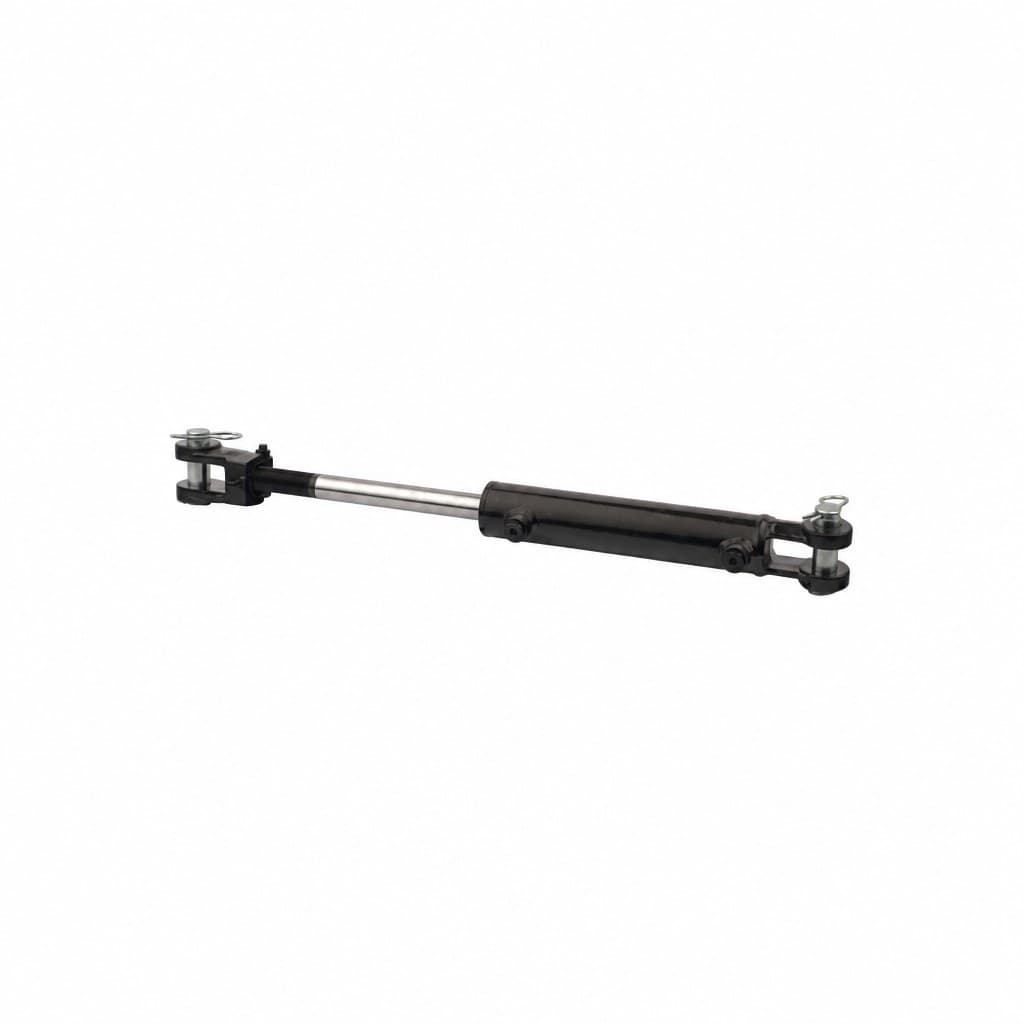 IH-CHF-CL-3Chief Welded Clevis Hydraulic Cylinder, 3" BoreChief
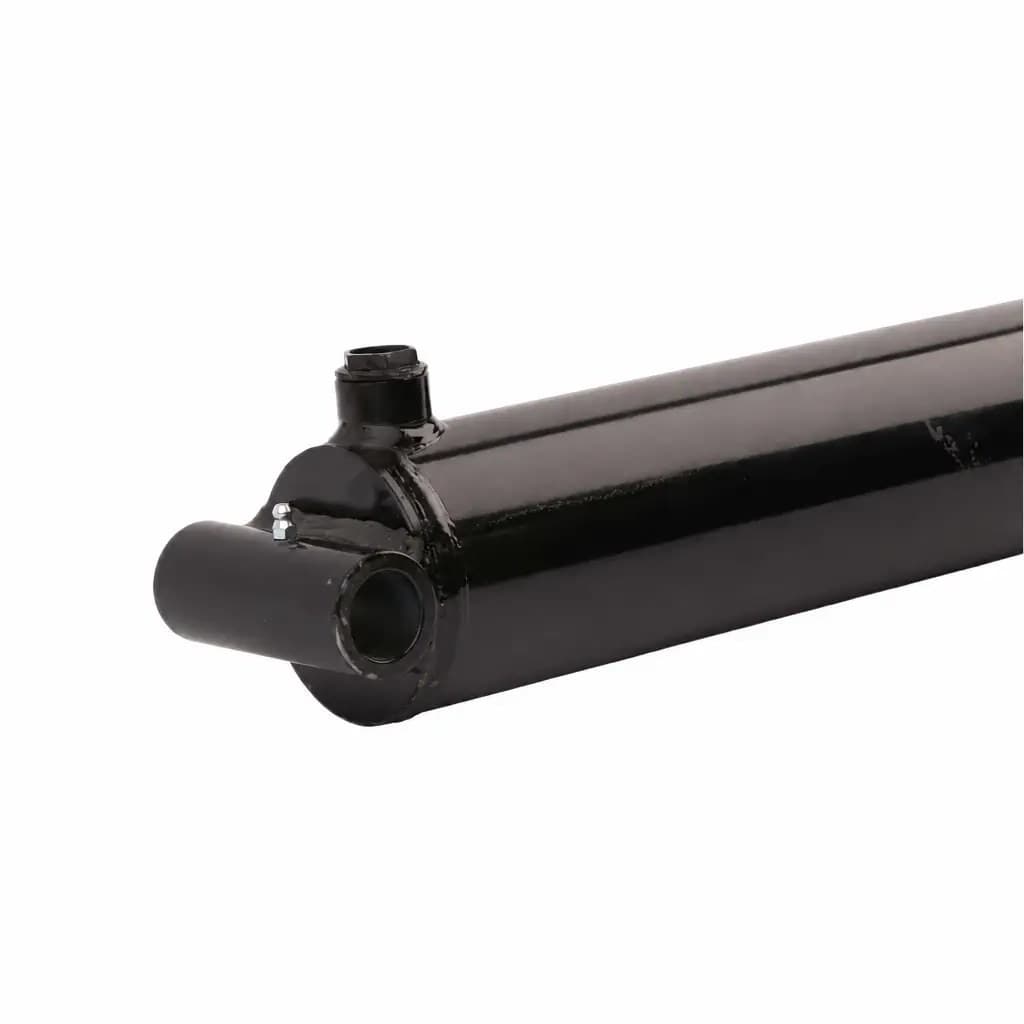 IH-MAG-WCTN-CT-3Magister WCTN Welded Cross Tube Hydraulic Cylinder, 3" BoreMagister Hydraulics
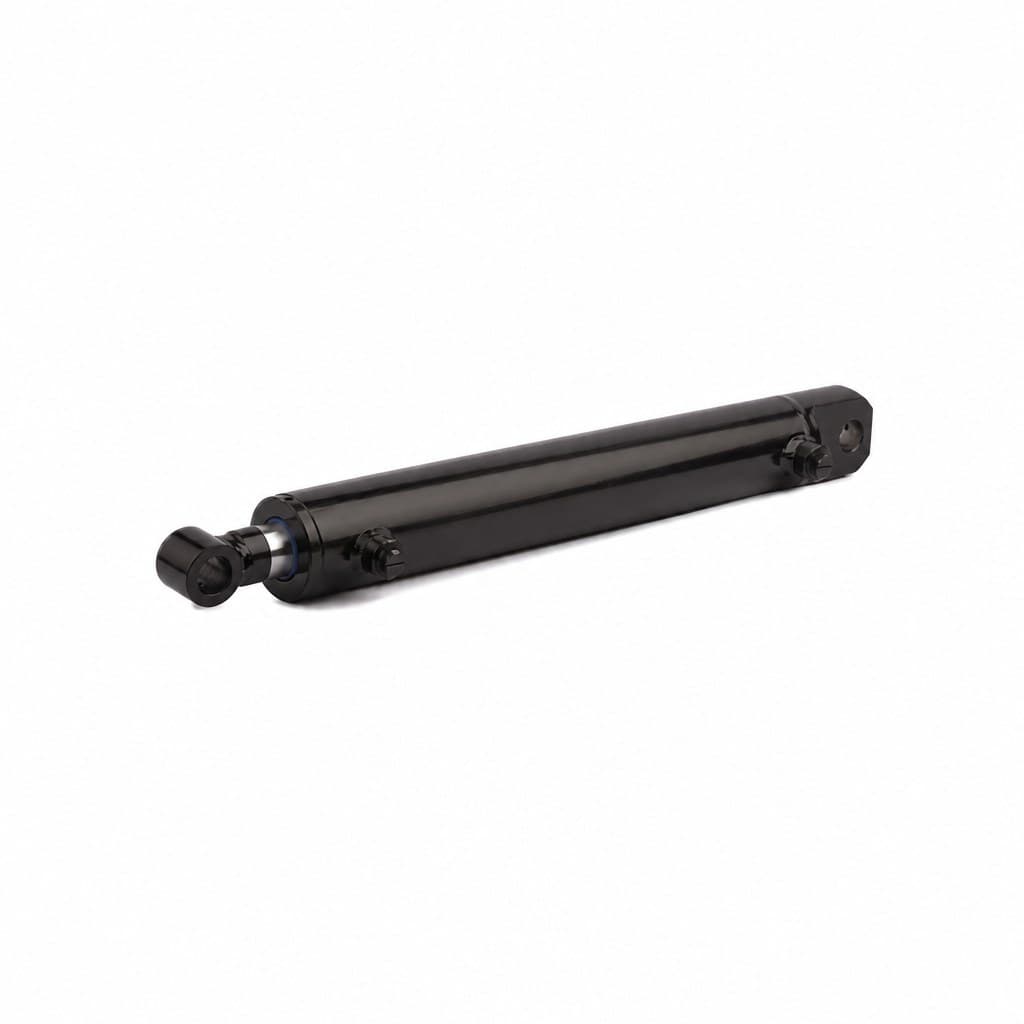 IH-CHF-TG-25Chief Welded Tang Hydraulic Cylinder, 2.5" BoreChief
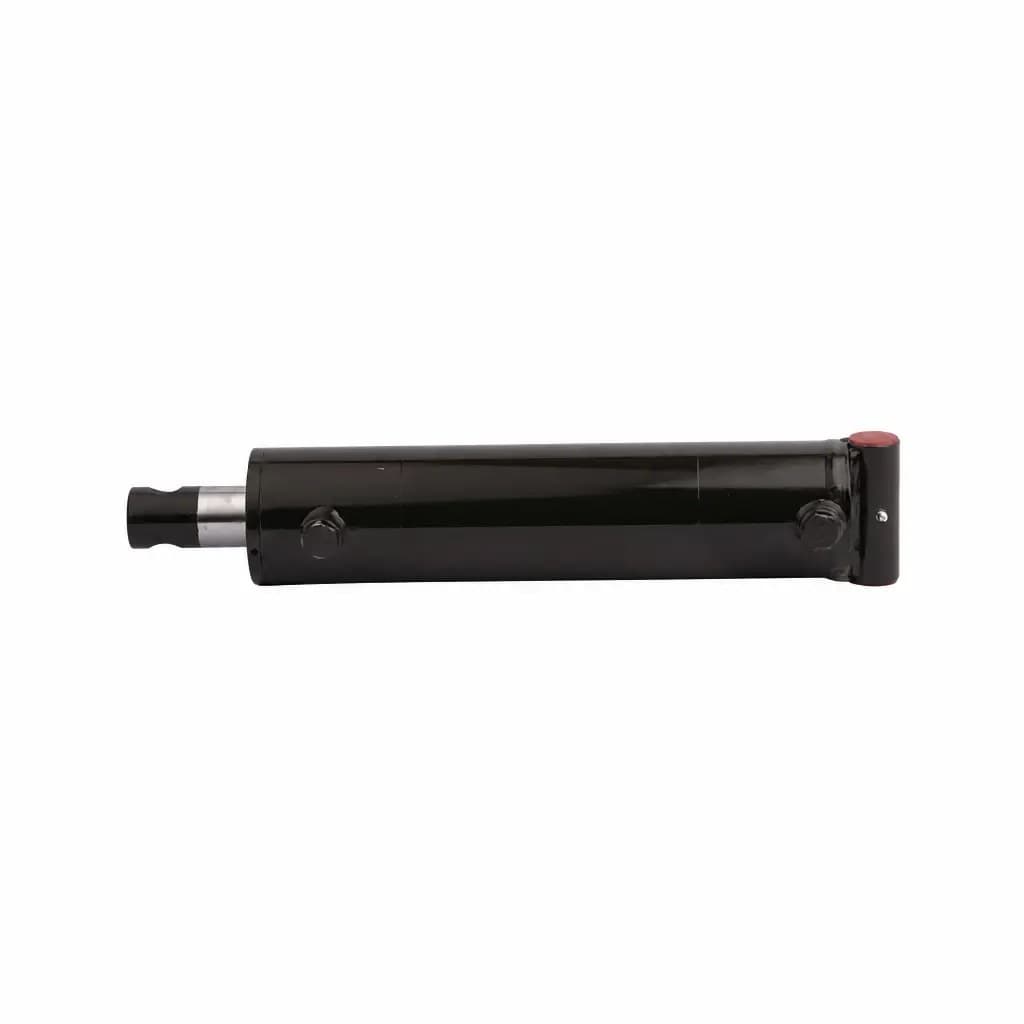 IH-MAG-WPEN-PE-3Magister WPEN Welded Pin Eye Hydraulic Cylinder, 3" BoreMagister Hydraulics
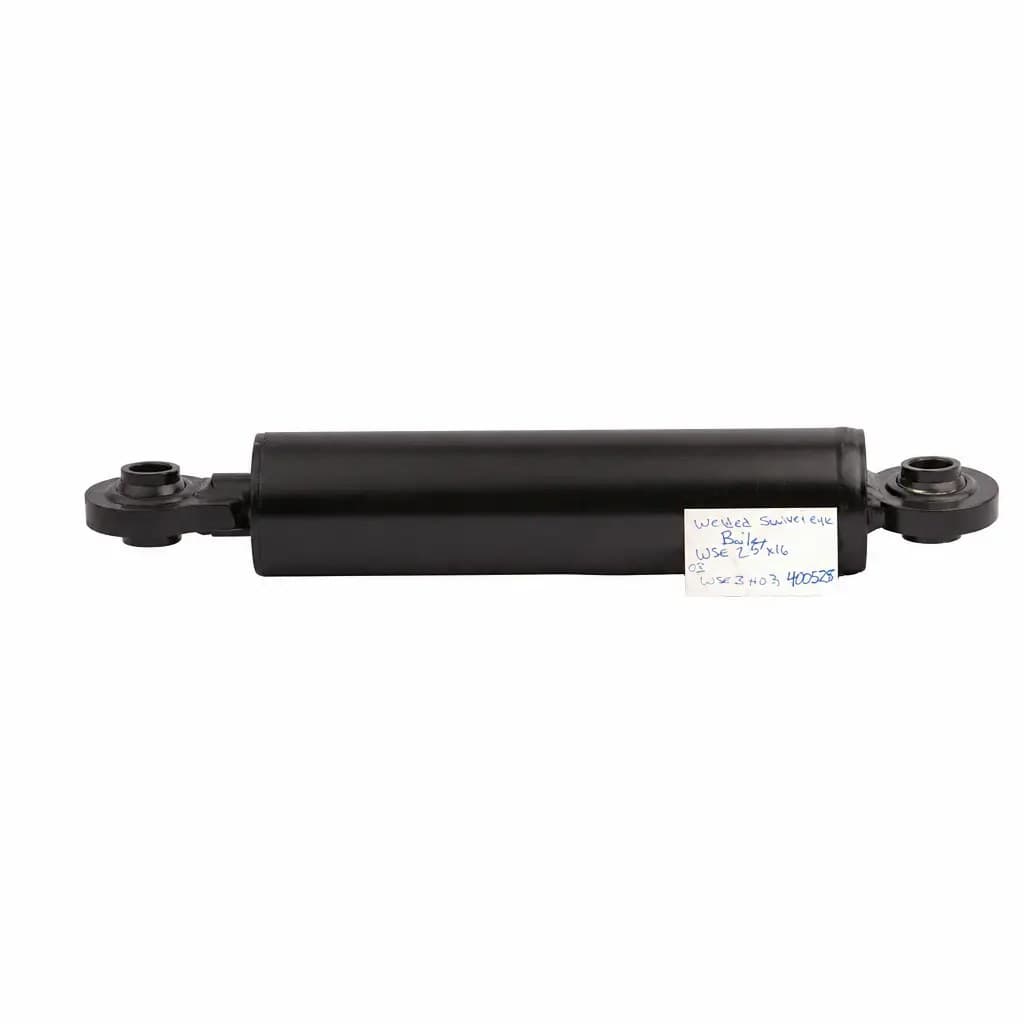 IH-MAX-SE-2Maxim Welded Swivel Eye Hydraulic Cylinder, 2" BoreMaxim
 IH-BLY-AGC-25Bailey Welded Ag Clevis Hydraulic Cylinder, 2.5" BoreBailey International
- IH-CYL-100-70-500Rexroth CDT3 Tie-Rod Cylinder 100/70 × 500 mm, Foot Mounting MS2 (ISO 6020-2)Bosch Rexroth
- IH-CYL-63-45-200Rexroth CDT3 Tie-Rod Cylinder 63/45 × 200 mm, Clevis Mounting MP1 (ISO 6020-2)Bosch Rexroth