
Rexroth CDT3 Tie-Rod Cylinder 100/70 × 500 mm, Foot Mounting MS2 (ISO 6020-2)
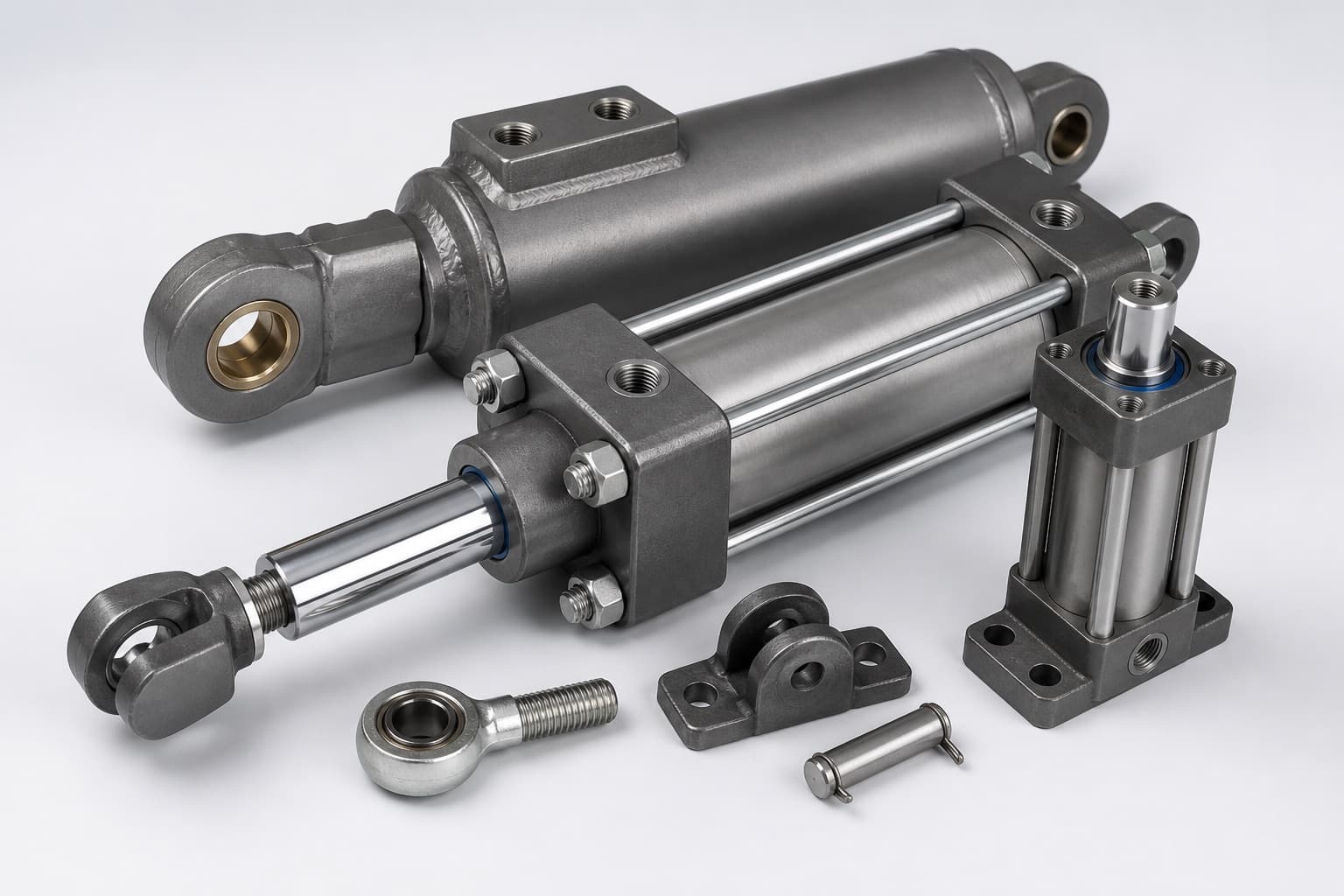 Category image · Hydraulic Cylinders
Bosch Rexroth CDT3 tie-rod differential cylinder to ISO 6020-2: 100 mm piston, 70 mm rod, 500 mm stroke, MS2 foot mounting. Rated 160 bar nominal; 210 bar maximum for static loads only.
Key features
- Bore: 100 mm
- Stroke: 500 mm
Product description
A Bosch Rexroth CDT3 tie-rod differential cylinder, 100 mm piston and 70 mm rod, 500 mm stroke. CDT3 is Rexroth's tie-rod series with installation dimensions to ISO 6020-2, so it is interchangeable with other ISO 6020-2 cylinders of the same size and mounting. Rexroth offers it in 13 mounting types, pistons from 25 to 200 mm and strokes up to 3000 mm, with an integrated guide socket for quicker maintenance, optional end cushioning and a patented safety bleed.
Rexroth rates the CDT3 160 bar nominal, and 210 bar maximum only for static loads — fewer than 10,000 load cycles; for dynamic loads the limit is 75 % of that.
This size
- Piston 100 mm; rods offered: 45, 56 or 70 mm
- Stroke 500 mm; maximum available 2000 mm, subject to a buckling check
- Mounting: MS2, foot mounting
- Theoretical force at 160 bar: 125.7 kN push, 64.1 kN pull
- Line connections: G3/4 standard, G1 enlarged
- Maximum stroke velocity: 0.30 m/s with standard ports, 0.50 m/s enlarged
- Weight: about 41.4 kg at 500 mm stroke (21 kg at 100 mm plus 5.1 kg per 100 mm more, MS2)
- Test pressure: 240 bar (static)
The type code
Rexroth's code starts CDT3MS2/100/70/500Z3X/…: CD differential cylinder, T3 tie-rod series, the mounting, piston, rod and stroke, Z for tie-rod design and 3X for the component series. The rest specifies the line connections, rod end, cushioning, seals and rod finish. The code this page carried was not a Rexroth code; give the full code from your cylinder's nameplate, or the options you need, on the RFQ.
Seals and fluid
Rexroth offers seal system M as standard (HL, HLP and HFA fluids), T for servo quality and low friction (also HFC), and S for HFDR phosphate ester and up to +120 °C. It does not publish the elastomers. With seal system M on mineral oil the fluid may run from −20 to +80 °C. Rexroth asks for ISO 4406 20/18/15 cleanliness or better, and at least 10 bar operating pressure with no load.
Ordering
Send the full type code or the options on your RFQ. We supply new cylinders and confirm lead time on the quotation.
Dimensions
| Parameter | Value |
|---|---|
| Bore | 100 mm |
| Rod diameter | 70 mm |
| Stroke | 500 mm |
Mechanical
| Parameter | Value |
|---|---|
| Mount style | MS2, foot mounting |
| Seal material | Seal system M (standard), T or S |
| Line connections | G3/4 standard, G1 enlarged |
Performance
| Parameter | Value |
|---|---|
| Push force | 125.7 kN |
| Nominal pressure | 160 bar |
| Maximum operating pressure | 210 bar, static loads only |
Identification
| Parameter | Value |
|---|---|
| Series | Rexroth CDT3, ISO 6020-2 |
Shipping & lead time
What is the Rexroth CDT3 100/70 × 500 mm cylinder (MS2) and where is it used?▾
How do I read the Rexroth type code of the Rexroth CDT3 100/70 × 500 mm cylinder (MS2), CDT3MS2/100/70/500Z3X?▾
Which rod diameters and strokes are offered on the Rexroth CDT3 100/70 × 500 mm cylinder (MS2)?▾
How much force does the Rexroth CDT3 100/70 × 500 mm cylinder (MS2) give?▾
What pressure is the Rexroth CDT3 100/70 × 500 mm cylinder (MS2) rated for?▾
Which seals and fluids does the Rexroth CDT3 100/70 × 500 mm cylinder (MS2) take?▾
What standard does the Rexroth CDT3 100/70 × 500 mm cylinder (MS2) follow, and is it interchangeable?▾
What line connections and speed does the Rexroth CDT3 100/70 × 500 mm cylinder (MS2) have?▾
Which mounting does the Rexroth CDT3 100/70 × 500 mm cylinder (MS2) have and what are the alternatives?▾
How do I check the Rexroth CDT3 100/70 × 500 mm cylinder (MS2) for buckling at full stroke?▾
How does the Rexroth CDT3 100/70 × 500 mm cylinder (MS2) differ from the Rexroth CDT3 63/45 × 200 cylinder (MP1)?▾
Can I buy the Rexroth CDT3 100/70 × 500 mm cylinder (MS2) from stock in the UAE and get a quotation?▾
Shipped worldwide from our Dubai warehouse. Transit, routes and documentation for 136 destinations
From the blog
Written about this part
Cylinders, pumps & motors
Hydraulic cylinders: the complete guide to types, parts, seals and selection
Single-acting or double-acting, welded or tie-rod, ram, telescopic or 10,000 psi — what each cylinder type is for, what is inside it, how the seals work, what the rod and barrel are made of, and the eight measurements that identify a replacement.
9 min read
Cylinders, pumps & motors
Hydraulic cylinder force and speed: how to size bore, rod and stroke from first principles
Force is pressure times area and speed is flow divided by area, but a cylinder has two areas, a rod that can buckle and a rod end that can multiply pressure. Worked examples in inches and millimetres, the push and pull tables, retract speed, regeneration, buckling and the intensification trap that bursts rod-end seals.
16 min read
Cylinders, pumps & motors
Hydraulic cylinder mounting styles: clevis, cross tube, trunnion, flange and the codes that name them
The mount decides whether a cylinder pushes straight or bends itself to death. Welded mounts — clevis, cross tube, tang, pin eye, swivel eye — the NFPA and ISO codes for tie-rod mounts, what an ASAE or “ag” cylinder is, and how to measure pins, gaps and closed length so a replacement fits first time.
8 min read