Drilling fluid holds back formation pressure, carries cuttings out and cools the bit; cement seals the casing to the rock so the well does not leak behind the pipe. Both are pumped from surface equipment that sits on the rig site for the whole job, and both depend on getting the fluid’s density right.
/01Cementing equipment.
| Unit | Job |
|---|---|
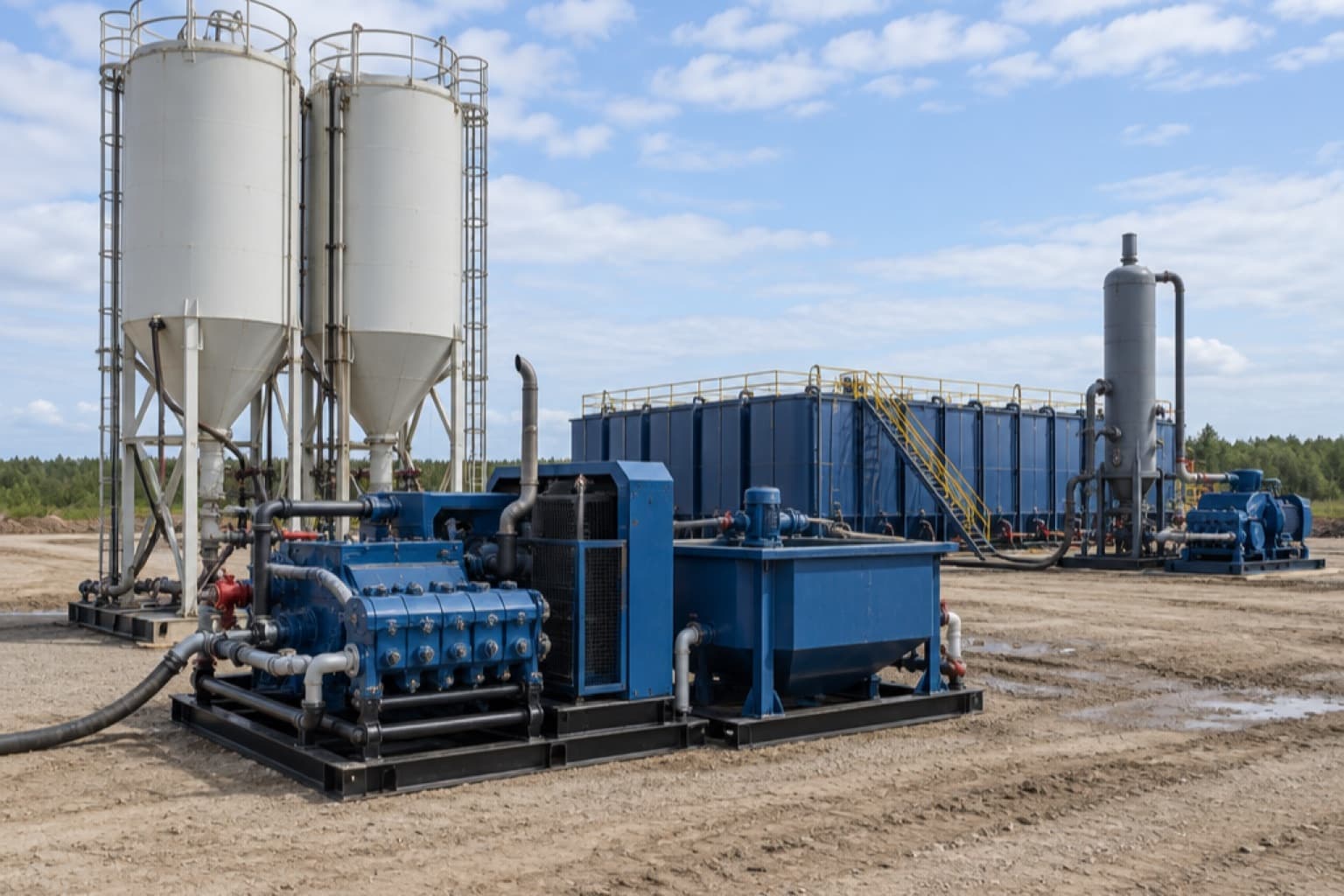
| Bulk cement silos | Store dry cement; aerated and conveyed pneumatically to the mixer |
| Batch mixer | Mixes the whole slurry to an exact density before pumping; twin tanks mix and discharge in turn |
| On-the-fly (recirculating) mixer | Mixes slurry continuously; recirculation keeps it uniform |
| Cementing unitHighlighted | Pumps (usually triplex) with displacement tanks and density control |
| Dust collector | Captures cement dust vented from silos and bulk transfer |
| Rock catcher | Strains debris out of the slurry before it reaches the pumps |
| Cutting bottle | Opens bulk bags of cement or additive into the system |
| Cement and kill manifold | Valves and chokes on a skid between the pumps and the well, for cementing lines and for pumping kill fluid |
NOV describes batch mix units as the economical way to ensure homogeneous slurry of an exact density, with recirculating mixers and non-nuclear density measurement, and cement pumpers with high-energy recirculating mixers, twin displacement tanks and mix-water flowmeters. Density is held by automated control of mix water and cement feed. For field checks, SLB gives the mud balance’s accuracy as ±0.1 lbm/gal; a pressurised balance removes the effect of entrained air.
The high-pressure pumps also serve well control. SLB defines the kill line as a high-pressure pipe from an outlet on the BOP stack to the rig’s high-pressure pumps: kill fluid is normally pumped down the drillstring, but if the drillpipe cannot be reached, heavy fluid can be pumped into the top of the well. A cement and kill manifold puts the valves and chokes for that line and the cementing lines on one skid, 2-1/16″ to 7-1/16″ and 3,000 to 20,000 psi. Choke and kill equipment falls under API 16C; see API 16C choke and kill lines.
/02Drilling-fluid equipment.
- Mud tanks hold the active system, with agitators, guns and sight gauges; workover tanks hold brine and completion fluids.
- A liquid mud plant stores and mixes mud in bulk — at a base or on a large location — for delivery to rigs.
- Mud pumps — triplex on most rigs — circulate the fluid; the standpipe manifold routes their discharge up the derrick, about one-third of its height, to the kelly hose or top drive. Many large rigs have dual standpipes.
- Degassers remove entrained gas so the mud keeps its density and the pumps keep their suction: the vacuum type expands bubbles under vacuum, the surface-area type spreads mud over baffles. Heavily gas-cut mud goes first to a mud gas separator, which has more capacity and sends the gas to the flare.
- A mobile mud lab lets the mud engineer test density, viscosity and filtration on site.
For the hose between pump and standpipe, see API 7K rotary and vibrator hose.
Common questions
- Batch mixer or on-the-fly mixer for cementing?
- A batch mixer prepares the whole job’s slurry to an exact density first; an on-the-fly recirculating mixer mixes continuously while pumping, with automatic density control.
- How do I convert specific gravity to ppg?
- Multiply by 8.33: a 2.5 SG slurry is about 20.8 lb/gal.
- What is the difference between a degasser and a mud gas separator?
- A degasser (vacuum or surface-area) removes entrained gas from mud returning to the tanks; a mud gas separator handles heavily gas-cut returns and vents the gas to the flare.
- What does a standpipe manifold do?
- It routes mud pump discharge to the standpipe and on to the kelly hose or top drive, with valves to isolate pumps and lines.
What we list
Cementing and drilling-fluid equipment:
- Single-Pump Cementing Unit, Skid-Mounted, Triplex 600 HP, Auto Density Control
- Cement Batch Mixer, Twin 2×100 BBL, Coriolis Density, Hydraulic Drive
- On-The-Fly Cement Mixer, 20 BBL Surge Tank, 2.5 SG Max, Auto Density
- Cement Silo, 1,500 cu.ft., L-Frame, Aerated, Load Cells
- Cement Dust Collector, Velocity-Drop, 50 cu.ft. Vessel, Synthetic Fabric Bag
- Cement Rock Catcher, Inline Vessel, SS Screen, Selectable Mesh
- Cement Cutting Bottle, Skid-Mounted, 4-Blade Needle, Pneumatic Top Valve
- Cement and Kill Manifold, API 6A, 3,000 to 20,000 psi
- Mud Tank, Skid-Mounted, 500 BBL, 40-ft ISO Footprint, Manholes + Sight Gauges
- Liquid Mud Plant (LMP), Modular 8,000-BBL Total Storage, ISO Container Footprints
- Mud Pump Package, Triplex 1,600 HP, Electric Drive, Modular for Offshore Lift
- Drilling Mud Manifold, 4-inch 5,000 psi, Demco Valves, X-Ray + PWHT
- Standpipe Manifold, 5,000 and 7,500 psi
- Mud Degasser, Vertical, 1,000 GPM, U-Tube Vent, NACE MR-0175
- Workover Tank, 240 BBL, Brine Service, Insulated, Manholes + Recirc Manifold
- Mobile Mud Lab, 20-ft Container, Lab Benches + Storage + HVAC
Cementing and mud equipment
- IH-CMU-S600-SKDSingle-Pump Cementing Unit, Skid-Mounted, Triplex 600 HP, Auto Density ControlIndus Hydraulics
- IH-CBM-2X100-CRLCement Batch Mixer, Twin 2×100 BBL, Coriolis Density, Hydraulic DriveIndus Hydraulics
- IH-OTF-20-ADCOn-The-Fly Cement Mixer, 20 BBL Surge Tank, 2.5 SG Max, Auto DensityIndus Hydraulics
- IH-CSL-1500-LCCement Silo, 1,500 cu.ft., L-Frame, Aerated, Load CellsIndus Hydraulics
- IH-MTK-500-ISO40Mud Tank, Skid-Mounted, 500 BBL, 40-ft ISO Footprint, Manholes + Sight GaugesIndus Hydraulics
- IH-MPP-T1600-EDR-MODMud Pump Package, Triplex 1,600 HP, Electric Drive, Modular for Offshore LiftIndus Hydraulics
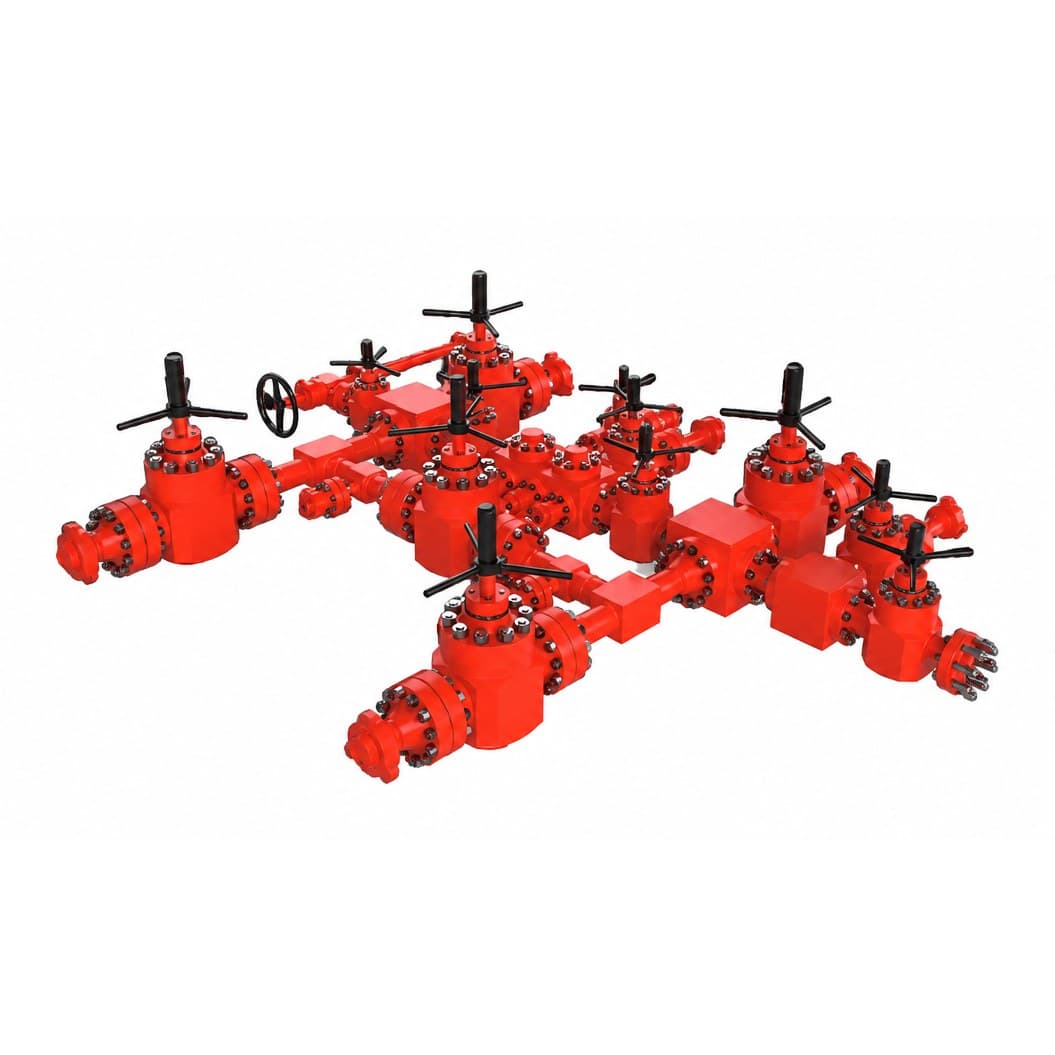 IH-OFE-SPMStandpipe Manifold, 5,000 and 7,500 psiIndus Hydraulics
- IH-MDG-V1000-UT-NACEMud Degasser, Vertical, 1,000 GPM, U-Tube Vent, NACE MR-0175Indus Hydraulics