
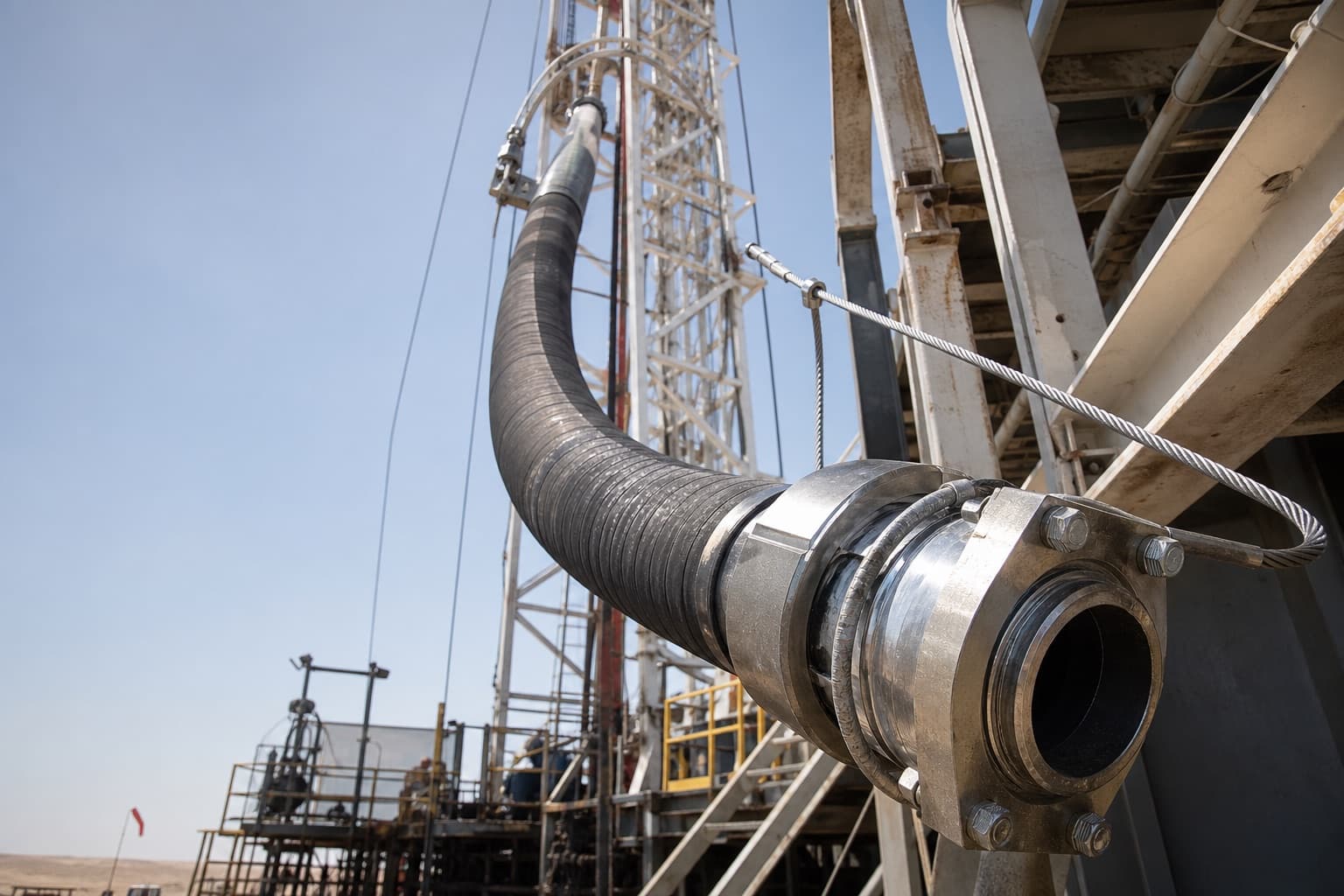
Rotary and vibrator hose is the largest flexible item on most rigs and the one whose failure is most immediately dangerous to people standing near it. The specification work is less about pressure — almost everything in this class is 5,000 psi — and more about coupling method, temperature and whether the well is sour.
Three coupling methods.
| Construction | Coupling | Service | Temperature |
|---|---|---|---|
| Rotary & vibrator, mud | Bonded | Drilling mud | −30 to +82 °C |
| Rotary & vibrator, mud | Crimped | Drilling mud | −30 to +82 °C |
| Rotary & vibrator, cement | Bonded | Cementing | −30 to +82 °C |
| Rotary & vibrator, cement | Crimped (Powerspiral) | Cementing | −30 to +82 °C |
| Rotary & vibrator | Swaged | General | −30 to +82 °C |
| Rotary & vibrator, HT / sour | Bonded | High temp, NACE MR-0175 | −30 to +121 °C |
All are 5,000 psi working. The coupling method is set at manufacture and is part of what the assembly is qualified as — it is not a field choice, and a hose is not converted from one to another. What it does affect is lead time and availability, so it is worth knowing which your rig already runs before an urgent replacement is needed.
Restraint is part of the installation.

This is the oilfield case of a general principle covered elsewhere on this blog: restraint addresses separation, and nothing else does. It does not substitute for inspection, and it does not extend the life of a hose that is past its recertification date — it limits what happens if the assembly lets go between inspections.
High temperature and sour.
What changes for sour service on rotary hose?
NACE MR-0175 applies on top of API 7K, constraining material selection for hydrogen sulphide environments — and it applies to the end fittings as well as the hose. The high-temperature construction we supply for this service also raises the ceiling from 82 °C to 121 °C, so the two requirements often arrive together.
The recurring error is treating NACE as a property of the hose. It is a property of the assembly. A compliant hose terminated in non-compliant ends is not a NACE assembly, and the ends are the part most likely to be sourced separately and least likely to be checked.
Mud booster is not a cheaper rotary hose.
The mud booster construction is rated 3,000 psi working against 7,500 psi minimum burst — the same 2.5:1 factor, at a lower class, for a different duty. It is a purpose-built item for booster service rather than a downgraded rotary hose, and substituting in either direction is a specification error rather than a saving.
API 7K constructions
Common questions
Can I re-end a rotary hose in the field?
No. The coupling method is part of the assembly qualification and is applied at manufacture under controlled conditions. A field-terminated 7K hose is an unqualified assembly regardless of how well it is made.
Is the cement construction different from the mud one?
They are separate constructions for separate duties in our range, at the same 5,000 psi rating. Specify against the service the hose will actually see.
What is the difference between rotary and vibrator hose?
They are commonly supplied as one class — the naming reflects position and duty on the rig rather than a different specification. The constructions here cover both.
How does the 2.5:1 factor compare with hydraulic hose?
Hydraulic hose to EN or SAE is built to 4:1. API 7K at 2.5:1 has less proportional margin, and API 16C choke and kill less again at 1.5:1 — which is why inspection discipline scales with pressure class rather than relaxing.
Drilling hose
Rotary, vibrator, cementing and mud booster constructions to API 7K.
Figures verified · Ratings from the constructions we stock, resting on the manufacturers’ API certification. API 7K covers multiple classes — confirm against the assembly datasheet.
Industry
Oil and gas
Pressure control, drilling and downstream hose across the Gulf.
Service
112 assemblies for a rig refit
Bulk build and tagging, fourteen days, every hose traceable.
Replacing a rotary or vibrator hose?
Tell us the size, the coupling type your rig runs and whether the well is sour. We will confirm the construction, the certification and the lead time.
Plant-down? Call +971 52 2477942 — 24/7