
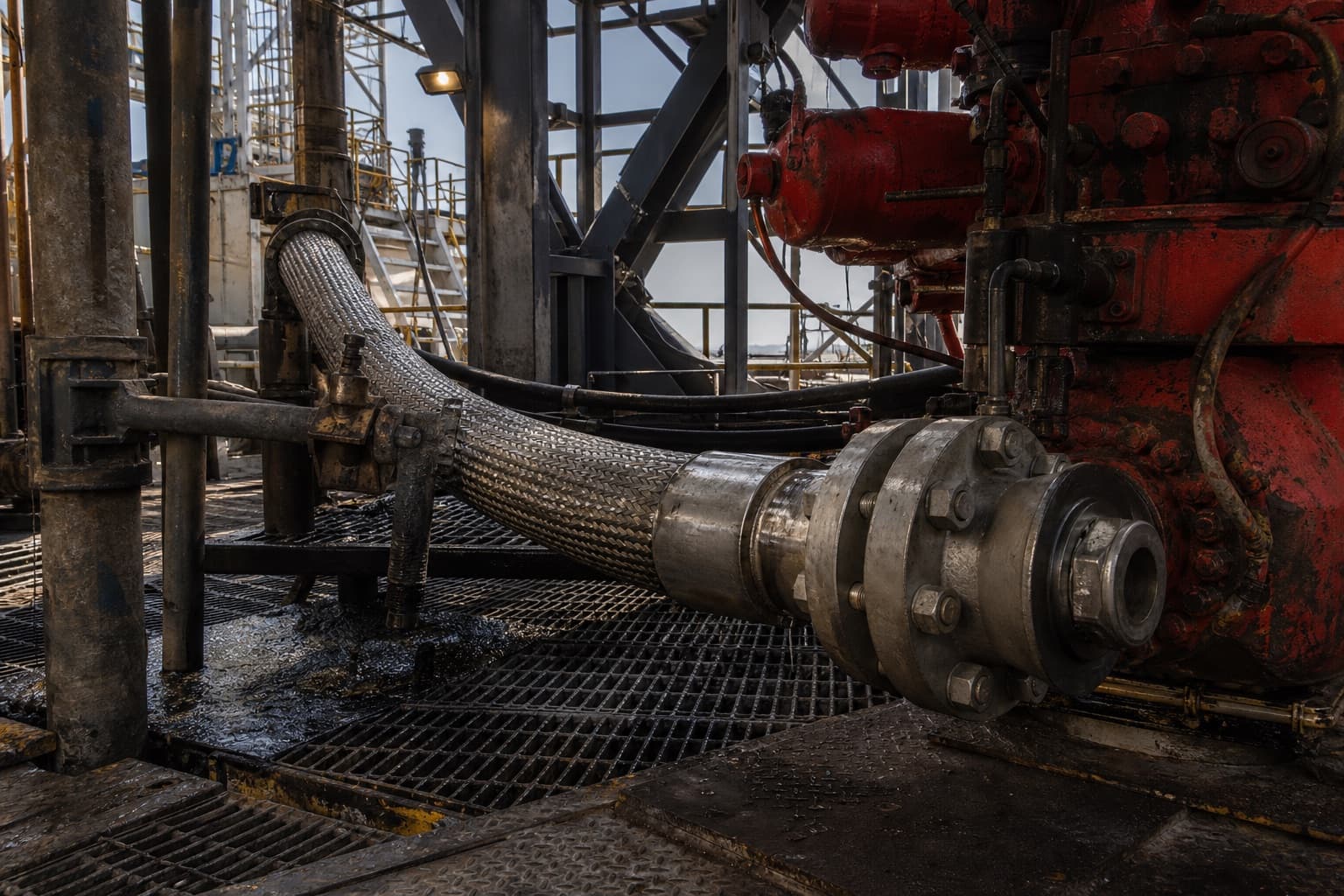
The choke and kill line is one of the few flexible items on a rig where the consequence of a failure is measured in well control rather than downtime. It is also, by design factor, one of the least forgiving — and those two facts are related.
What 1.5:1 actually means.
How much margin does an API 16C choke and kill line have?
On the constructions we supply, 10,000 psi working against 15,000 psi minimum burst — a ratio of 1.5:1. For comparison a hydraulic hose to EN or SAE is built to 4:1. The choke and kill line is engineered much closer to its limit, which is exactly why its inspection and recertification regime is stricter.
The instinct that a higher-rated hose is a more forgiving hose is wrong here, and it is worth saying plainly. A 16C line is qualified to contain a specific pressure with a defined margin, on the assumption that it is inspected, pressure tested and recertified on schedule. Damage that a hydraulic hose would absorb inside its 4:1 factor has nowhere to go on a 16C line.
The liner is the decision.
| Construction | Temperature ceiling | Standards | Size |
|---|---|---|---|
| Tauroflon™ liner | 130 °C (266 °F) | API 16C, API 17J, NACE MR-0175 | 3" – 4" |
| PA liner, high temperature | 130 °C (266 °F) | API 16C, API 17J | 3" – 4" |
| PA liner, standard | 100 °C (212 °F) | API 16C | 3" – 4" |
| General 16C assembly | 121 °C | API 16C, API 17J | 2" – 4" |
All four are 10,000 psi working. The differentiator is temperature and service environment, which means the specification conversation is about what is flowing and how hot it is, not about pressure class. A line specified purely on pressure can be correct on paper and unsuitable for the well.
Sour service and subsea.
Sour service adds NACE MR-0175 to the 16C requirement. The point that gets missed is scope: it constrains materials throughout the assembly, including the flanged ends. Specifying a NACE-compliant hose and pairing it with non-compliant end connections does not produce a NACE-compliant assembly, and it is the ends that tend to be treated as a commodity.
Subsea changes the governing document. Below the LMRP the relevant specification is API 17J alongside ISO 13628-2, and the constructions we supply there are rated 15,000 psi working. A surface 16C line is not a substitute, and the qualification regimes are not equivalent.
Choke and kill constructions
IH-OG-WCT-002
Flexible Choke & Kill Line (with Tauroflon™ liner, up to 266°F/130°C)
Manuli
IH-OG-WCT-003
Flexible Choke & Kill Line (with PA liner, up to 266°F/130°C)
Continental
IH-OG-WCT-004
Flexible Choke & Kill Line (with PA liner, up to 212°F/100°C)
Continental
IH-OG-WCT-005
Subsea LMRP Hoses for Choke & Kill and Hydraulic Conduit Application
Continental
Common questions
Can a choke and kill line be repaired?
No. There is no field repair for a 16C assembly that restores its qualification. Damage means removal from service and replacement or manufacturer assessment.
What temperature should I specify against?
The maximum the line will actually see, including any excursion, not the nominal produced-fluid temperature. The liner ceiling is a hard limit and the difference between the 100 °C and 130 °C constructions is exactly this decision.
Does the flange rating need to match the hose?
The assembly is qualified as a whole, ends included. Mixing a hose of one class with ends of another does not give you an assembly rated at the lower of the two — it gives you an unqualified assembly.
How often does a 16C line need recertification?
On the interval set by the applicable specification and the operator’s own regime, which is stricter than most flexible equipment precisely because of the design factor. Our services team handles recertification alongside choke and kill manifold work.
Well control hose
Choke and kill, subsea LMRP, BOP control and conduit constructions.
Figures verified · Ratings from the constructions we stock, resting on the manufacturers’ API certification. API 16C covers multiple pressure classes — confirm against the assembly datasheet.
Industry
Oil and gas
Pressure control, drilling and downstream hose across the Gulf.
Export market
Iraq
Oilfield-heavy demand and a documentation-heavy route.
Specifying a choke and kill line?
Tell us the pressure class, the maximum temperature and whether the service is sour. We will come back with the construction, the certification and the recertification interval.
Plant-down? Call +971 52 2477942 — 24/7