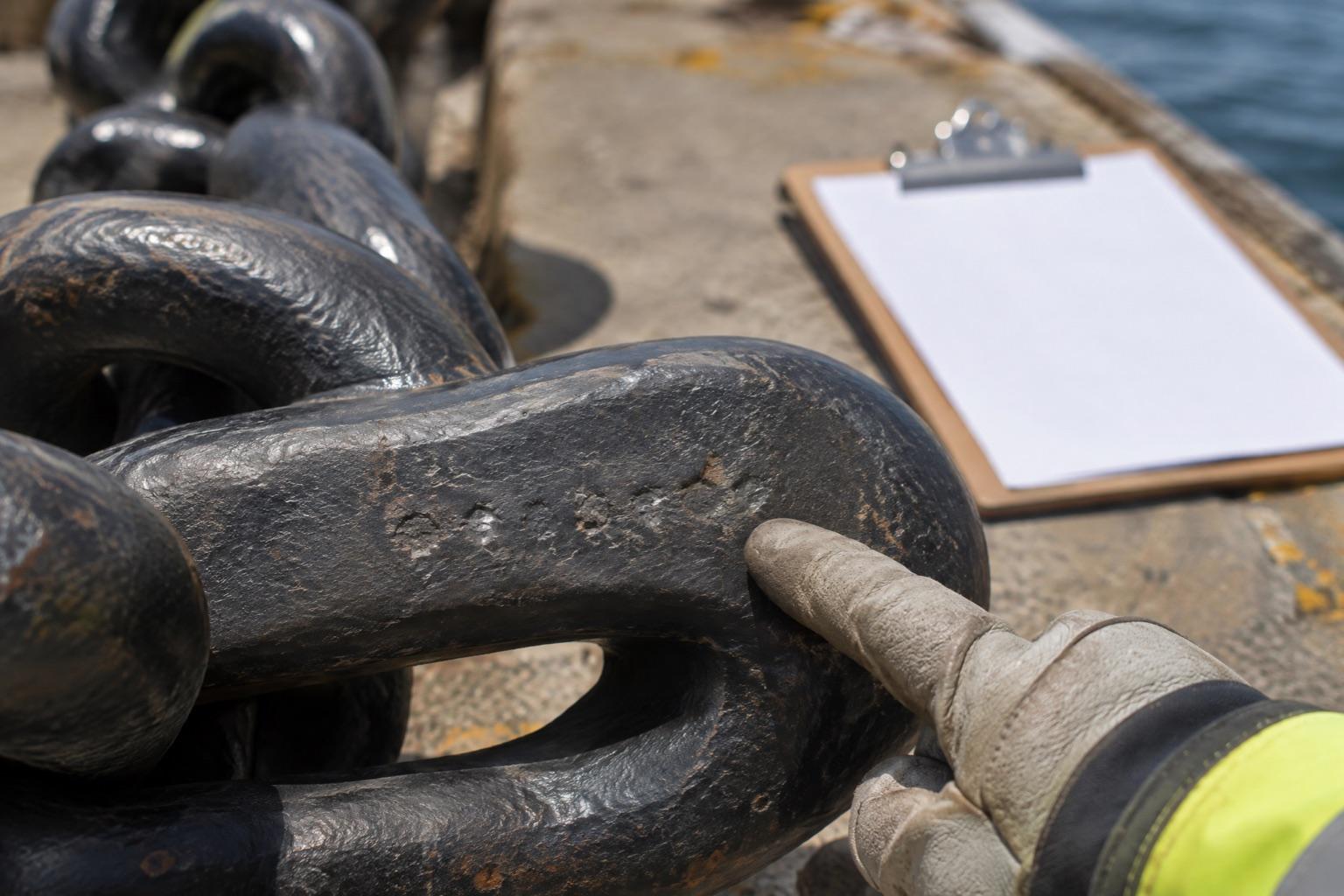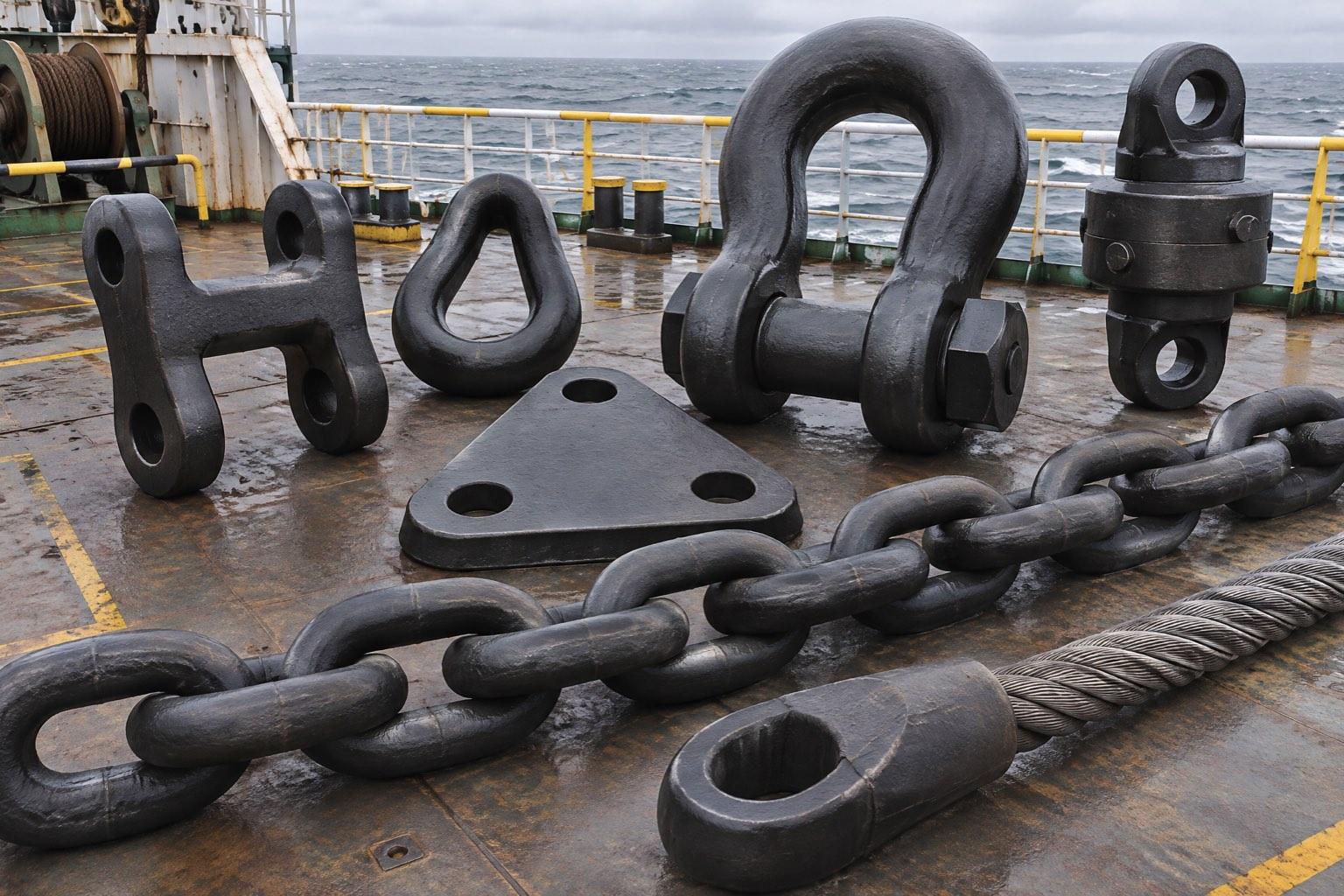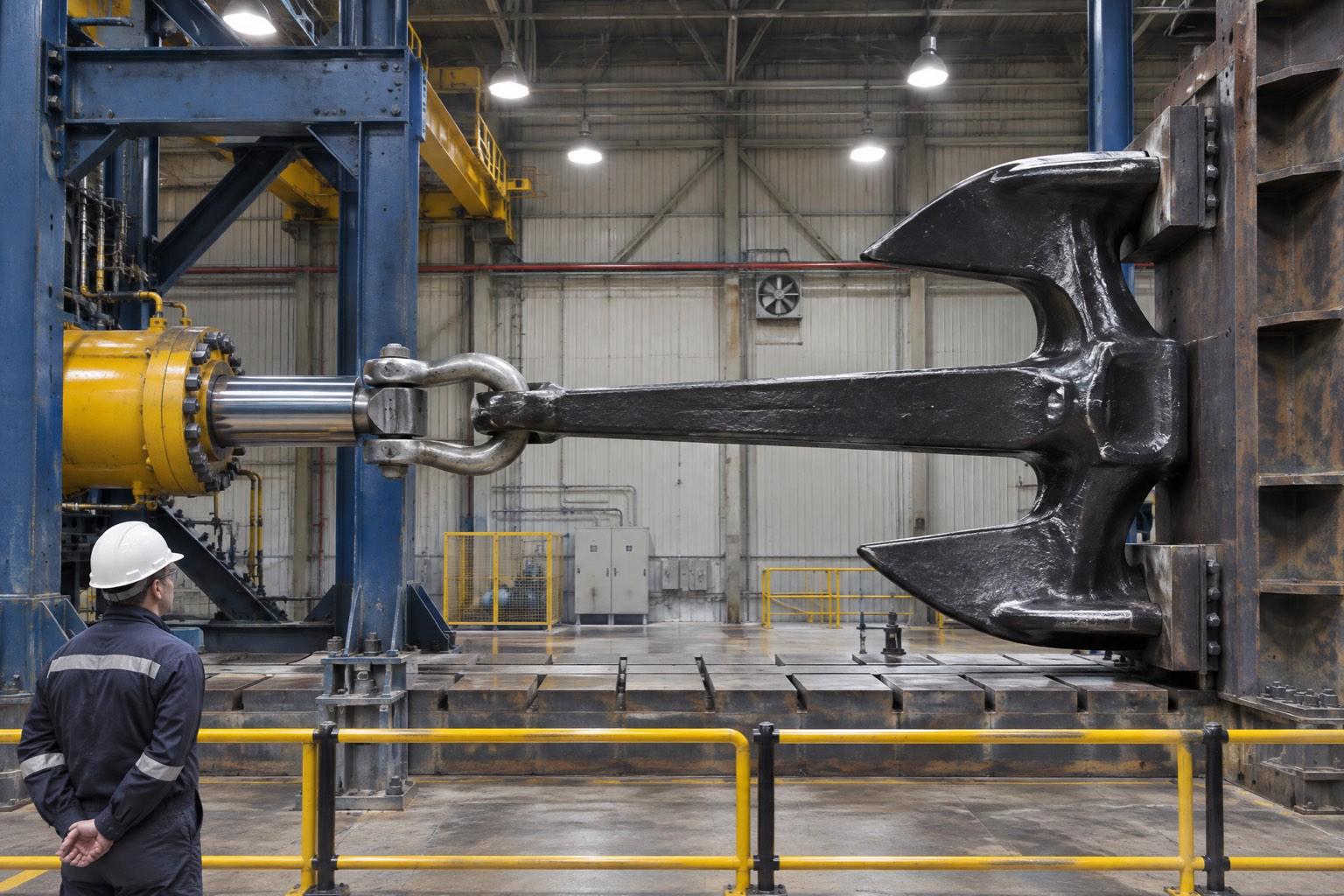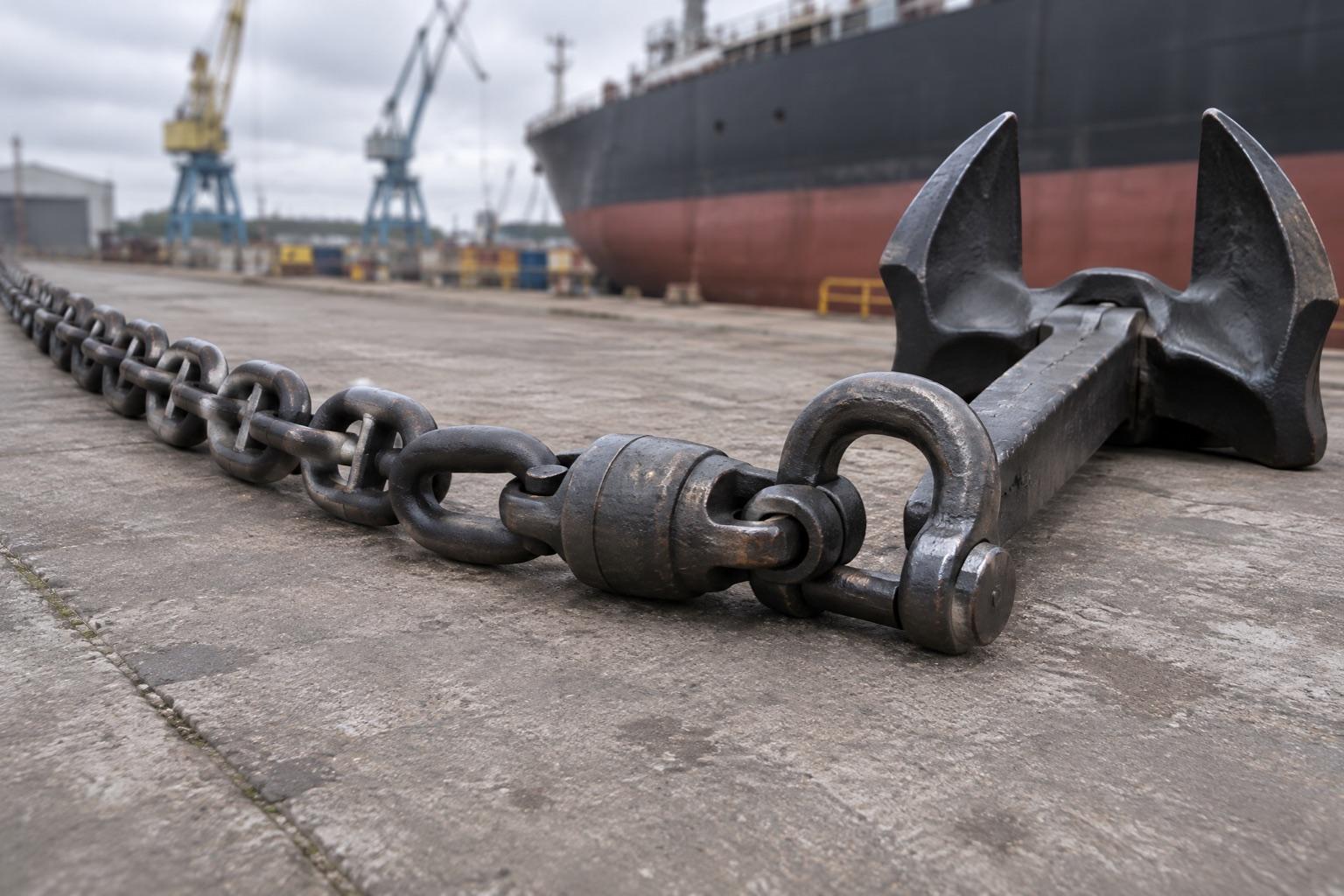
A ship’s anchor cable looks like one long chain, but it is built from parts: standard lengths, the shackles that join them, special links where the joins are made, a swivel near the anchor and a fastening at the far end in the chain locker. Knowing the parts matters when you order a replacement length, re-arrange a cable after an inspection, or specify a new one — because each part has to match the chain’s diameter and grade.
/01The length, or shot.
Chain cable is made, proof tested and certified in standard lengths of 27.5 m — 15 fathoms, or 90 feet. Seafarers call a length a shot; makers’ sheets call it a length or a section. A shot of 76 mm stud link chain has 89 links and a 50 mm shot 135 — the number falls as the diameter rises because each link is longer. The total length a ship carries, and so the number of shots, comes from its equipment number: see how the equipment number sizes anchors and chain.
/02Common, enlarged and end links.
| Link | Length | Width | Bar |
|---|---|---|---|
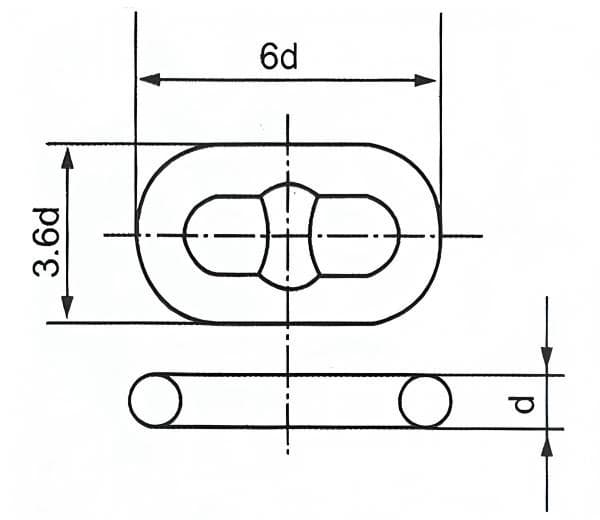
| Common link (stud link) | 6D | 3.6D | 1.0D |
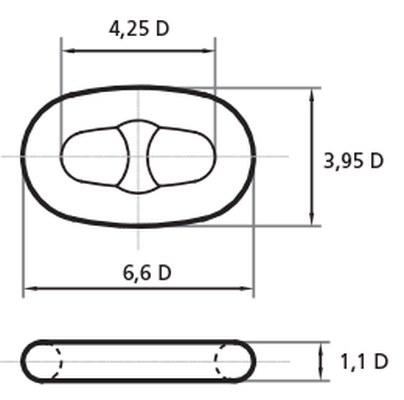
| Enlarged link | 6.6D | 3.95D | 1.1D |
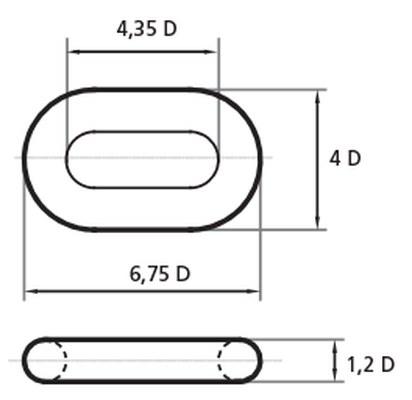
| End link (no stud) | 6.75D | 4D | 1.2D |
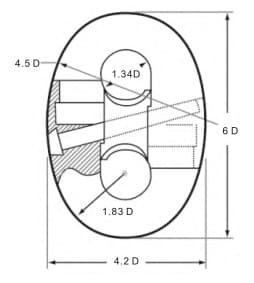
| Kenter shackle | 6D | 4.2D | 1.0D |
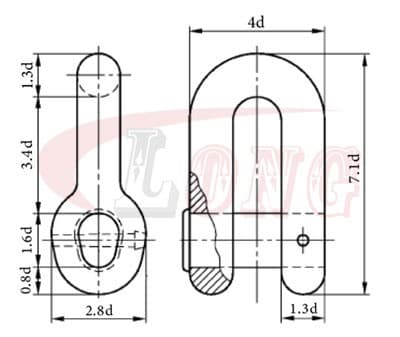
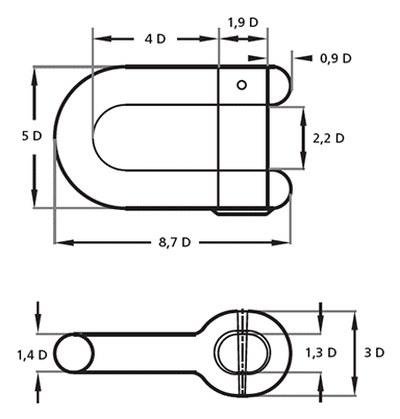
| D-type joining shackle | 7.1D | 4D | 1.3D |
The common link is the body of the chain. The end link is a heavier, studless link with a larger opening, made to take the bolt or pin of a D-type shackle. Because an end link is too big to sit next to a common link neatly, an enlarged link steps between them. The proportions in the table are why a 76 mm end link weighs about 59 kg against 39 kg for a common link of the same chain.
/03Joining the lengths.
Two ways, and a cable usually uses one throughout:
- Kenter shackle. Two interlocking halves and a centre stud, held by a taper pin sealed with a lead plug. It has the length and stud of a common link, so it runs over the windlass cable lifter like any other link and needs no special links either side. How to take one apart and put it back is in our Kenter shackle guide.
- D-type joining shackle. A forged D with a bolt. It is bigger than a common link, so each length ends in an enlarged link and an end link — the arrangement one maker codes “length with EL and E both ends”.
Studless chain is joined with D-type joining shackles straight onto the studless links.
| Arrangement | Make-up | Use |
|---|---|---|
| All common links | C … KS … C | Lengths joined by Kenter shackles |
| EL and E both ends | E – EL – C … C – EL – E | Lengths joined by D-type shackles |
| EL and E one end | E – EL – C … C – KS | Changing from D-type to Kenter joins |
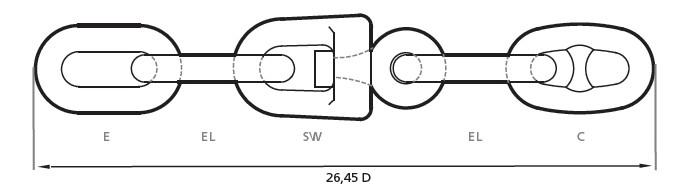
| Swivel length | E – EL – SW – EL – C … KS | The anchor-end length, swivel built in |
| All studless | SL … JS … SL | Studless cable |
/04The anchor end: swivel forerunner and anchor shackle.
An anchor turns as it is weighed and let go, and without a swivel the cable takes on twist. The swivel forerunner is a short assembly — end link, enlarged link, swivel, enlarged link and a common link, about 26.45D long — fitted between the first length and the anchor. A short swivel forerunner of end link, swivel and common link (17.95D) saves length where the hawse is short. The forerunner is shackled to the anchor with an anchor shackle — a larger D, 8.7D long, whose bolt passes through the anchor’s shank — or a Kenter-pattern anchor shackle. A swivel shackle combines the two.
/05The inboard end.
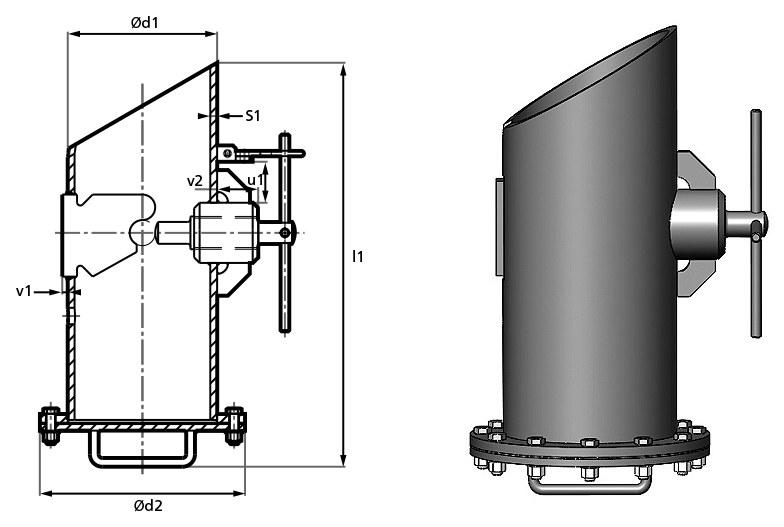
The last length ends in an end shackle on an end fastening — the bitter end — in the chain locker. Class rules, following IACS Recommendation No. 10, want that attachment to hold at least 15% but no more than 30% of the chain’s minimum breaking load, and to be releasable in an emergency from a position outside the locker: if the anchor fouls and must be slipped, the crew can let the cable go rather than have it tear out the ship’s structure. A chain locker securing device or a weak link provides that.
Common questions
- How long is a shot of anchor chain?
- 27.5 m — 15 fathoms or 90 feet. Chain is made, tested and certified in these lengths.
- What is the difference between an end link and an enlarged link?
- The end link is the larger, studless link that takes a D-type shackle. The enlarged link sits between it and the common links, stepping the size up.
- Why use a Kenter shackle instead of a D-type joining shackle?
- A Kenter shackle has the same length and stud as a common link, so it passes over the windlass and needs no end or enlarged links either side.
- What is a swivel forerunner?
- A short assembly of end link, enlarged links, swivel and a common link, fitted between the anchor shackle and the first length so the cable does not twist.
- How strong must the bitter end be?
- Between 15% and 30% of the chain’s minimum breaking load, and releasable from outside the chain locker.
What we list
Every listing on our Anchor Chain Accessories shelf:
- Aluminium Anode for Stud Link Anchor Chain
- Anchor Crown Shackle, Type A
- Anchor Crown Shackle, Type R
- Anchor Kenter Shackle — Heavy-Duty Pattern
- Ball-Joint Anchor Swivel
- BBB Windlass Chain — Grade 30
- Bearing Mooring Swivel
- Bow Shackle, Bolt Type — Bolt and Nut
- Bow Shackle, Screw Pin
- Box Mooring Swivel — Grade R4
- C-Type Joining Shackle (C-Connector)
- Compact Mooring Swivel — Grades R4 and R5
- End Shackle, D Type — Grades U2 and U3
- In-Line Mooring Swivel — Grade R4
- Lead Plug for Kenter and Joining Shackle Pins
- LTM Anchor Shackle, D Type — Bolt and Nut
- LTM End Joining Shackle, D Type — Grade R4
- LTM Joining Shackle, D Type
- Mooring Shackle — 28 to 150 t MBL
- Pear-Shaped End Shackle — Grade 3
- Pear-Shaped End Shackle — Grade R4
- Safety Bow Shackle
- Slim Kenter Joining Shackle
- Special Anchor Shackle, D Type
- Swivel Shackle, Type B
- Swivel Shackle, Type K
- Zinc Anode for Stud Link Anchor Chain
The parts of a chain cable
 IH-LR-AC-SLACGU1U2Stud Link Anchor Chain — Grades U1, U2 and U3
 IH-LR-AC-KSGU2U3Kenter Shackle — Grades U2 and U3
 IH-LR-AC-JSDGU2U3Joining Shackle, D Type — Grades U2 and U3
 IH-MR-AC-ENDEnd Link — Stud Link Anchor Chain, Grades U2 and U3
 IH-MR-AC-ENLEnlarged Link — Stud Link Anchor Chain, Grades U2 and U3
 IH-LR-AC-SFACGU2U3Swivel Forerunner — Anchor Chain, Grades U2 and U3
 IH-MR-AC-ASDAnchor Shackle, D Type — Grades U2 and U3
 IH-MR-DF-EFCEnd Fastening for Anchor Chain Cable — DIN 81860