Most anchor cables are joined with Kenter shackles, and sooner or later one has to be opened — to remove a worn length, to turn the cable end for end, or to fit a new forerunner. The job is simple with the right tools, and easy to get wrong without them: a taper pin driven from the wrong end, a lead plug left out, or halves from two shackles mixed up.
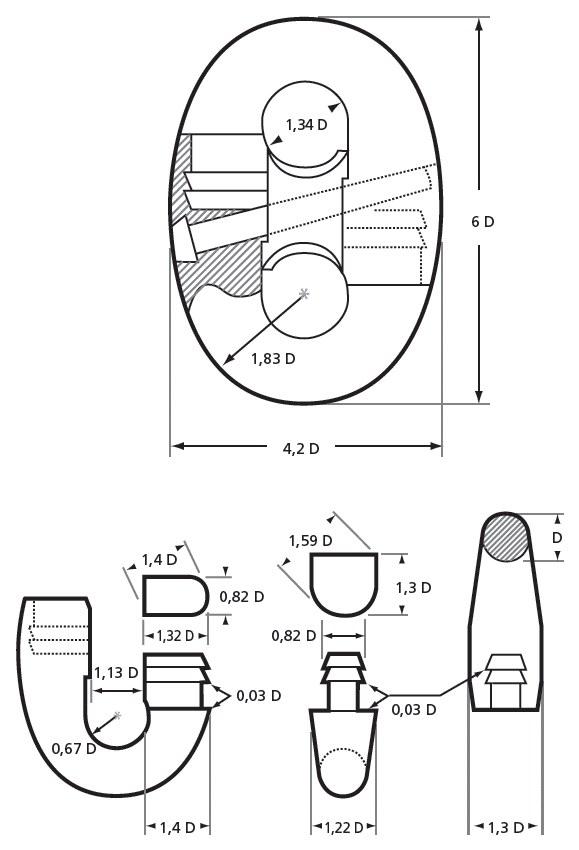
/01The parts.
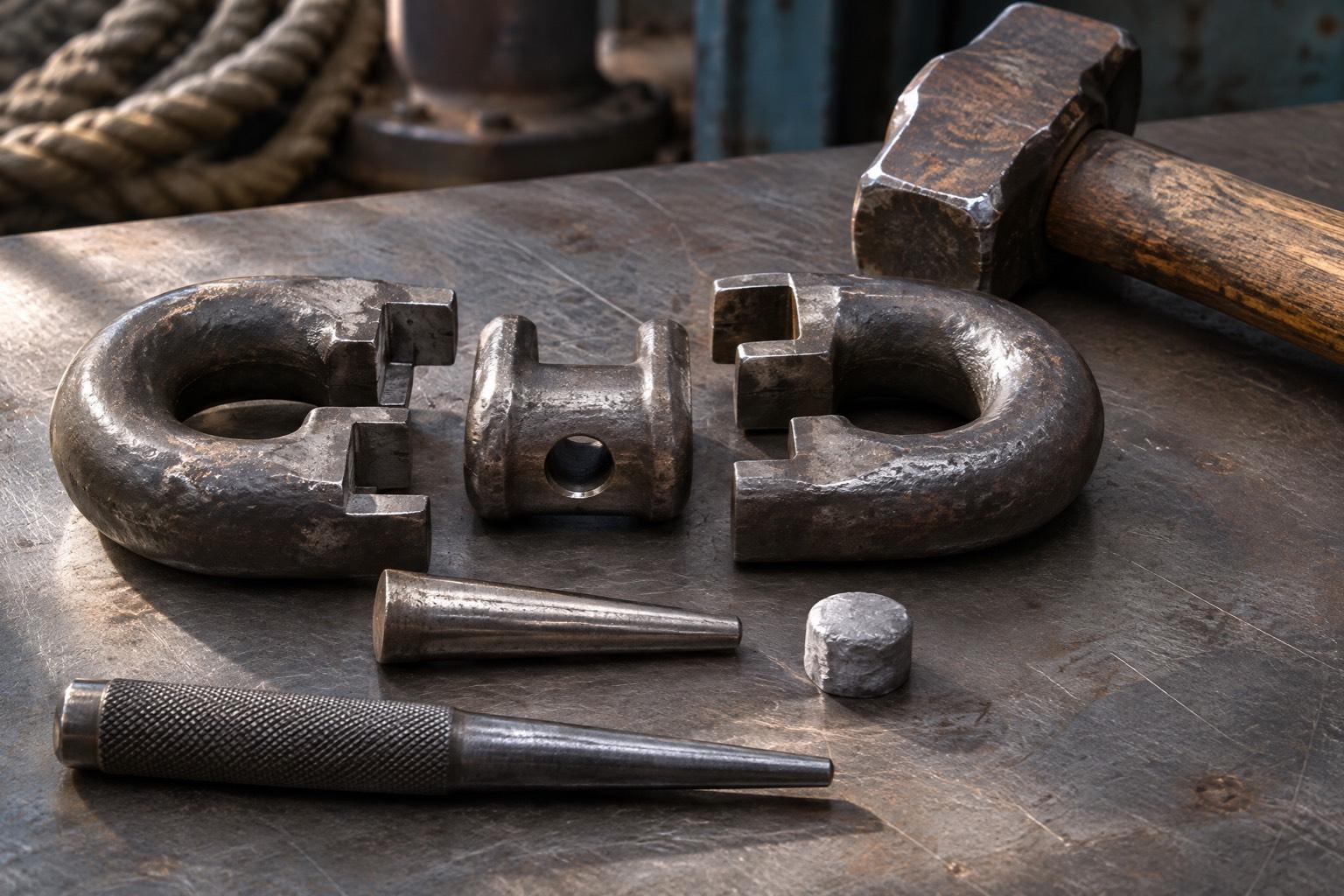
| Part | What it does |
|---|---|
| Two halves | Interlocking C-shaped halves that together form the link body |
| Centre stud (chock) | Sits across the middle, holding the halves together, like the stud of a common link |
| Taper pin | Passes through the halves and stud and locks them |
| Lead plug (pellet) | Hammered into the recess behind the taper pin so it cannot work out |
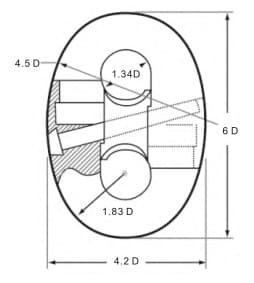
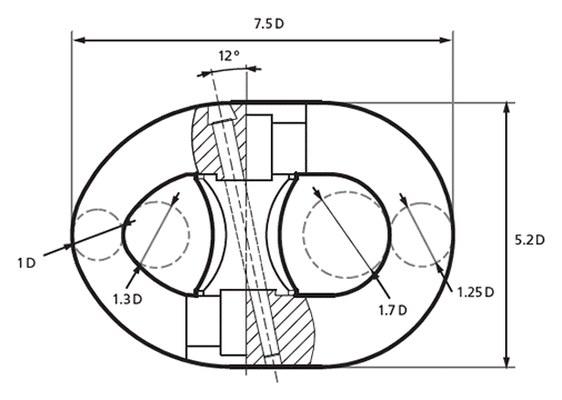
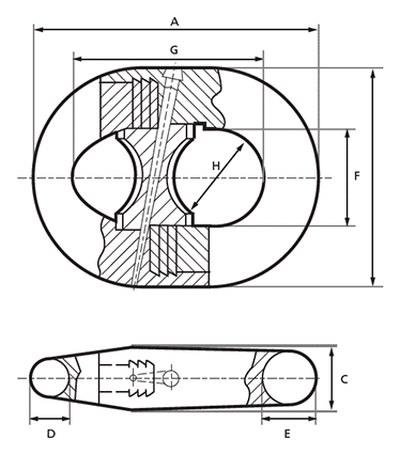
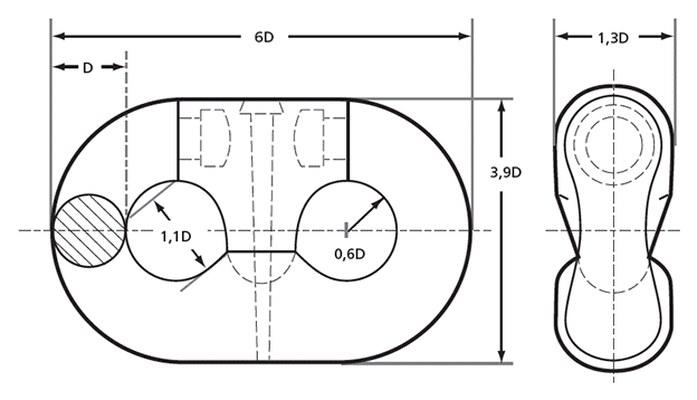
The shackle is 6D long and 4.2D wide — the length of a common link and slightly wider — so it runs over the cable lifter like any other link. Our Kenter shackles come in grades U2 and U3 for ship chain; the slim Kenter suits tight cable lifters, and the anchor Kenter shackle connects offshore chain to an anchor. Where it sits in a cable is in the arrangement of a chain cable.
/02Dismantling.
Tools: a hammer, a drift punch slightly smaller than the narrow end of the taper pin, and something to support the shackle firmly. Lay the shackle flat on a solid surface.
- Drive out the taper pin. Put the punch on the narrow end of the pin and drive it out towards the wide end. The pin pushes the lead plug out of its recess as it goes.
- Knock out the centre stud. With the pin removed, drive the stud straight out of the halves.
- Separate the halves. Slide the two halves apart sideways. The links either side are now free.
Clean every part and keep the parts of each shackle together — they are made and supplied as a matched set.
/03Assembling.
Assembly is dismantling in reverse. Follow the maker’s instructions for the shackle, and check each part as you go:
- Inspect. No cracks, burrs or wear on the halves, stud or pin; the pin hole and the lead recess clean.
- Fit the halves through the end links of the two lengths and slide them together.
- Insert the centre stud so the holes for the taper pin line up.
- Drive the taper pin home, narrow end leading, from the side it was driven out towards, until it seats.
- Seal it. Put a new lead plug of the right size into the recess behind the pin and hammer it in until it fills the recess and locks the pin.
/04Lead plug sizes.
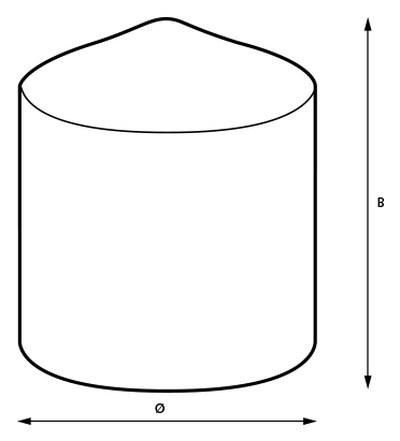
| Chain size | Ø | B |
|---|---|---|
| 12.5 mm | 10 | 6, 10 or 15 |
| 14–22 mm | 13, 14 or 15 | 17, 18 or 20 |
| 24–32 mm | 16 | 13 |
| 34–42 mm | 16 | 20 |
| 44–54 mm | 20 | 20 |
| 56–64 mm | 25 | 25 |
| 66–73 mm | 30 | 30 |
| 76 mm | 30 | 45 or 50 |
| 81–92 mm | 35 | 35 |
| 95–100 mm | 40 | 40 |
| 102–107 mm | 45 | 50 |
| 111–117 mm | 45 | 45 |
| 120–127 mm | 49 | 45 |
| 130–137 mm | 50 | 50 |
Where two or three sizes are listed for one chain size, match the plug to the recess in your shackle — makers’ recesses differ. All sizes are in our lead plug listing.
Common questions
- What is a Kenter shackle?
- A joining link for anchor chain made of two interlocking halves, a centre stud and a taper pin sealed with lead. It is the size of a common link, so it passes over the windlass.
- Which way does a Kenter taper pin come out?
- It is driven out from its narrow end towards its wide end.
- Can I reuse the lead plug?
- No. Fit a new lead plug every time the shackle is assembled.
- Can I mix parts from different Kenter shackles?
- Keep each shackle’s parts together; they are supplied as a matched set.
- Can a Kenter shackle join two chain sizes?
- Yes — Kenter shackles can be made with ends for two different chain diameters.
Kenter shackles and lead plugs
 IH-LR-AC-KSGU2U3Kenter Shackle — Grades U2 and U3
 IH-MR-AC-SKSSlim Kenter Joining Shackle
 IH-MR-AC-AKSAnchor Kenter Shackle — Grades R3 and R4
 IH-MR-AC-AKSHAnchor Kenter Shackle — Heavy-Duty Pattern
 IH-MR-AC-LPLLead Plug for Kenter and Joining Shackle Pins
 IH-MR-AC-CCSC-Type Joining Shackle (C-Connector)