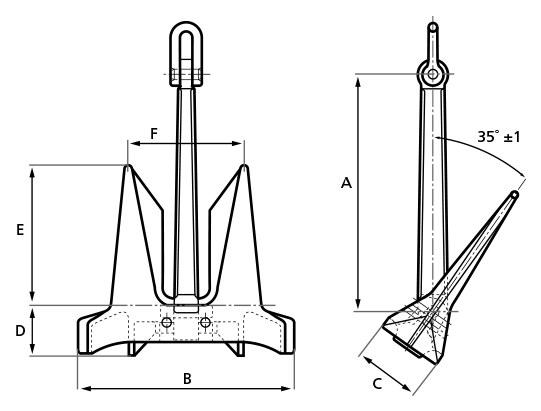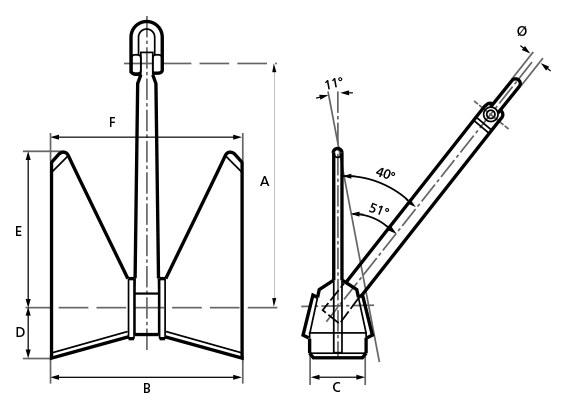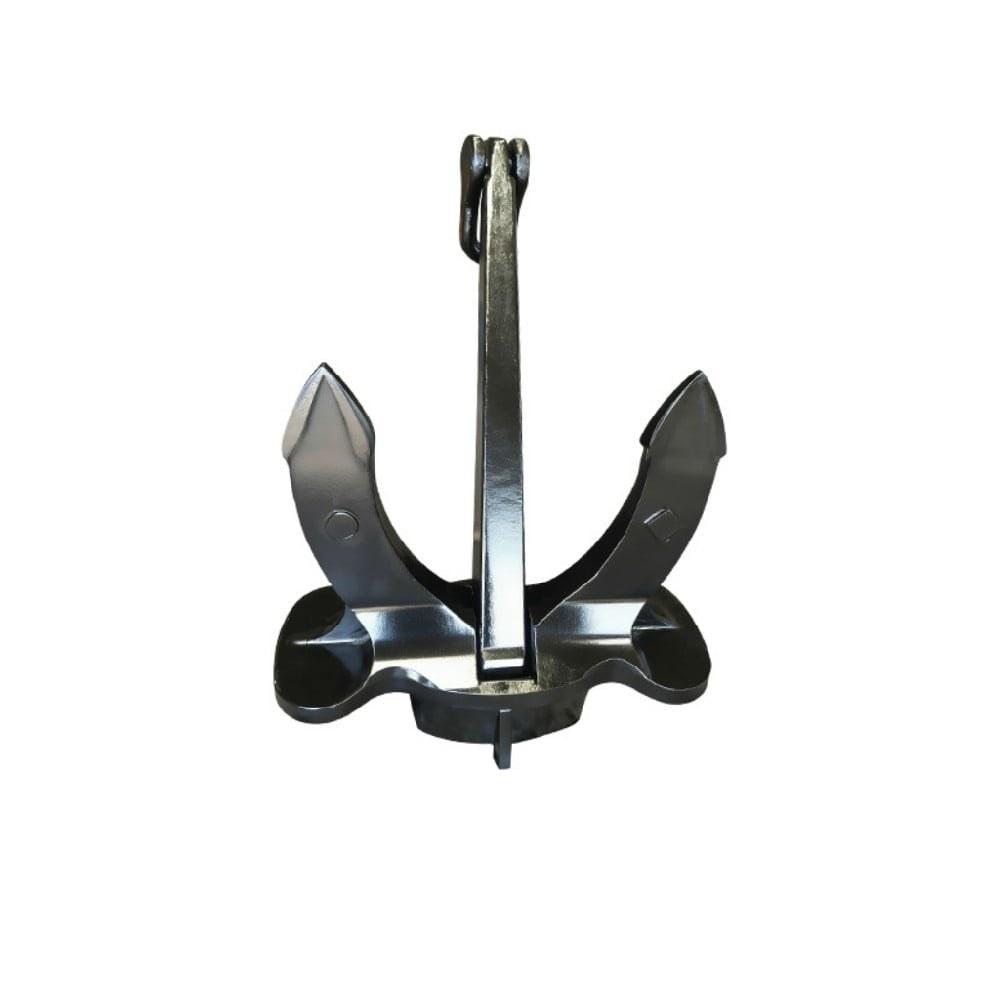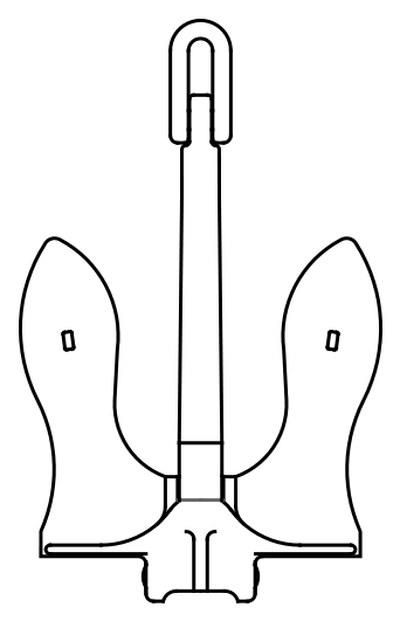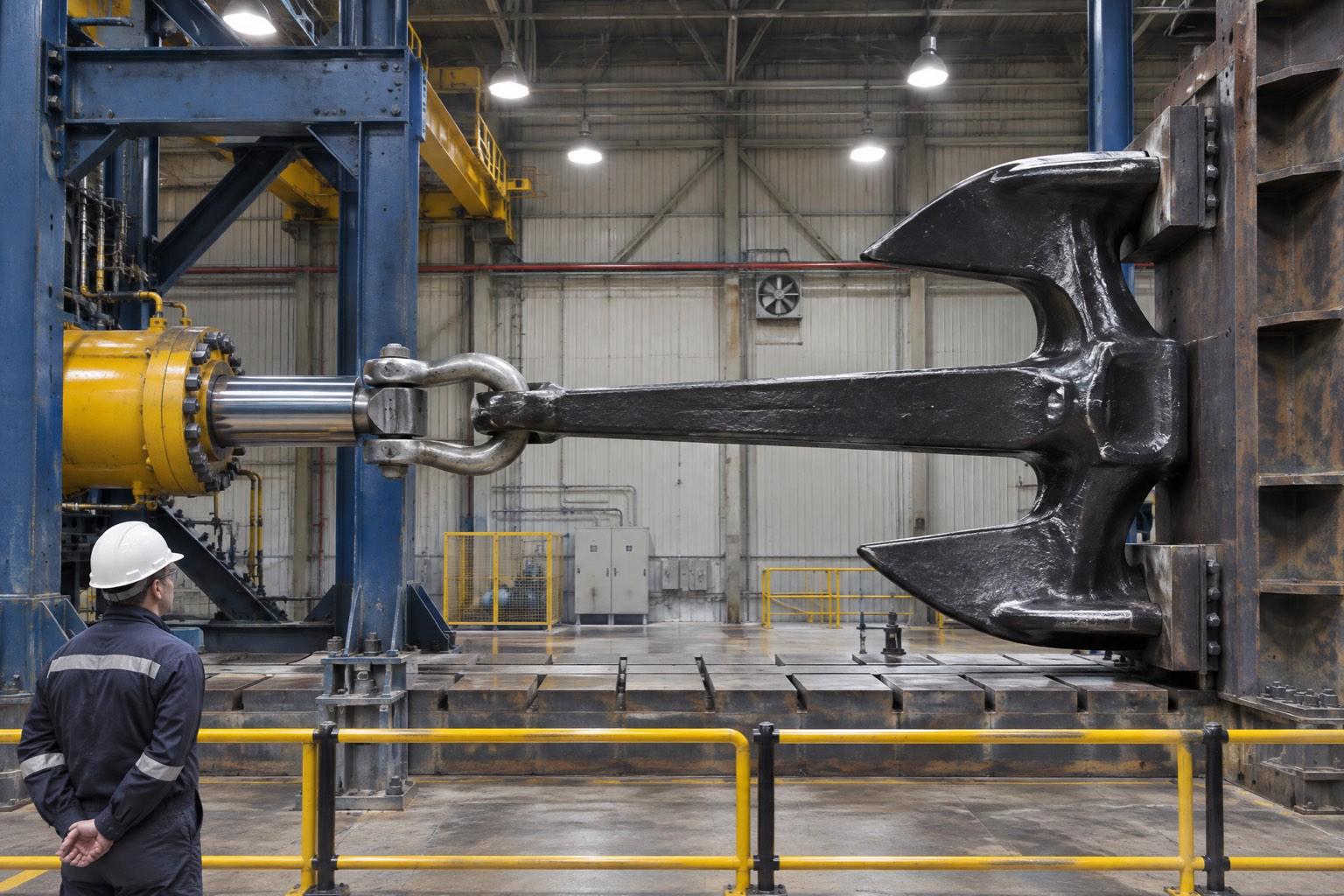
An anchor is a casting or fabrication that takes enormous loads at a single point — the shank, the crown and the flukes — and a hidden flaw in any of them would show up at the worst possible moment. So every anchor for a classed ship is proof tested before it leaves the works, and the load comes from a table keyed to the anchor’s mass.
/01Proof test loads.
Selected rows from a published proof-load table that follows the class rules. Read across from the anchor’s mass, or from the HHP column if it is a high-holding-power anchor. For a mass between rows, the classification society’s rules give the method.
| Ordinary anchor kg | HHP anchor kg | Proof test load kN |
|---|---|---|
| 50 | 38 | 23.2 |
| 75 | 56 | 32.4 |
| 100 | 75 | 39.1 |
| 140 | 105 | 49 |
| 200 | 150 | 61.3 |
| 250 | 188 | 70.4 |
| 300 | 226 | 79.5 |
| 400 | 301 | 97.9 |
| 500 | 376 | 116 |
| 600 | 451 | 132 |
| 700 | 526 | 149 |
| 800 | 602 | 166 |
| 900 | 677 | 182 |
| 1,000 | 752 | 199 |
| 1,200 | 902 | 231 |
| 1,400 | 1,053 | 262 |
| 1,600 | 1,203 | 292 |
| 1,800 | 1,353 | 321 |
| 2,000 | 1,504 | 349 |
| 2,500 | 1,880 | 414 |
| 3,000 | 2,256 | 474 |
| 3,500 | 2,632 | 528 |
| 4,000 | 3,008 | 577 |
| 4,500 | 3,383 | 622 |
| 5,000 | 3,759 | 661 |
| 6,000 | 4,511 | 735 |
| 7,000 | 5,263 | 804 |
| 8,000 | 6,015 | 877 |
| 9,000 | 6,767 | 949 |
| 10,000 | 7,519 | 1,010 |
| 12,000 | 9,023 | 1,110 |
| 14,000 | 10,526 | 1,210 |
| 16,000 | 12,030 | 1,300 |
| 18,000 | 13,534 | 1,410 |
| 20,000 | 15,038 | 1,520 |
| 22,000 | 16,541 | 1,620 |
| 24,000 | 18,045 | 1,720 |
| 26,000 | 19,549 | 1,800 |
| 28,000 | 21,053 | 1,900 |
| 30,000 | 22,556 | 1,990 |
| 34,000 | 25,564 | 2,160 |
| 38,000 | 28,571 | 2,330 |
| 42,000 | 31,579 | 2,490 |
| 46,000 | 34,586 | 2,650 |
| 48,000 | 36,090 | 2,730 |
/02HHP anchors are tested harder.
A high-holding-power anchor holds more per kilogram than an ordinary stockless anchor, which is why the rules let a ship carry an HHP anchor of 75% of the ordinary mass — see the equipment table. The proof test keeps pace: the HHP anchor is proved at the load of the heavier ordinary anchor it replaces. A 2,256 kg HHP anchor, for example, is proved at 474 kN — the load for a 3,000 kg ordinary anchor. Our AC-14, HY-14 and TW pool anchors are HHP types.
/03What the test proves.
The proof test is made in the presence of the class surveyor. The classification rules set where the load is applied and how the anchor is examined afterwards. A pass shows:
- the anchor carried its proof load without breaking;
- it shows no cracks and no permanent deformation beyond the rules’ limits afterwards.
It does not measure holding power in the seabed — that depends on the anchor’s design and the soil — and it does not rate the chain or shackle attached to it. The anchor shackle is tested with the chain it belongs to: see anchor chain testing. The same idea for lifting gear is in proof load testing of lifting gear.
/04Checking the certificate.
When an anchor arrives, check that its certificate shows:
- the anchor type and whether it is approved as HHP;
- its mass, matching the mass cast or stamped on the anchor;
- the proof load applied, matching the table for that mass;
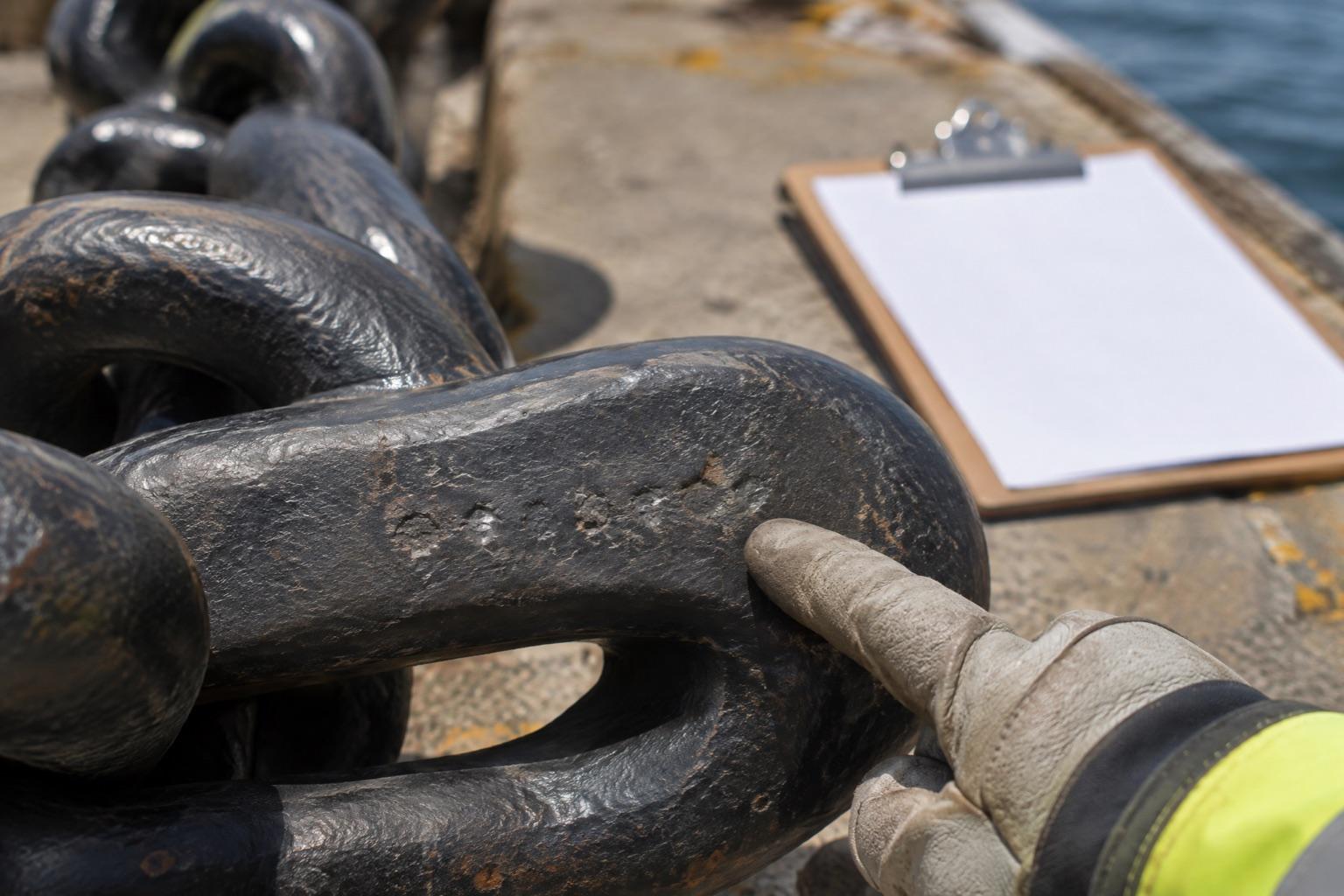
- the classification society and surveyor, and the identification marks on the anchor.
More on class documents in chain marks and class certificates.
Common questions
- Is every ship anchor proof tested?
- Anchors for classed ships are proof tested before certification, in the presence of the class surveyor.
- What is the proof load for a 3,000 kg anchor?
- 474 kN.
- Why does an HHP anchor have a higher proof load for its mass?
- Because the rules let it replace an ordinary anchor a third heavier, it is proved at that heavier anchor’s load.
- Does the proof test measure holding power?
- No. It proves the anchor’s strength. Holding power depends on its design and the seabed.
- What about offshore drag anchors?
- Offshore drag embedment anchors are sized by mooring analysis and certified to their own class requirements; this table is for ships’ anchors.