A well test answers the questions a field development depends on — how much the well will flow, of what, at what pressure — and it does so with a temporary plant built on the wellsite or rig deck. The spread is assembled from skid-mounted units joined by high-pressure flow iron, and each unit has one job. This guide follows the fluid from the wellhead to the flare.
/01The spread, in order.
| Unit | What it does |
|---|---|
| Flowhead and SSV, ESD panelHighlighted | Control the well at surface; the SSV closes it automatically on an ESD trip |
| Data header | Ports for pressure and temperature gauges, sampling and chemical injection |
| Sand filter | Removes produced sand before it erodes the choke and separator |
| Desander or debris catcher | Spins out heavy sand loads (cyclone) or screens out plug and milling debris (catcher) ahead of the choke manifold |
| Choke manifold | Controls flow rate; one adjustable choke can be isolated for repair while the other runs |
| Heater | Warms the stream to prevent hydrates, reduce viscosity and break emulsions |
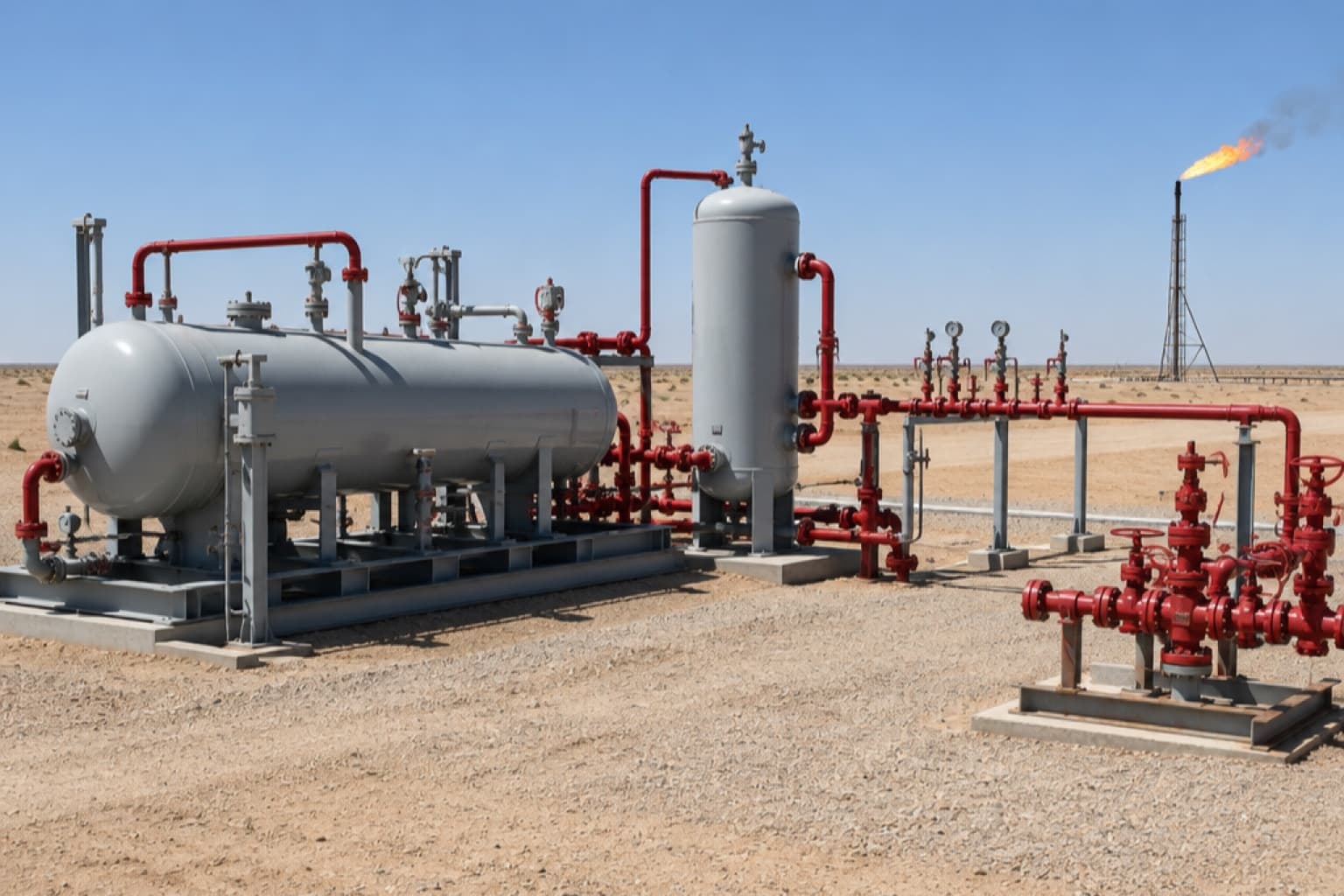
| Three-phase separator | Splits oil, gas and water by gravity and meters each phase |
| Surge tank | Absorbs pressure surges; oil shrinkage is measured here |
| Transfer pump | Moves separated oil to storage, a pipeline or the burner |
| Flare or burner | Disposes of produced gas, and liquids that cannot be stored |
SLB’s description of the chain: the separator sits downstream of the choke manifold that controls flow at surface; the heater is placed upstream of the separator; the surge tank downstream of it; and the burner downstream of the surge tank disposes of the gas. The data header and sand filter usually go upstream of the choke, close to the well, where pressure is highest. On knock-out drums ahead of the flare, liquid carried over with the gas is caught before it reaches the flame.
For the flowhead, SSV and ESD system, see surface safety valves and ESD; for the iron that joins the units, flow iron.
After a frac or a plug mill-out the stream carries more solids than a sand filter is meant for. A cyclonic desander spins sand out of the flow; Hunting places its unit upstream of the choke manifold for well testing, frac flowback and clean-up, and claims it handles a wider range of particle sizes and larger volumes of solids than sand filters, with dual pots so sand can be dumped while the other pot stays on line. A debris or plug catcher takes out larger pieces — bridge-plug fragments and milling debris — upstream of the sand separator or choke manifold, with a bypass so the screen can be isolated, depressurised and the debris measured. We list a cyclone desander, a double-barrel screen desander and a dual-channel debris catcher, rated 5,000 to 20,000 psi.
/02Ratings and codes.
Equipment upstream of the choke sees full well pressure; equipment downstream sees the separator’s working pressure. In SLB’s compact well test system, for example, the SSV and flowhead are rated 10,000 psi to API 6A PSL 3 PR2, the separator 1,440 psi to ASME Section VIII Division 2, and the vertical surge tank 150 psi.
- ASME stamps: U is a Section VIII Division 1 pressure vessel, U2 Division 2 (alternative rules), U3 Division 3 (high pressure).
- DNV 2.7-1 is applied to the skids and frames of separators and tanks lifted offshore; SLB applies DNV 2.7-3 to portable units such as SSVs, flowheads and pumps.
- NACE MR0175 / ISO 15156 materials are needed wherever the well may produce H₂S.
/03Multiphase meters.
A multiphase flow meter measures oil, gas and water rates without separating the stream — SLB’s PhaseTester combines a venturi with a dual-energy gamma-ray detector. It is typically installed close to the wellhead, upstream of the separator, and lets the well be measured during clean-up, when a separator cannot yet be put on line; SLB notes clean-up can otherwise take two to three days of progressive choke adjustments.
Common questions
- What equipment is in a well testing spread?
- Typically a flowhead and SSV with an ESD panel, data header, sand filter, choke manifold, heater, three-phase separator, surge tank, transfer pump and flare or burner, joined by flow iron.
- What does a three-phase test separator do?
- It separates the well stream into oil, gas and water by gravity and density, and meters each phase as it leaves the vessel.
- What is a surge tank for?
- It takes liquid from the separator, absorbs pressure surges, and lets oil shrinkage be measured as gas leaves solution.
- What is the difference between ASME U and U2?
- U marks a vessel built to ASME Section VIII Division 1; U2 to Division 2, the alternative rules.
- Where does a multiphase meter go?
- Usually near the wellhead, upstream of the separator; it measures without separating the phases.
What we list
Well testing equipment:
- 3-Phase Well-Test Separator, 1,440 psi, 60-in OD × 15-ft, ASME U, NACE MR-0175, DNV Skid
- Well-Testing Surge Tank, Dual-Compartment, 100 BBL, 600 psi, ASME U, DNV Skid
- Knock Out Drum, 720 psi, 60-in OD × 12-ft, ASME U, NACE MR-0175
- Sand Filter, Dual-Pot Vertical, 10,000 psi, ASME U2, SS316 Sintered, DNV Frame
- Cyclone Desander, 5,000 to 20,000 psi
- Debris Catcher, Dual Channel, 5,000 to 20,000 psi
- Double Barrel Screen Desander, 5,000 to 20,000 psi
- Data Header, 2-1/16" to 5-1/8", 2,000 to 20,000 psi
- Data Header, 4-Port ACLV + 4-Port NPT, Isolation + Thermowells + Gauges
- MPFM System, Skid-Mounted, Roxar-Emerson Compact, Upstream + Downstream Piping
- Well-Test Transfer Pump, Centrifugal Single-Stage, 100 m³/h, Diesel Drive, Skid-Mounted
- Flush / Test Pump, Reciprocating 150 HP, 10,000 psi, Skid + Chart Recorder
- Well-Testing Piping Package, 1502 Series, 15,000 psi, NACE MR-0175, X-Ray + PWHT
- Flare Stack, Trailer-Mounted, Hydraulic Deployment, Piezo Ignition, 60-ft, Tri-Heads Green
- ESD Panel, Single-SSV Control, SS316, Haskel + Maximator, 3 Remote Stations
Well testing equipment
- IH-3PS-1440-60X15-DNV3-Phase Well-Test Separator, 1,440 psi, 60-in OD × 15-ft, ASME U, NACE MR-0175, DNV SkidIndus Hydraulics
- IH-WTS-DC100-600-DNVWell-Testing Surge Tank, Dual-Compartment, 100 BBL, 600 psi, ASME U, DNV SkidIndus Hydraulics
- IH-SFL-DP-10K-SS316-DNVSand Filter, Dual-Pot Vertical, 10,000 psi, ASME U2, SS316 Sintered, DNV FrameIndus Hydraulics
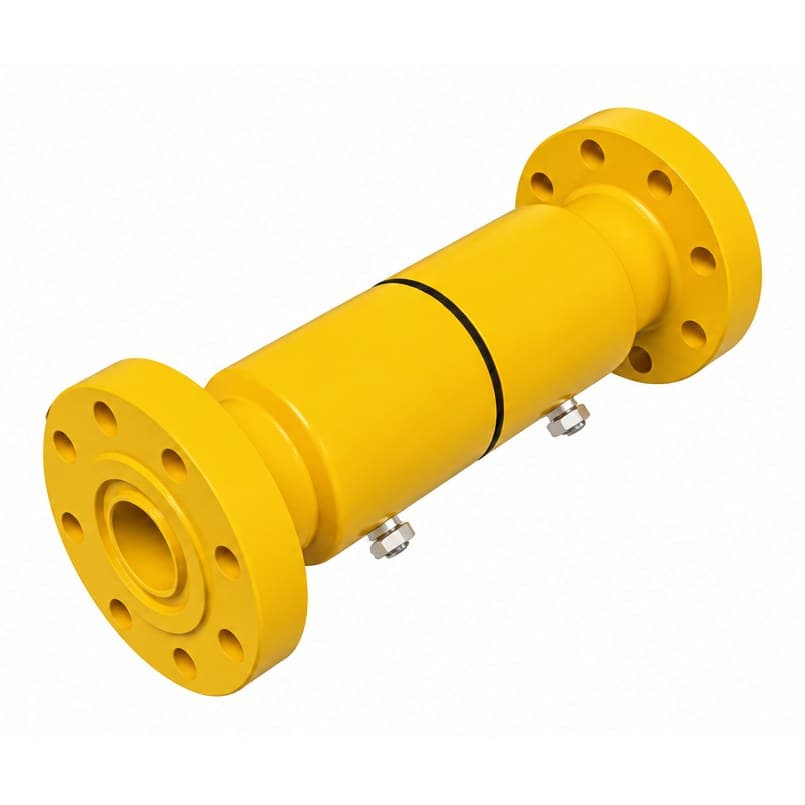 IH-OFE-DHDData Header, 2-1/16" to 5-1/8", 2,000 to 20,000 psiIndus Hydraulics
- IH-MPFM-SKD-RXE-CMPCTMPFM System, Skid-Mounted, Roxar-Emerson Compact, Upstream + Downstream PipingIndus Hydraulics
- IH-FLS-TRL-HYD-60-TRIFlare Stack, Trailer-Mounted, Hydraulic Deployment, Piezo Ignition, 60-ft, Tri-Heads GreenIndus Hydraulics
- IH-ESD-1SSV-SS316-3RESD Panel, Single-SSV Control, SS316, Haskel + Maximator, 3 Remote StationsIndus Hydraulics
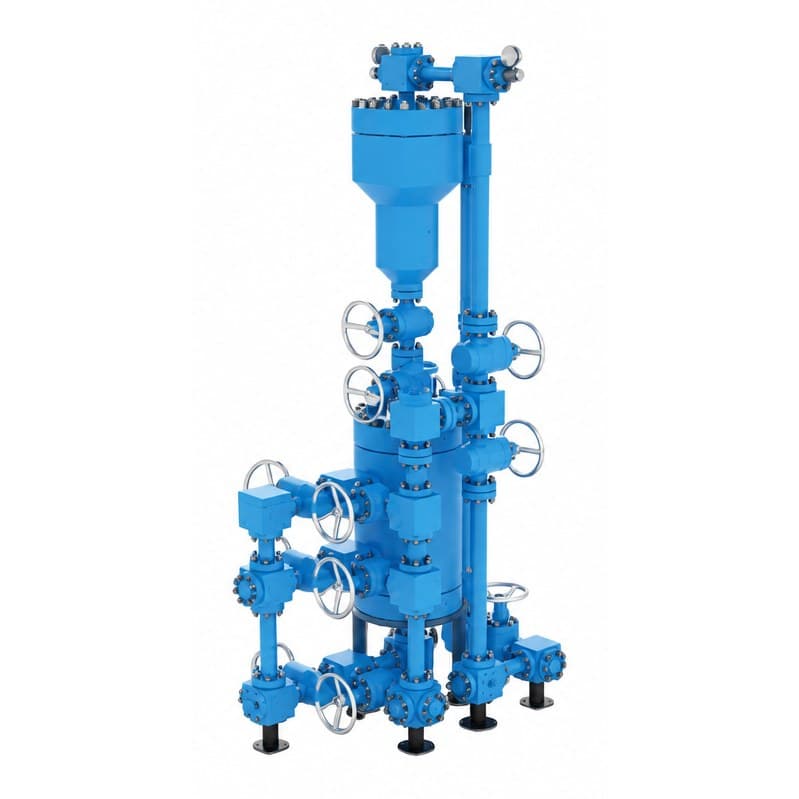 IH-OFE-CYDCyclone Desander, 5,000 to 20,000 psiIndus Hydraulics