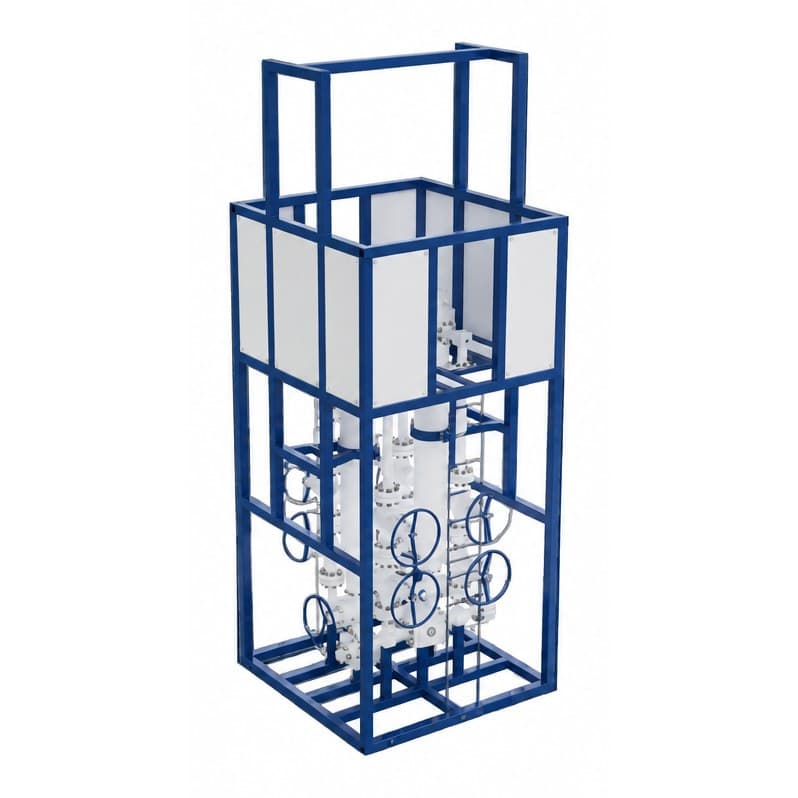
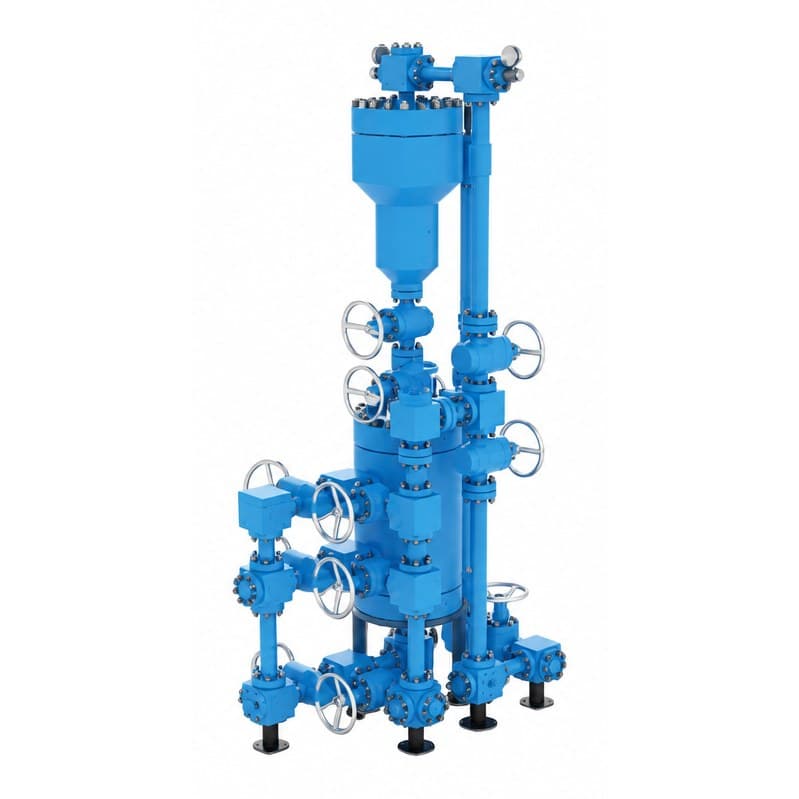
Debris Catcher, Dual Channel, 5,000 to 20,000 psi
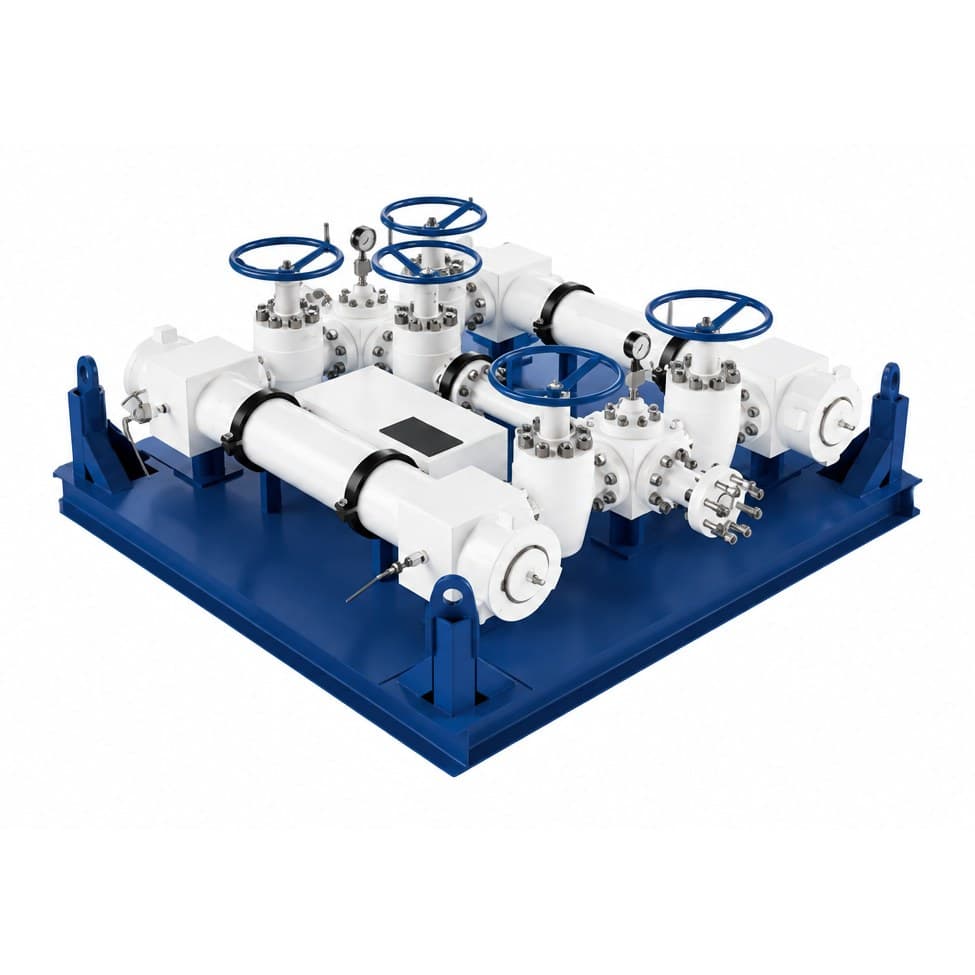
Dual-channel debris catchers for gas testing and coiled-tubing milling: 5,000 to 20,000 psi, 2-1/16" to 4-1/16" ports, switchable filters, quick unions, instant pressure relief.
Key features
- Valve type: Debris catcher, dual channel
- Construction: Two switchable filter channels with relief
- Design standard: API 6A (21st edition)
- Size range: 2-1/16" to 4-1/16" main and bypass ports
- Pressure class: 5,000 to 20,000 psi working pressure
- Body material: API 6A material classes AA to HH (DD to HH for sour service)
- End connections: Hammer union or flanged
- Operation: Manual valves
- Valve type
- Debris catcher, dual channel
- Design standard
- API 6A (21st edition)
- Pressure class
- 5,000 to 20,000 psi working pressure
- End connections
- Hammer union or flanged
- Operation
- Manual valves
Product description
Catches bridge-plug pieces and milling cuttings from the well before they block lines, cut through pipe or wreck chokes and control valves downstream. Two filter channels let one be cleaned while the other stays on line.
Pressure-control and well-service equipment is the hardware between the well and everything downstream: it holds and directs well pressure while drilling, testing, stimulating and producing. Each piece is built to API 6A, 16A or 16C for its working pressure, temperature class and material class, with sour-service materials to NACE MR0175 / ISO 15156 where the well needs them.
Construction
- Dual-channel filter: switch over and clean at any time
- Quick-union connections for fast disassembly
- Instant pressure-relief device before filter removal
- Compact skid; large capacity; easy cleaning
Sizes and ratings
Published range: 2-1/16" to 4-1/16" main and bypass ports, 5,000 to 20,000 psi working pressure, in api 6a material classes aa to hh (dd to hh for sour service). End connections: Hammer union or flanged. Operation: manual valves.
Each unit is configured to the job; the general arrangement drawing and data book index come with the quotation.
Testing and documents
Hydrostatic tests to API 6A / 16A / 16C at the PSL ordered, with function tests of valves and controls, with the material certificates and the pressure-test record supplied with the equipment. Third-party inspection and extra tests are added when the order specifies them.
Supply
Debris catchers are supplied from Dubai to projects, plants and maintenance teams across the GCC, the wider Middle East and Africa. Most are built to the order specification, so delivery depends on size, class, material and operator; standard carbon-steel sizes move fastest. We review the data sheet before quoting and flag anything that needs clarifying, such as a missing pipe schedule or an operator torque that has not been sized.
Related valves
Other desanders and debris catchers in the range, for comparison when the duty is not settled yet: Double Barrel Screen Desander, 5,000 to 20,000 psi, Cyclone Desander, 5,000 to 20,000 psi.
Materials
| Parameter | Value |
|---|---|
| Body material | API 6A material classes AA to HH (DD to HH for sour service) |
| Seat and trim | PSL 1 to 3G; PR1 |
Range
| Parameter | Value |
|---|---|
| Temperature range | -60 °C to 121 °C (K to V) |
| Size range | 2-1/16" to 4-1/16" main and bypass ports |
| Pressure class | 5,000 to 20,000 psi working pressure |
Identification
| Parameter | Value |
|---|---|
| Valve type | Debris catcher, dual channel |
| Construction | Two switchable filter channels with relief |
Standards
| Parameter | Value |
|---|---|
| Design standard | API 6A (21st edition) |
| Pressure testing | Hydrostatic tests to API 6A / 16A / 16C at the PSL ordered, with function tests of valves and controls |
Construction
| Parameter | Value |
|---|---|
| End connections | Hammer union or flanged |
| Operation | Manual valves |
Application
| Parameter | Value |
|---|---|
| Typical service | Plug mill-out, coiled tubing, flowback and gas testing |
Supply
| Parameter | Value |
|---|---|
| Supply | Built to order and supplied from Dubai with the documentation and test record |
Shipping & lead time
What is a dual-channel debris catcher used for?▾
What do PSL 1 to 3G and PR1 mean on a debris catcher?▾
What sizes and pressure ratings does the dual-channel debris catcher come in?▾
Why does a dual-channel debris catcher have two filter channels?▾
How is the dual-channel debris catcher tested?▾
Which material and temperature classes does the dual-channel debris catcher offer?▾
Is the dual-channel debris catcher to API specification, and what documents are supplied?▾
How is the dual-channel debris catcher operated?▾
How do I clean a dual-channel debris catcher safely?▾
Debris catcher or desander: which do I need for plug mill-out?▾
Can the dual-channel debris catcher be supplied from Dubai with test records?▾
Do you stock the dual-channel debris catcher in Dubai?▾
Shipped worldwide from our Dubai warehouse. Transit, routes and documentation for 136 destinations
From the blog