Small-bore stainless piping — drains, vents, instrument take-offs, utility water and air, chemical dosing — is mostly threaded or socket-welded rather than butt-welded. The fittings look alike on a shelf, and buyers often order "1" stainless elbow, NPT" without saying which kind. This guide sets out the two threaded families, the socket-weld option, nipples, and how each is rated.
/01Cast Class 150: MSS SP-114.
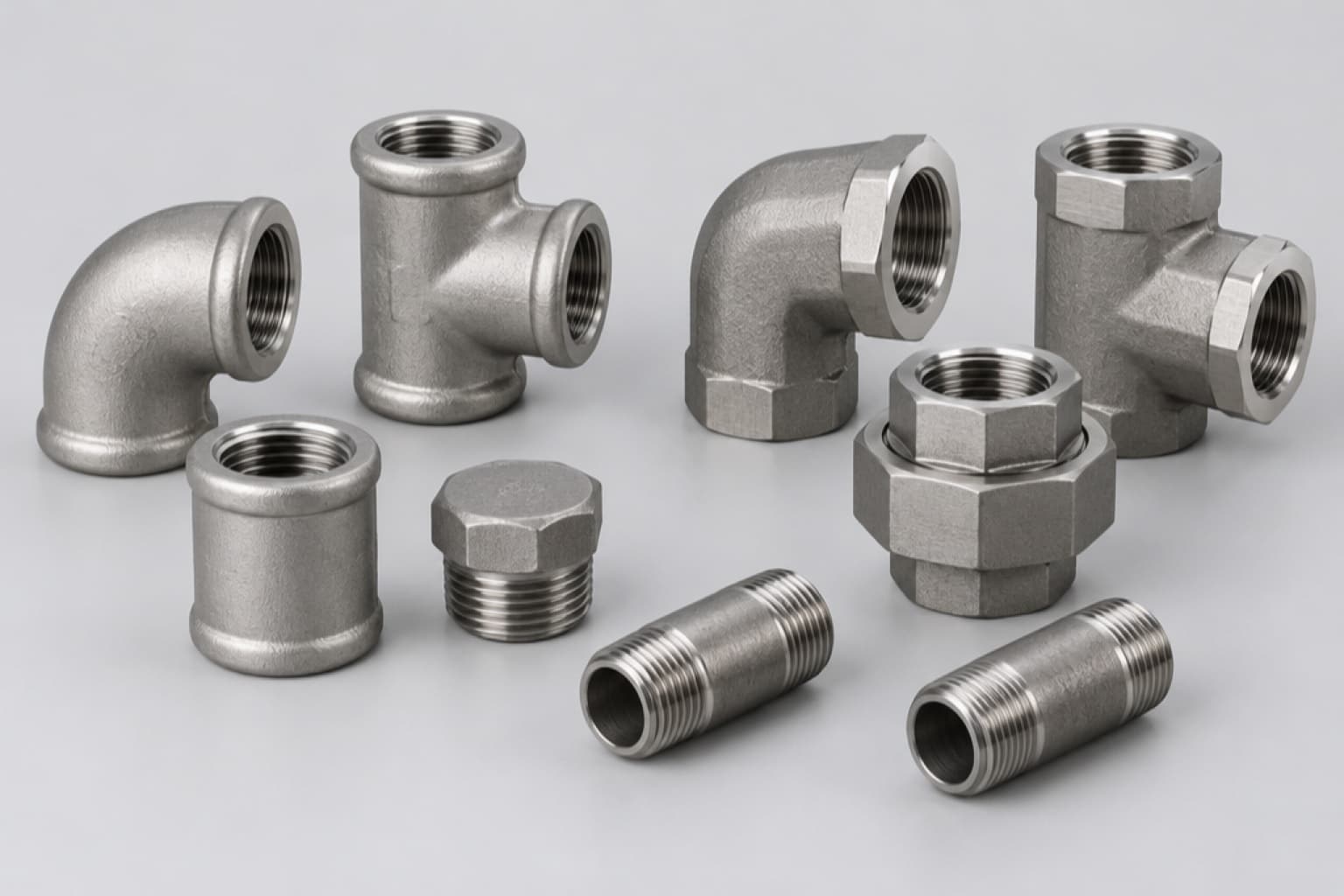
The economical stainless threaded fitting is a casting — ASTM A351 CF8 (the cast equivalent of 304) or CF8M (316, with 2–3% molybdenum) — machined with NPT threads to ASME B1.20.1. The standard is MSS SP-114, "Corrosion Resistant Pipe Fittings, Threaded and Socket-Welding, Class 150 and 1000". You can usually tell a cast fitting by its rounded body and beaded band at each end.
Class 150 is a pressure–temperature rating, not a pressure. A fitting maker’s table reproducing SP-114 for heavy-pattern cast 304 and 316 gives:
| Material temperature | Maximum working pressure |
|---|---|
| −20 to 150 °F (−28 to 65 °C)Highlighted | 300 psi (20.6 bar) |
| 200 °F (93 °C) | 265 psi (18.2 bar) |
| 250 °F (121 °C) | 225 psi (15.5 bar) |
| 300 °F (148 °C) | 185 psi (12.8 bar) |
| 350 °F (176 °C) | 150 psi (10.3 bar) |
The same table assumes the material is at the fluid temperature and allows interpolation between rows. One consequence worth noting: saturated steam at 150 psig is about 366 °F — beyond the table’s last row — so "150# for 150 psi steam" is not something this table supports. Ask the fitting maker for its own steam rating, or use forged fittings. Use cast 150# for water, air, low-pressure chemicals and process utilities; not for shock, vibration or cyclic service.
/02Forged Class 3000: ASME B16.11.
Where pressure, vibration or the piping class demand more, the fitting is forged — ASTM A182 F304/F316 bar or forgings — and dimensioned to ASME B16.11. B16.11 rates threaded fittings in Classes 2000, 3000 and 6000 and socket-weld fittings in Classes 3000, 6000 and 9000. The class says which pipe the fitting is built to match:
| Class | Threaded fitting matches | Socket-weld fitting matches |
|---|---|---|
| 2000 | Sch 80 / XS | — |
| 3000Highlighted | Sch 160 | Sch 80 / XS |
| 6000 | XXS | Sch 160 |
| 9000 | — | XXS |
That is the trap: Class 3000 threaded is matched to Sch 160 pipe, because the thread cuts into the wall, while Class 3000 socket weld is matched to Sch 80. A forged fitting is rated as the pipe it matches, so its working pressure comes from the pipe rating for that schedule, grade and temperature — which is why our forged listings carry no single psi figure. Class 3000 threaded fittings are made from ½" to 2" (Class 2000 to 4"); socket-weld fittings are generally used at NPS 2 and below.
Forged Fittings, Socket-Welding and Threaded
Ratings, dimensions, tolerances, marking and material requirements for forged fittings: Class 2000, 3000 and 6000 for threaded ends and Class 3000, 6000 and 9000 for socket-weld ends.
/03Socket weld: leave the gap.
The rule, attributed to the ASME B31 piping codes, is an expansion gap of about 1/16" (1.6 mm) between pipe end and socket shoulder — a nominal clearance, not a precise tolerance. Socket weld leaves a small crevice behind the pipe end, which is why hygienic and some corrosive services avoid it in favour of butt welds.
/04Sealing stainless NPT without galling it.
NPT (ASME B1.20.1) is a 60° thread on a 1°47′ taper — 1 in 16 on diameter — and it seals on the thread itself, so it always needs a sealant. Swagelok makes the second reason explicit: sealant reduces the potential for galling, and two stainless threads forced together dry can cold-weld and seize. PTFE tape or a PTFE paste does both jobs. There is no standard torque or turn count for tapered threads, so stop at a firm make-up rather than chasing one more turn; a stainless thread that has started to bind is about to gall.
/05Pipe nipples.
A nipple is a short length of pipe threaded at both ends. ASTM A733 covers welded and seamless stainless nipples from 1/8" to 12" with NPT threads both ends. A "close" nipple is threaded along its whole length with no plain pipe between the threads. Order the schedule as well as the size — a Sch 80 seamless nipple is the match for Class 3000 forged fittings and for anything vibrating; welded Sch 40 suits general low-pressure work — and hex nipples where the joint must be made up with a spanner.
Cast 150#, forged 3000# or socket weld?
IfWater, air or mild chemicals, below ~150 psi, no shock?
Cast 150# threaded fittings.
IH-PF-C90-B6IfHigher pressure, vibration, or a piping class that calls for B16.11?
Forged 3000# threaded fittings on Sch 80 or heavier nipples.
IH-PF-F90-J6IfMust not leak through a thread, small bore, weld allowed?
Socket-weld fittings, with the 1/16" gap.
IfHygienic or crevice-sensitive service?
Neither — use butt-weld or sanitary fittings.
Common questions
- What is the difference between 150# and 3000# stainless fittings?
- 150# fittings are cast (MSS SP-114) for moderate pressure; a maker table gives 300 psi at room temperature falling to 150 psi at 350 °F. 3000# fittings are forged to ASME B16.11 and rated to match Sch 160 pipe (threaded) or Sch 80 (socket weld).
- What pressure is a 3000# threaded fitting rated for?
- B16.11 rates it to the pipe it matches — Sch 160 for a threaded Class 3000 fitting — at the grade and temperature in service. The pipe rating gives the figure.
- Can I use 150# cast stainless fittings on steam?
- Only within the maker’s rating. The SP-114 Class 150 table reproduced by one maker ends at 150 psi at 350 °F, which is below the temperature of 150 psi saturated steam; ask for the maker’s steam rating or use forged fittings.
- Why leave a gap in a socket weld?
- To give the fillet weld room to shrink as it cools. A pipe bottomed in the socket can crack the weld root. About 1/16" (1.6 mm) is the usual clearance.
- How do I stop stainless NPT threads galling?
- Always use a sealant that also lubricates — PTFE tape or paste — and stop at a firm make-up. Dry stainless threads forced together can cold-weld.
- What is a close nipple?
- A nipple threaded along its full length with no plain pipe between the threads — the shortest nipple for a given size.
What we list
Cast 150# and forged 3000# threaded fittings in 304 and 316, and stainless pipe nipples:
- 304 Stainless Steel 150# Cast Threaded 45° Elbow
- 316 Stainless Steel 150# Cast Threaded 45° Elbow
- 304 Stainless Steel 150# Cast Threaded 90° Elbow
- 316 Stainless Steel 150# Cast Threaded 90° Elbow
- 304 Stainless Steel 150# Cast Threaded Cap
- 316 Stainless Steel 150# Cast Threaded Cap
- 304 Stainless Steel 150# Cast Threaded Full Coupling
- 316 Stainless Steel 150# Cast Threaded Full Coupling
- 304 Stainless Steel 150# Cast Threaded Half Coupling
- 316 Stainless Steel 150# Cast Threaded Half Coupling
- 304 Stainless Steel 150# Cast Threaded Hex Reducing Bushing
- 316 Stainless Steel 150# Cast Threaded Hex Reducing Bushing
- 304 Stainless Steel 150# Cast Threaded Hex Head Plug
- 316 Stainless Steel 150# Cast Threaded Hex Head Plug
- 304 Stainless Steel 150# Cast Threaded Square Head Plug
- 316 Stainless Steel 150# Cast Threaded Square Head Plug
- 304 Stainless Steel 150# Cast Threaded Reducing Coupling
- 316 Stainless Steel 150# Cast Threaded Reducing Coupling
- 304 Stainless Steel 150# Cast Threaded 90° Street Elbow
- 316 Stainless Steel 150# Cast Threaded 90° Street Elbow
- 304 Stainless Steel 150# Cast Threaded Tee
- 316 Stainless Steel 150# Cast Threaded Tee
- 304 Stainless Steel 150# Cast Threaded Union
- 316 Stainless Steel 150# Cast Threaded Union
- 304 Stainless Steel 150# Cast Threaded Cross
- 316 Stainless Steel 150# Cast Threaded Cross
- 304 Stainless Steel 3000# Forged Threaded 45° Elbow
- 316 Stainless Steel 3000# Forged Threaded 45° Elbow
- 304 Stainless Steel 3000# Forged Threaded 90° Elbow
- 316 Stainless Steel 3000# Forged Threaded 90° Elbow
- 304 Stainless Steel 3000# Forged Threaded Cap
- 316 Stainless Steel 3000# Forged Threaded Cap
- 304 Stainless Steel 3000# Forged Threaded Full Coupling
- 316 Stainless Steel 3000# Forged Threaded Full Coupling
- 304 Stainless Steel 3000# Forged Threaded Half Coupling
- 316 Stainless Steel 3000# Forged Threaded Half Coupling
- 316 Stainless Steel 3000# Forged Threaded Hex Head Plug
- 304 Stainless Steel 3000# Forged Threaded Hex Reducing Bushing
- 316 Stainless Steel 3000# Forged Threaded Hex Reducing Bushing
- 304 Stainless Steel 3000# Forged Threaded Reducing Coupling
- 316 Stainless Steel 3000# Forged Threaded Reducing Coupling
- 304 Stainless Steel 3000# Forged Threaded 90° Street Elbow
- 316 Stainless Steel 3000# Forged Threaded 90° Street Elbow
- 304 Stainless Steel 3000# Forged Threaded Tee
- 316 Stainless Steel 3000# Forged Threaded Tee
- 304 Stainless Steel 3000# Forged Threaded Union
- 316 Stainless Steel 3000# Forged Threaded Union
- 304 Stainless Steel 3000# Forged Threaded Cross
- 316 Stainless Steel 3000# Forged Threaded Cross
- 304 Stainless Steel NPT Reducing Hex Nipple
- 304 Stainless Steel NPT Pipe Nipple, Sch 80 Seamless
- 304 Stainless Steel NPT Pipe Nipple, Sch 40 Welded
- 316 Stainless Steel NPT Hex Nipple
- 316 Stainless Steel NPT Reducing Hex Nipple
- 316 Stainless Steel NPT Pipe Nipple, Sch 80 Seamless
- 316 Stainless Steel NPT Pipe Nipple, Sch 40 Welded
Threaded fittings and nipples
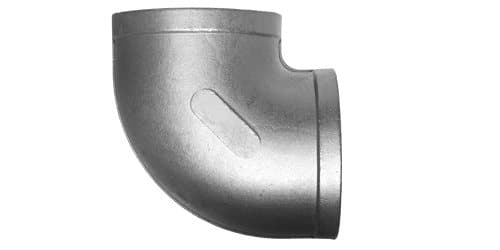 IH-PF-C90-B6316 Stainless Steel 150# Cast Threaded 90° ElbowIndus Hydraulics
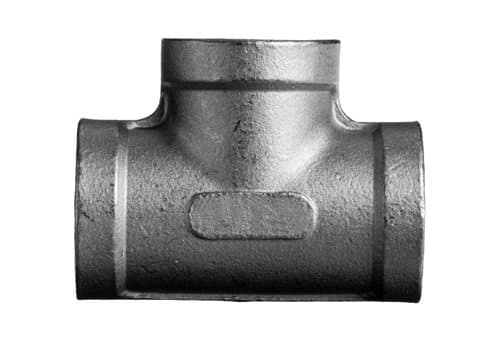 IH-PF-CT-B6316 Stainless Steel 150# Cast Threaded TeeIndus Hydraulics
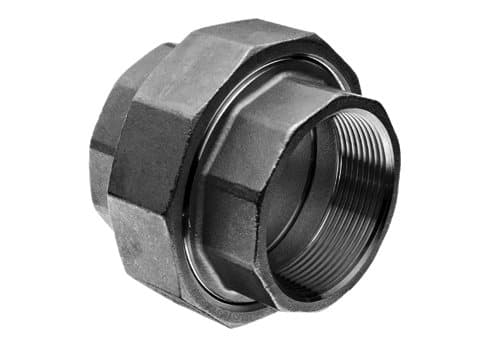 IH-PF-CU-B6316 Stainless Steel 150# Cast Threaded UnionIndus Hydraulics
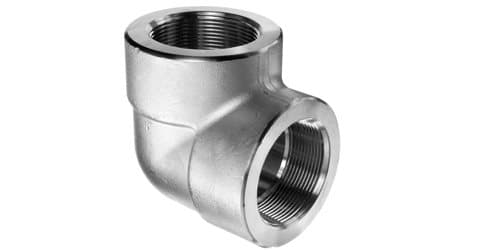 IH-PF-F90-J6316 Stainless Steel 3000# Forged Threaded 90° ElbowIndus Hydraulics
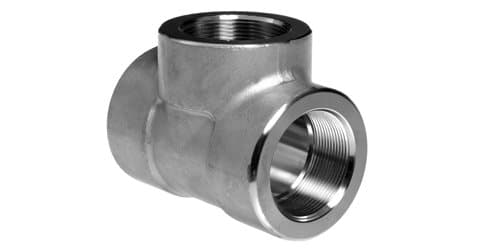 IH-PF-FT-J6316 Stainless Steel 3000# Forged Threaded TeeIndus Hydraulics
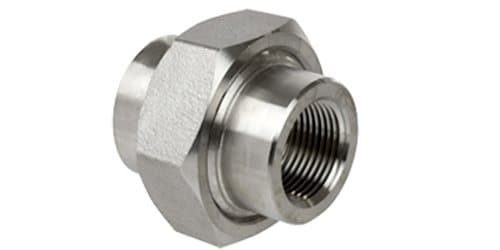 IH-PF-FU-J6316 Stainless Steel 3000# Forged Threaded UnionIndus Hydraulics
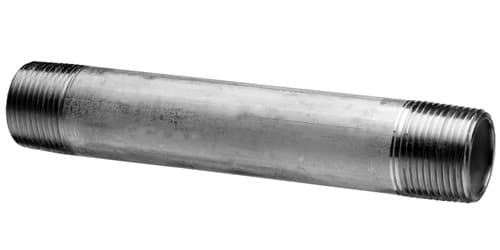 IH-PF-N6S8316 Stainless Steel NPT Pipe Nipple, Sch 80 SeamlessIndus Hydraulics
 IH-PF-N6H316 Stainless Steel NPT Hex NippleIndus Hydraulics
Sources
- 1.ASME B16.11 — Forged Fittings, Socket-Welding and Threaded, scope. ↗
- 2.MSS SP-114 — Corrosion Resistant Pipe Fittings, Threaded and Socket-Welding, Class 150 and 1000. ↗
- 3.Wermac. Threaded fittings to ASME B16.11. ↗
- 4.Wermac. Socket-weld fittings to ASME B16.11. ↗
- 5.ASTM A733 — Welded and Seamless Carbon Steel and Austenitic Stainless Steel Pipe Nipples. ↗
- 6.Swagelok. Thread and End Connection Identification Guide, MS-13-77. ↗