Metal-to-metal seats are unforgiving in stainless: a slightly harder tube, a scratched cone or a little vibration, and a 37° flare starts to weep. The two O-ring connections — ORFS on the tube side and ORB at the port — take that job away from the metal. This guide covers how both seal, how they are rated in 316, and the assembly details that keep them dry.
/01O-ring face seal.
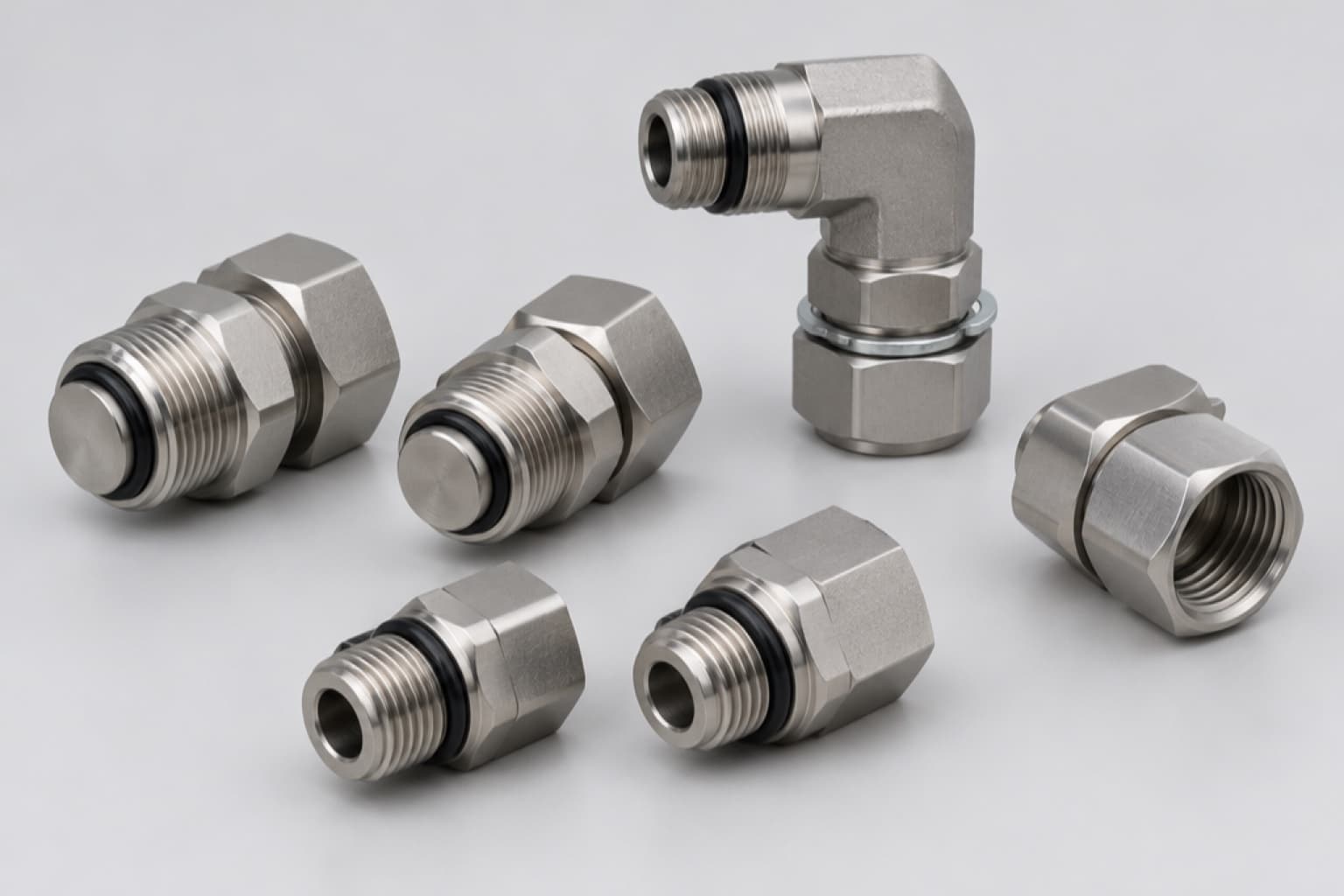
An ORFS connection is a nut, a body, an O-ring and a sleeve. The O-ring sits in a captive groove in the flat face of the male body; the tube end is either flanged to 90° or brazed to a sleeve, and the nut draws that flat sleeve face onto the O-ring. The seal is the O-ring, not the metal, which is why Parker describes the design as leak-free and why ORFS is the usual choice where vibration or high pressure defeats a flare. Parker requires a Seal-Lok connection to withstand 200% of its rated torque, so it tolerates over-tightening better than most.
| Dash | Tube OD | Steel | 316 stainless |
|---|---|---|---|
| -4, -6, -8Highlighted | 1/4"–1/2" | 9,200 | 9,200 |
| -10 to -20 | 5/8"–1 1/4" | 6,000 | 6,000 |
| -24 | 1 1/2" | 5,000 | 5,000 |
| -32 | 2" | 3,000 | 3,000 |
| Dash | Tube OD | Nut thread | Torque |
|---|---|---|---|
| -4 | 1/4" | 9/16-18 | 18 ft-lb (25 N·m) |
| -6 | 3/8" | 11/16-16 | 30 ft-lb (40 N·m) |
| -8Highlighted | 1/2" | 13/16-16 | 40 ft-lb (55 N·m) |
| -10 | 5/8" | 1-14 | 60 ft-lb (80 N·m) |
| -12 | 3/4" | 1 3/16-12 | 85 ft-lb (115 N·m) |
| -16 | 1" | 1 7/16-12 | 110 ft-lb (150 N·m) |
| -20 | 1 1/4" | 1 11/16-12 | 150 ft-lb (205 N·m) |
| -24 | 1 1/2" | 2-12 | 230 ft-lb (315 N·m) |
| -32 | 2" | 2 1/2-12 | 375 ft-lb (510 N·m) |
Note that ORFS nut threads are not the 37° JIC threads for the same dash size — a -8 ORFS nut is 13/16-16, a -8 JIC nut 3/4-16 — so the two families cannot be mixed by mistake.
/02O-ring boss ports.
ORB is the SAE J1926 / ISO 11926 port: a UN/UNF straight thread with an O-ring that seals in a chamfer at the top of the port, under the fitting shoulder. Its thread follows the tube dash size (-4 7/16-20, -8 3/4-16, -16 1 5/16-12). Parker recommends ORB, four-bolt flanges or ISO 6149 over pipe threads, and notes that straight-thread O-ring ports give 6,000 psi and higher up to size 12 (M27), above which the rating falls and the assembly torque climbs quickly.
- Non-adjustable ends — on straight fittings; screw in to the shoulder and torque.
- Adjustable ends — on elbows and tees, with a locknut and back-up washer, so the fitting can be turned to face the line before the locknut is tightened onto the O-ring.
/03O-ring material in stainless.
A stainless fitting is usually specified for a harsher environment or fluid — and its O-ring has to match. Makers do not agree on the default: Parker’s standard O-ring in its SAE fittings and adapters is 90-durometer nitrile (Buna-N), with fluorocarbon as an option, and it calls for 90-durometer O-rings at 1,500 psi and above; metric makers commonly fit FKM to their stainless fittings as standard. If the system runs hot, uses phosphate-ester or other fluids nitrile dislikes, or sits in sun and ozone, order FKM explicitly.
Common questions
- What pressure are stainless ORFS fittings rated for?
- Parker rates stainless the same as steel: 9,200 psi for -4 to -8, 6,000 psi for -10 to -20, 5,000 psi at -24 and 3,000 psi at -32.
- What is the difference between ORFS and ORB?
- ORFS is a tube or hose end that seals on an O-ring in a flat face (SAE J1453). ORB is a port thread that seals on an O-ring under the fitting shoulder (SAE J1926). An adapter can have one of each.
- Are ORFS and JIC threads the same?
- No. For the same dash size the threads differ — -8 ORFS is 13/16-16, -8 JIC is 3/4-16 — so they do not mate.
- What O-ring comes in a stainless ORFS fitting?
- Often 90-durometer nitrile (Parker’s SAE default); FKM is available and is standard from many metric makers. Specify it for heat or aggressive fluids.
- What torque for a -8 ORFS fitting?
- Parker gives 40 ft-lb (55 N·m) for -8; torque is its preferred assembly method for ORFS.
- What is an adjustable ORB fitting?
- A shaped fitting with a locknut and back-up washer on its ORB end, so it can be turned to face the line before the locknut is tightened onto the O-ring.
What we list
Stainless ORFS and ORB fittings and adapters:
- Stainless Steel ORFS Male Union
- Stainless Steel ORFS Male × NPT Male Connector
- Stainless Steel ORFS Male × NPT Female Connector
- Stainless Steel ORFS Female Swivel × ORFS Male Reducer
- Stainless Steel ORFS Male Plug
- Stainless Steel ORFS Female Plug
- Stainless Steel ORFS Male Union 90° Elbow
- Stainless Steel ORFS Male × NPT Male 90° Elbow
- Stainless Steel ORFS Male × NPT Male 45° Elbow
- Stainless Steel ORFS Male × NPT Male Branch Tee
- Stainless Steel ORFS Male Union Tee
- Stainless Steel ORFS Male Union Cross
- Stainless Steel ORFS Male Bulkhead Union
- Stainless Steel ORFS Male Bulkhead Union 90° Elbow
- Stainless Steel ORFS Male Bulkhead Union 45° Elbow
- Stainless Steel ORFS Bulkhead Locknut
- Stainless Steel ORFS Tube Nut
- Stainless Steel ORFS Braze Sleeve
- Stainless Steel ORFS Male × JIC 37° Male Connector
- Stainless Steel ORFS Male × ORFS Female Swivel 90° Elbow
- Stainless Steel ORFS Swivel Nut Branch Tee
- Stainless Steel ORFS Swivel Nut Run Tee
- Stainless Steel ORFS Male × ORB Male Adjustable 90° Elbow
- Stainless Steel ORFS Male × ORB Male 90° Elbow, Long
- Stainless Steel JIC 37° Male × ORB Male Connector
- Stainless Steel JIC 37° Male × ORB Male Connector, Long
- Stainless Steel ORB Male × NPT Male Connector
- Stainless Steel ORB Male × JIC 37° Female Swivel Connector
- Stainless Steel ORB Female × NPT Male Connector
- Stainless Steel ORB Male × NPT Female Connector
- Stainless Steel ORB Male Union
- Stainless Steel ORB Hex Head Plug
- Stainless Steel ORB Hex Socket Plug
- Stainless Steel ORB Male × ORB Female Reducer / Expander
- Stainless Steel ORB Female Coupling
- Stainless Steel JIC 37° Male × ORB Male Adjustable 90° Elbow
- Stainless Steel JIC 37° Male × ORB Male Adjustable 45° Elbow
- Stainless Steel JIC 37° Male × ORB Male Adjustable Branch Tee
- Stainless Steel JIC 37° Male × ORB Male Adjustable Run Tee
- Stainless Steel ORB Male × NPT Female 90° Elbow
Stainless ORFS and ORB fittings
 IH-SS-FS2403Stainless Steel ORFS Male UnionIndus Hydraulics
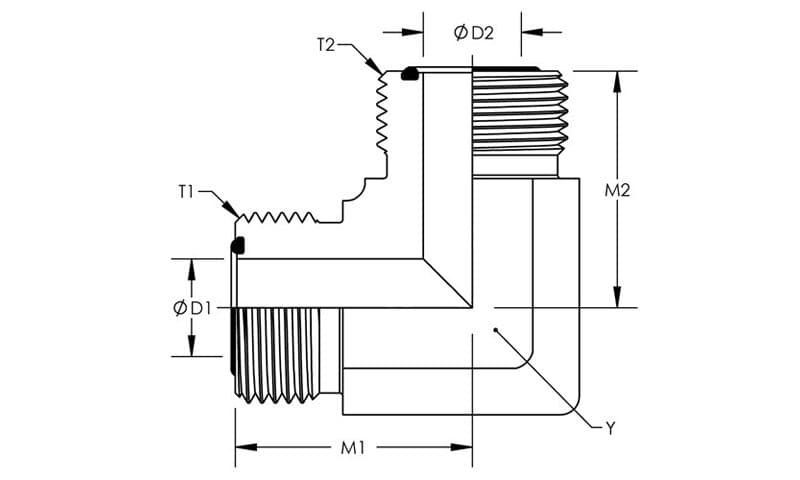 IH-SS-FS2500Stainless Steel ORFS Male Union 90° ElbowIndus Hydraulics
 IH-SS-FS6801Stainless Steel ORFS Male × ORB Male Adjustable 90° ElbowIndus Hydraulics
 IH-SS-FS6403Stainless Steel ORFS Male × JIC 37° Male ConnectorIndus Hydraulics
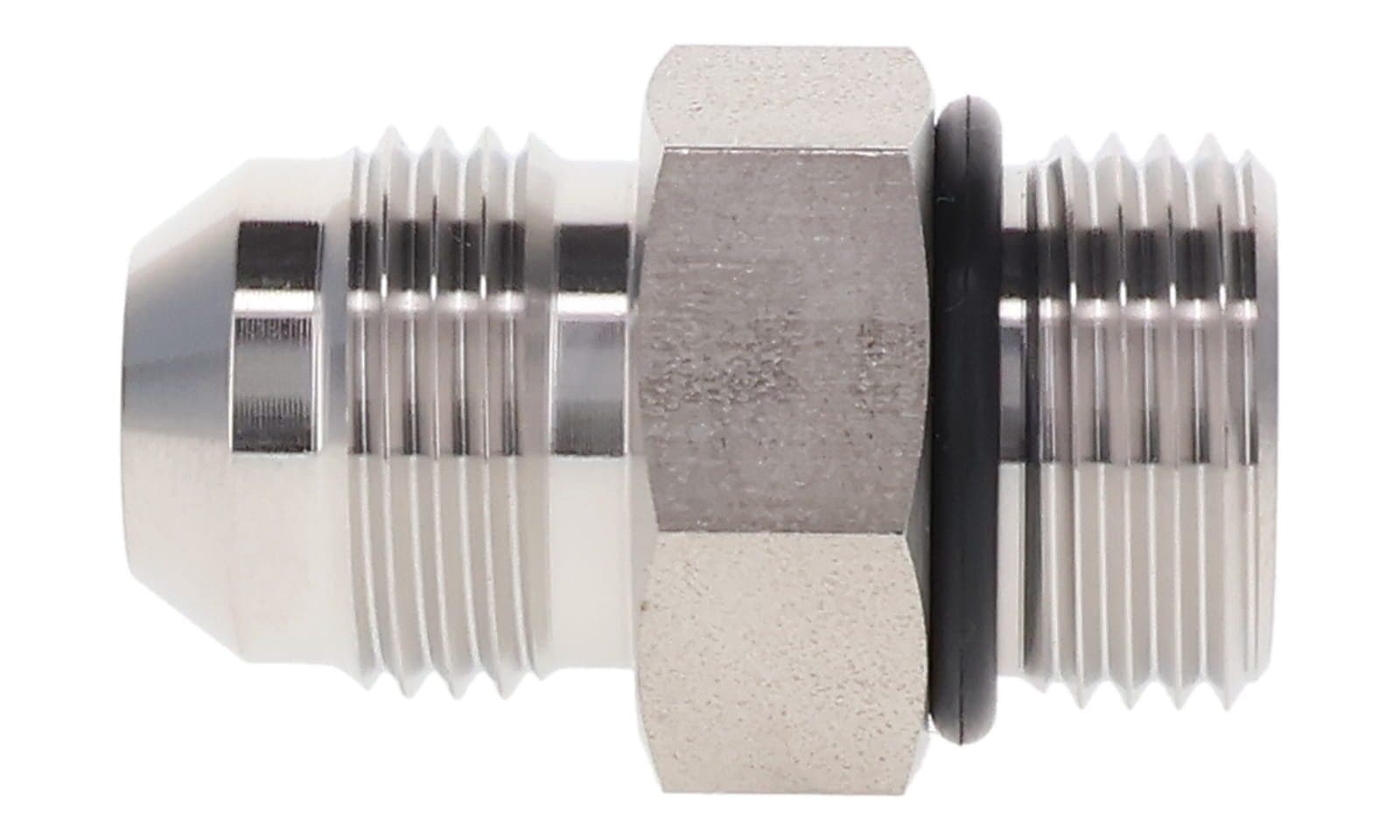 IH-SS-6400Stainless Steel JIC 37° Male × ORB Male ConnectorIndus Hydraulics
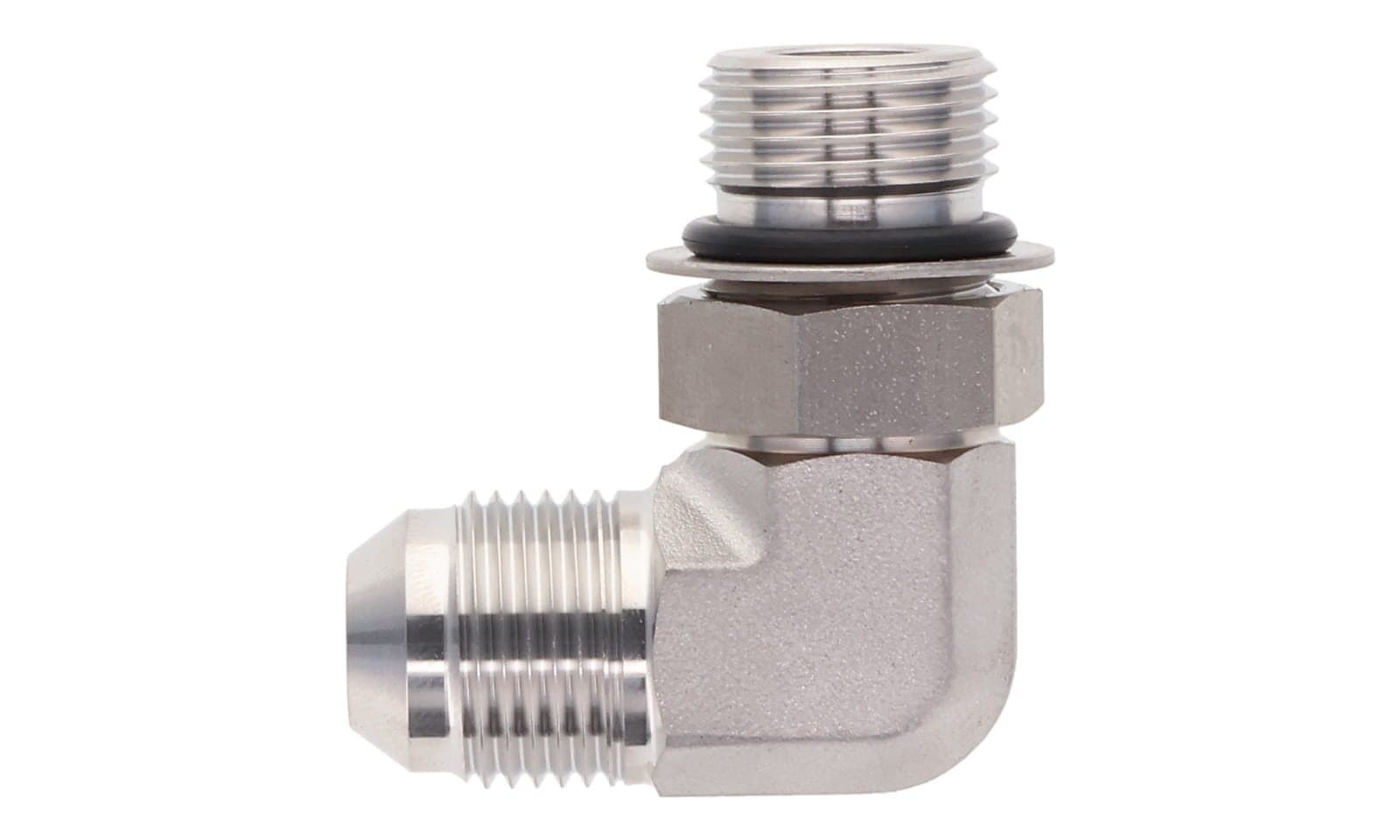 IH-SS-6801Stainless Steel JIC 37° Male × ORB Male Adjustable 90° ElbowIndus Hydraulics
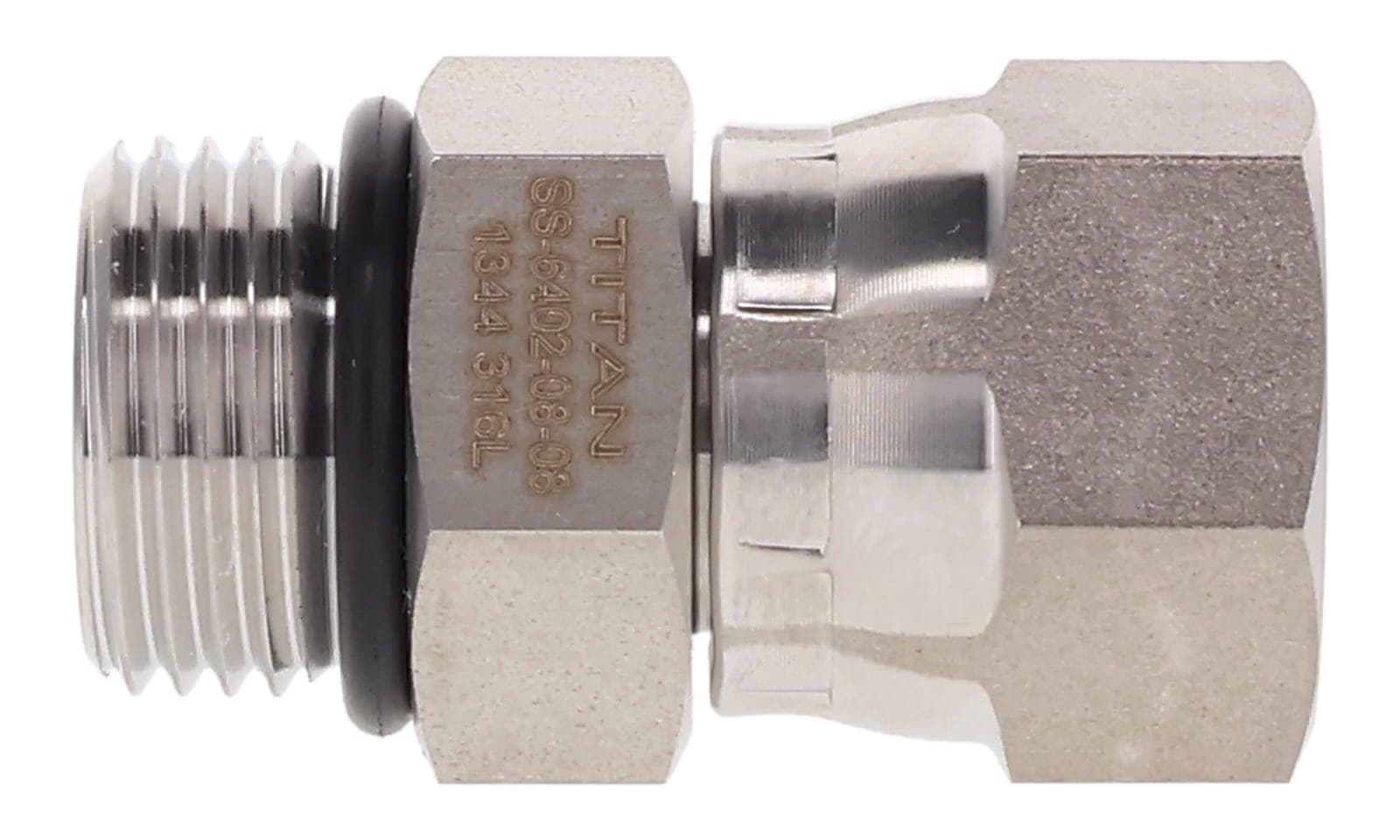 IH-SS-6402Stainless Steel ORB Male × JIC 37° Female Swivel ConnectorIndus Hydraulics
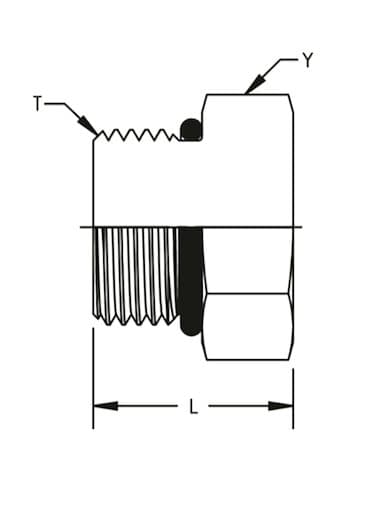 IH-SS-6408Stainless Steel ORB Hex Head PlugIndus Hydraulics
Sources
- 1.Parker Hannifin Tube Fittings Division. Catalog 4300 (2017 edition; current edition 9/2023). ↗