
Load binders are the tensioners in a chain tie-down, and their handles are the part makers and regulators warn about most. Choosing the right type, and using it the way the makers say, removes most of that risk.
The two types.
| Aspect | Lever (snap) binder | Ratchet binder |
|---|---|---|
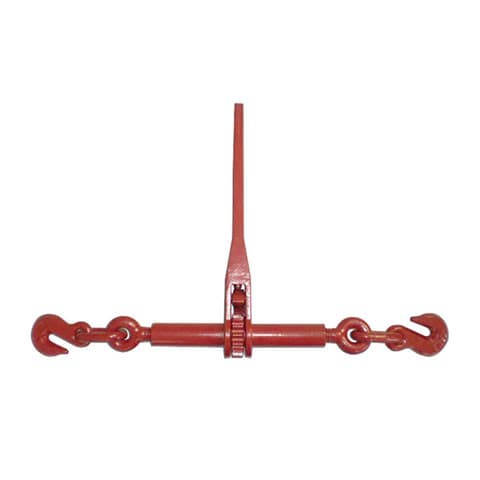
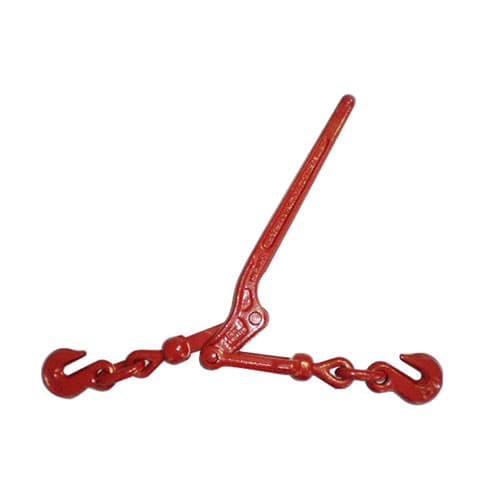
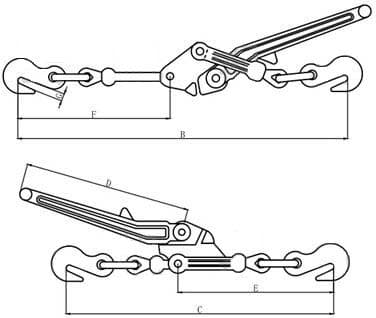
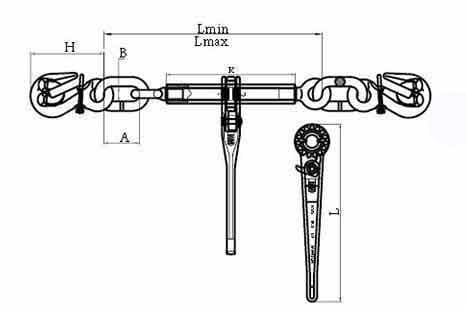
| How it tensions | One swing of the handle pulls the hooks together and locks over centre | A ratchet handle winds a threaded barrel in steps |
| Mechanical advantage | About 25:1 | About 50:1 |
| Speed | Fast | Slower |
| Release | Handle can whip back as the over-centre lock is broken | Wound back in steps |
| Fine adjustment | Limited to the take-up of the lever | Any position within the barrel’s travel |
Both types are rated by the chain size range they take, and for the same range ours carry the same WLL: 2,600 lb for 1/4″–5/16″ chain, 5,400 lb for 5/16″–3/8″, 9,200 lb for 3/8″–1/2″ and 13,000 lb for 1/2″–5/8″. The difference is in how they are used, not what they hold.
The kickback hazard.
A lever binder stores the chain’s tension in its handle. When the handle is pushed over centre, or pulled back to release, that energy can throw the handle round with enough force to injure. Makers’ warnings and road regulators say the same things:
- Keep your body clear of the handle’s path when tightening or releasing. Expect it to whip.
- Never use a cheater pipe or handle extension, to tighten or to release. If a lever binder will not close, it is overloaded or the wrong size — use a ratchet binder.
- Release with care: pry the handle open with a steel bar, or push it with an open hand — never grip it.
- Secure the closed handle by tying it to the chain with the loose chain or soft wire, so vibration cannot open it.
- Stand on the ground, not on the load, and never have more than one person operating a binder.
Is a ratchet binder safer than a lever binder?
Generally, yes. A lever binder’s handle can whip back violently when it goes over centre or is released, and makers warn users to keep clear of its path. A ratchet binder tensions in controlled steps with about twice the mechanical advantage. Both must be used without cheater pipes and matched to the chain size.
Matching the binder to the chain.
Choose the binder for the chain size range it is made for. A tie-down is rated at its weakest part, so a binder rated below the chain limits the whole tie-down to the binder’s WLL. Hooks must seat properly on the chain links; grab hooks on the binder should match the chain size.
We also stock a recoil-less lever binder for Grade 70 chain, designed to limit handle recoil, and Grade 80 and Grade 100 ratchet binders to EN 12195-3 for European lashing systems.
Binders in this guide
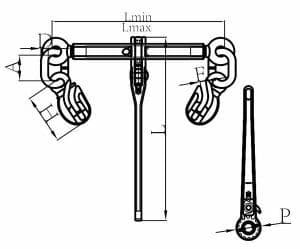
Common questions
Why is a cheater pipe dangerous on a load binder?
It overloads the binder and gives the handle a longer, faster arc if it slips or whips back. Makers prohibit it; if a lever binder will not close, use a ratchet binder instead.
Do lever and ratchet binders have different ratings?
Not for the same chain size range — our lever and ratchet binders are both rated 5,400 lb for 5/16″–3/8″ chain, for example. They differ in how they tension and release.
How do I release a lever binder safely?
Stand clear of the handle’s path and pry it open with a steel bar, or push it with an open hand. Never grip the handle or use a pipe to release it.
Can a load binder be used for lifting?
No. Load binders are load-restraint equipment and are not rated for lifting.
Load binders
Lever, ratchet and recoil-less binders, rated by chain size.
Transport chain
Grade 43 and Grade 70 binder chain and hooks.
Figures verified · Safe-use rules and mechanical advantage from Kito Crosby’s published load securement warnings; regulator guidance from NHVR and WorkSafeNB. Ratings from the linked size tables.
Kitting out a truck?
Tell us the chain size and grade and how many tie-downs you run. We will quote matching binders, chain and hooks.
Plant-down? Call +971 52 2477942 — 24/7