
Load-securing gear is rated differently from lifting gear, and the numbers on a strap label are easy to misread. The big figure is not how hard the strap pulls the load down. Understanding the two numbers is what turns “put enough straps on it” into a load that stays put when the driver brakes hard.
The numbers on a strap label.
| Term | Means | Typical 50 mm polyester strap |
|---|---|---|
| Lashing capacity (LC) | The most the lashing may carry in use — a share of its breaking strength | 1,600–2,000 daN |
| Standard tension force (STF) | The tension the ratchet produces with a standard 50 daN hand pull | 250–500 daN |
| Working load limit (WLL) | The US equivalent of LC, usually in pounds | Our 2″ strap: 3,330 lb |
In European practice the lashing capacity is half the assembly’s breaking strength. Our 2″ strap, rated to US practice, breaks at 10,000 lb and is rated 3,330 lb — one-third. Where a label shows two LC values, use the lower. And because neither LC nor STF can be judged by eye, a lashing with a missing or illegible label must not be used.
How much securing a load needs.
Europe. The EU guidelines, working from EN 12195-1, require a securing system to hold forces of 0.8 times the load’s weight forward and 0.5 times sideways and rearward — 0.6 sideways for loads at risk of tipping. Friction, blocking and lashing all count toward it.
US. Under the federal cargo-securement rules, the combined working load limit of the tie-downs must be at least half the cargo’s weight. A tie-down that runs from the vehicle, over the cargo and back to the vehicle counts at its full WLL; one attached to the cargo counts at half. The minimum number of tie-downs, for an article not blocked at the front:
| Article | Tie-downs |
|---|---|
| Up to 5 ft long and up to 1,100 lb | 1 |
| Up to 5 ft and over 1,100 lb, or 5–10 ft long | 2 |
| Over 10 ft long | 2, plus 1 for each extra 10 ft or part of it |
A tie-down’s rating is the lowest of all its parts, including the tensioner and the anchor point. A chain stronger than its binder is limited to the binder’s rating.
Straps or chain.
| Aspect | Ratchet straps | Chain and binders |
|---|---|---|
| Best for | Pallets, crates, finished and painted goods, lighter loads | Machinery, steel, plant, dense and heavy loads |
| Edges | Cut on sharp edges — need edge protection | Tolerant of edges |
| Weight and handling | Light, fast to fit | Heavy; needs binders and hooks |
| Rated capacity | 50 mm strap typically 1,600–2,000 daN LC | Class 8 chain: 10 mm 6,300 daN, 13 mm 10,000 daN LC |
| Damage to the load | Gentle on surfaces | Can mark finishes |
Should I use ratchet straps or chains to secure a load?
Use chain and binders for heavy, dense or sharp-edged loads such as machinery and steel; use ratchet straps for lighter and finished loads, with edge protection. Whichever you use, the tie-downs must together meet the securing requirement — in the US, a combined WLL of at least half the cargo weight.
Load-securing gear in this guide
IH-LR-RS-RS250M
Ratchet Strap — 2″ (50 mm)

IH-LR-RS-RS4100M
Ratchet Strap — 4″ (100 mm)
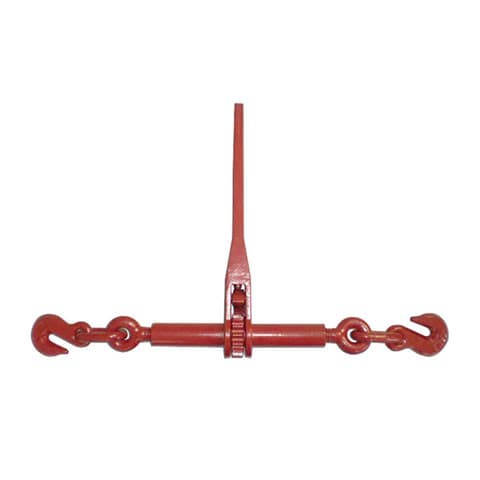
IH-LR-LB-RAT
Ratchet Load Binder
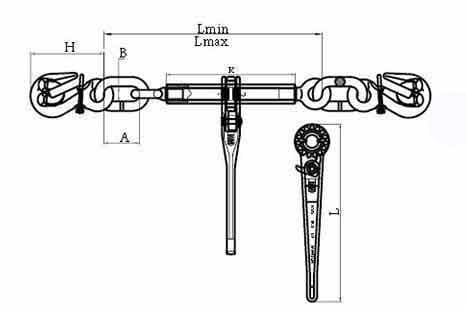
IH-LR-LB-80RLBE121
Grade 80 Ratchet Load Binder — EN 12195-3
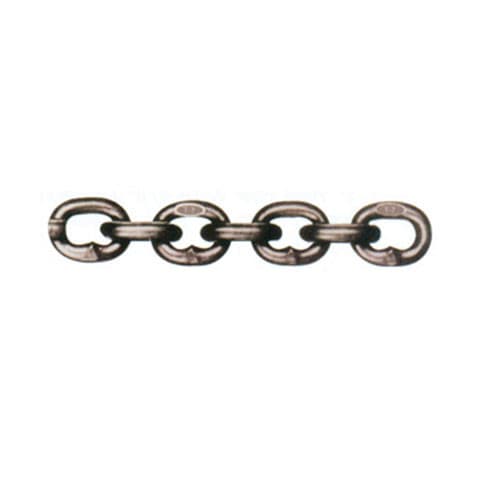
IH-LR-CH-G70A
Grade 70 Transport Chain — Inch Sizes
IH-LR-CH-BCH4370
Binder Chain with Hooks — Grade 43 and Grade 70
Common questions
What is the difference between LC and STF on a ratchet strap?
LC (lashing capacity) is the most the strap may carry. STF (standard tension force) is how hard the ratchet actually tensions it with a normal hand pull — typically 250–500 daN on a 50 mm strap with an LC of 1,600–2,000 daN.
How many tie-downs does a load need?
Under US rules, at least one for an article up to 5 ft and 1,100 lb, two for anything up to 10 ft or heavier short items, and one more for every extra 10 ft. The tie-downs’ combined WLL must also be at least half the cargo weight.
Can I use a ratchet strap with no label?
No. Without a legible label its capacity cannot be known, and it must be taken out of use.
Can I lift with a lashing strap?
No. Lashing straps are rated for load restraint only. Use a lifting sling made and rated for lifting.
Ratchet straps and tie-downs
25 mm to 100 mm ratchet straps with hook and end-fitting options.
Load binders
Ratchet and lever binders, rated by chain size.
Figures verified · European figures from the European Commission’s Best Practice Guidelines on Cargo Securing (2014), based on EN 12195; US rules from 49 CFR 393. Product figures from the linked size tables.
Securing a heavy or awkward load?
Tell us the load’s weight, size and the trailer. We will quote straps or chain, binders and fittings rated for the job.
Plant-down? Call +971 52 2477942 — 24/7