Instrument fittings do not carry a pressure rating of their own in the way a flange does. They are tested across a range of tube walls for every size, and the working pressure the makers publish is a property of the tube. So choosing tube is choosing the pressure rating of the whole line — and choosing the hardness and finish that decide whether it seals at all.
/01Working pressure by OD and wall.
| OD × wall (in) | Swagelok | Parker seamless | Parker welded |
|---|---|---|---|
| 1/8 × 0.028 | 8,500 | 8,600 | 7,300 |
| 1/4 × 0.028 | 4,000 | 4,000 | 3,400 |
| 1/4 × 0.035Highlighted | 5,100 | 5,100 | 4,400 |
| 1/4 × 0.049 | 7,500 | 7,500 | 6,400 |
| 1/4 × 0.065 | 10,200 | 10,300 | 8,700 |
| 3/8 × 0.035 | 3,300 | 3,300 | 2,800 |
| 3/8 × 0.049 | 4,800 | 4,800 | 4,100 |
| 3/8 × 0.065 | 6,500 | 6,600 | 5,600 |
| 1/2 × 0.035 | 2,600 | 2,600 | 2,200 |
| 1/2 × 0.049 | 3,700 | 3,700 | 3,200 |
| 1/2 × 0.065 | 5,100 | 5,100 | 4,300 |
| 1/2 × 0.083 | 6,700 | 6,700 | 5,700 |
| 3/4 × 0.065 | 3,300 | 3,300 | 2,800 |
| 1 × 0.083 | 3,100 | 3,200 | 2,700 |
The two makers’ tables agree to within 100 psi on every row, because both calculate from ASME B31.3 with an allowable stress of 20,000 psi for 316 to ASTM A269. Parker states that its figures are calculated at maximum OD and minimum wall. Two notes from Swagelok’s tables are worth keeping: the 1/4" × 0.065" rating needs Swagelok’s medium-pressure fittings above that point, and some ratings are based on fitting tests with a 4:1 design factor rather than on the tube formula.
Metric 316 seamless tube to EN ISO 1127, from Swagelok’s metric table at −28 to 37 °C: 6 mm tube is rated 320 bar at 0.8 mm wall, 430 bar at 1.0 mm, 550 bar at 1.2 mm and 720 bar at 1.5 mm; 12 mm tube is 200 bar at 1.0 mm and 330 bar at 1.5 mm.
Walls outside the maker’s tested range are not rated: Swagelok does not recommend its fittings outside the minimum and maximum walls in its tables, and Parker treats any combination without a pressure figure as not recommended.
/02Temperature derating.
| Temperature | 316/316L (Swagelok) | 304/304L (Swagelok) | 316 (Parker) |
|---|---|---|---|
| 200 °F (93 °C) | 1.00 | 1.00 | 1.00 |
| 400 °F (204 °C) | 0.96 | 0.93 | 0.97 |
| 600 °F (315 °C)Highlighted | 0.85 | 0.82 | 0.85 |
| 800 °F (426 °C) | 0.80 | 0.76 | 0.80 |
| 1000 °F (537 °C) | 0.76 | 0.69 | 0.77 |
Worked examples:
- 1/2" × 0.035" 316 at 1,000 °F: 2,600 × 0.76 = 1,976 psig (Swagelok’s own example).
- 1/2" × 0.049" 316 at 800 °F: 3,700 × 0.80 = 2,960 psi (Parker’s own example).
- 3/8" × 0.049" 316 at 600 °F: 4,800 × 0.85 = 4,080 psig.
Other alloys derate faster. Swagelok’s factors at 400 °F are 0.91 for 2507 super duplex and 0.74 for 6Mo, and 2507 must not be used above 250 °C (482 °F) at all, because its microstructure changes and it embrittles. Above about 425 °C (800 °F), Parker notes that 300-series stainless can suffer carbide precipitation and intergranular corrosion.
/03Seamless or welded.
Welded-and-drawn tube is acceptable for compression fittings, but it is derated: Swagelok multiplies the seamless rating by 0.85 for double-welded and 0.80 for single-welded tube, and Parker publishes a separate welded table (the right-hand column above). So 1/2" × 0.049" double-welded tube is good for about 3,700 × 0.85 = 3,145 psig. We stock 304 and 316 in both seamless (ASTM A269 / A213) and welded (ASTM A269 / A270, 3-A) forms; the welded tube is often chosen for sanitary and low-pressure process duty, the seamless for high-pressure instrument lines.
/04Hardness and finish decide whether it seals.
- Fully annealed, softer than the fitting. The ferrules must be able to deform the tube surface. Swagelok specifies stainless tube no harder than 90 HRB (200 HV) and has tested its fittings to that limit. Parker treats 90 HRB as the ASTM maximum and recommends 80 HRB or less, particularly for gas — its sample purchase order reads “fully annealed, 80 Rb or less”.
- OD tolerance. Swagelok’s requirement for small tube is tight — no more than ±0.003" on 1/16" OD.
- Ovality. Some austenitic tube is allowed an ovality of twice the OD tolerance, which may not fit precision fittings. Never force an oval tube into a fitting.
- Surface. Scratches, dents and raised marks where the ferrule sits are leak paths, and the larger the tube the more likely a defect lands under the ferrule. Low-density gases such as helium and argon cannot be sealed on damaged tube.
/05Bending, routing and support.
| Tube OD | Bender radius | Support spacing |
|---|---|---|
| 1/8" | 3/8" | — |
| 1/4" | 9/16" | 3 ft (0.9 m) |
| 3/8" | 15/16" | 3–4 ft (0.9–1.2 m) |
| 1/2"Highlighted | 1-1/2" | 3–4 ft (0.9–1.2 m) |
| 3/4" | 2-1/4" | 4 ft (1.2 m) |
| 1" | 3" | 5 ft (1.5 m) |
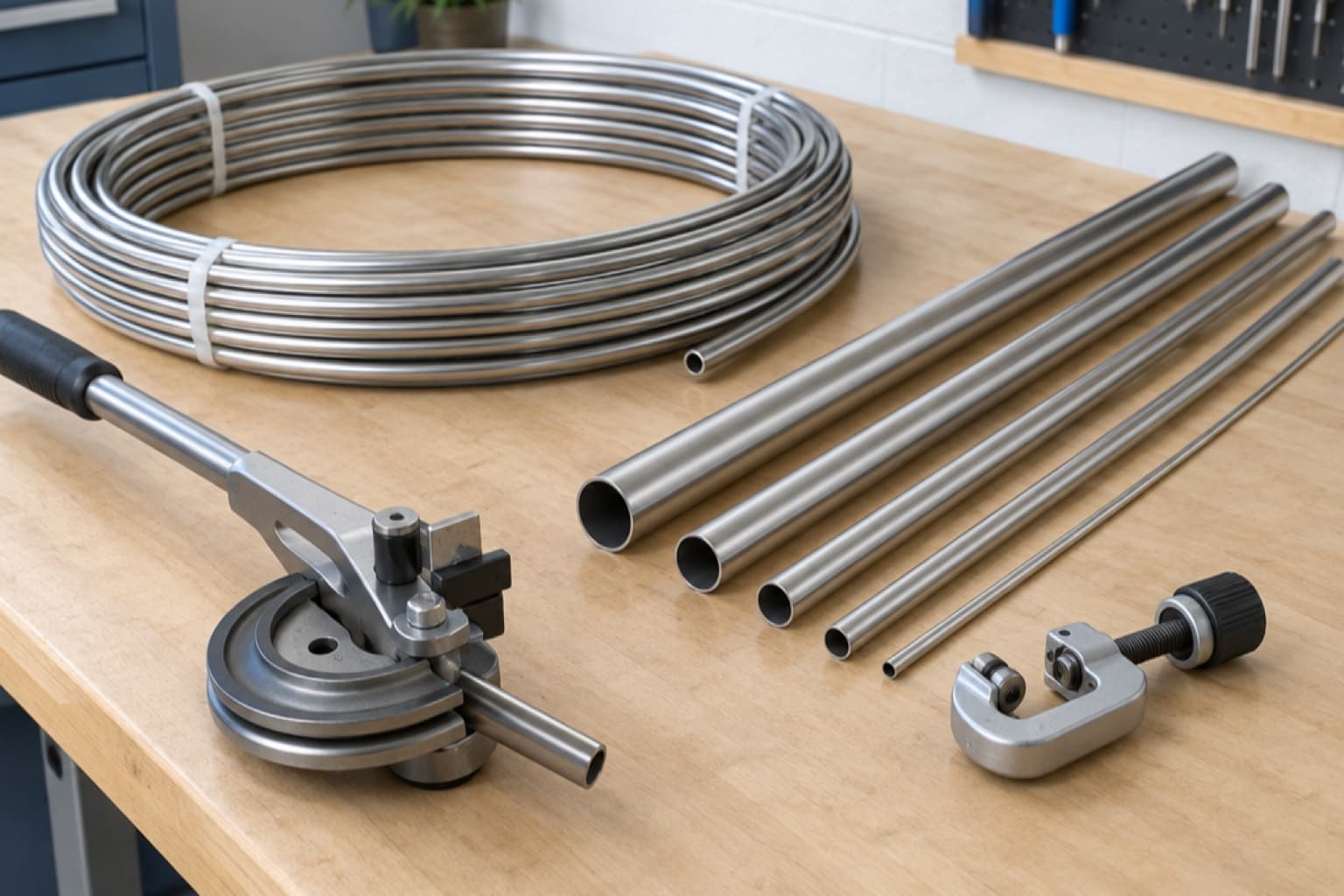
Parker’s support table prints overlapping bands for 3/8"–1/2" (3 ft for 1/4–1/2", 4 ft for 3/8–7/8"); take the shorter where vibration is present. Clamp as close to each bend as possible, and on both sides of it. Unsupported tube vibrates, loosens its fittings and can fatigue through. In long runs, put in U-bends to take expansion and contraction — Parker’s warning is that a strained joint will eventually leak. And allow for stretch: a tube grows by about one tube diameter per 90° bend, which matters when measuring a run before cutting.
Choosing instrument tube
IfWhat is the maximum working pressure and temperature?
Find the OD and wall whose ambient rating × temperature factor exceeds it, with margin.
IfGas, vacuum or liquid?
Gas and vacuum: heavier wall, outside the shaded thin-wall cells, and scratch-free tube.
IfSeamless or welded?
Seamless for high-pressure instrument lines; welded is derated by 0.85 or 0.80.
IfWhich grade?
316/316L for most; 6Mo or 2507 for hot marine air (2507 not above 250 °C); NACE-compliant material for sour service.
IfIs the tube fully annealed and within hardness?
Stainless no harder than 90 HRB; 80 HRB or less preferred.
IfInside the fitting maker’s wall range for that size?
If not, the joint is unrated whatever the tube formula says.
Common questions
- What pressure is 1/4 inch stainless tubing rated for?
- 316 seamless 1/4" tube is rated 4,000 psig at 0.028" wall, 5,100 at 0.035", 7,500 at 0.049" and about 10,200 at 0.065", at ambient temperature on the ASME B31.3 basis.
- What pressure is 1/2 inch stainless tubing rated for?
- 316 seamless 1/2" tube is rated 2,600 psig at 0.035" wall, 3,700 at 0.049", 5,100 at 0.065" and 6,700 at 0.083", at ambient temperature.
- How much does temperature reduce tubing pressure rating?
- For 316, multiply the ambient rating by about 0.96 at 400 °F, 0.85 at 600 °F, 0.80 at 800 °F and 0.76 at 1,000 °F.
- Is welded tubing OK for compression fittings?
- Yes, welded-and-drawn tube is acceptable, but derated: × 0.85 for double-welded and × 0.80 for single-welded.
- What hardness should stainless instrument tubing be?
- Fully annealed and no harder than 90 HRB (200 HV); Parker recommends 80 HRB or less, especially for gas service.
- Why does gas service need thicker wall tubing?
- Heavier wall resists the ferrules so they coin out minor surface defects as they swage; thin wall yields and leaves the defect under the seal.
- How often should instrument tubing be supported?
- Parker gives about 3 ft (0.9 m) for 1/4"–1/2", 4 ft (1.2 m) up to 7/8", 5 ft (1.5 m) for 1" and 7 ft (2.1 m) above, with clamps close to each bend.
Tubing and fittings
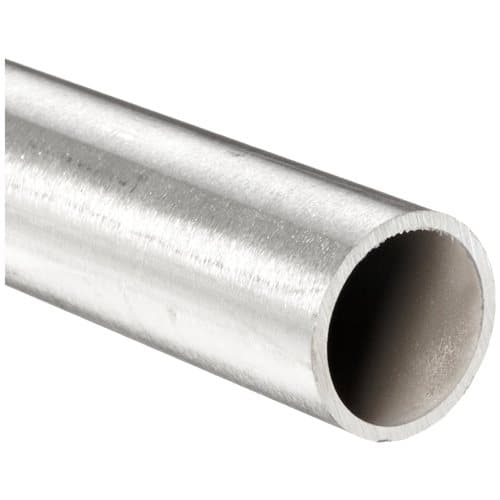 IH-TB-ST6316 Stainless Steel Seamless Tubing, InchIndus Hydraulics
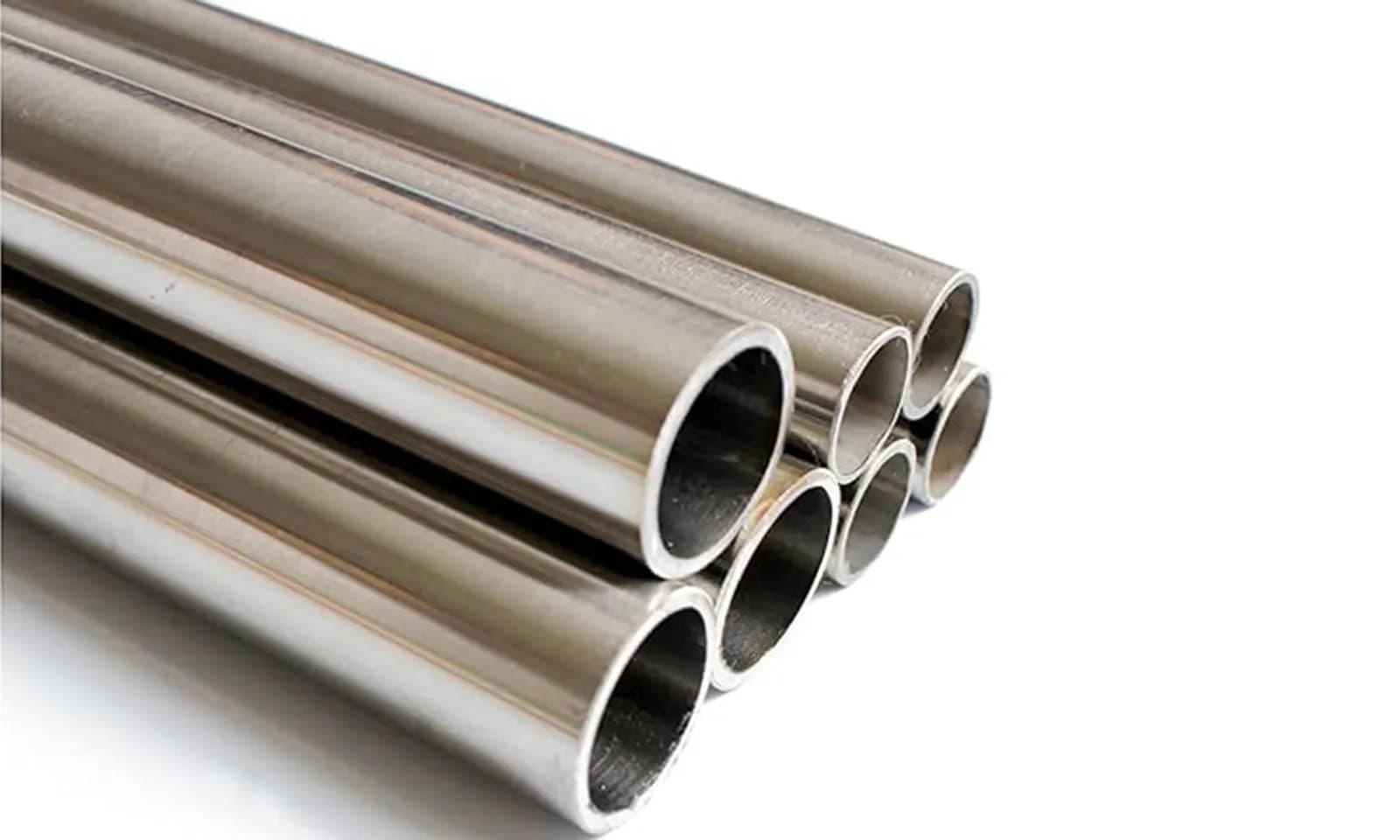 IH-TB-ST6W316 Stainless Steel Welded Tubing, InchIndus Hydraulics
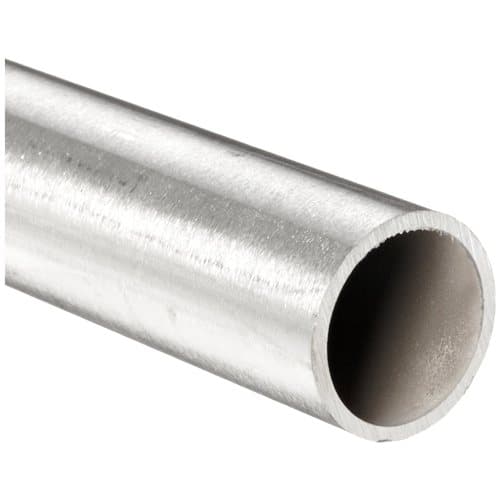 IH-TB-ST4304 Stainless Steel Seamless Tubing, InchIndus Hydraulics
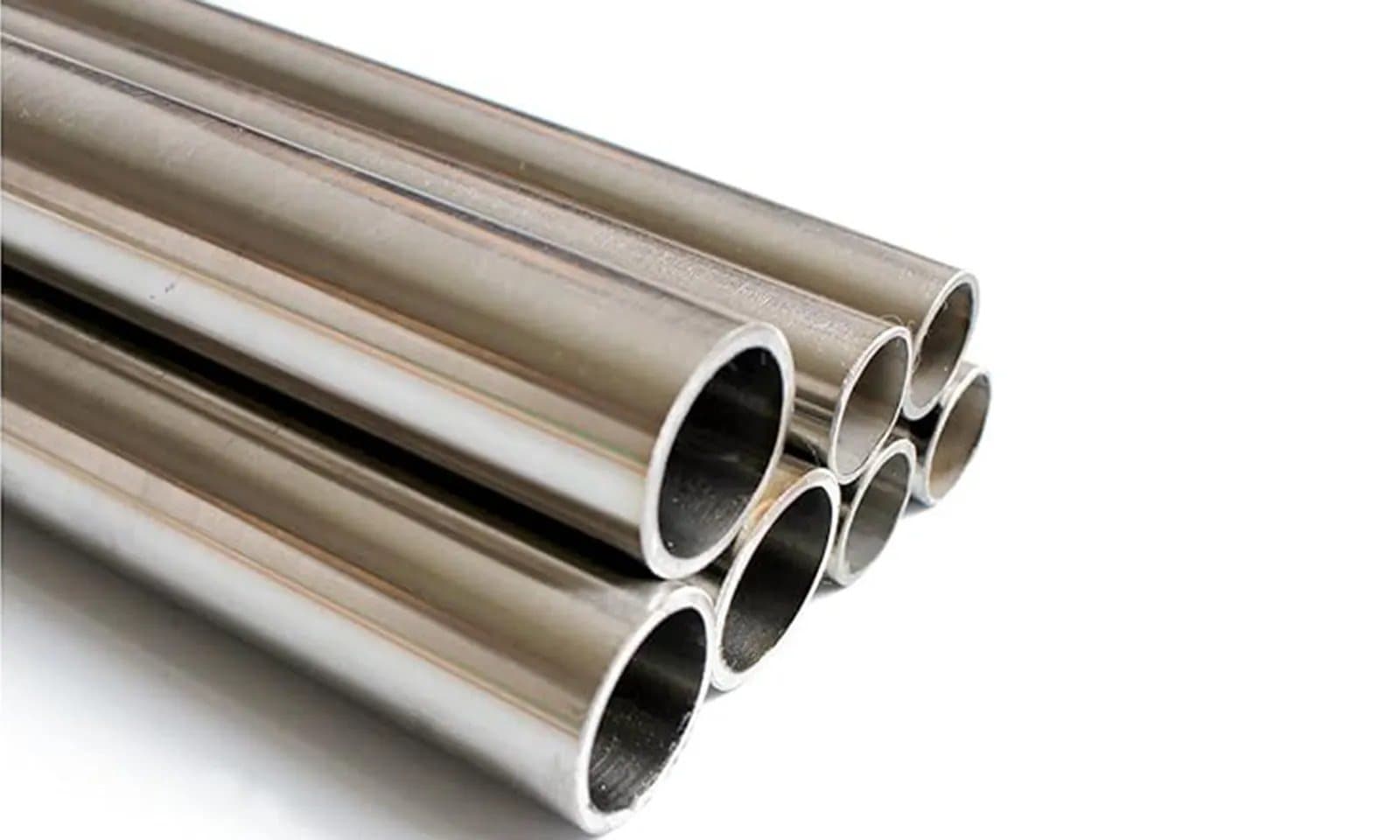 IH-TB-ST4W304 Stainless Steel Welded Tubing, InchIndus Hydraulics
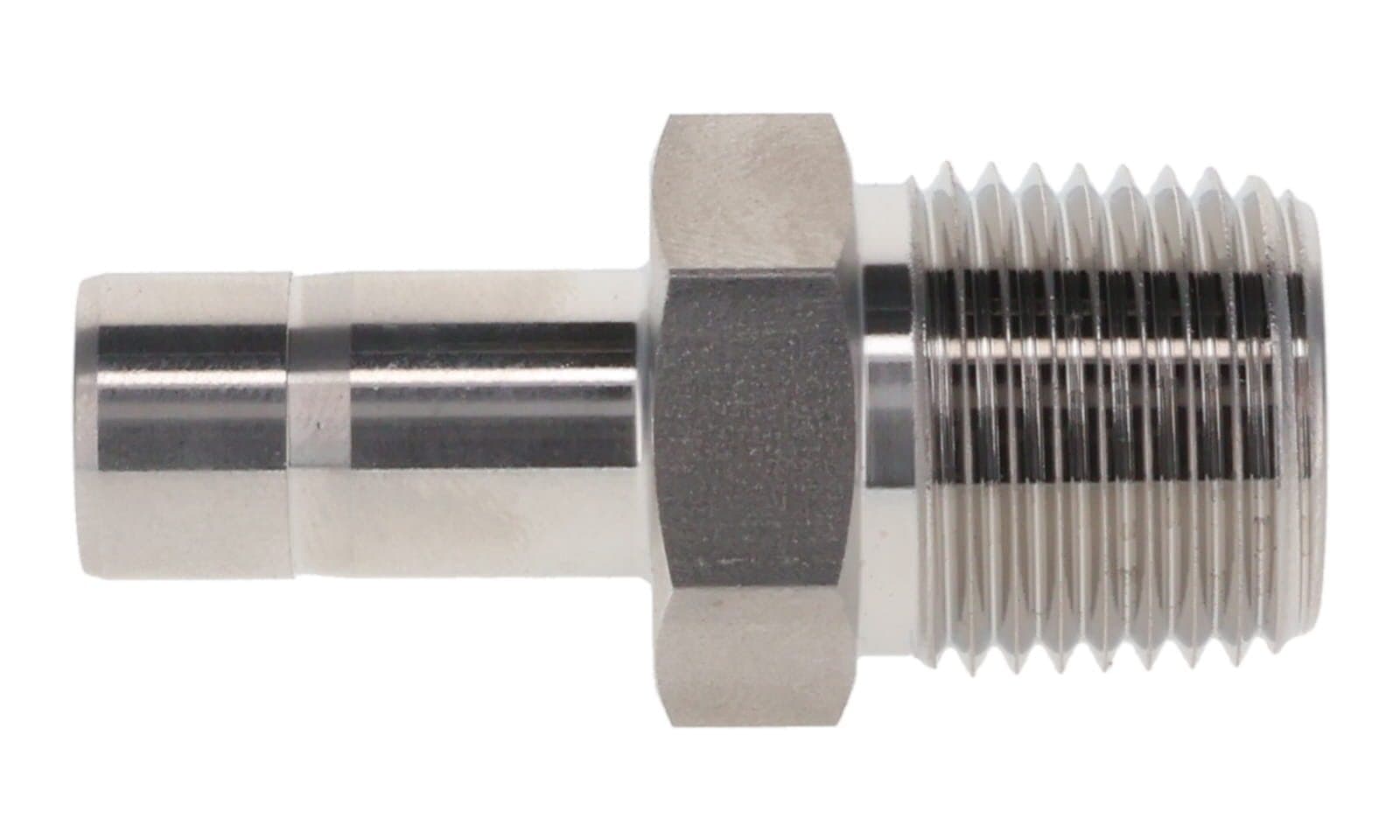 IH-TF-AM316 Stainless Double Ferrule Male Adapter, Tube Stub × NPT MaleIndus Hydraulics
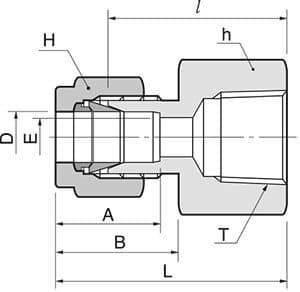 IH-TF-CF316 Stainless Double Ferrule Female Connector, Tube × NPT FemaleIndus Hydraulics
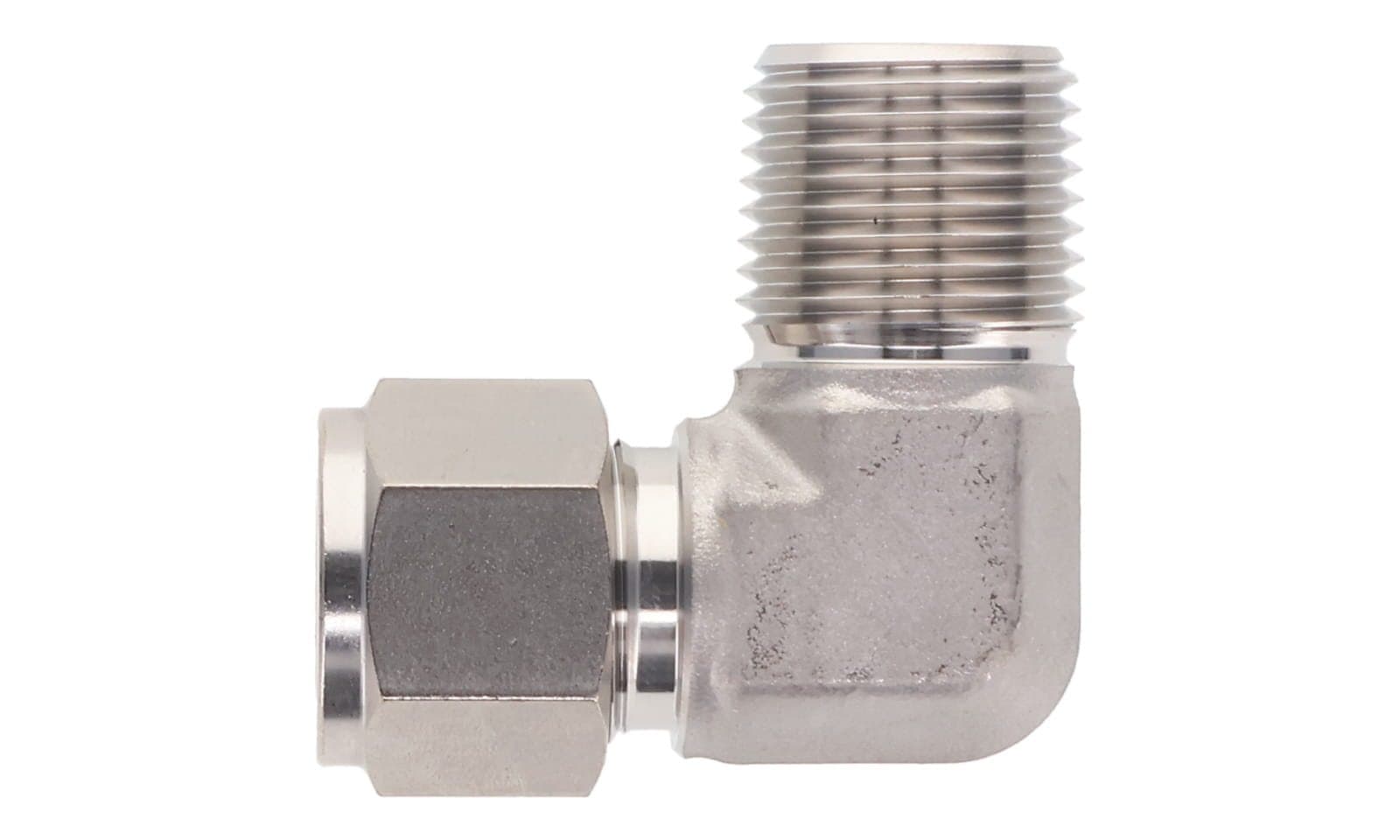 IH-TF-LM316 Stainless Double Ferrule Male Elbow, Tube × NPT MaleIndus Hydraulics
Tubing Data
Working pressures for 316 and 304 tube by OD and wall on the ASME B31.3 basis, hardness and tolerance requirements, welded-tube factors and elevated-temperature factors; Parker’s catalogue 4230/4233 gives matching figures.