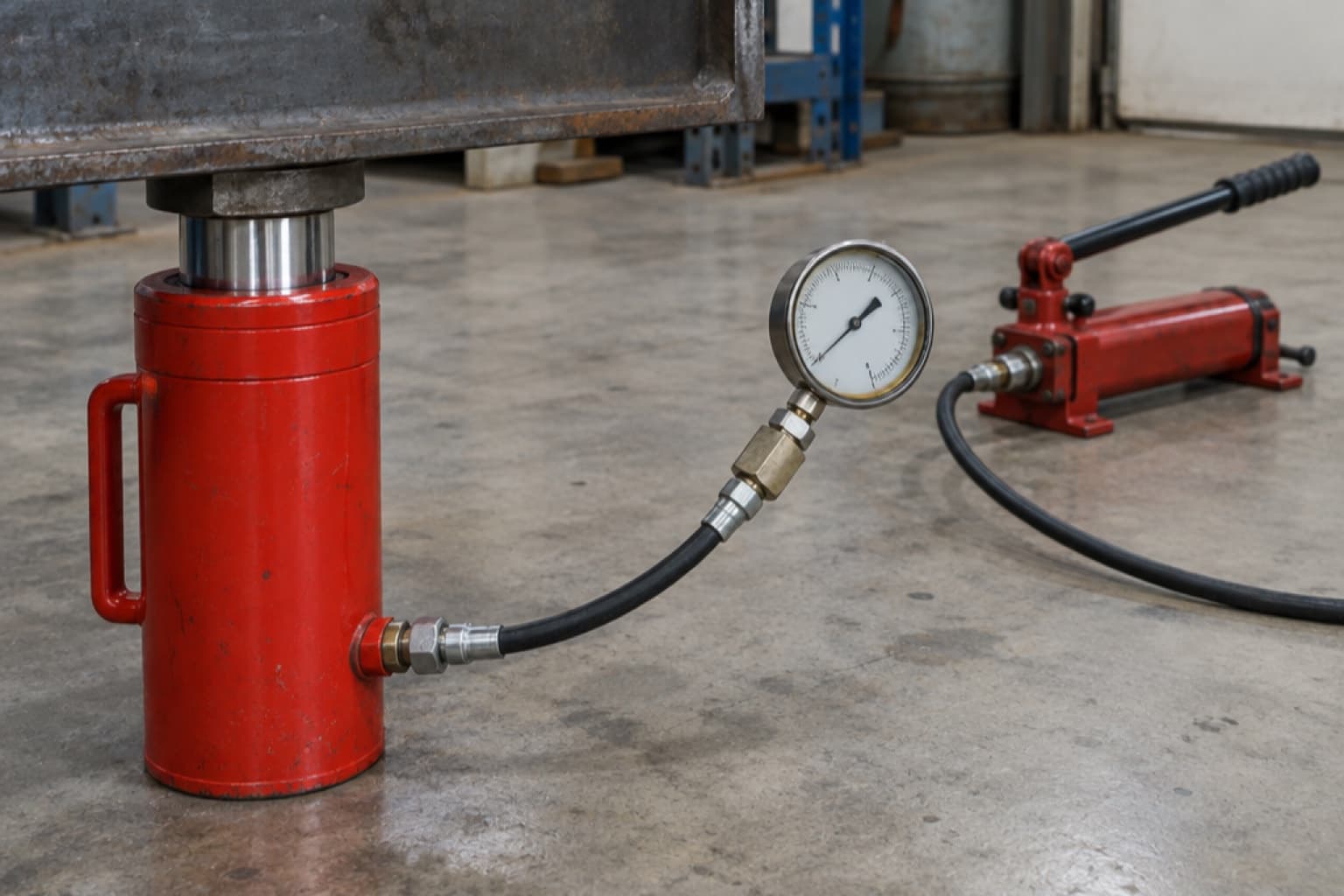
In a 10,000 psi system the cylinders are small, the hoses are thin and the forces are enormous, and none of it shows from the outside. A cylinder under 40 tonnes looks exactly like one under 4. The gauge is how an operator knows what the load is, whether the pump is making pressure, and whether a relief setting is about to be passed. This guide covers the gauges used on jacking, pressing, pulling and bolting systems.
/01Why every system needs a gauge.
Enerpac puts it simply: “A pressure gauge provides a window into the system.” A gauge shows whether the pump is building pressure; a falling reading reveals a leak or a blockage; and it is the only way to see a relief setting being approached. Enerpac links its absence to exploding gauges, fluid leaks, injuries from pressurised connections and dropped loads, and its press instructions call for a gauge in every hydraulic system to indicate safe operating loads.
One more rule from Enerpac’s instructions matters at these pressures: the system’s operating pressure must not exceed the rating of its lowest-rated component. A 10,000 psi pump with a 5,000 psi gauge or hose is a 5,000 psi system.
/02Pressure gauges.
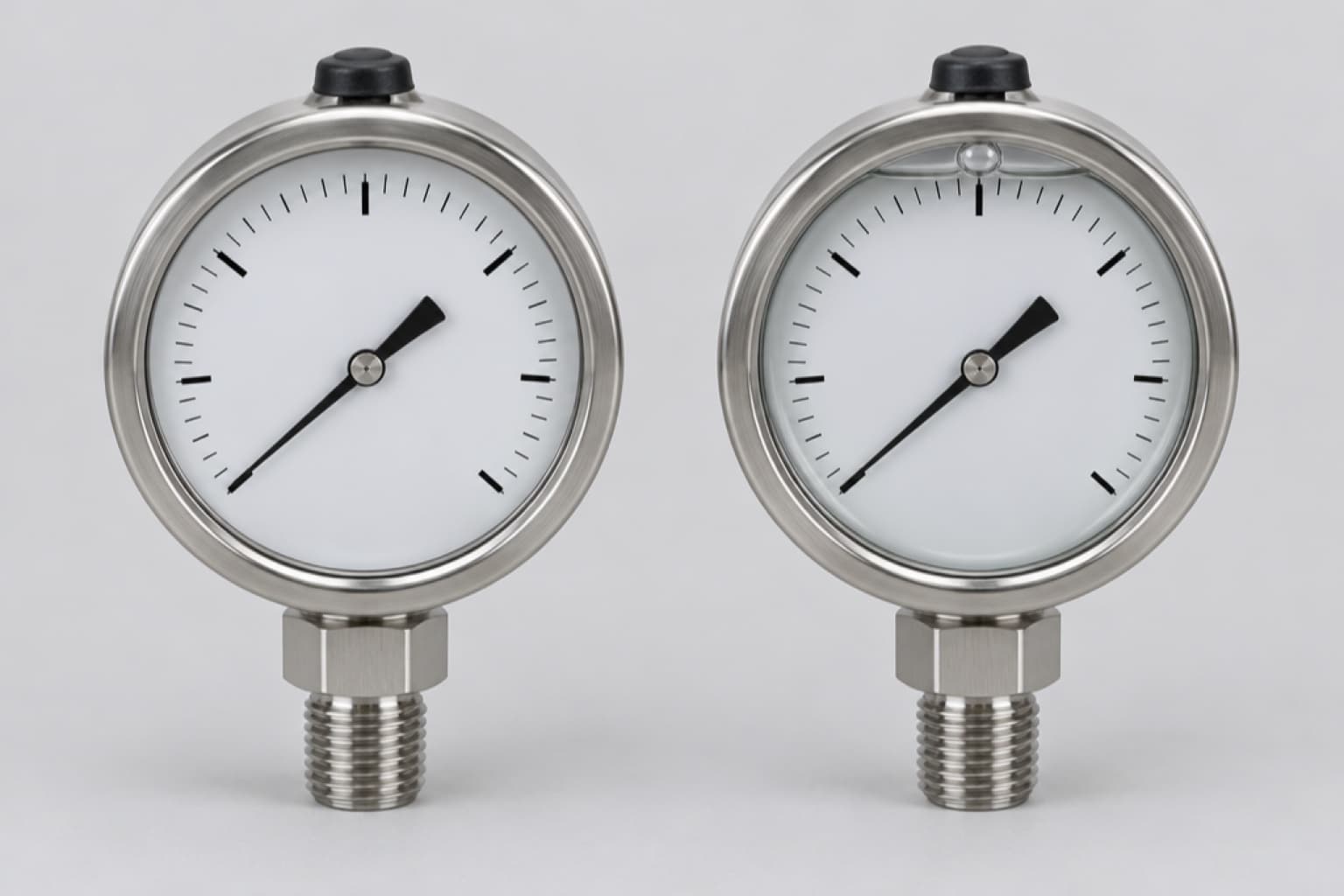
Enerpac’s analogue G-series covers 100 to 15,000 psi (7 to 1,000 bar). The 63 mm G2535L is typical of a 10,000 psi system gauge: 10,000 psi / 700 bar, glycerine-filled, ±1.5% of full scale, dual psi and bar scales, a 1/4" NPTF lower connection, and a safety blow-out disc with a pressure-equalising membrane. Larger 4" (100 mm) gauges are easier to read at a distance; Enerpac also lists 1.5" rear-mount gauges to 10,000 psi for compact pumps and tools.
Filled or dry, and beyond 15,000 psi
Not every Enerpac gauge is filled. Its H-series are dry gauges built for high-cycle work and harsh environments, at 10,000 psi on a 4" face with 1/4" or 1/2" NPTF connections; Enerpac recommends a snubber or needle valve to shut them off when not in use. Above the G-series’ 15,000 psi, Enerpac’s T-6000 test system gauges run from 1,000 psi up to 20,000, 40,000 and 50,000 psi, in alloy or stainless steel, for test benches and high-pressure proof testing rather than everyday jacking. See filled vs dry gauges.
Beyond Enerpac, our general high-pressure gauges include a 6" dial, 1/2" NPT bottom-mount 0–10,000 psi gauge with an SS316 connection and glycerine fill, offered to 15,000 psi and with NACE MR0175 materials on request.
Range
Enerpac’s guidance is that a gauge should be operated at pressures that do not normally exceed 75% of full scale — and that reading a low pressure on a very high-range gauge (its example: 25 bar on a 1,000 bar gauge) costs accuracy. On a 10,000 psi pump, a 0–10,000 psi gauge is normal for jacking to 6,000–7,500 psi; for work that must be read precisely at low pressure, add a lower-range gauge or use a digital one. See choosing a gauge range.
/03Force gauges: reading the load directly.
Cylinder force is pressure times effective area. Enerpac’s own example: an RC-106 has 2.24 in² of effective area, so at 8,000 psi it pushes 17,920 lb — about 9 short tons. A force gauge does that sum on the dial: it carries a pressure scale and a force scale matched to the effective area of a particular cylinder or set of cylinders.
- GF10B — 0–100 kN for Enerpac’s 10-ton RC, RCS and RSM cylinders, ±1% of full scale, 100 mm face, 1/2" NPTF connection, glycerine-filled, stainless case; fitted with a GA1 or GA2 gauge adaptor.
- GF510B — dual force scales of 0–450 and 0–900 kN for the 50-ton RCS502 and 100-ton RCS1002 cylinders.
- GT gauges — tonnage-only analogue gauges for named cylinder sets.
A force gauge is only correct for the cylinder (or combination of cylinders) it is scaled for. Moved to a different cylinder, its force scale is wrong; the pressure scale is still right. With several cylinders on one pump, the force scale must be for their combined area.
/04Digital gauges.
Enerpac’s DGR2 digital gauge reads to 20,000 psi (1,380–1,400 bar) with ±0.25% of full-scale accuracy and 1 psi resolution, switchable between psi, bar, MPa and kg/cm², with zero reset, auto shut-off and an IP65 case. Against ±1.5% for standard analogue gauges, it is the choice for bolt tensioning and torque work where the target pressure is read off a chart, for proof testing, and for anywhere the low end of the range must be read accurately.
/05Adaptors, isolation and damping.
- Gauge adaptors put a gauge into a line: the male end goes into the pump or cylinder port, the female end takes the hose or coupler, and the third port takes the gauge. They are pressure-rated for 10,000 psi service. Enerpac’s GA45GC is a complete assembly — a 45° adaptor angled for visibility, with a CR400 high-flow female coupler, a 3/8"-18 NPTF male end and a G2535L gauge fitted.
- Snubber valves damp the gauge. Enerpac’s V91 is infinitely adjustable, stops the pointer snapping back when load is released, and can shut the gauge off; its V10 auto-damper needs no adjustment. Enerpac recommends snubbers or needle valves for high-cycle work.
- Shut-off valves such as Enerpac’s NV251 isolate the gauge so it can be changed without depressurising everything else.
Installation rules from Enerpac: put thread sealant only on male threads, use PTFE tape sparingly and keep it off the first thread, and tighten on the connection’s flats, never through the case.
Common questions
- Why do I need a gauge on a hydraulic hand pump?
- It is the only way to see the pressure — and so the load — and to avoid exceeding the cylinder, hose or relief rating. Enerpac calls the gauge a window into the system.
- What is a hydraulic force gauge?
- A gauge with a force scale (kN or tonnes) as well as pressure, matched to the effective area of a specific cylinder so it reads the load directly.
- Can I use a force gauge on a different cylinder?
- Only the pressure scale. The force scale is correct only for the cylinder area it was made for.
- Are all hydraulic gauges glycerine-filled?
- No. Enerpac’s G-series are glycerine-filled, but its H-series are dry gauges designed for high-cycle work and harsh environments.
- How accurate are hydraulic gauges?
- Enerpac’s standard analogue gauges are ±1.5% of full scale; its GF force gauges ±1%; its DGR2 digital gauge ±0.25%.
- What range gauge should I use on a 10,000 psi pump?
- Usually 0–10,000 psi, operated below about 75% of full scale. For precise low-pressure readings, add a lower-range or a digital gauge.
- What is a gauge adaptor?
- A pressure-rated tee that goes between the pump or cylinder and the hose, with a third port for the gauge.
High-pressure gauges and adaptors
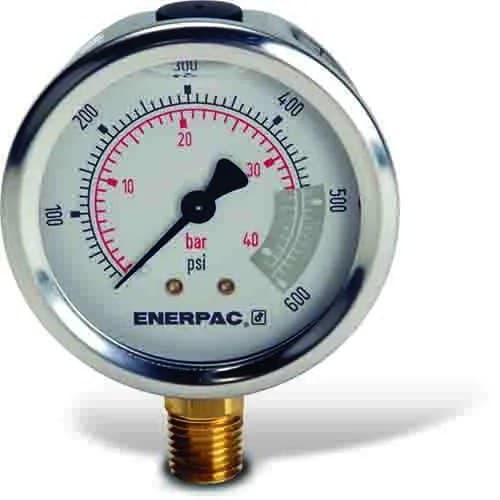 IH-ENE-GAUGE-G25Enerpac 2.5" Glycerin-Filled Hydraulic Pressure GaugesEnerpac
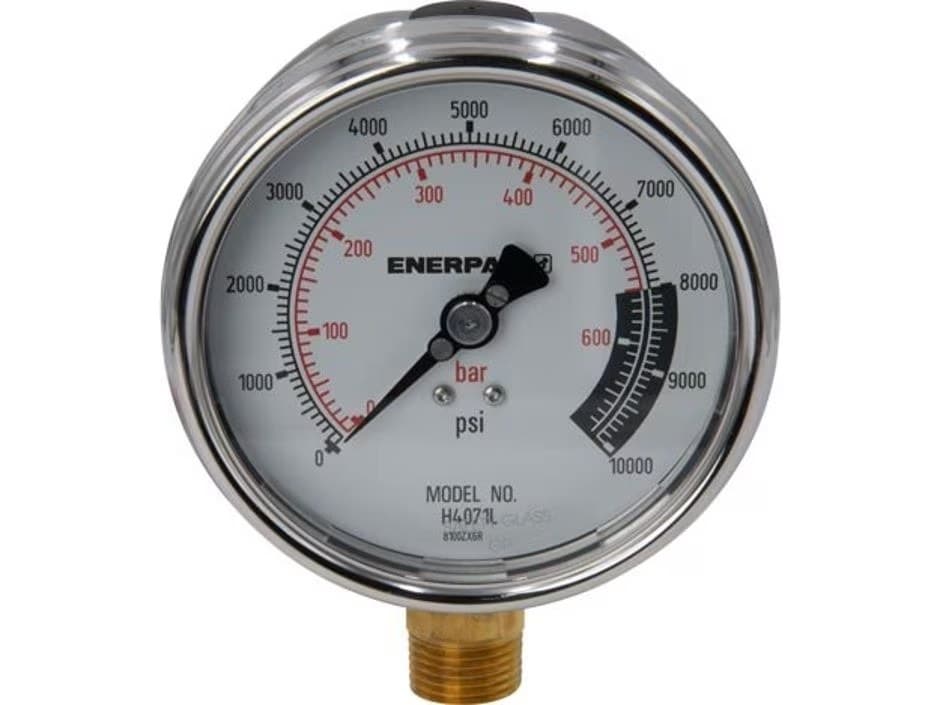 IH-ENE-GAUGE-G40Enerpac 4" Hydraulic Pressure Gauges: Glycerine-Filled G-Series and High-Cycle Dry H-SeriesEnerpac
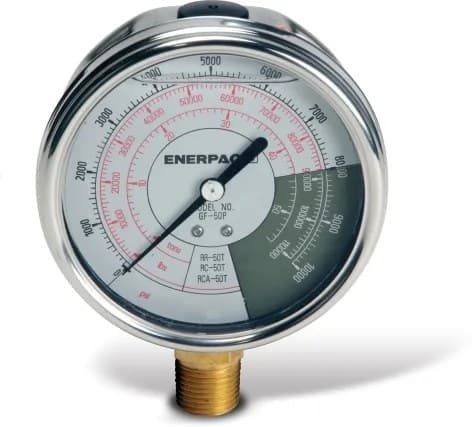 IH-ENE-GAUGE-GFEnerpac GF Force and Pressure GaugesEnerpac
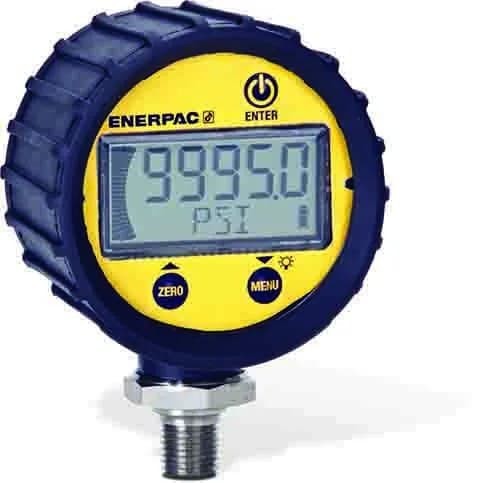 IH-ENE-GAUGE-DGREnerpac DGR-2 Digital High-Pressure GaugeEnerpac
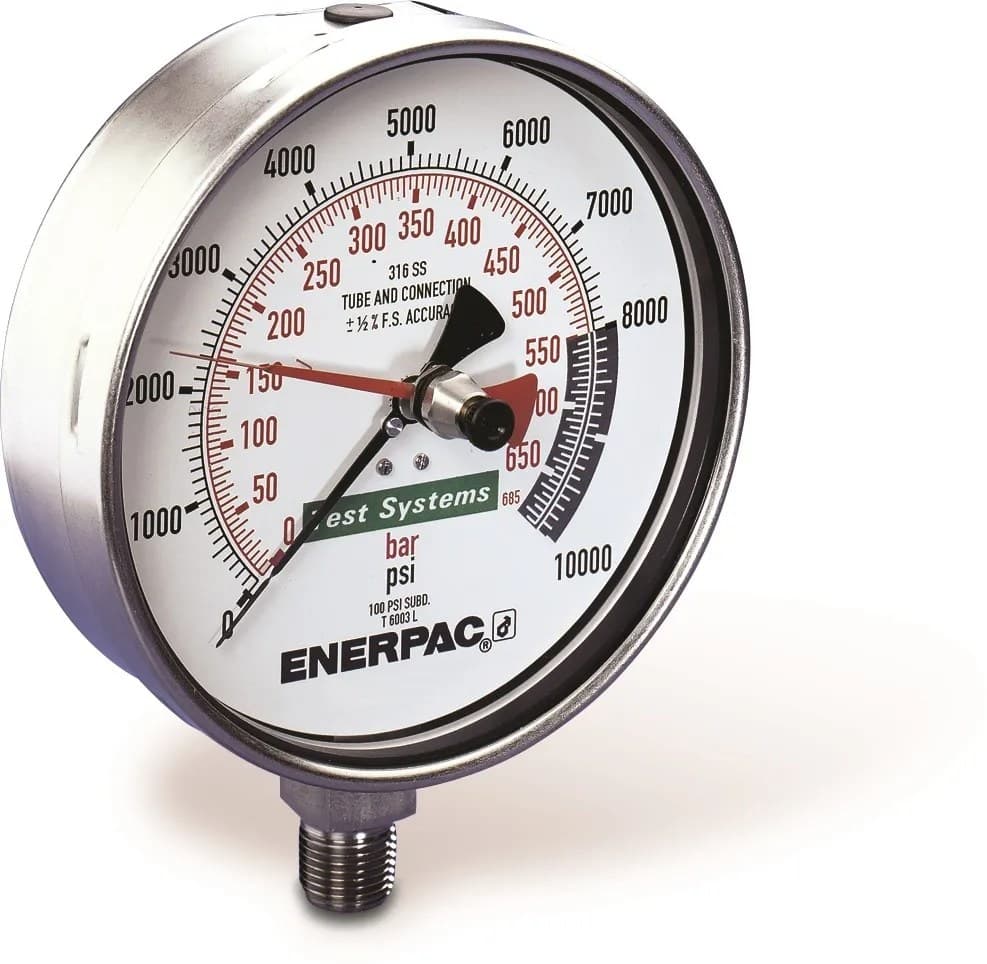 IH-ENE-GAUGE-T6000Enerpac T-6000 Test System GaugesEnerpac
- IH-ENE-GAUGE-GA45GCEnerpac GA45GC Gauge Adapter AssemblyEnerpac
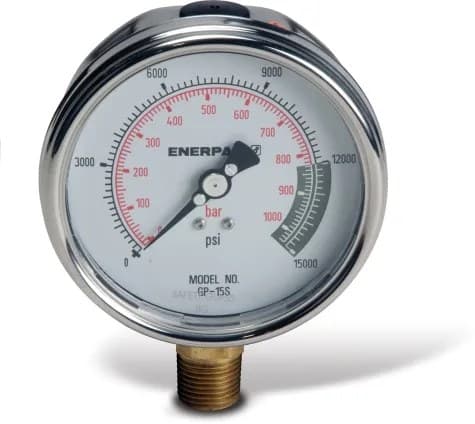 IH-ENE-GAUGE-GPEnerpac GP 4" Dry Pressure GaugesEnerpac
- IH-PG-12NPT-BM-6IN-10KPressure Gauge, 1/2-inch NPT Bottom Mount, 6-inch Dial, 10,000 psi, SS316, Glycerine-FilledIndus Hydraulics