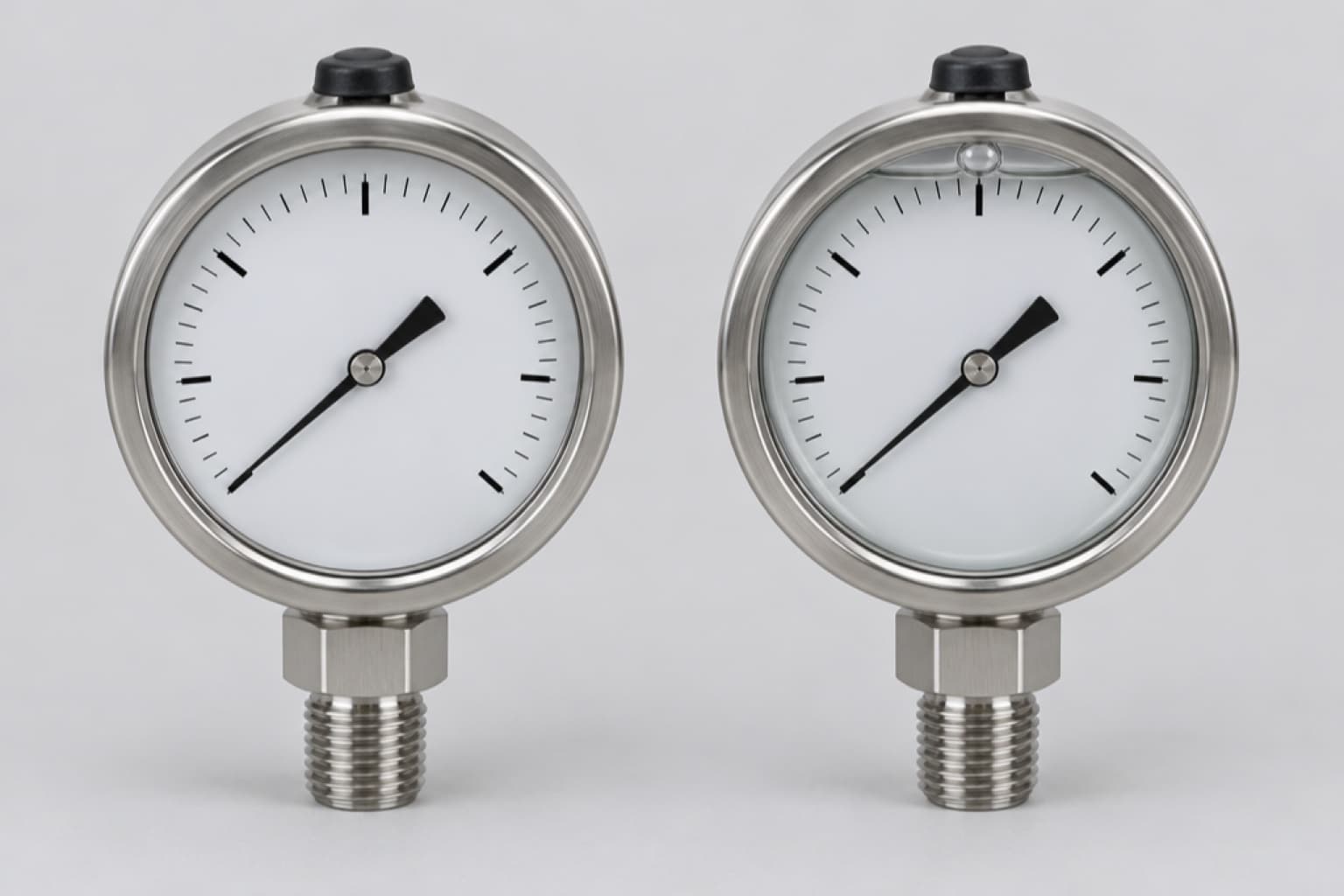
Look at a gauge on a hydraulic power unit and the dial is usually floating in a clear liquid. That fill is doing real work — and on the wrong service it does real harm. This guide covers what a fill does, which fluid to choose, the rules that come with it, and what to use instead when filling is not enough or not allowed.
/01What the fill does.
A gauge movement is a delicate train of gears and a hairspring. On a pump line or a vibrating machine, a dry gauge’s pointer flutters so much it cannot be read, and the movement teeth wear until the gauge reads high at zero. Enerpac describes glycerine fill as protecting the sensing parts from vibration, sudden pressure changes and moisture, damping needle vibration on powered pumps and under shock loads — its example is nut splitters — which improves readability and extends gauge life.
Ashcroft makes the point about the pulsation you cannot see: high-frequency pulsation may show only as an upscale zero shift from movement wear. A liquid-filled gauge is its first remedy for both pulsation and vibration.
| Fill | Temperature (maker) | Good for | Never use with |
|---|---|---|---|
| Dry | Ashcroft: −20 to 200 °F (−29 to 93 °C) ambient | Stable pressure, oxygen-clean service, high ambient | — |
| GlycerineHighlighted | Ashcroft: 20 to 150 °F (−7 to 66 °C) ambient; Enerpac: −4 to 140 °F (−20 to 60 °C) | Hydraulic and pump vibration, general industry | Oxygen, chlorine, nitric acid, hydrogen peroxide |
| Silicone | Ashcroft: −40 to 150 °F (−40 to 66 °C) | Cold climates, wide temperature swings | Oxygen and strong oxidisers |
| Halocarbon (fluorinated) | Ashcroft: −40 to 150 °F (−40 to 66 °C) | Oxidising media where a fill is needed | — |
/02The oxidiser rule.
/03Venting: the rule for low ranges.
A sealed, filled case is a small pressure vessel. As the gauge warms, the fill expands and pressurises the case; as it cools, it pulls a slight vacuum. On a high-range gauge the effect is negligible. On a low-range gauge it is not: Enerpac requires every filled gauge with a range of 100 psi or less (including vacuum-to-100 psi compound ranges) to be case-vented, otherwise the pointer may not return to zero — and warns that an unvented glycerine gauge can become unstable and even burst.
To vent, Enerpac’s instruction is to cut the tip of the nipple on the fill plug and mount the gauge with the plug at 12 o’clock, so the fill cannot run out. On a Gulf site where a gauge sees 50 °C afternoons and cool nights, the swing is large; low-range filled gauges outdoors should always be vented.
Refilling
If a gauge has lost fill, Enerpac’s procedure is to fill at 20–29 °C (glycerine warmer than about 29 °C traps air bubbles), let the gauge breathe for at least ten minutes before refitting the plug, and wipe excess fluid off the plug, which can otherwise pop out at high temperature.
/04When fill is not enough.
A fill damps the pointer but does not reduce the pressure surges reaching the Bourdon tube. On severe pulsation — reciprocating pumps, hammering tools, high-cycle presses — add damping at the connection:
- Throttle screw or plug in the gauge socket: a fixed restriction, threaded types removable for cleaning.
- Snubber: a porous metal disc, graded for the medium — Ashcroft grades for oil, for water and light oil, and for air, steam and gas.
- Pulsation dampener with selectable orifices, self-cleaning.
- Needle valve or snubber valve: adjustable throttling and isolation in one. Enerpac’s adjustable snubber valve also stops the pointer snapping back when a load is released.
- Diaphragm seal for corrosive, viscous or slurry media, or where the medium would attack the gauge’s wetted parts or plug the tube.
- Siphon on steam, to hold a water barrier between the steam and the gauge.
Filled or dry?
IfOxygen or other strong oxidiser?
Dry, oxygen-clean gauge, or halocarbon fill. Never glycerine or silicone.
IfPump pulsation, vibration or shock loads?
Filled gauge, plus a snubber or throttle on severe pulsation.
IfVery cold site or large temperature swings?
Silicone fill rather than glycerine.
IfRange 100 psi or less, filled?
Vent the case, plug at 12 o’clock.
IfStable pressure, no vibration, high ambient?
A dry gauge is fine, and has the wider temperature range.
Common questions
- Why are pressure gauges filled with glycerine?
- To damp pointer vibration from pumps and shock loads, protect the movement from wear and keep moisture out, which makes the gauge easier to read and last longer.
- Can glycerine-filled gauges be used with oxygen?
- No. Glycerine and silicone fills can react, ignite or explode with oxygen and other strong oxidisers. Use a halocarbon fill or a dry, oxygen-clean gauge.
- What is the difference between glycerine and silicone filled gauges?
- Silicone stays fluid at lower temperatures, so it suits cold sites and large temperature swings; glycerine is the common choice for general hydraulic and industrial service.
- Why does my filled gauge not return to zero?
- On ranges of 100 psi or less, an unvented case is pressurised by the fill expanding with temperature. Vent the fill plug and mount it at 12 o’clock. If it still does not return to zero, the element may be damaged.
- What temperature can a glycerine gauge take?
- It depends on the maker: Enerpac rates its glycerine gauges for about −20 to +60 °C; Ashcroft gives about −7 to +66 °C ambient. Check the gauge’s own data.
- Is a filled gauge enough on a pulsating pump?
- Often, but on severe pulsation add a snubber, throttle screw or needle valve so the surges are damped before they reach the Bourdon tube.
Filled and dry gauges
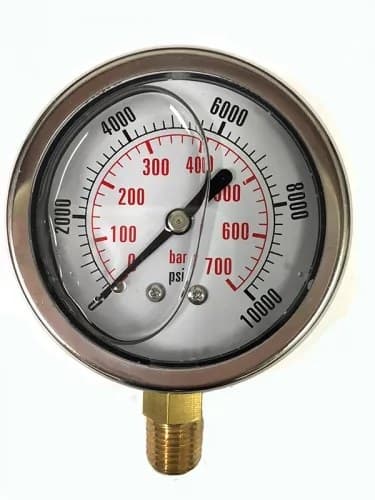 IH-DFC-CF-25-14NPTDynamic Fluid Components CF 2.5" Glycerine-Filled Pressure Gauges, 1/4" NPTDynamic Fluid Components
- IH-DFC-CF-25-71620SAEDynamic Fluid Components CF 2.5" Glycerine-Filled Pressure Gauges, 7/16-20 SAEDynamic Fluid Components
- IH-DFC-CDS-25-14NPTDynamic Fluid Components CDS 2.5" Compound Dry Pressure Gauges, 1/4" NPTDynamic Fluid Components
- IH-DFC-PDLC-4-14NPTDynamic Fluid Components PDLC 4" Glycerine-Filled Pressure Gauges, 1/4" NPTDynamic Fluid Components
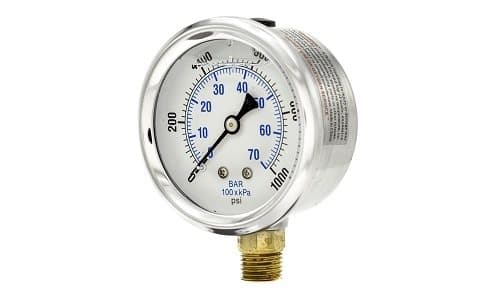 IH-GA-201L2-1/2" Glycerin-Filled Pressure Gauge, Stainless Case, 1/4" Bottom MountIndus Hydraulics
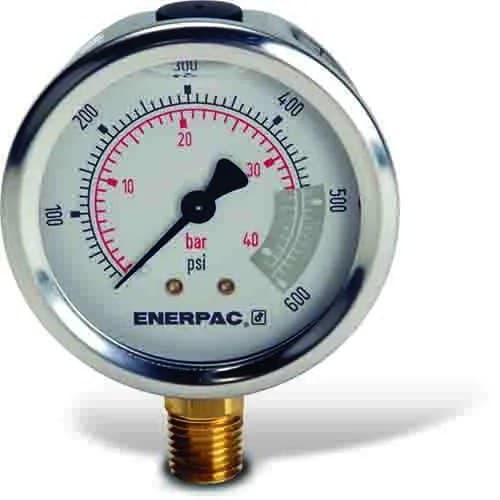 IH-ENE-GAUGE-G25Enerpac 2.5" Glycerin-Filled Hydraulic Pressure GaugesEnerpac