
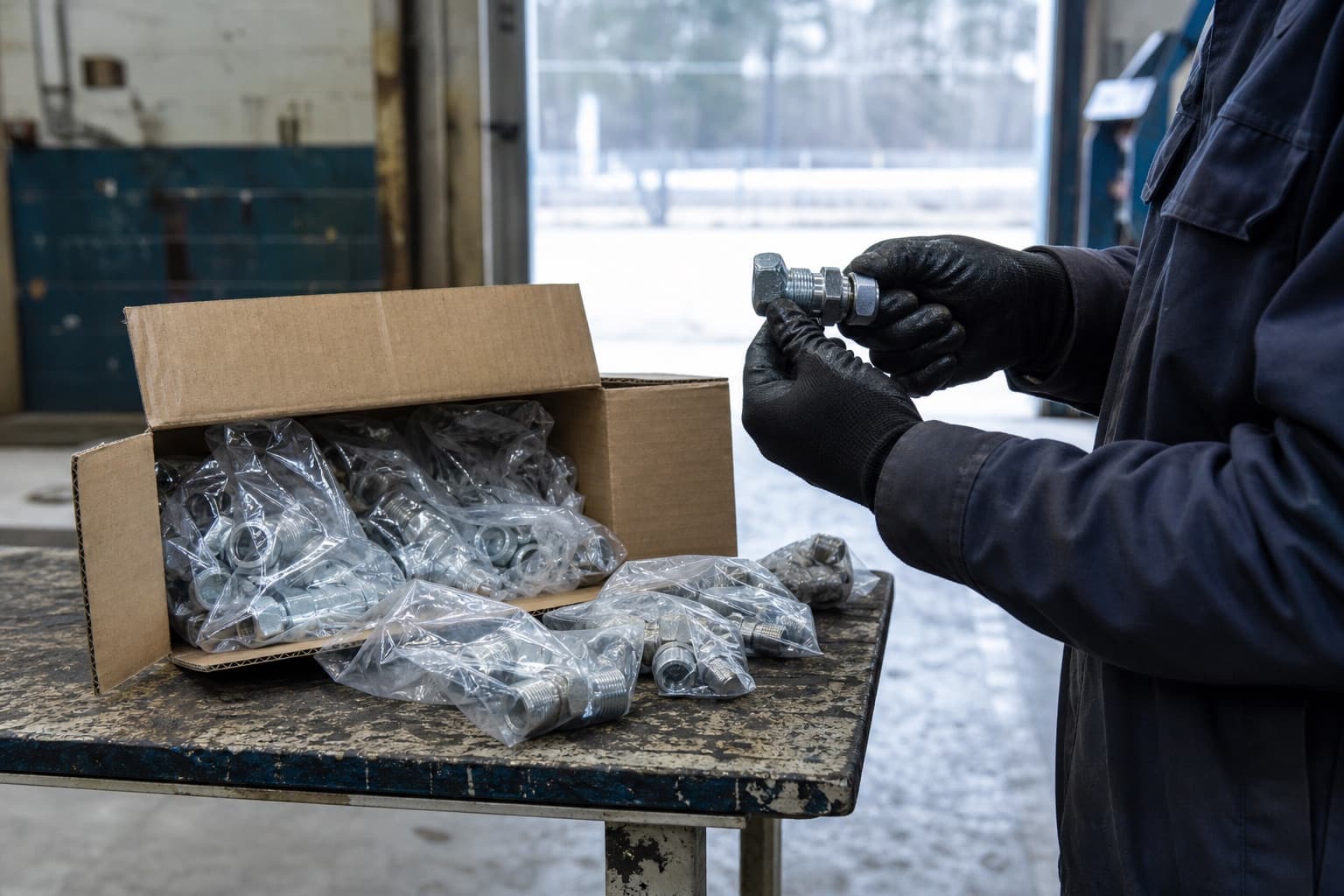
Inspecting fittings on arrival takes five minutes and settles arguments that are unwinnable six weeks later. Fittings arrive in bags, in quantity, and usually when someone is busy. They get signed for and shelved, and any problem in them surfaces weeks later at the worst moment, by which point the consignment is untraceable and the argument is unwinnable. Five minutes on the bay prevents nearly all of that.
The five checks.
| Check | Catches |
|---|---|
| Run a known nut down each male thread | Rough, burred or out-of-tolerance threads |
| Look into the seat under a light | Machining marks or damage across the sealing face |
| Compare against a known-good sample | Wrong size or family in a correctly-labelled bag |
| Count, and measure a sample from each bag | Short delivery and mixed bags |
| Photograph the consignment as received | Everything you will need if there is a dispute |
What inspection cannot see.
Two properties decide whether a fitting is safe in the line you are about to put it in, and neither is visible: the material and the pressure rating. A part can be dimensionally perfect, beautifully finished, and wrong for a 350-bar line. Those are settled at the order, in what you specified and what the supplier confirmed — which is the practical argument for buying fittings against a stated rating rather than against a picture and a price.
Storing what you accepted.
Fittings survive storage well and seals do not. Keep elastomers out of sunlight and heat, keep bags closed so grit does not find the seats, and cap or bag anything with an exposed sealing face. A drawer of loose adapters rolling against each other produces exactly the seat damage the arrival check was looking for — inflicted after the check, by you.
Should I pressure-test fittings on arrival?
No — a fitting is tested as part of the assembly it goes into, which is what the assembly proof test is for. Arrival inspection is about geometry, finish, count and documentation.
What do I do if one bag is wrong?
Photograph it as received, alongside the packing list, and raise it the same day. Any supplier worth keeping treats a same-day discrepancy as a correction; nobody can do much with an unlabelled bag found in a drawer months later.
Is a rough thread always a reject?
A thread that will not accept a known-good nut smoothly is. Minor tooling marks away from the sealing face are cosmetic. The seat and the thread are where the judgement should be strict.
Want the rating stated on the quotation?
Ask for it — material and working pressure, per line. We would rather answer that at quotation than have you inspecting for something that cannot be seen.
Plant-down? Call +971 52 2477942 — 24/7