
A thread reference board is the cheapest fix available for a workshop that identifies the same parts every month. Every workshop that runs a mixed fleet ends up identifying the same handful of threads over and over, usually under pressure, usually by a different person each time. A reference board fixes that for the price of an afternoon and a sheet of plywood, and it is the single cheapest improvement most of the workshops we supply could make.
What goes on it.
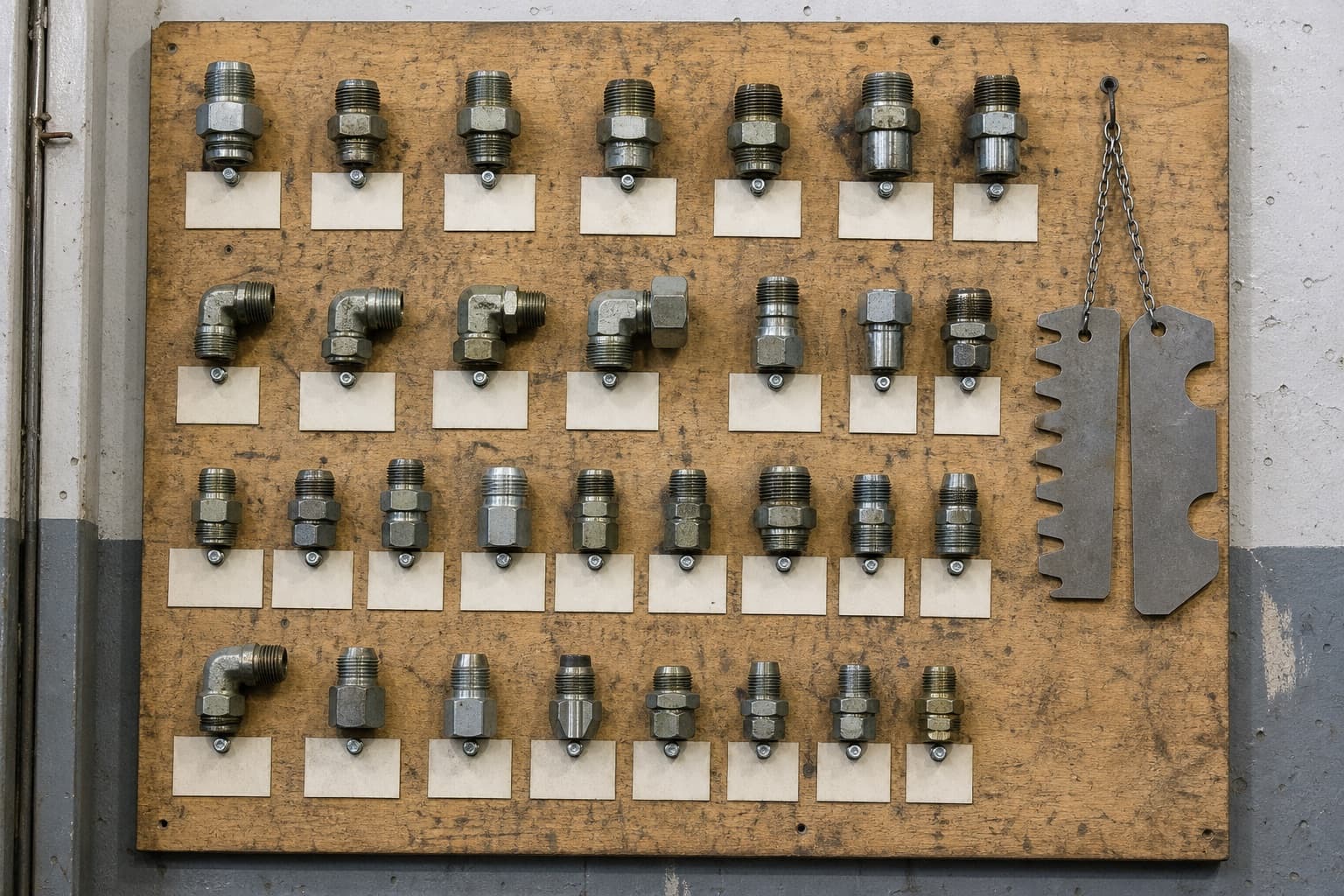
Samples, not pictures. A person identifying a fitting wants to offer the part up to a known one and see whether the nut starts, whether the seats match, whether the hex is the same. Mount both halves where you can — a male and its mating female — because half the identification problems in a workshop are about a port rather than a hose end.
| Item | Why it earns a place |
|---|---|
| Male and female of each family you run | The core of the whole thing |
| The two or three bores that actually fail | Depth where it is used, not breadth for completeness |
| One example of each seat: 24°, 30°, 37°, flat face, taper | Trains the eye on the distinction that matters most |
| A bonded seal, an O-ring and a bite ring | The parts people forget are part of the joint |
| Pitch gauge and seat gauge, on a chain | Tools that are attached do not walk |
How to label it so it stays trustworthy.
Three lines per sample. The thread as measured. The seat. And where it came from — "boom cylinder, the yellow loader" — because that last line is what makes the board useful to someone ordering a part rather than only to someone identifying one. Write on the board itself, not on tape that will fall off in the heat.
Then photograph it, in good light, straight on, and keep that photograph where whoever raises orders can find it. A supplier receiving that image with an order has your entire fleet convention in one file, and the conversation about what you mean by "the usual" stops happening.
Keeping it current.
Add to it when a new machine arrives, and take something off when the last machine using it leaves the yard. A board that has grown for ten years and been pruned never is a museum: it holds families nobody runs any more, and it teaches new fitters that anything is possible, which is the opposite of what it is for.
Hydraulic fittings
Hose ends and ferrules across the families a mixed fleet meets.
Is a printed chart not enough?
A chart tells you what a family is; a sample lets you compare the part in your hand against a known good one. Charts are useful alongside a board and a poor substitute for one.
What if we run too many families to mount them all?
Then mount the seats and the bores that fail, and treat the rest as order-on-demand. A board of six things people trust beats a board of forty that nobody reads.
Can you supply the samples?
Yes — send your fleet list or the photographs from a yard walk and we will quote a set of male and female samples in the families you actually run, along with the gauges.
Want a sample set for the wall?
Tell us which families your fleet runs, or send photographs and we will work it out. We will quote a labelled set of samples and the two gauges, shipped as one consignment.
Plant-down? Call +971 52 2477942 — 24/7