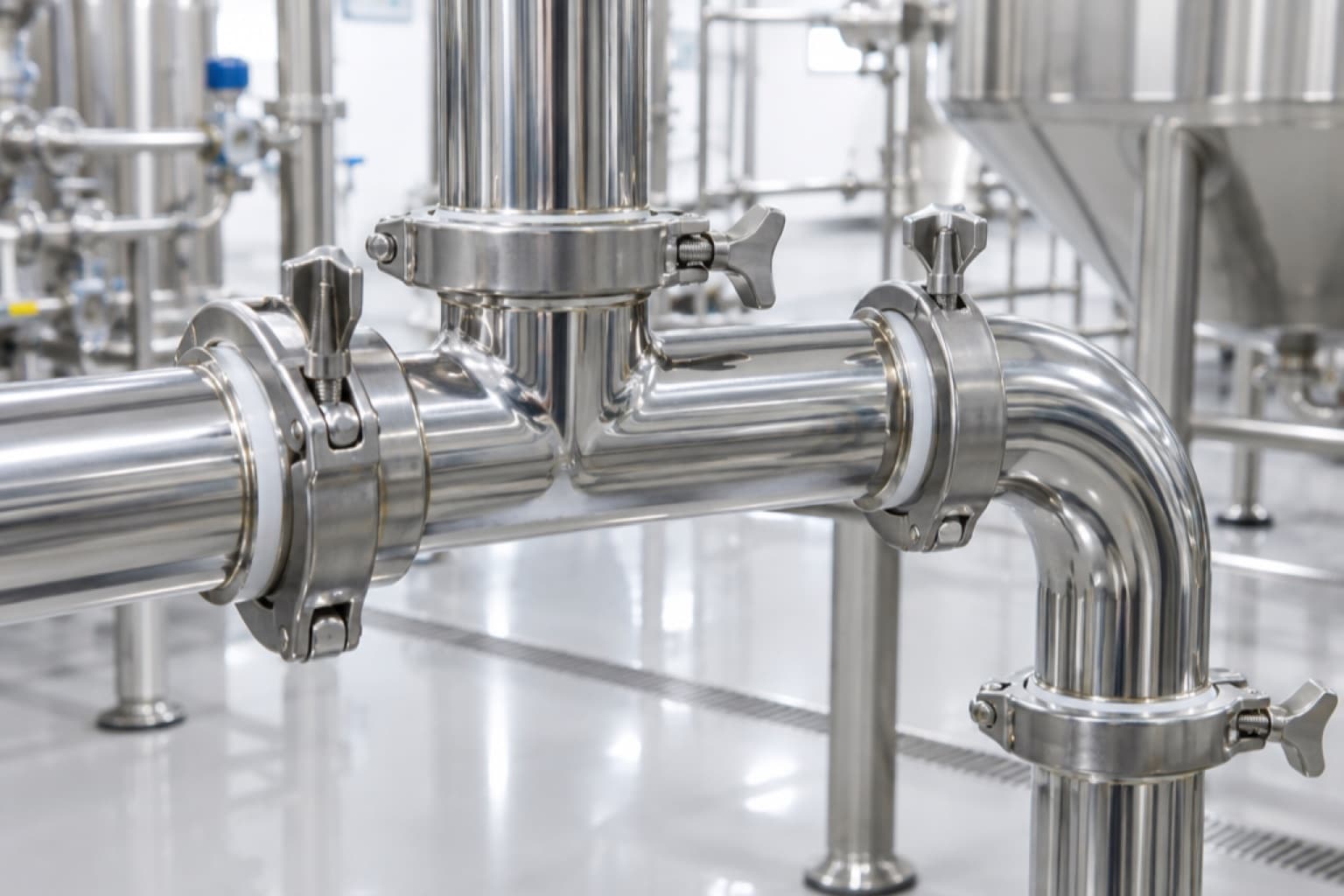
Walk through any dairy, brewery, juice plant or pharmaceutical suite and the pipework comes apart by hand: a hinged clamp, a wing nut, two polished flanges and a white gasket. That is the tri-clamp joint, and it exists because a hygienic line has to be opened, inspected and cleaned without leaving anywhere for product to lodge. This guide covers how the joint works, how its sizes are counted, what it is rated for, and the choices — gasket, grade, finish — that decide whether it stays clean and tight.
/01How the joint seals.
A clamp connection is three parts. Two ferrules — short lengths of tube with a flange on one end — are welded to the tube ends. A gasket sits between the flange faces. A clamp closes over the outside of both flanges. Dixon draws the flange back faces with a 20° taper on sizes from 1" to 12", and notes that the flanges are symmetrical: there is no male and no female ferrule, so any two of the same size mate. Closing the clamp rides it down the tapers, which pulls the ferrules together and squeezes the gasket.
The bore of the ferrule matches the bore of the tube, and the gasket sits flush with it, so the inside of the joint is smooth — no thread, no recess, no ledge for product or bacteria to collect. That, more than speed of assembly, is why hygienic plants use it.
/02Sizes: tube OD, and the shared flanges.
Sanitary fittings are sized by the outside diameter of the tube, not by nominal pipe size. A 2" sanitary tube measures 2.000" across; a 2" pipe measures 2.375". Dixon publishes a separate series of pipe-size clamp ferrules, and for the same nominal size the flange is different — a 2" pipe-size ferrule has a 3.047" flange, a 2" tube ferrule a 2.516" one — so a "2-inch" tube clamp and a "2-inch" pipe clamp do not fit each other. Always say which you mean.
The clamp size is set by the flange, and two pairs of tube sizes share one. Alfa Laval and Dixon both show it:
| Tube OD | Wall | Tube ID | Clamp flange (A) | Shares a clamp with |
|---|---|---|---|---|
| ½" | 0.065" (16 ga) | 0.37" | 0.984" (mini) | ¾" |
| ¾" | 0.065" (16 ga) | 0.62" | 0.984" (mini) | ½" |
| 1"Highlighted | 0.065" (16 ga) | 0.87" | 1.984" (50.5 mm) | 1½", DIN 32676 DN25, ISO 2852 38 mm |
| 1½"Highlighted | 0.065" (16 ga) | 1.37" | 1.984" (50.5 mm) | 1", DIN 32676 DN25, ISO 2852 38 mm |
| 2" | 0.065" (16 ga) | 1.87" | 2.516" | — |
| 2½" | 0.065" (16 ga) | 2.37" | 3.047" | 2" pipe-size ferrule |
| 3" | 0.065" (16 ga) | 2.87" | 3.579" | — |
| 4" | 0.083" (14 ga) | 3.87" | 4.682" | — |
Two details catch buyers out. The mini flange is given as 0.984" by Alfa Laval and 0.992" by Dixon — about 25 mm either way — so if you are mixing makers, check before relying on it. And the wall is 0.065" (16 gauge) only up to 3"; from 4" it is 0.083" (14 gauge), and Alfa Laval lists 6" and 8" tube at 0.109".
Metric clamps
In Europe the clamp is DIN 32676 or ISO 2852. The 50.5 mm flange of a DIN 32676 DN25 ferrule (29 × 1.5 mm tube) and an ISO 2852 38 mm ferrule is the same flange as the inch 1" and 1½" — which is why one clamp closes all of them. The tube underneath is not the same, so a metric and an inch ferrule on one clamp still need matching bores to stay hygienic. Alfa Laval notes that DIN 11850 tube was replaced by EN 10357 in 2014, whose series A follows the old DIN sizes and series C follows ASME BPE.
/03What a clamp is rated for.
A clamp rating is a rating for the clamped union — clamp, two ferrules and gasket together — and it falls with size and temperature. Steel & O’Brien state the assumptions: elastomer gaskets, weld ferrules, a properly aligned joint, wing nuts torqued to 25 in·lb, and no water hammer. They add that the clamp on its own would rate higher, but that figure means nothing without the gasket.
| Clamp | 1–1½" | 2" | 2½" | 3" | 4" | 6" |
|---|---|---|---|---|---|---|
| Standard heavy-duty, single pin (13MHHM)Highlighted | 500 / 300 | 450 / 300 | 400 / 200 | 350 / 195 | 300 / 150 | 150 / 75 |
| Heavy-duty (13MHHS) | 600 / 300 | 550 / 275 | 450 / 225 | 350 / 175 | 300 / 150 | — |
| High-pressure bolted (13MHP) | 1,000–1,500 / 800–1,200 | 1,000 / 800 | 1,000 / 800 | 1,000 / 800 | 800 / 600 | 300 / 200 |
Makers do not always agree. For the 1–1½" bolted clamp, Alfa Laval and VNE give 1,500 psi at 70 °F while Steel & O’Brien give 1,000; for the 4" standard clamp, VNE gives 200 psi against the others’ 300. Use the figure of the clamp you are actually fitting. Two maker rules are worth repeating: Alfa Laval recommends only bolted high-pressure clamps above 250 °F, and Steel & O’Brien do not recommend PTFE gaskets in bolted high-pressure clamps. Light-duty hinged clamps (VNE’s EG13 is rated 150 psi at 70 °F) belong on low-pressure gravity and transfer lines.
/04Gaskets: choose for the process, not the price.
| Gasket | Temperature | Good with | Poor with |
|---|---|---|---|
| EPDMHighlighted | −60 to 300 °F (−51 to 149 °C) | Steam, hot water, alkaline CIP, acids | Fats and oils |
| FKM (Viton) | −20 to 350 °F (−29 to 177 °C) | Oils, fats, acids | Alkalis (poor to good) |
| Buna-N (NBR) | −65 to 200 °F (−54 to 93 °C) | Fats and oils, abrasion | Higher temperatures |
| Silicone | −40 to 400 °F (−40 to 204 °C) | Heat; low compression set | Abrasion, oils, alkali |
| PTFE | −40 to 200 °F (−40 to 93 °C) | Almost all chemicals, fats, alkalis | Cold flow — limits temperature |
Alfa Laval limits PTFE to 200 °F not because the polymer cannot take heat but because it cold-flows and does not compress, so a hot PTFE gasket can creep and leak. Other makers publish different temperature limits for nominally the same materials, so quote the gasket maker’s own figures.
For food contact in the US the rubber is made to FDA 21 CFR 177.2600, which sets extraction limits for repeated-use rubber articles — for aqueous foods no more than 20 mg/in² in the first seven hours and 1 mg/in² in the next two. For pharmaceutical lines, Alfa Laval offers EPDM, FKM and silicone gaskets with a USP Class VI certificate on request.
Which gasket?
IfSteam sterilising or hot alkaline CIP, no fat?
EPDM.
IH-PF-SF04GIfDairy cream, edible oils, fats?
FKM (or Buna-N at lower temperature) — not EPDM.
IfAggressive chemicals or a mix of products?
PTFE, kept below its temperature limit and not in a bolted high-pressure clamp.
IH-PF-SF16GIfHot product, low pressure, frequent opening?
Silicone.
/05Grade, finish and the standards.
304 or 316L
Clamp fittings come in both. Alfa Laval’s chemistry shows the difference: 304 is 18–20% chromium and 8–13% nickel; 316L drops carbon to 0.030% and adds 2–3% molybdenum, which is what resists chlorides — brines, salted products, chlorinated cleaning water. Use 316L on product contact where any of those appear; 304 suits water, beer and general transfer. Do not mix them in one line. See 304 vs 316.
3-A
3-A Sanitary Standards date from dairy equipment in the 1920s; the 3-A Symbol has been licensed since 1956, now with a third-party inspection. The fittings standard, 3-A 63-04, covers fittings from the connection up to and including the gasket — and explicitly excludes the clamps themselves. Alfa Laval’s hygienic range quotes an internal finish of Ra < 0.8 µm (about 32 µin) to 3-A.
ASME BPE
For bioprocessing and pharmaceutical lines, ASME BPE sets materials, dimensions, tolerances, marking and finish. BPE fittings are 316L, and their weld ends carry controlled sulphur of 0.005–0.017%, which Steel & O’Brien say improves orbital weld consistency and penetration. Finishes are designated by maximum Ra on product contact:
| Designation | Ra max | Process |
|---|---|---|
| SF1Highlighted | 20 µin (0.51 µm) | Mechanically polished |
| SF2 | 25 µin (0.64 µm) | Mechanically polished |
| SF3 | 30 µin (0.76 µm) | Mechanically polished |
| SF4 | 15 µin (0.38 µm) | Mechanically polished and electropolished |
| SF5 | 20 µin (0.51 µm) | Mechanically polished and electropolished |
| SF6 | 25 µin (0.64 µm) | Mechanically polished and electropolished |
Sanitary Fittings
Covers sanitary fittings from the equipment or pipeline connection up to and including the gasket, O-ring or seal. It does not cover the clamps, recessed ferrules attached by expansion or soldering, or rolled-on fittings; fittings on hose assemblies come under 3-A 62.
/06The fittings, and the other hygienic unions.
A clamp system is built from a small set of shapes: weld ferrules (short, long, recessless and tank-weld), clamp-end and weld-end 45° and 90° elbows, tees and reducing tees, concentric and eccentric reducers, end caps, and adapters to NPT thread or to hose. BPE elbows are drawn on a centreline radius of 1.5 × tube OD.
Clamps are not the only hygienic union, and the others do not interchange with them or with each other:
- Bevel seat — a plain and a threaded bevel-seat ferrule drawn together by a hex nut on an Acme thread; long used on North American dairy.
- I-Line — male and female ferrules held by a 37° clamp (30° on 6–8"); its flanges are not tri-clamp sizes.
- DIN 11851 — the German dairy union with a round slotted nut, for DIN 11850 tube.
- SMS 1145, IDF (ISO 2853) and RJT — Swedish, international and British dairy unions, each with its own thread form.
What we list
Every sanitary listing in 304 and 316 stainless — clamp-end and weld-end fittings, ferrules, bevel-seat and I-Line parts, adapters, gaskets, tube hangers and sanitary tube:
- 304 Stainless Steel Sanitary Clamp-End 45° Elbow
- 304 Stainless Steel Sanitary Clamp-End 90° Elbow
- 304 Stainless Steel Sanitary Bevel-Seat Hex Nut
- 304 Stainless Steel Sanitary Clamp-End Eccentric Reducer
- 304 Stainless Steel Sanitary Clamp × NPT Female Adapter
- 304 Stainless Steel Sanitary Long Plain Bevel-Seat Ferrule
- 304 Stainless Steel Sanitary Long Weld Ferrule, Clamp End
- 304 Stainless Steel Sanitary Clamp × NPT Male Adapter
- 304 Stainless Steel Sanitary Clamp-End Concentric Reducer
- 304 Stainless Steel Sanitary Clamp × Rubber Hose Adapter
- 304 Stainless Steel Sanitary Recessless Ferrule, Clamp End
- 304 Stainless Steel Sanitary Clamp-End Reducing Tee
- 304 Stainless Steel Sanitary Short Plain Bevel-Seat Ferrule
- 304 Stainless Steel Sanitary Short Weld Ferrule, Clamp End
- 304 Stainless Steel Sanitary Clamp-End Tee
- 304 Stainless Steel Sanitary Tank Weld Ferrule, Clamp End
- 304 Stainless Steel Sanitary Female I-Line Short Weld Ferrule
- Sanitary Clamp Gasket, EPDM
- 304 Stainless Steel Sanitary Tube Hanger with Grommets
- 304 Stainless Steel Sanitary Tube Hanger with Sleeves
- 304 Stainless Steel Sanitary Heavy-Duty I-Line Clamp
- 304 Stainless Steel Sanitary Long-Thread Bevel-Seat Ferrule
- 304 Stainless Steel Sanitary Male I-Line Short Weld Ferrule
- 304 Stainless Steel Sanitary Solid End Cap, Clamp
- 304 Stainless Steel Sanitary Short-Thread Bevel-Seat Ferrule
- 316 Stainless Steel Sanitary Clamp-End 45° Elbow
- 316 Stainless Steel Sanitary Clamp-End 90° Elbow
- 316 Stainless Steel Sanitary Clamp-End Eccentric Reducer
- 316 Stainless Steel Sanitary Clamp × NPT Female Adapter
- 316 Stainless Steel Sanitary Long Weld Ferrule, Clamp End
- 316 Stainless Steel Sanitary Clamp × NPT Male Adapter
- 316 Stainless Steel Sanitary Clamp-End Concentric Reducer
- 316 Stainless Steel Sanitary Recessless Ferrule, Clamp End
- 316 Stainless Steel Sanitary Clamp-End Reducing Tee
- 316 Stainless Steel Sanitary Short Weld Ferrule, Clamp End
- 316 Stainless Steel Sanitary Clamp-End Tee
- 316 Stainless Steel Sanitary Tank Weld Ferrule, Clamp End
- 316 Stainless Steel Sanitary Clamp-End Check Valve
- Sanitary Clamp Gasket, PTFE
- 316 Stainless Steel Sanitary Tube Hanger with Sleeves
- 316 Stainless Steel Sanitary Solid End Cap, Clamp
- 316 Stainless Steel Sanitary Clamp-End Sight Glass
- 316 Stainless Steel Sanitary Tygon Hose Adapter, Clamp End
- 316 Stainless Steel Sanitary Tube Plate Flange
- 316 Stainless Steel Sanitary Weld-End 45° Elbow
- 316 Stainless Steel Sanitary Weld-End 90° Short-Radius Elbow
- 316 Stainless Steel Sanitary Weld-End 90° Long-Radius Elbow
- 316 Stainless Steel Sanitary Weld-End Concentric Reducer
- 316 Stainless Steel Sanitary Weld-End Eccentric Reducer
- 316 Stainless Steel Sanitary Weld-End Reducing Tee
- 316 Stainless Steel Sanitary Weld-End Tee
- 304 Stainless Steel Sanitary Tubing
- 316 Stainless Steel Sanitary Tubing
Common questions
- What size is a 1.5" tri-clamp?
- A 1½" sanitary tube is 1.5" OD with a 1.984" (50.5 mm) clamp flange — the same flange as a 1" ferrule, so one 1–1½" clamp fits both.
- Is a 2" tri-clamp the same as a 2" pipe clamp?
- No. Sanitary tube is sized by OD (2.000"), pipe by nominal size (2.375" OD). A 2" tube ferrule has a 2.516" flange and a 2" pipe-size ferrule a 3.047" one; they do not mate.
- What pressure can a tri-clamp hold?
- It depends on size, clamp type and temperature. A standard 1–1½" heavy-duty clamp is rated about 500 psi at 70 °F and 300 psi at 250 °F; 4" about 300 / 150 psi; bolted high-pressure clamps 800–1,500 psi. Use the clamp maker’s own table.
- Which tri-clamp gasket is best for steam?
- EPDM is the usual choice for steam and alkaline CIP. It is poor with fats and oils, where FKM is used instead.
- Can I use PTFE tri-clamp gaskets?
- Yes, for chemical resistance, but PTFE cold-flows: Alfa Laval limits it to about 200 °F, and Steel & O’Brien do not recommend it in bolted high-pressure clamps.
- Are tri-clamp fittings 3-A approved?
- Fittings can be made to 3-A 63-04, which covers fittings up to and including the gasket. The clamps themselves are outside that standard.
- What does SF1 mean on a sanitary fitting?
- An ASME BPE surface designation: mechanically polished product-contact surface, maximum 20 µin (0.51 µm) Ra. SF4 is electropolished to 15 µin.
Sanitary fittings
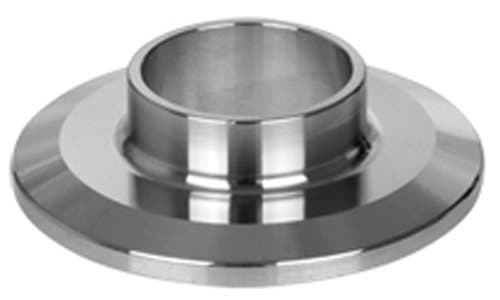 IH-PF-SF16CSF16316 Stainless Steel Sanitary Short Weld Ferrule, Clamp EndIndus Hydraulics
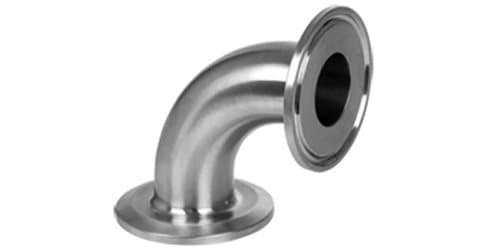 IH-PF-SF16C90E316 Stainless Steel Sanitary Clamp-End 90° ElbowIndus Hydraulics
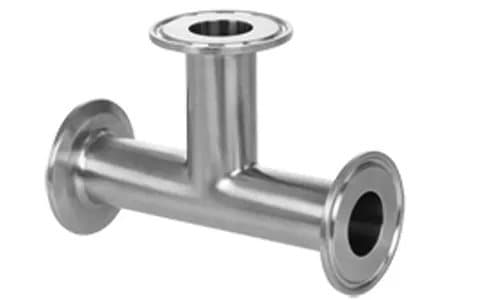 IH-PF-SF16CT316 Stainless Steel Sanitary Clamp-End TeeIndus Hydraulics
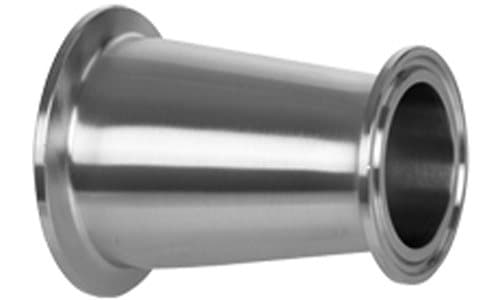 IH-PF-SF16CR316 Stainless Steel Sanitary Clamp-End Concentric ReducerIndus Hydraulics
- IH-PF-SF16SC316 Stainless Steel Sanitary Solid End Cap, ClampIndus Hydraulics
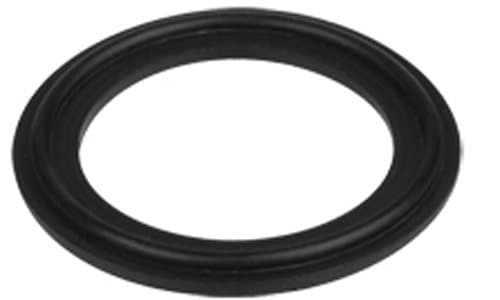 IH-PF-SF04GSanitary Clamp Gasket, EPDMIndus Hydraulics
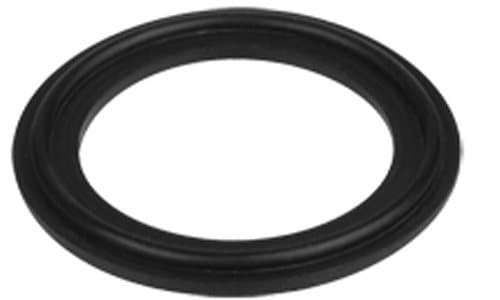 IH-PF-SF16GSanitary Clamp Gasket, PTFEIndus Hydraulics
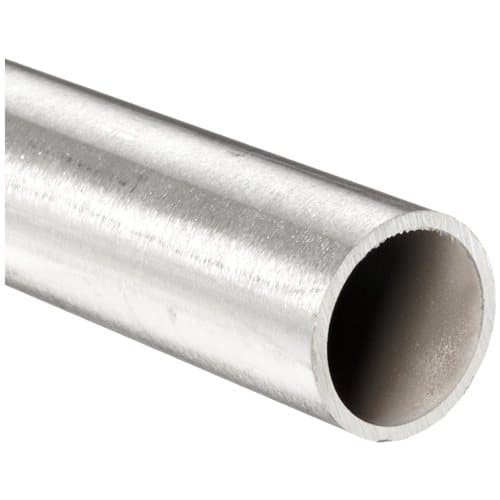 IH-PF-SNT6316 Stainless Steel Sanitary TubingIndus Hydraulics
Sources
- 1.Alfa Laval. Tubes and Fittings Introduction (installation material product leaflet). ↗
- 2.Dixon Sanitary. Sanitary Fittings Identification (2014). ↗
- 3.Steel & O’Brien. Stainless Steel Sanitary Clamp — Temperature/Pressure Ratings. ↗
- 4.Steel & O’Brien. BPE Fittings Specifications. ↗
- 5.US Code of Federal Regulations, 21 CFR 177.2600 — Rubber articles intended for repeated use. ↗