Stainless is not one material, and "stainless fitting" is not a specification. The two grades you will be offered for almost every fitting — 304 and 316 — look identical, machine alike and cost a little differently. In fresh water and food they behave alike too. Bring chlorides into the picture — sea air, brine, chlorinated cleaning water, salty product — and they part company. This guide explains why, and how to choose.
/01What is in them.
| Grade | EN | C | Cr | Ni | Mo |
|---|---|---|---|---|---|
| 304 | 1.4301 | 0.04 | 18.1 | 8.1 | — |
| 304L | 1.4307 | 0.02 | 18.1 | 8.1 | — |
| 316Highlighted | 1.4401 | 0.04 | 17.2 | 10.1 | 2.1 |
| 316LHighlighted | 1.4404 | 0.02 | 17.2 | 10.1 | 2.1 |
Chromium forms the passive film that makes stainless stainless. Molybdenum strengthens that film where chloride ions try to break through it — Outokumpu says plainly that it is the molybdenum that lets the CrNiMo grades serve where corrosion resistance demands more. The specification range for 316 is 2.0–3.0% Mo; typical mill product sits near the bottom of it. Castings use their own designations: CF8 is the cast equivalent of 304 and CF8M of 316, which is what a cast 150# fitting is made of.
/02Pitting: PREN.
The pitting resistance equivalent number weights the alloying elements by how much they help: PRE = %Cr + 3.3 × %Mo + 16 × %N. Alleima’s duplex datasheet gives 316L at 24, 317L at 30 and SAF 2205 above 35. Worked from Outokumpu’s typical figures, 304 comes out at about 18–19. The gap between 304 and 316 is almost entirely the molybdenum term. PREN is a ranking, not a guarantee: it says which grade pits first, not whether a given grade will pit in a given service.
| Grade | PRE | Source |
|---|---|---|
| 304 | ≈ 18–19 | Calculated from Outokumpu typical composition |
| 316LHighlighted | 24 | Alleima |
| 317L | 30 | Alleima |
| Duplex 2205 | > 35 | Alleima |
/03The 60 °C limit: chloride stress-corrosion cracking.
Molybdenum does not save 316 from the other chloride failure. Alleima states that both 304L and 316L are prone to stress-corrosion cracking in chloride-bearing solutions above 60 °C (140 °F), and lower still where hydrogen sulphide is present. SSINA, the US stainless industry body, agrees that chloride SCC is rare below 60 °C — under full immersion. Under evaporative conditions, where a few ppm of chloride dries out and concentrates to hundreds, stainless can crack well below that threshold.
That is the Gulf case: insulated hot lines that get wet under the cladding, splash zones, cooling-water evaporation, salt deposited on hot surfaces in the sun. There the choice is no longer 304 or 316 but whether either austenitic grade belongs at all. Alleima says duplex 2205 has much higher SCC resistance than the standard austenitic grades and can be used at considerably higher temperatures and chloride levels without pitting.
/04L grades and welding.
Heat a standard-carbon austenitic stainless steel through roughly 425–815 °C — which the band beside every weld passes through — and chromium carbides form at the grain boundaries, leaving the metal next to them short of chromium. That sensitised band corrodes along the grain boundaries a few millimetres from the weld: weld decay. The L grades cap carbon at 0.03%, too little to form significant carbide during welding. So the rule is simple: specify 304L or 316L for butt-weld and socket-weld fittings, flanges and anything else that will be welded. Dual-certified 316/316L material meets both specifications.
/05Choosing.
304, 316 or something else?
IfFresh water, air, beer, dry indoor service?
304 (304L if welded).
IH-PF-W490LES4IfCoastal or offshore air, sea spray, brine, chlorinated cleaning water, salty product?
316 (316L if welded).
IH-PF-W490LES6IfChlorides above about 60 °C, or chlorides drying on a hot surface?
Question austenitic grades — duplex 2205 or higher alloy.
IfAny welding?
An L grade, whichever base grade you chose.
Two practical rules finish it. Keep one grade through a line: a 304 elbow in a 316 system becomes its weakest point, and a stainless fitting next to plain carbon steel in salt air invites galvanic attack on the steel. And remember the crevices — threads, socket-weld gaps, gasket faces and clamps under insulation are where chlorides concentrate first; see stainless in salt air and when stainless is worth it.
Common questions
- What is the difference between 304 and 316 stainless fittings?
- 316 contains about 2–3% molybdenum and a little more nickel; 304 contains none. The molybdenum gives 316 much better resistance to pitting and crevice corrosion in chlorides.
- Is 316 stainless suitable for seawater?
- For sea air and splash it is the usual minimum. In warm seawater and crevices it can still pit, and above about 60 °C with chlorides it can stress-corrosion crack; duplex or higher alloys are used there.
- What does the L in 316L mean?
- Low carbon — 0.03% maximum. It stops the area beside a weld sensitising and corroding along grain boundaries. Use L grades for anything welded.
- What is CF8M?
- The cast equivalent of 316 stainless (CF8 is the cast 304). Cast 150# threaded fittings are usually CF8 or CF8M.
- What is PREN?
- Pitting resistance equivalent number: %Cr + 3.3 × %Mo + 16 × %N. Higher is more resistant to pitting. 316L is about 24, duplex 2205 over 35.
- Can I mix 304 and 316 fittings?
- They can be joined, but the line is only as resistant as its 304 parts. Keep one grade through a system exposed to chlorides.
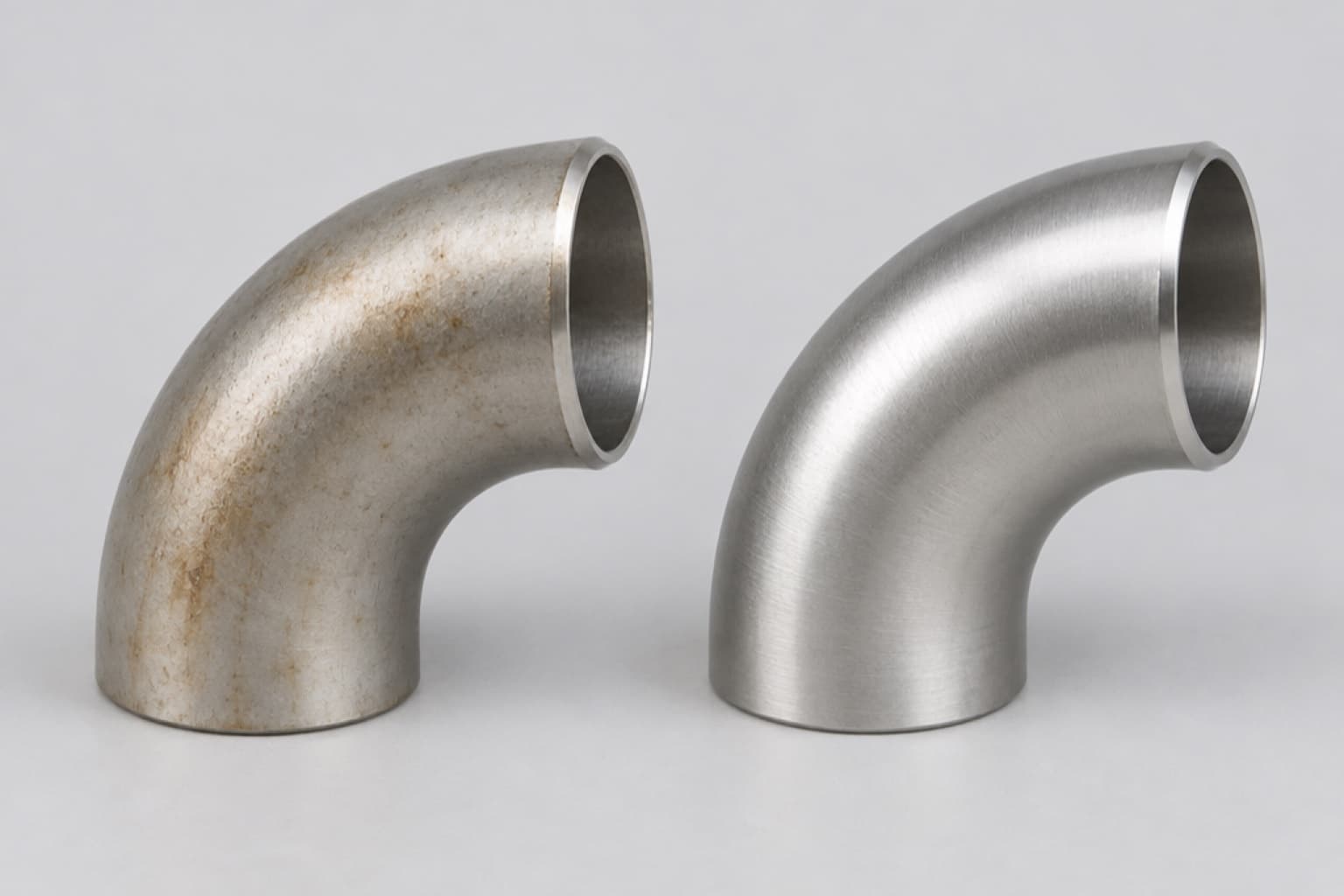
The same fittings in 304 and 316
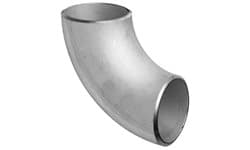 IH-PF-W490LES4304 Stainless Steel Butt-Weld 90° Long-radius Elbow, Sch 40Indus Hydraulics
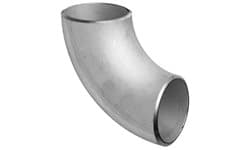 IH-PF-W490LES6316 Stainless Steel Butt-Weld 90° Long-radius Elbow, Sch 40Indus Hydraulics
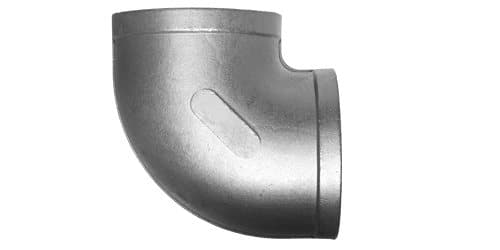 IH-PF-C90-B4304 Stainless Steel 150# Cast Threaded 90° ElbowIndus Hydraulics
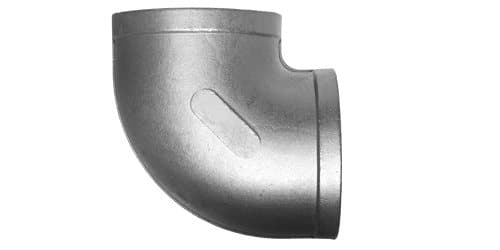 IH-PF-C90-B6316 Stainless Steel 150# Cast Threaded 90° ElbowIndus Hydraulics
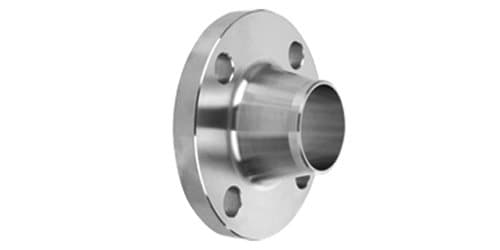 IH-PF-WNRF-304304 Stainless Steel Weld Neck Raised Face FlangeIndus Hydraulics
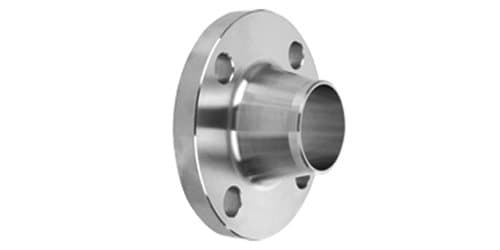 IH-PF-WNRF-316316 Stainless Steel Weld Neck Raised Face FlangeIndus Hydraulics
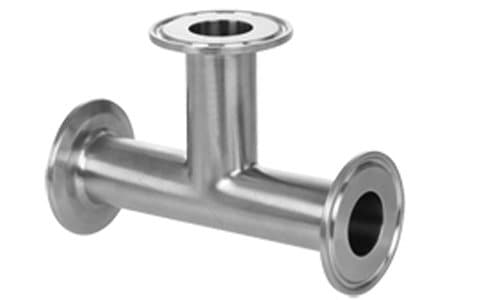 IH-PF-SF04CT304 Stainless Steel Sanitary Clamp-End TeeIndus Hydraulics
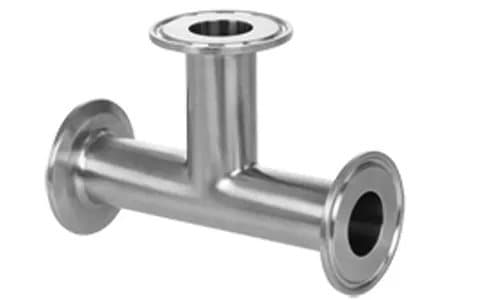 IH-PF-SF16CT316 Stainless Steel Sanitary Clamp-End TeeIndus Hydraulics