
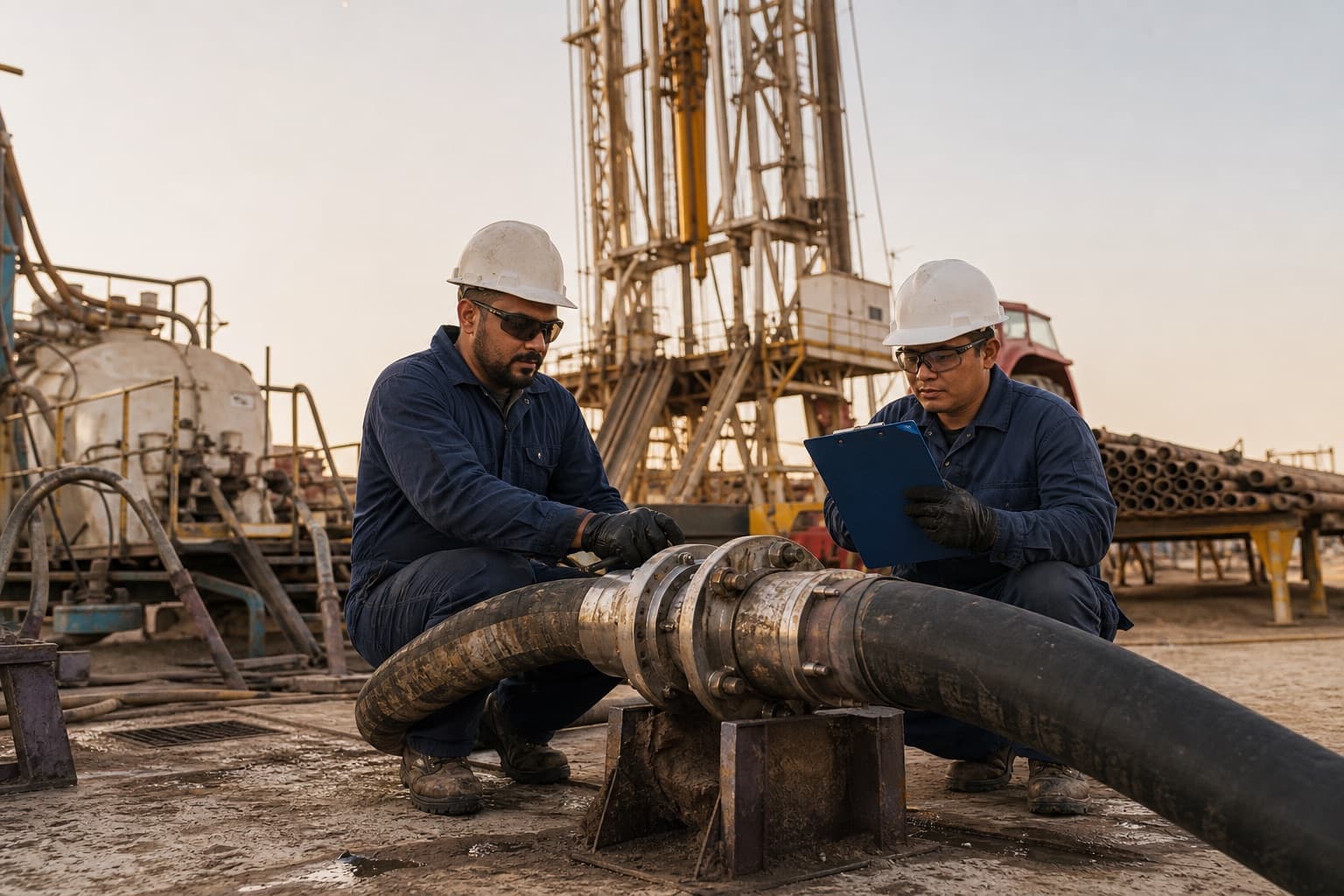
Ask what delayed a rig hose replacement and the answer is almost never the hose. It is that the visit needed a permit, the permit needed a scope, the scope needed the assembly specified, and the assembly needed identifying — a sequence that runs for hours while the rig stands.
Two categories, two routes.
| Circuit | Route | Why |
|---|---|---|
| Choke and kill, well control | Supplied as a certified assembly | API 16C qualification belongs to the assembly, ends included |
| BOP control hose | Supplied as a certified assembly | Fire rating is qualified by test — it cannot be field-built |
| Rotary and vibrator | Supplied as a certified assembly | API 7K coupling method is applied at manufacture |
| HPU and auxiliary hydraulics | On site | Standard hydraulic assemblies to EN or SAE |
| Power tongs, catwalk, ancillary | On site | Same — measure, crimp, fit |
That split is not a commercial preference, it is what the specifications require. A choke and kill line is qualified as a complete assembly with its flanged ends; a rotary hose carries a coupling method applied under controlled conditions at manufacture. Neither is something a mobile unit can legitimately produce at a wellsite, and anyone offering to is offering an unqualified assembly.
The permit is the timeline.
What actually delays a rig-site hose replacement?
Access. The physical work of measuring, building and fitting a general hydraulic assembly is short. Writing the permit, arranging escorted access, confirming safety training and getting the crew to the location is what consumes the day — which is why the assemblies you already hold on site are worth far more than their cost.
Habshan, Al Dhafra and the coast.
The Al Dhafra region and Habshan are gas and processing country, and the access regime reflects it — permit to work, escorted movement, and safety training verified before arrival rather than on the day. Mussafah and ICAD, by contrast, are workshop and fabrication environments where a mobile unit can generally be dispatched and inducted the same day. The hose work is often identical; the planning is not.
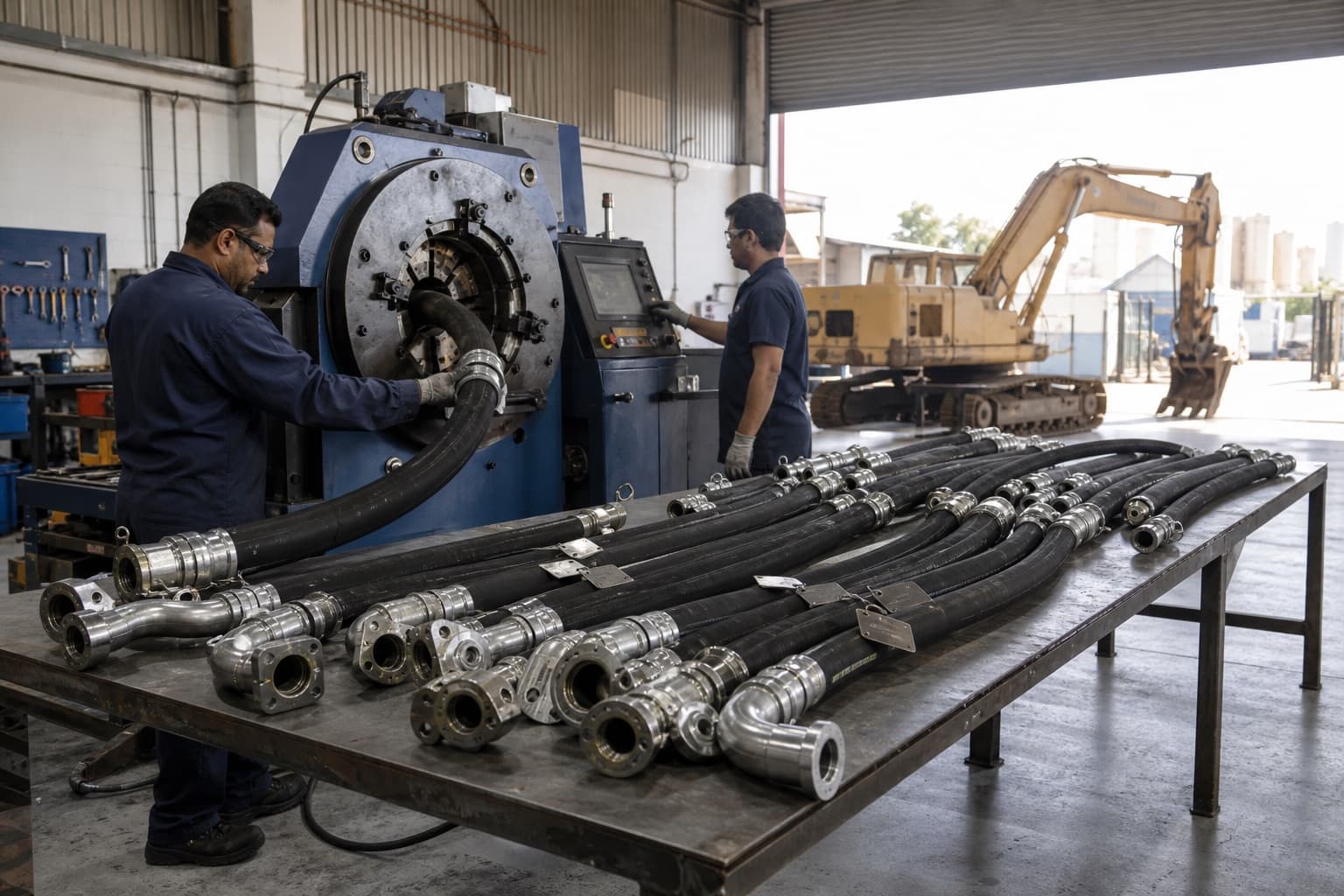
Where a rig or unit is being recommissioned rather than repaired, bulk build in the bay wins outright. Our 112-assembly refit for a cold-stacked rig was built and tagged over 14 days at the Jebel Ali hose bay — that is a throughput and traceability job, and doing it a hose at a time at the wellsite would have taken far longer and produced a worse record.
Certified oilfield constructions
Common questions
Can you attend a wellsite at short notice?
Subject to the site’s own access and permit regime, which is usually the binding constraint rather than our availability. Tell us the location and the permit requirement when you call and we will be straight about what is achievable.
Do your crews hold H₂S and well-control certification?
Our field service crews are H₂S trained and IWCF carded — that is the basis on which the BOP field-service day-rate crew operates. Confirm the specific certification your site requires and we will confirm what we hold.
Can you supply a certified choke and kill line at short notice?
It depends on the class, size and liner. These are built and certified assemblies rather than stock items in every configuration, so lead time is a real constraint — which is the argument for holding the critical ones.
What is worth pre-staging?
The assemblies whose failure stops the rig, identified from the register rather than from memory. It is usually a much shorter list than people expect, and it is the highest-return spares decision available.
Oil & gas hose
Drilling, well control and low-pressure oilfield constructions, supplied certified.
Figures verified · Service scope only. No response-time commitments — rig-site attendance depends on the operator’s access and permit regime.
Industry
Oil and gas
Pressure control, drilling and downstream hose across the Gulf.
Service
112 assemblies for a rig refit
Bulk build and tagging, fourteen days, every hose traceable.
Planning a rig hose scope?
Send the circuit list and the access regime. We will separate what must be supplied certified from what can be built on site, and tell you what is worth holding.
Plant-down? Call +971 52 2477942 — 24/7