
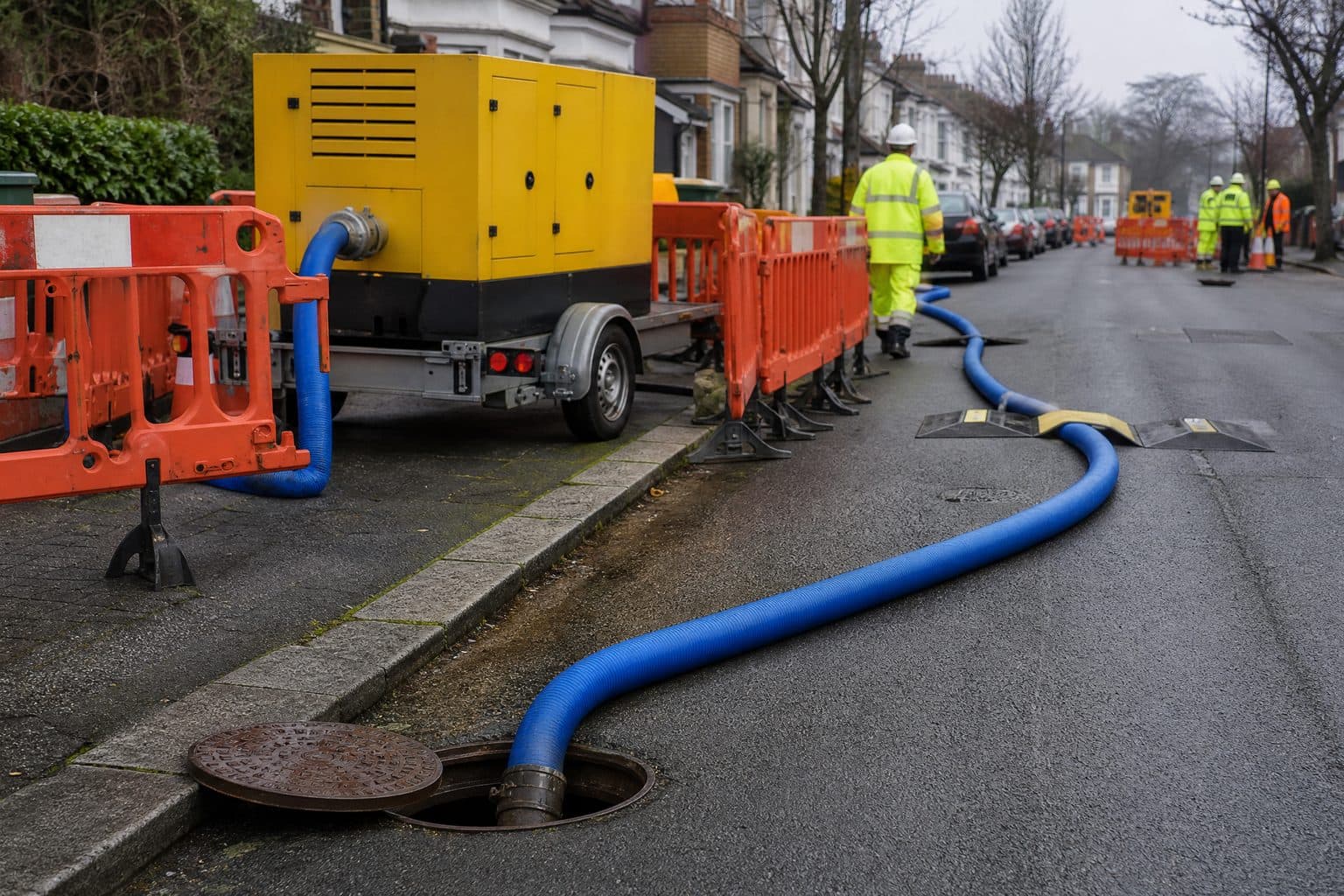
Most of the UK’s water and sewer networks are maintained live. A sewer being relined still receives flow from every house upstream; a main being repaired still has customers expecting water at the tap. The answer in both cases is a temporary bypass laid over the ground — over-pumping for sewage, a temporary overland main for drinking water. The volumes can be large: one published case study of a trunk sewer rehabilitation for an English water company describes over-pumping about 2,200 litres a second through temporary overland pipework.
/01Over-pumping.
In over-pumping, pumps draw from a manhole or wet well upstream of the work and discharge through a temporary line to a manhole downstream. Water companies also use it to manage groundwater infiltration and to keep networks running during pumping-station work. The line has to carry peak flow, including storm flow, for as long as the work lasts — so it is sized on the worst day, not the average one, with standby pumps. Lay flat hose is the quick option for shorter runs and lower flows, laid along kerbs and verges and protected at crossings with hose ramps; for the largest flows and long durations, rigid temporary pipe takes over. See lay flat hose vs HDPE pipe.
Sewage carries rags, grit and fats, so over-pumping hose needs abrasion and chemical resistance: TPU transfer hose for longer, higher-pressure lines, or NBR discharge hose where oil and fats are heavy. Every pump needs rigid suction hose on its inlet, and the discharge end must be secured so it cannot whip out of the receiving manhole when the pump starts.
/02Temporary drinking-water mains.
A temporary overland main bypasses a section of water main that is being repaired, replaced or relined, and keeps customers supplied. In the UK, Water UK’s Technical Guidance Note on Temporary (Overland) Mains and Services treats them as a short-term measure where no other satisfactory supply exists, and installing one as a restricted operation: the people doing it must hold National Water Hygiene registration. The main points:
- A pre-planned temporary main is disinfected, sampled and must pass before it is commissioned.
- All joints and fittings are disinfected with 1,000 mg/L free chlorine.
- The risk of oil, petrol or solvents permeating plastic pipe must be checked; on contaminated land, use barrier pipe.
- Chlorinated water discharged afterwards is dechlorinated where necessary.
- A bypass main moved during relining that has been out of service for 14 days or less and is judged clean can be re-disinfected at 50 mg/L for 30 minutes; otherwise the company’s new-mains procedure applies.
/03Product approval.
In England and Wales, Regulation 31 of the Water Supply (Water Quality) Regulations 2016 governs products used by water companies from source to customer; the Drinking Water Inspectorate (DWI) maintains the approved list. A separate section of that list covers products for emergency, limited use that may not be permanently installed — the DWI asks for its advice before use beyond 90 days on any one occasion, and names flexible hoses among emergency equipment. In the Netherlands, materials in contact with drinking water are certified under the Kiwa Water Mark, recognised by the ministry as proof of compliance. For temporary supplies outside the public network — building sites, events — BS 8551 covers the design and operation of temporary water supply systems.
Our TPU drinking-water hose is blue for identification and its manufacturer lists NSF/ANSI 61 certification, the North American drinking-water standard. That is not a UK Regulation 31 approval or a Kiwa Water Mark: if your water company or authority requires either, tell us before ordering and we will confirm what can be supplied against it.
/04Sizing the bypass.
A drinking-water bypass must carry peak demand at a pressure customers will accept, so friction matters as much as on any pumped line. Over a few hundred metres, one size larger than the main’s outlet often keeps losses acceptable; for longer runs use our friction loss guide. Our TPU drinking-water hose runs from 1-1/2" to 16" — 21 bar up to 2-1/2", 17 bar at 3" and 4", 14–15 bar from 6" to 14" and 10 bar at 16" — in lengths up to 400 m, so long bypasses have few joints to disinfect.
For what drinking-water hose certification does and does not cover, see drinking-water hose and NSF/ANSI 61.
Common questions
- What is over-pumping?
- Pumping sewage or surface water from upstream of a section under repair to a point downstream, through temporary pipe or hose, so the network keeps working during the work.
- Who can install a temporary water main in the UK?
- Water UK guidance treats it as a restricted operation: installers must hold National Water Hygiene registration, and the water company’s procedure applies.
- How is a temporary main disinfected?
- Under Water UK guidance it is disinfected, sampled and must pass before use; joints and fittings are disinfected with 1,000 mg/L free chlorine.
- Is NSF/ANSI 61 accepted in the UK?
- Not as a substitute for Regulation 31 approval for public water supply in England and Wales. Confirm the approval your water company needs before ordering.
- Can over-pumping hose be cleaned and used for drinking water?
- No. Keep sewage and drinking-water hose as separate stocks.
For over-pumping and bypass
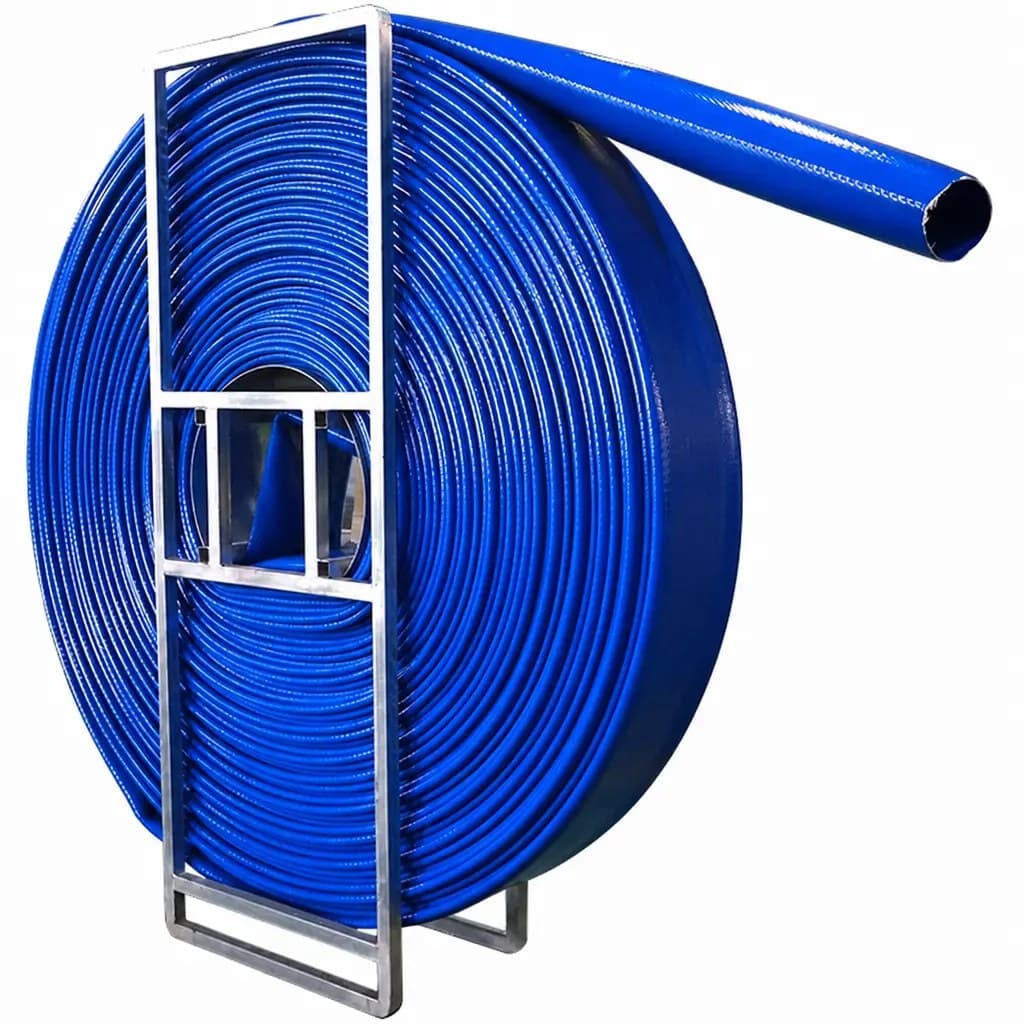 IH-LF-TPWTPU Lay Flat Drinking Water HoseIndus Hydraulics
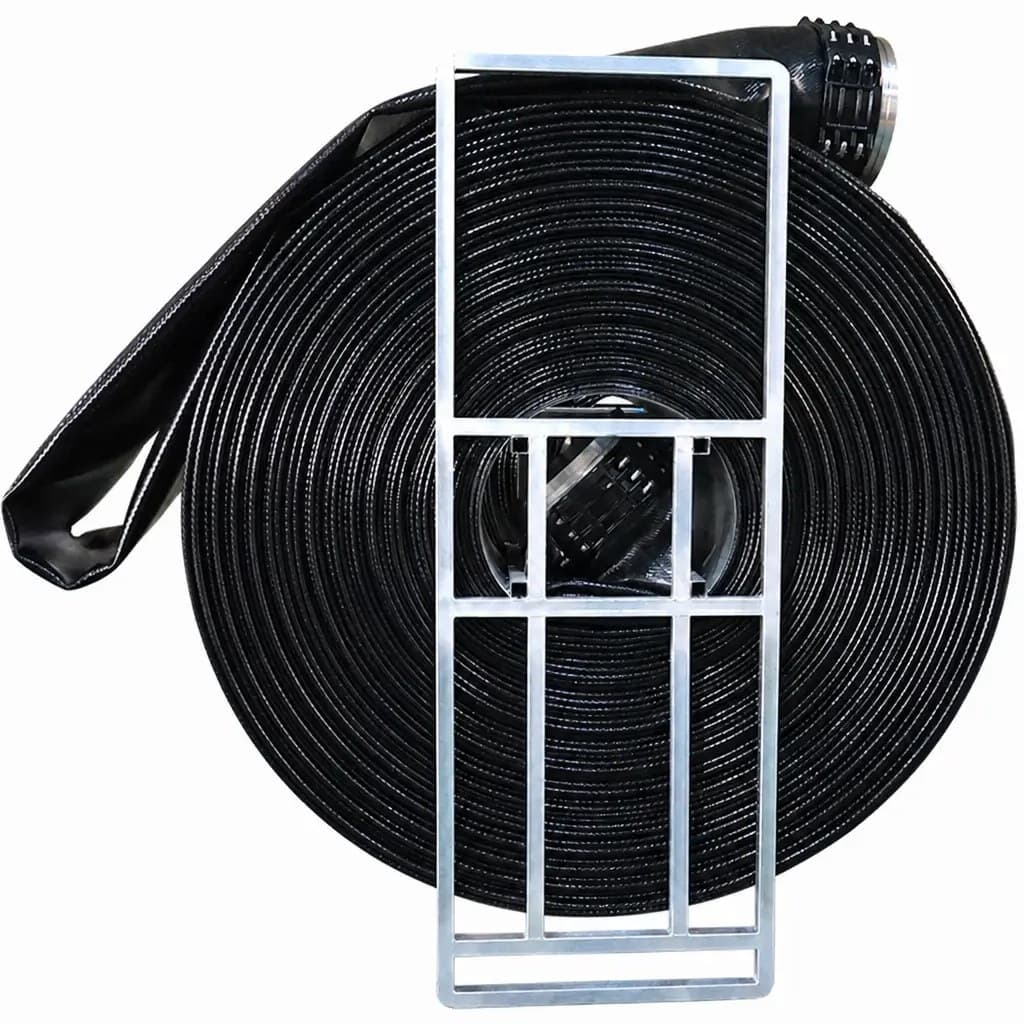 IH-LF-TDWTPU Lay Flat Dewatering and Water Transfer HoseIndus Hydraulics
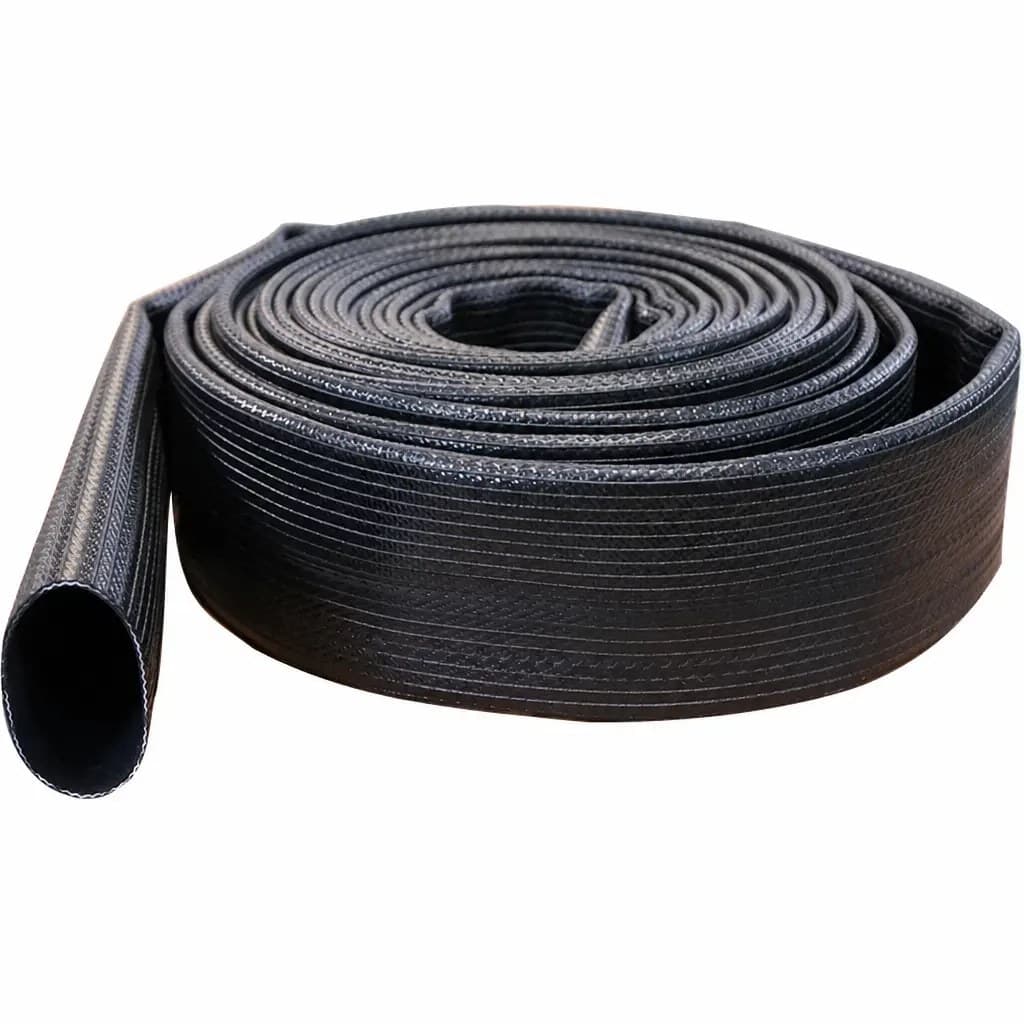 IH-LF-NBRNBR Lay Flat Discharge Hose, Ribbed CoverIndus Hydraulics
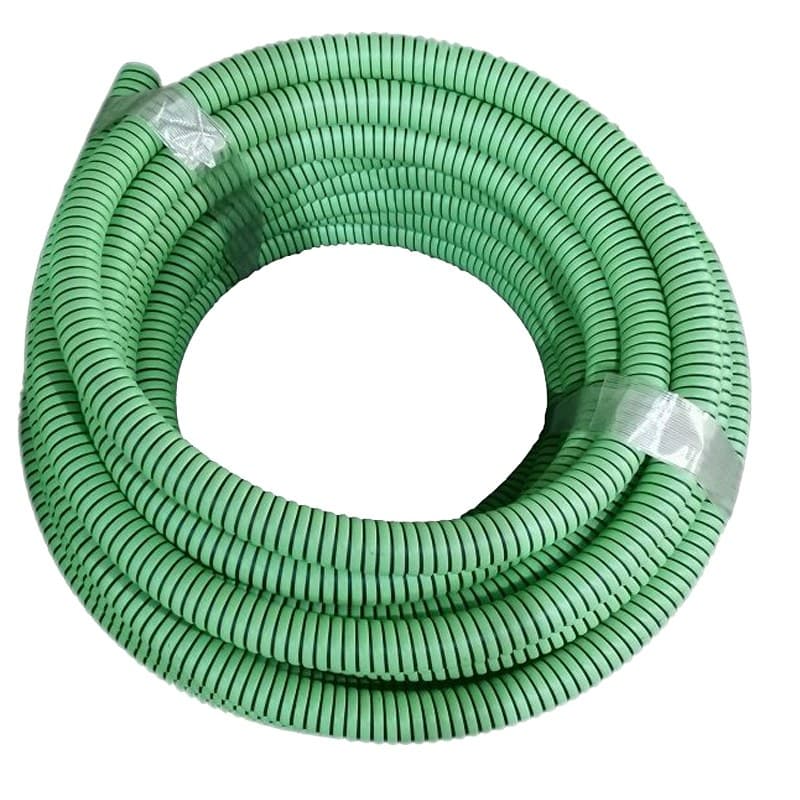 IH-LF-SEPEPDM/PE Suction Hose with Rigid HelixIndus Hydraulics
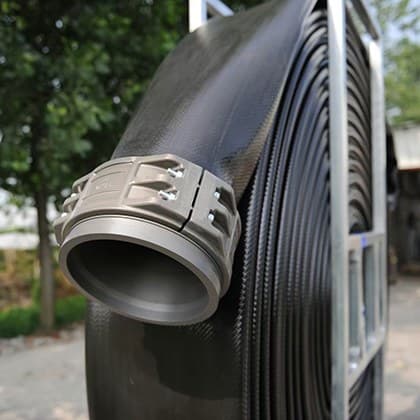 IH-LF-CVGLarge-Bore Lay Flat Hose Coupling, Grooved EndIndus Hydraulics
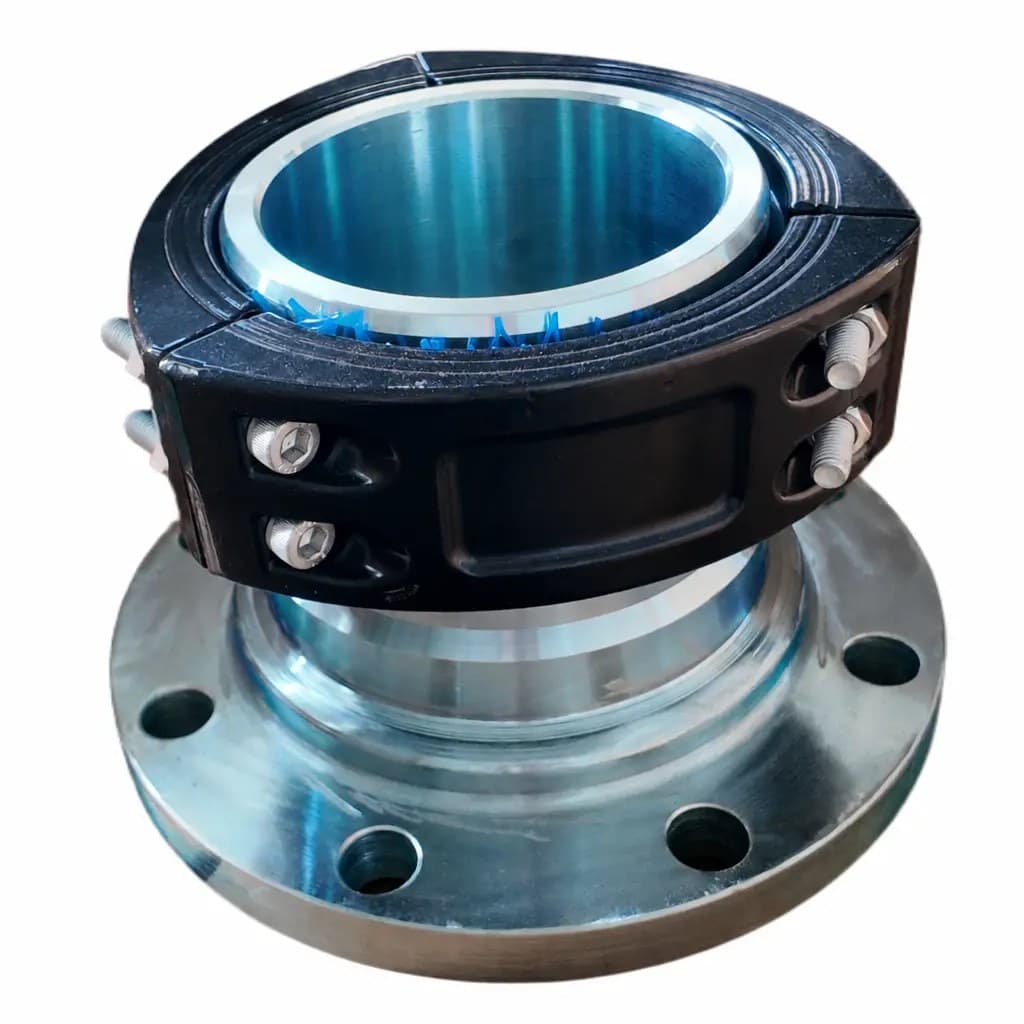 IH-LF-CFLLarge-Bore Flanged Lay Flat Hose CouplingIndus Hydraulics


