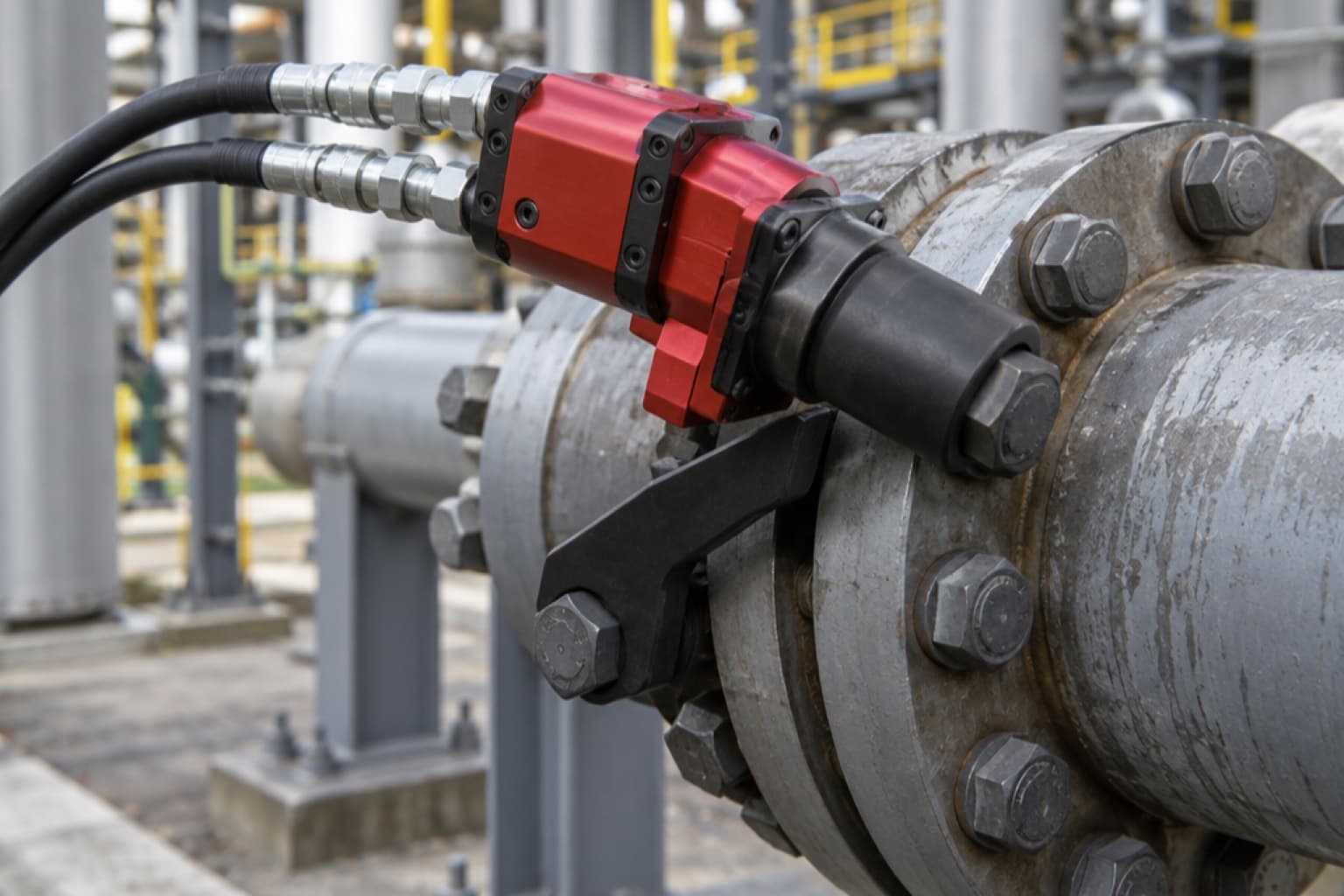
Bolts on pressure flanges, wind towers, heavy machinery and structural steel are tightened to a torque that no person can apply with a bar. A hydraulic torque wrench does it with a piston and ratchet, driven by a 10,000 psi pump, and reacts the force against a neighbouring nut or a fixed point rather than against the operator. Choosing one is mostly a question of fit — the joint decides the tool far more often than the torque does.
/01How a hydraulic torque wrench works.
Oil from the pump pushes a piston, which drives a ratchet through a short arc — 35° on Enerpac’s S-Series and DSX, 30° on the W-Series — then retracts and resets. The reaction arm or paddle braces against an adjacent nut, a flange edge or a fixed structure, so the force goes into the fastener rather than the operator’s hands. Torque is proportional to pump pressure: the wrench’s calibration certificate converts the gauge reading into torque, and Enerpac quotes accuracy of ±3% across the full stroke.
Enerpac’s safety rule for every wrench: hold the tool at its handle only, and never put any part of the body between the wrench and the reaction point.
/02Square drive or low-profile hexagon.
| Series | Type | Torque range | Fits |
|---|---|---|---|
| S-Series (X-Edition)Highlighted | Square drive, steel | 1,440–26,150 ft-lb (1,952–35,455 Nm) | 3/4"–2-1/2" drive sockets |
| DSX | Square drive, aluminium | 1,411–24,057 ft-lb (1,913–32,617 Nm) | 3/4"–2-1/2" drive sockets |
| RSQ | Square-drive head on RSL drive | 1,408–28,002 ft-lb (1,909–37,965 Nm) | 3/4"–2-1/2" drive sockets |
| W-Series (X-Edition)Highlighted | Low-profile hexagon cassettes | 2,040–35,000 ft-lb (2,766–47,453 Nm) | 30–155 mm hex |
| RSL | Low-profile hexagon cassettes | 1,408–28,002 ft-lb | 26–155 mm hex |
| HMT | Modular drive, HLP hex or HSQ square cassettes | 1,541–13,489 ft-lb (2,089–18,289 Nm) | 27–115 mm hex |
Square drive wrenches take a heavy-duty impact socket on the drive and need room above the nut for the socket and the tool body. They are the general-purpose choice: one tool covers many nut sizes by changing the socket, and Allen (hex) drives let the DSX turn socket-head cap screws.
Low-profile hexagon wrenches replace the socket with a slim cassette that slides over the nut from the side. They fit where a socket cannot — close to a flange neck, between bolts on a tight pitch, under a structure — and each cassette covers one nut size, so a job with several sizes needs several cassettes. Enerpac’s W-Series takes stepped-width UltraSlim cassettes for the tightest spaces.
Where there is no hydraulic supply, Enerpac’s PTW pneumatic wrenches (1,000–6,000 ft-lb) run on air regulated to 120 psi at 50 CFM, and its ETW electric wrenches (up to 6,000 ft-lb) store torque-and-angle settings and record each fastener.
/03Sizing the wrench to the joint.
- Start from the tightening torque in the joint procedure — it depends on bolt grade, size and lubricant, never on the tool.
- Allow for breakout. Enerpac: it can take up to 2½ times the tightening torque to break a nut loose, and corrosion raises it further — up to 2× for humidity, 2½× for sea water or chemicals and 3× for heat. When loosening, use no more than 75% of the tool’s maximum.
- Stay above the bottom of the range. Enerpac recommends a minimum of 10% of a wrench’s maximum rated torque.
- Keep margin. Enerpac’s general rule: ratings are maximum safe limits, and good practice uses only 80% of them.
- Check the access — nose radius for a square-drive tool, hex size and clearance for a cassette — and where the reaction arm will land.
/04What has to arrive with the wrench.
- Pump — a 10,000 psi torque-wrench pump with a gauge (electric, air or hand).
- Twin hoses — Enerpac THQ thermoplastic twin hoses, rated 700 bar with a 4:1 safety factor, in 6 ft, 19.5 ft and 39 ft lengths.
- Sockets — BSH heavy-duty impact sockets for 3/4", 1", 1-1/2" and 2-1/2" drives (19–155 mm). Enerpac specifies impact sockets to ISO 2725 and ISO 1174, DIN 3129 and DIN 3121, or ASME B107.2 — never hand sockets.
- Cassettes for low-profile tools, one per nut size.
- Reaction arms, paddles and extensions to reach a reaction point.
- Back-up spanners — BUS spanners hold the back nut so it does not turn; each fits two hex sizes from 27 to 120 mm.
Common questions
- What pressure does a hydraulic torque wrench run at?
- Enerpac rates its hydraulic wrenches at a maximum of 10,000 psi (690 bar); torque is set by adjusting pump pressure against the calibration certificate.
- Square drive or low-profile wrench?
- Square drive where there is room above the nut for a socket; low-profile hexagon cassettes where there is not — near flange necks, on tight bolt pitches or under structures.
- How much bigger should the wrench be for loosening?
- Enerpac warns breakout can take up to 2½ times the tightening torque, and more with corrosion, and advises using no more than 75% of the tool’s maximum when loosening.
- Can I use a normal socket on a hydraulic wrench?
- No. Use heavy-duty impact sockets made to ISO 2725/ISO 1174, DIN 3129/3121 or ASME B107.2.
- How accurate is a hydraulic torque wrench?
- Enerpac quotes ±3% across the stroke for its hydraulic series, provided the tool is used with its calibration certificate and a calibrated gauge.
- What is the smallest torque a wrench should be used for?
- Enerpac recommends no less than 10% of the wrench’s maximum rated torque.
What we list
Hydraulic, pneumatic and electric torque wrenches, and their sockets, cassettes, reaction arms, back-up spanners and hoses:
- Enerpac DSX Aluminium Square Drive Hydraulic Torque Wrenches
- Enerpac HMT Hexagon Hydraulic Torque Wrenches
- Enerpac HSQ Square Drive Hydraulic Torque Wrenches
- Enerpac PTW Pneumatic Torque Wrenches
- Enerpac RSL Low-Profile Hydraulic Torque Wrenches
- Enerpac RSQ Square Drive Torque Wrenches
- Enerpac S-Series Square Drive Hydraulic Torque Wrenches
- Enerpac W-Series Low-Profile Hexagon Torque Wrenches
- Enerpac BSH Impact Sockets for 1 1/2" Square Drive
- Enerpac BSH Impact Sockets for 1" Square Drive
- Enerpac BSH Impact Sockets for 2 1/2" Square Drive
- Enerpac BSH Impact Sockets for 3/4" Square Drive
- Enerpac BUS Back-Up Spanners
- Enerpac DDA Allen (Hex) Drives for DSX Torque Wrenches
- Enerpac HLP Hexagon Cassettes for HMT Torque Wrenches
- Enerpac Reaction Arms and Extended Drives for PTW and ETW Torque Wrenches
- Enerpac Reaction Arms and Extended Reaction Tubes for RSL Torque Wrenches
- Enerpac Reaction Arms and Tube Extensions for S-Series X-Edition Torque Wrenches
- Enerpac Reaction Paddles and Arms for W-Series Hexagon Torque Wrenches
- Enerpac RSQ Torque Wrench Accessories and Safe-T Torque Locks
- Enerpac THQ Twin Torque Wrench Hoses
Torque wrenches and accessories
 IH-ENE-TW-SEnerpac S-Series Square Drive Hydraulic Torque WrenchesEnerpac
 IH-ENE-TW-WEnerpac W-Series Low-Profile Hexagon Torque WrenchesEnerpac
 IH-ENE-TW-DSXEnerpac DSX Aluminium Square Drive Hydraulic Torque WrenchesEnerpac
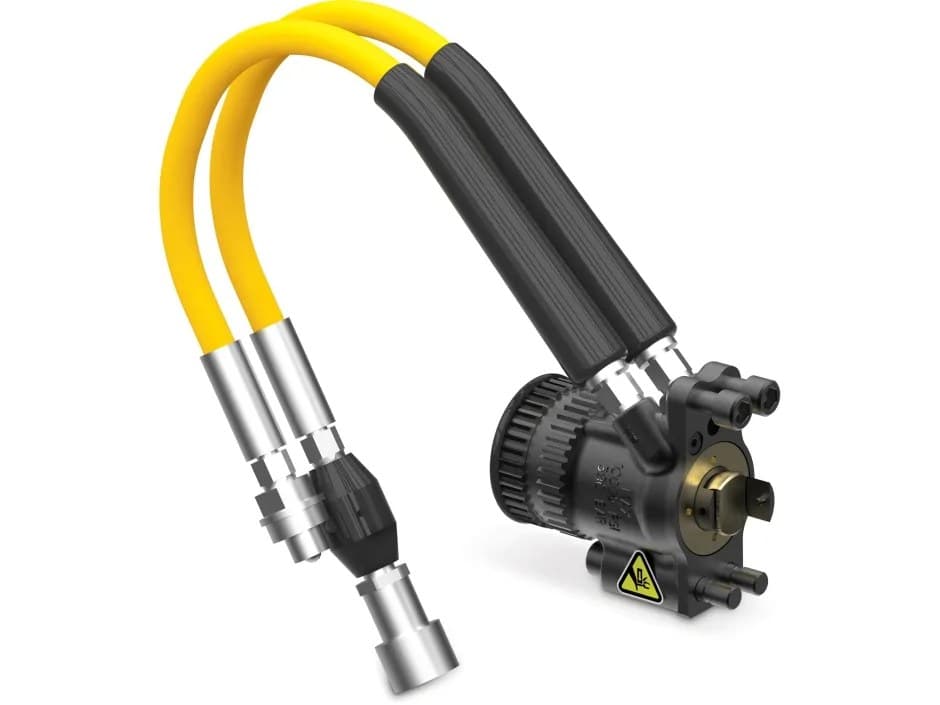 IH-ENE-TW-RSLEnerpac RSL Low-Profile Hydraulic Torque WrenchesEnerpac
 IH-ENE-TW-HMTEnerpac HMT Hexagon Hydraulic Torque WrenchesEnerpac
 IH-ENE-BSH10Enerpac BSH Impact Sockets for 1" Square DriveEnerpac
 IH-ENE-THQEnerpac THQ Twin Torque Wrench HosesEnerpac
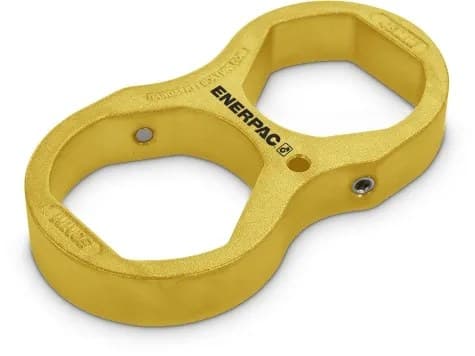 IH-ENE-BUSEnerpac BUS Back-Up SpannersEnerpac