
Why do the fittings on a used Japanese machine share a seat angle and still not interchange?
Because the seat and the thread are separate decisions. Japanese practice includes a 30° flare seat carried on a BSP parallel thread and a 30° flare seat carried on a metric thread. Measure only the seat and both look like the same family; measure the thread and they are not interchangeable. Always identify a fitting by seat angle *and* thread — one without the other is half an answer.
Used Japanese excavators and loaders are the backbone of a great many fleets we supply, and they carry the most quietly confusing connection convention in common circulation. Nothing about it is exotic. It simply punishes the very reasonable habit of identifying a fitting by looking at the seat.
Seat and thread are two separate questions.
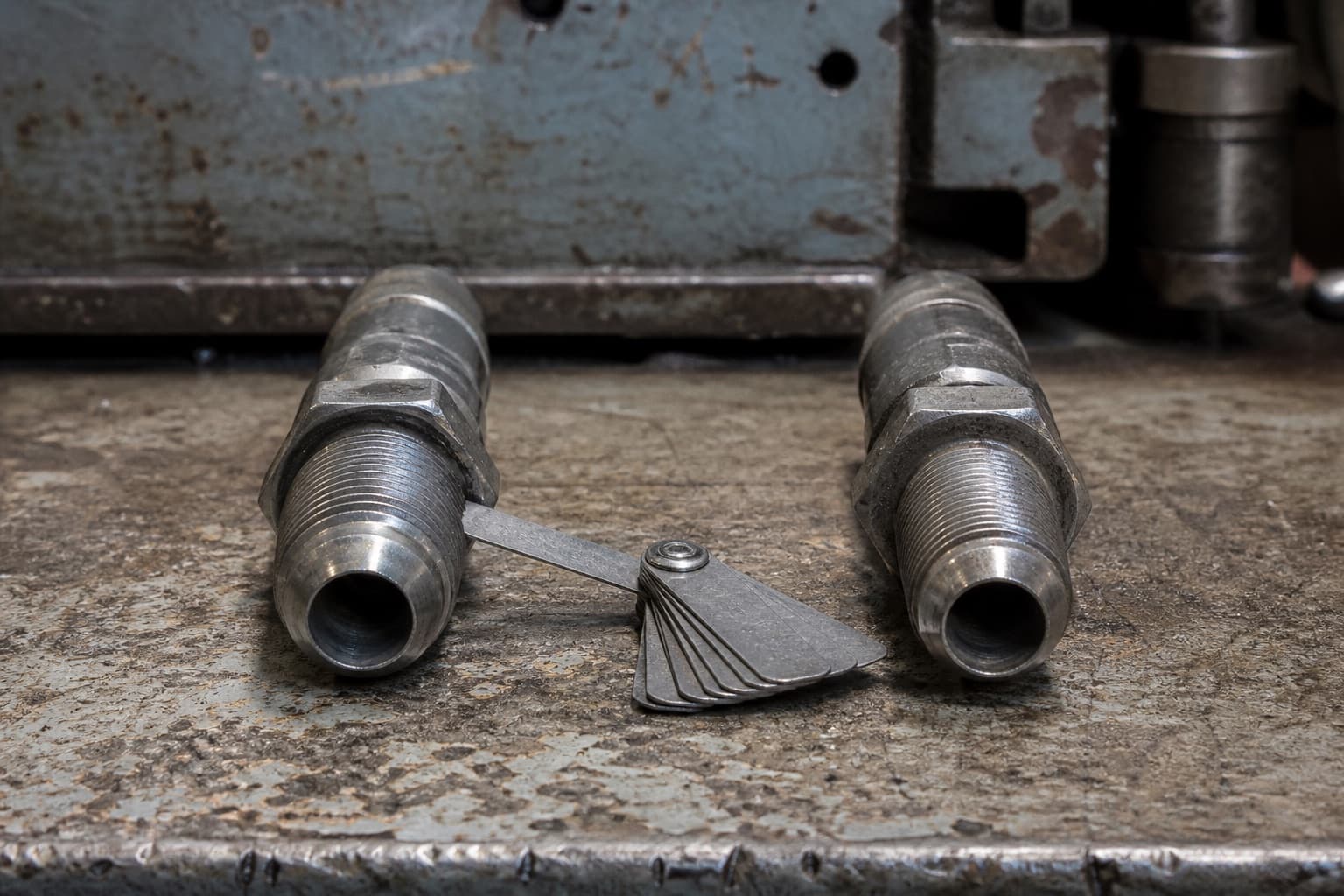
Every threaded hydraulic connection answers two questions independently: what holds it together — the thread — and what seals it — the seat, the O-ring, or the bonded washer. Most families pair one thread with one seat consistently enough that people stop thinking of them as separate. On Japanese machines that shortcut fails, because the same 30° seat appears above two different threads.
| Property | 30° flare on a BSP parallel thread | 30° flare on a metric thread |
|---|---|---|
| Seat angle | 30° — identical to the eye and to a seat gauge | 30° |
| Thread form | 55° Whitworth, threads per inch | 60° metric, millimetre pitch |
| What separates them | A pitch gauge, in one second | A pitch gauge, in one second |
| Failure if swapped | Cross-threads, or engages and never seals | Same |
What else is on the machine.
Alongside the 30° flare families you will meet BSP parallel with a bonded seal at ports, metric 24° cone on tube work, and four-bolt flanges at the pump and the travel motors. On machines that have been through a rebuild in a market where inch fittings are the norm, expect to find JIC and NPT that the factory never fitted — a used machine carries the history of its repairs as much as its build.
What to stock for a used-import fleet.
Depth beats breadth. For a workshop running used Japanese machines the useful drawer is: 30° flare ends in both thread conventions across the two or three bores you actually meet, BSP parallel with bonded seals, a small set of bridging adapters, and the flange halves for your pump sizes. Add a seat gauge and a pitch gauge to the toolbox and the identification problem mostly disappears.
Japanese hose fittings
30° flare hose ends for JIS and metric conventions.
BSP adapters
Parallel and taper, with bonded seals.
Is a JIS 30° fitting the same as a metric 30° fitting?
No. The seat is the same and the thread is not, so they will not interchange. Identify by seat angle and thread together; either one alone is ambiguous on these machines.
Can I adapt between the two conventions?
Yes, with the correct adapter, and it is a normal thing to do on a machine that has already been repaired once. Use one adapter, not a stack of three — every joint is a leak path and a stack also moves the hose end further from where it was designed to sit.
The machine came without any documentation. Where do I start?
At the fitting rather than the machine. Photograph the end, measure across the thread crests, take the pitch, and check the seat. Those four things identify almost any fitting in circulation, and they are the same four we ask for when we quote.
Running used imports with no dealer support?
Send photographs and measurements of the ends you replace most. We will name them, say which bridging adapters your fleet actually needs, and quote the set as one consignment rather than piece by piece.
Plant-down? Call +971 52 2477942 — 24/7