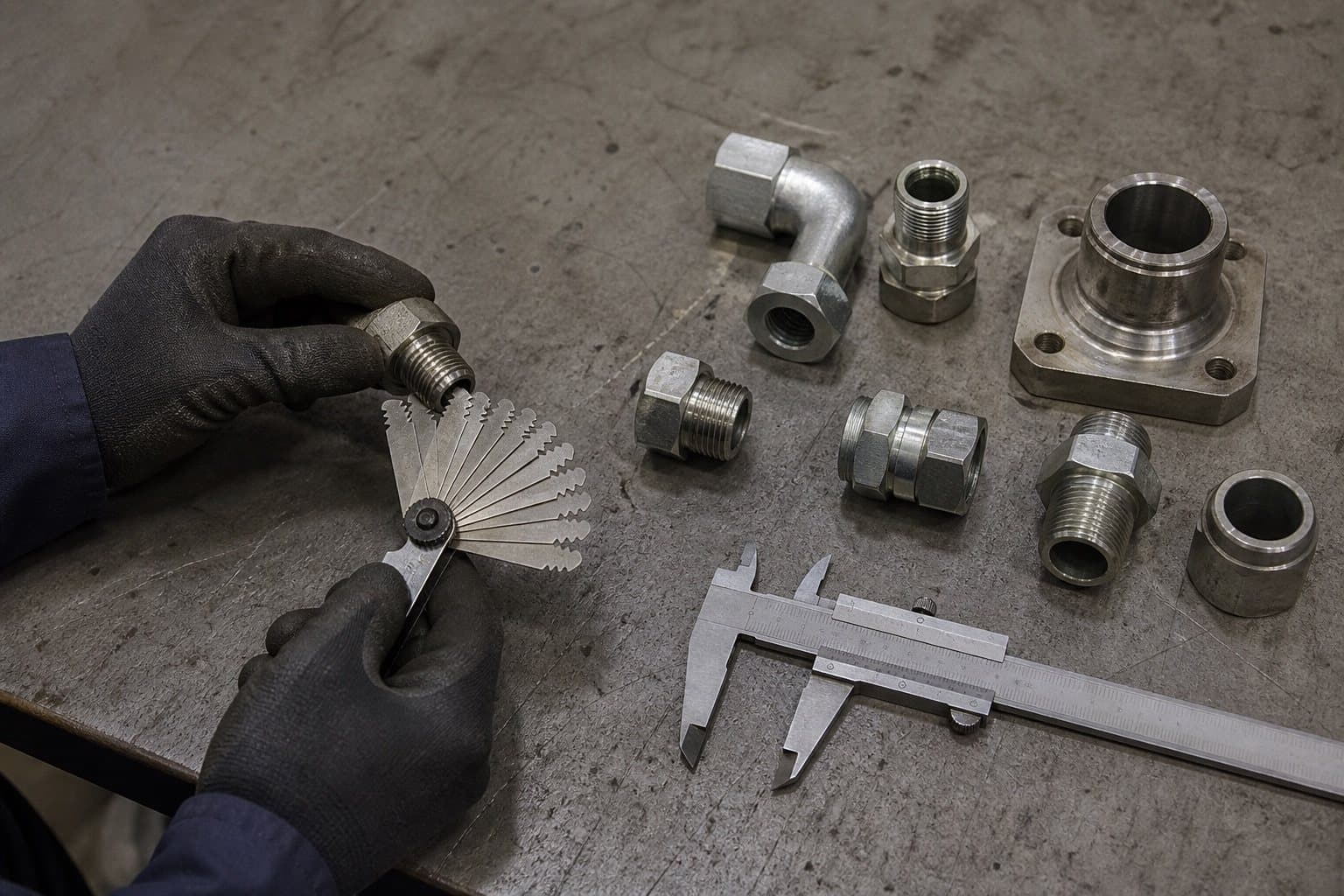
A thread gauge tells you the pitch. Callipers tell you the diameter. Together they will get you to a designation — and a designation is only two thirds of the answer, because the thing that decides whether a joint seals is the seat, and the seat is not something a thread gauge can see.
/01What a designation does and does not settle.
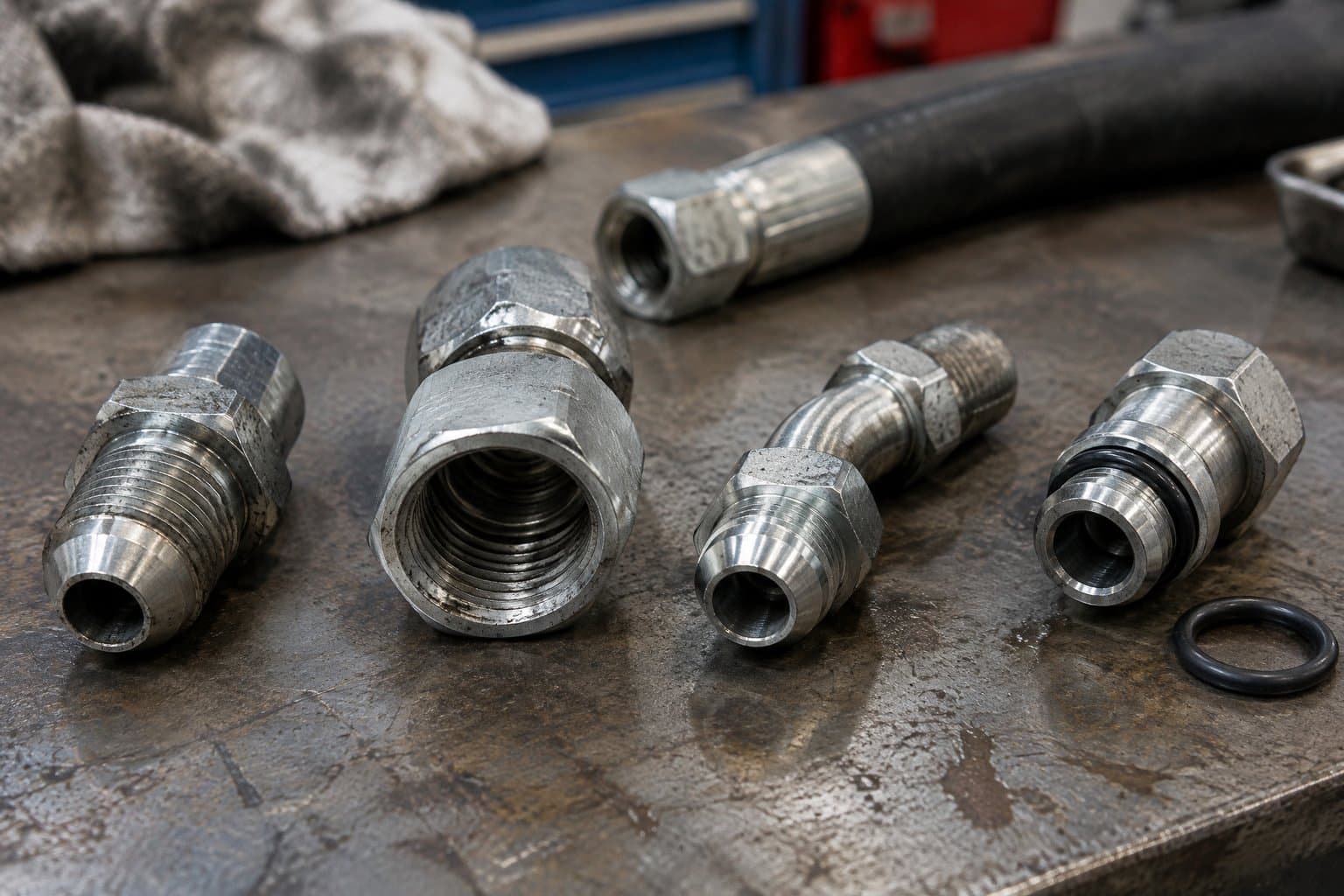
Every fitting has three independent properties: the thread (size and pitch), the seat (how it seals), and the gender. A designation like 9/16"-18 describes the first only. Two fittings sharing it can be entirely different parts.
| Family | Designation | How it seals |
|---|---|---|
| JIC 37°Highlighted | 9/16"-18 | Metal-to-metal on a 37° cone |
| ORFSHighlighted | 9/16"-18 | O-ring compressed against a flat face |
Both appear in our catalogue at that size, on dozens of variants each. They will thread together. The cone will bottom against the flat face, the O-ring will have nothing to seal against, and the joint will weep under pressure — usually not immediately, which is what makes it a field problem rather than a bench one.
/02The families, size by size.
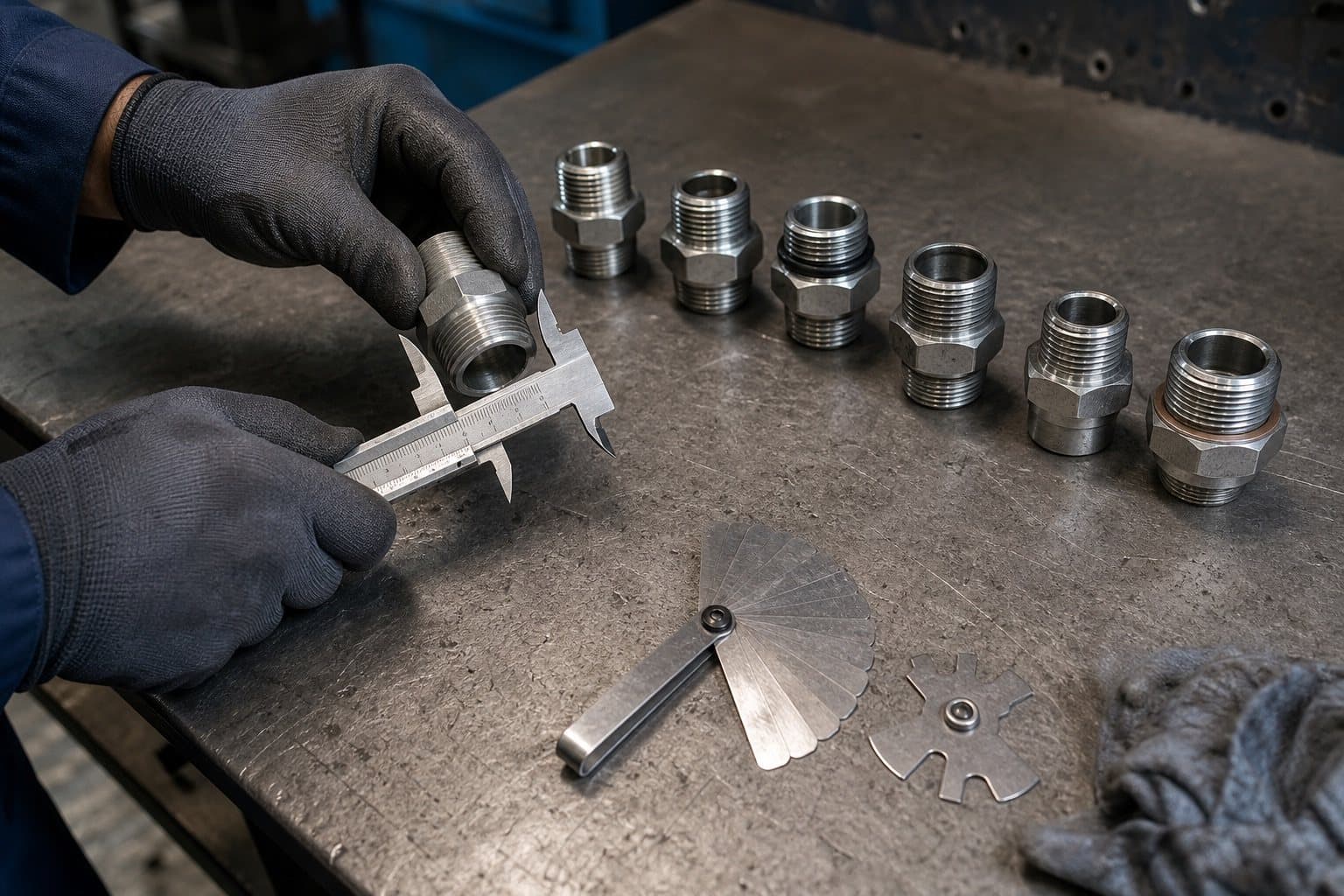
Designations below are the ones carried across our own catalogue, family by family. Pitch is threads per inch on the imperial families and millimetres on metric.
| Nominal | BSPP (G) | BSPT male (R) | BSPT female (Rc) |
|---|---|---|---|
| 1/8" | 28 | 28 | 28 |
| 1/4" | 19 | 19 | 19 |
| 3/8" | 19 | 19 | 19 |
| 1/2" | 14 | 14 | 14 |
| 5/8" | 14 | — | — |
| 3/4" | 14 | 14 | 14 |
| 1" | 11 | 11 | 11 |
| 1.1/4" | 11 | 11 | 11 |
| 1.1/2" | 11 | 11 | 11 |
| 2" | 11 | 11 | 11 |
| Nominal | NPT | BSP | Same? |
|---|---|---|---|
| 1/8" | 27 | 28 | No |
| 1/4" | 18 | 19 | No |
| 3/8" | 18 | 19 | No |
| 1/2"Highlighted | 14 | 14 | Yes — thread form still differs |
| 3/4"Highlighted | 14 | 14 | Yes — thread form still differs |
| 1" | 11.5 | 11 | No |
| 1.1/4" | 11.5 | 11 | No |
| 1.1/2" | 11.5 | 11 | No |
| 2" | 11.5 | 11 | No |
At 1/2" and 3/4" the pitches match exactly, and the two will engage. They still are not the same thread — NPT has a 60° flank angle and BSP has 55°, so the flanks never seat properly along their length. Forcing one into the other damages the port, and on a cast-iron valve body that is the expensive kind of damage.
| JIC 37° | Pitch | ORFS | Pitch |
|---|---|---|---|
| 7/16" | 20 | — | — |
| 1/2" | 20 | — | — |
| 9/16"Highlighted | 18 | 9/16" | 18 |
| 3/4" | 16 | 11/16" | 16 |
| 7/8" | 14 | 13/16" | 16 |
| 1.1/16" | 12 | 1" | 14 |
| 1.3/16"Highlighted | 12 | 1.3/16" | 12 |
| 1.5/16" | 12 | 1.7/16" | 12 |
| 1.5/8" | 12 | 1.11/16" | 12 |
| 1.7/8" | 12 | 2" | 12 |
| 2.1/2" | 12 | — | — |
The two highlighted rows are the collisions. Everywhere else the families diverge in diameter even where the pitch coincides, so the parts will not start — which is the safe failure. 9/16"-18 and 1.3/16"-12 are the two sizes where the wrong part goes in without complaint.
| 1.0 mm pitch | 1.5 mm pitch | 2.0 mm pitch |
|---|---|---|
| M10×1 | M12×1.5 | M27×2 |
| — | M14×1.5 | M30×2 |
| — | M16×1.5 | M33×2 |
| — | M18×1.5 | M36×2 |
| — | M20×1.5 | M39×2 |
| — | M22×1.5 | M42×2 |
| — | M24×1.5 | M45×2 |
| — | M26×1.5 | M48×2 |
| — | M30×1.5 | M52×2 |
| — | M33×1.5 | M60×2 |
| — | M36×1.5 | M64×2 |
| — | M42×1.5 | — |
/03Identifying a thread on the bench.
Four steps, in order
Do all four. Stopping after two is how the collisions above get through.
IfIs it parallel or tapered?
Run callipers along the thread at both ends of its length.
A visible reduction means tapered — NPT, BSPT. Constant diameter means parallel — BSPP, JIC, ORFS, metric.
IfWhat is the pitch?
Use a thread pitch gauge, not a ruler and a count.
The difference between 18 and 19 TPI is what separates NPT from BSP at 1/4", and it is not something the eye resolves.
IfWhat is the seat?
Look at the end face — cone, flat face with a groove, or nothing.
A 37° cone is JIC. A flat face with an O-ring groove is ORFS. A flat end with no seat means the thread itself seals, so it is tapered.
IfDoes the answer match a real family size?
Check it against the tables above before ordering.
A measurement that lands between two published sizes is a measurement error, not a rare thread.
/04What this table does not have.
There is no measured male thread outside diameter column here, and it is the column most people want — the one that turns “I measured 15.8 mm” into a designation. We do not hold that measurement as data, so we are not publishing it. A table of thread diameters recalled rather than measured is precisely the artefact that causes the errors this article is about.
What works instead, today: measure the diameter and the pitch, then send both with a photograph of the end face. The seat is visible in a photograph and it is the property that resolves the JIC and ORFS collision that a diameter alone cannot. Our thread identifier walks the same four questions interactively if you would rather answer them one at a time.
Common questions
- How do I tell BSPP from BSPT without a gauge?
- Run callipers along the thread at each end of its length. A parallel thread reads the same at both; a tapered one visibly reduces. Where the fitting has a bonded washer or an O-ring under a shoulder, it is parallel — the seal is not the thread.
- Is NPT interchangeable with BSPT at 1/2 inch?
- No. The pitches happen to match at 14 TPI, so the two will engage, but the flank angles differ — 60° against 55° — so they never seat correctly. Forcing the combination damages the softer of the two, which is usually the port.
- What pitch gauge do I need for hydraulic work?
- One covering both imperial TPI and metric pitch. The imperial leaves need to include 11, 11.5, 12, 14, 16, 18, 19, 20, 24 and 27 to cover the families in these tables; the metric leaves need 1.0, 1.25, 1.5 and 2.0.
- Why is a metric thread designation not enough to order a DIN fitting?
- Because DIN 2353 defines a light and a heavy series on tube outside diameter rather than on thread size, and the two overlap in thread designation. The bodies differ even where the thread does not, so the series and the tube size have to be stated alongside the thread.