
Tractor hydraulic fittings are replaced further from a counter than almost anything else we supply. A tractor is repaired where it stops. That single fact separates agricultural hydraulics from every other kind we supply — an excavator is on a site with a workshop, and a tractor is in a field an hour from a road, at the point in the year when the work cannot wait. The right response is not faster identification. It is stocking correctly before the season starts.
The tractor and the implement are two different questions.
The tractor’s own circuits — steering, brakes, transmission, the loader if it has one — follow whatever convention the manufacturer built to, and for a great many tractors in circulation that means BSP parallel, with bonded seals at ports and 60° cones on unions. The implements hanging off the back are a separate population entirely: bought separately, often built by a different maker in a different country, and connected through couplers rather than through threads.
| Property | On the tractor | On the implement |
|---|---|---|
| Convention | Usually consistent across the machine | Whatever its own maker used |
| Connection to the rest | Threaded, permanent | Quick couplers, connected daily |
| What fails | Hoses, ports, occasional stripped threads | Couplers, seals and the hoses between |
| What to stock | Hose ends and adapters in the tractor’s family | Spare coupler halves and seals |
Couplers are their own world.
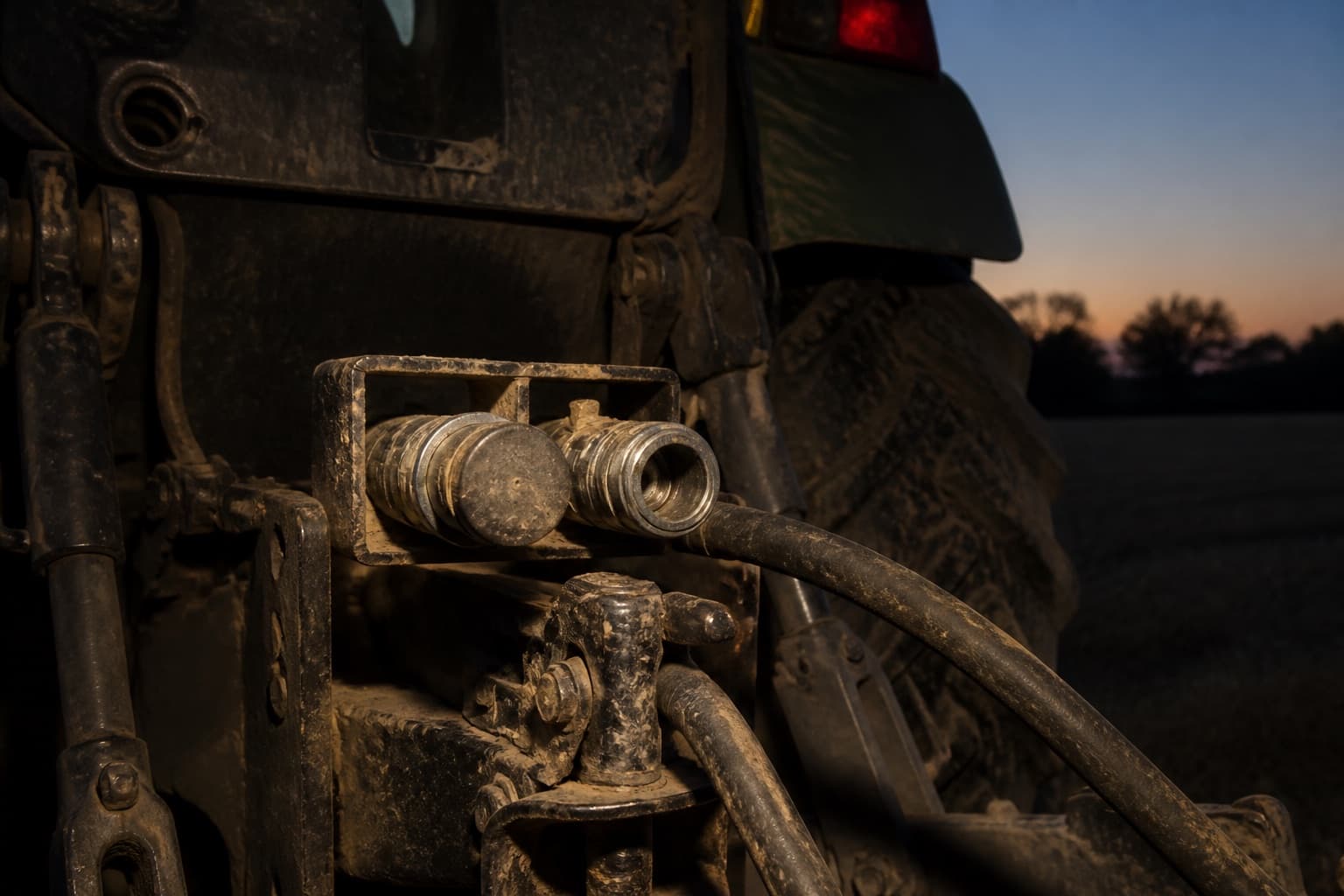
Agricultural quick couplers are a distinct family, standardised separately from the industrial couplers used on excavators and skid steers. They are designed to be connected and disconnected constantly, often by someone in gloves in poor light, and they carry their own failure mode: a coupler will not connect against trapped pressure. Heat in the sun raises the pressure in a disconnected implement line, and by afternoon the half that connected easily in the morning will not go on at all.
Quick couplers
Coupler halves, dust caps and seals.
The pre-season list.
The most useful hour a farm workshop spends is before the season, with a caliper and a notebook, writing down what each machine actually carries. Ports at the loader, the ends on the two hoses that always fail, the coupler sizes on each implement. Photograph them. That page turns an emergency into a phone call — and it is the single thing that makes ordering ahead possible at all when the nearest counter is a long drive away.
| Item | Why |
|---|---|
| Hose ends in the tractor’s family, in the two commonest bores | The hose that fails is nearly always one of two |
| Bonded seals, a box of the sizes you use | They are single-use in practice and cost almost nothing |
| One spare coupler half per implement type | The part most likely to be damaged by daily handling |
| A short list of bridging adapters | For the implement that does not match the tractor |
| Dust caps | Cheap, and the reason the coupler lasts a season instead of a month |
Are tractor fittings BSP?
BSP parallel is very common, particularly on tractors built for markets that inherited British plumbing conventions, but it is not universal and implements frequently differ from the tractor they hang on. Measure rather than assume — and write down what each machine carries so you only have to do it once.
Can I use an industrial quick coupler on an implement?
They are different families and do not interchange. Replacing one half with a coupler from another family gives you a connection that appears to work on one implement and fits nothing else you own.
The coupler will not connect in the afternoon but did in the morning.
Trapped pressure from heat in a disconnected line. Relieve it at the implement rather than forcing the halves together. It is the most common coupler complaint we hear and it is not a fault in the coupler.
Stocking a farm workshop before the season?
Send your list — machines, implements, the ends you replace most — and we will quote the set as one consignment, with the bridging adapters your particular mix needs.
Plant-down? Call +971 52 2477942 — 24/7