
A turnbuckle does one simple thing: turn the body and the two threaded ends draw together or apart, tensioning whatever is between them. What makes them confusing is the number of combinations — three common end fittings, two body styles, inch and metric threads, and several standards — and the fact that the rating can change by half depending on which end you choose.
The end fittings.
| End | Connects to | Rating |
|---|---|---|
| Jaw | A plate, pad eye or lug, through a pin or bolt | Full rating |
| Eye | A shackle, a thimbled wire rope eye or another eye | Full rating |
| Hook | An eye or ring that can be hooked on and off | Reduced — the lowest of the three |
| Stub or weld-on end | Welded directly to the structure | Set by the weld and the maker’s rating |
The hook is the weak end because it is an open shape that bends to open under load. Our tables show how much it costs:
| Turnbuckle | Hook end | Eye or jaw end |
|---|---|---|
| US drop-forged, 3/8″ | 1,000 lb | 1,200 lb |
| US drop-forged, 1/2″ | 1,500 lb | 2,200 lb |
| US drop-forged, 5/8″ | 2,250 lb | 3,500 lb |
| US drop-forged, 3/4″ | 3,000 lb | 5,200 lb |
| DIN 1478, M10 (hook and eye vs eye and eye) | 235 kg | 650 kg |
The gap widens with size: one major US maker rates a 1″ × 12″ hook-and-hook turnbuckle at 5,000 lb against 10,000 lb for eye-and-eye. A hook-and-eye turnbuckle is rated at its hook end. Where the connection allows it, choose jaw or eye ends: they carry more and cannot unhook.
Which turnbuckle end is strongest?
Jaw and eye ends carry the turnbuckle’s full rating; hook ends are rated lower because the open hook can straighten under load. On our US drop-forged range, a 1/2″ turnbuckle is rated 2,200 lb with eye or jaw ends but 1,500 lb with a hook. A turnbuckle with one hook is rated at the hook.
Open body or closed body.
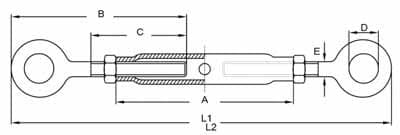
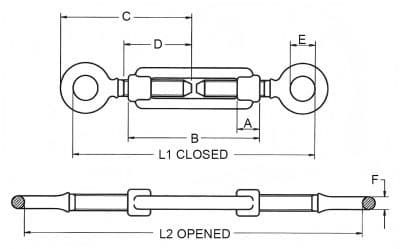
Open-body turnbuckles have a forged frame with the threads exposed in the middle — the US drop-forged pattern and the DIN 1480 body are both of this kind. You can see both threaded ends inside the frame, which makes it easy to check how much thread is engaged and how much take-up is left.
Closed-body turnbuckles, often called rigging screws, have a tubular body that hides the threads — DIN 1478 is the metric pipe-body pattern, and stainless rigging screws with jaw, eye or swage ends are common in marine and architectural work. They look neater and keep dirt off the threads, but you cannot see thread engagement, so the ends must be set to the maker’s marks or minimum lengths.
Light-duty patterns — die-cast zinc and commercial turnbuckles — are for tensioning wires, fences, nets and signs. Where one is listed without a published rating, it should not be put in any load path that matters.
The standards behind the names.
- ASTM F1145 is the US specification for turnbuckles — swaged, welded, cast or forged, with or without jam nuts — for tensioning rods, wire rope and similar. It covers several types and classes and requires proof, breaking, bending and galvanising tests. Major makers rate their forged turnbuckles at a 5:1 design factor and proof-test them at 2.5 times the WLL.
- DIN 1480 standardises the forged open body. It has no table of working loads. It says the body is stronger than DIN 34828 weld-on ends of the same steel; with other end fittings, the capacity has to be checked. In practice, use the WLL the maker publishes for the complete assembly.
- DIN 1478 is the tubular pipe-body pattern.
Using one safely.
- In-line pull only. Turnbuckles are made for a straight pull along their axis. Do not side-load them or let them bend over an edge.
- Engage the threads properly. On an open body, both threaded ends should be visible well into the frame. On a closed body, follow the maker’s minimum engagement. Never run a turnbuckle out to its last few threads to gain length; use a longer one.
- Lock it. Use the lock nuts supplied, or pass seizing wire through the body and the end fittings, so vibration cannot unwind it.
- Keep the parts matched. Never substitute an end fitting not made for that turnbuckle.
Check before every use: the markings are legible; the body and end threads are the same type and undamaged; the locking parts are in place and cannot vibrate out; and nothing is bent, nicked, cracked or opened out — especially the throat of a hook end. Remove any turnbuckle that fails one of these.
Choosing a turnbuckle
Start from what it connects to and what it holds.
If · Connecting to a plate or pad eye
Jaw end, full rating.
If · Connecting to a shackle or a thimbled rope eye
Eye end, full rating.
If · Needs to be hooked on and off quickly
Hook end — size it on the lower hook rating.
If · Marine, architectural or corrosive service
Stainless closed-body rigging screw, with a published WLL.
If · Fencing, netting or light tensioning
Commercial or die-cast turnbuckle — never in a load path.
Turnbuckles in this guide
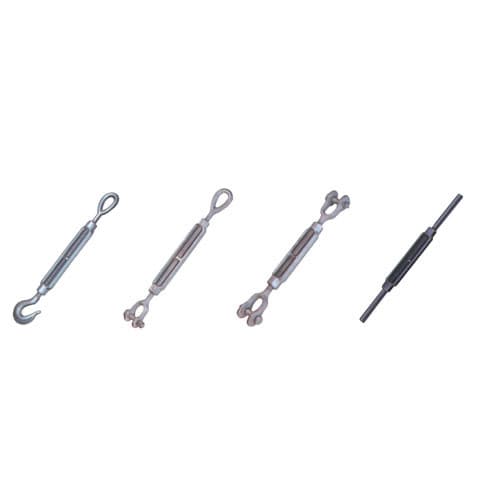
IH-LR-TB-US
Drop Forged Turnbuckle — US Type
IH-LR-TB-D1480
DIN 1480 Turnbuckle
IH-LR-TB-D1478TG
DIN 1478 Turnbuckle — Galvanized
IH-LR-TB-IT
Turnbuckle — Italian Type
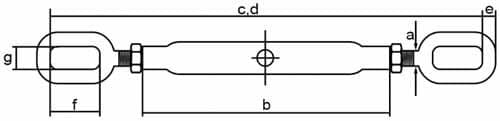
IH-LR-TB-GRSCB
Galvanized Rigging Screw, Closed Body

IH-LR-TB-SSJJ
Stainless Steel Rigging Screw, Jaw and Jaw
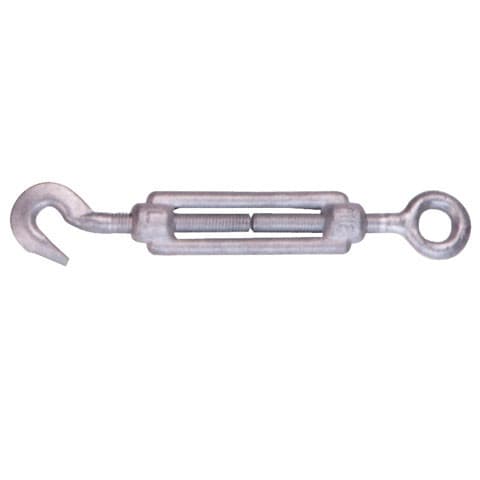
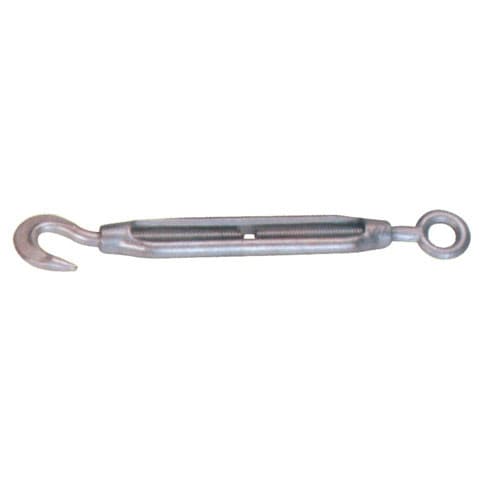
IH-LR-TB-COM
Commercial Turnbuckle, Hook and Eye
Common questions
What is the difference between a turnbuckle and a rigging screw?
The terms overlap. “Turnbuckle” is usually used for the open-frame type where the threads are visible, and “rigging screw” for a closed, tubular body that hides them. Both tension a line by turning the body to draw two threaded ends together.
Why is a hook-end turnbuckle rated lower?
Because an open hook can straighten under load before the rest of the turnbuckle is stressed. On our US range a 3/4″ turnbuckle is rated 5,200 lb with eye or jaw ends but 3,000 lb with a hook.
How do I stop a turnbuckle from loosening?
Tighten the lock nuts against the body, or pass seizing wire through the body and the end fittings. Vibration will otherwise slowly unwind it.
Can a turnbuckle take a side load?
No. Turnbuckles are rated for a straight, in-line pull. A side or bending load is not covered by the rating.
Is a DIN 1480 turnbuckle rated for lifting?
DIN 1480 standardises the body and has no load table, so the rating depends on the maker and the end fittings. Treat a DIN 1480 turnbuckle as rated only if the maker publishes a WLL for the complete assembly and supplies a certificate.
Turnbuckles and rigging screws
US drop-forged, DIN 1480, DIN 1478, Italian and stainless patterns, with ratings by end fitting.
Shackles
To connect an eye-end turnbuckle to a pad eye or chain.
Figures verified · Ratings from the size tables on the linked product pages. Standard scopes from ASTM F1145 and DIN 1480:2005; use and inspection rules from published manufacturer instructions.
Need turnbuckles with a published rating?
Tell us the end fittings, thread size and take-up you need, and the load. We will quote forged turnbuckles or rigging screws with their WLL and the manufacturer’s certificate.
Plant-down? Call +971 52 2477942 — 24/7