
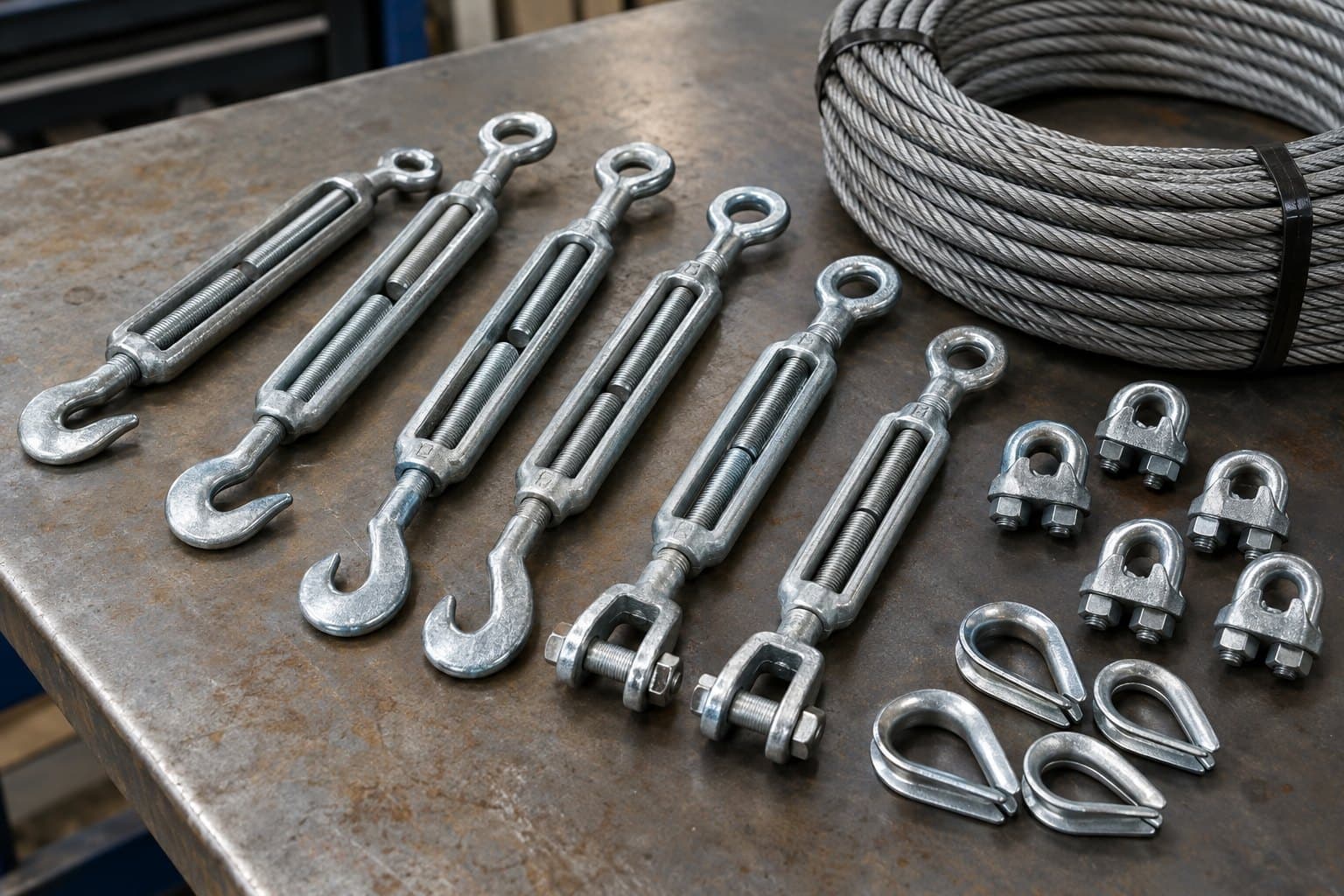
Turnbuckles hold guy wires, brace steel frames, tension cables on facades and shade structures, lash cargo and tune rigging. One right-hand and one left-hand thread let the body draw both ends together, and the same simplicity hides the three ways turnbuckles go wrong: the wrong end fittings for the load, a side pull that bends the frame, and vibration that slowly unwinds an unlocked body. Our guide to turnbuckle types covers the shapes; this one covers choosing and using them.
/01End fittings decide the rating.
| Size | Eye or jaw ends | Hook ends |
|---|---|---|
| 1/4" × 4" | 500 lb | 400 lb |
| 5/16" × 4-1/2" | 800 lb | 700 lb |
| 3/4" × 9"Highlighted | 5,200 lb | 3,000 lb |
| 1-1/4" × 6" | 15,200 lb | 6,500 lb |
Hooks are quick to attach but open under load; makers rate them well below eyes and jaws, and many sellers say hook-end turnbuckles are not for overhead lifting. Eyes take a shackle; jaws take a fixed plate or lug; stub ends are welded on. US Federal Specification FF-T-791 — now replaced by ASTM F1145 — classes them as eye and eye, hook and hook, hook and eye, jaw and jaw, jaw and eye, and stub ends, in open-body, pipe-body and rigging-body types. See DIN 1480 vs DIN 1478 for the European open and closed bodies.
/02Choosing the size.
Work out the maximum tension the turnbuckle will see — the design load of the guy, brace or lashing — and choose a turnbuckle whose rated load for your end fittings is at least that. Then check that every other part of the line matches: the wire rope, the clips or ferrules, the thimble and the shackle or anchor at each end. The line is only as strong as its weakest part. For guy wires and cable bracing, see turnbuckles for guy wires and cable bracing.
/03Tensioning.
- Open it out to its maximum length before fitting, so there is take-up for tensioning.
- Engage the threads fully. Each end’s thread should be fully engaged in the body; on closed bodies, inspection holes or marks show engagement.
- Connect in a straight line, with nothing bearing on the body or pulling it sideways.
- Turn the body with a spanner on its flats — not by twisting the rope or the end fittings.
- Stop at the design tension; if the frame starts to bend or deform, release the tension and replace the turnbuckle.
/04Locking it.
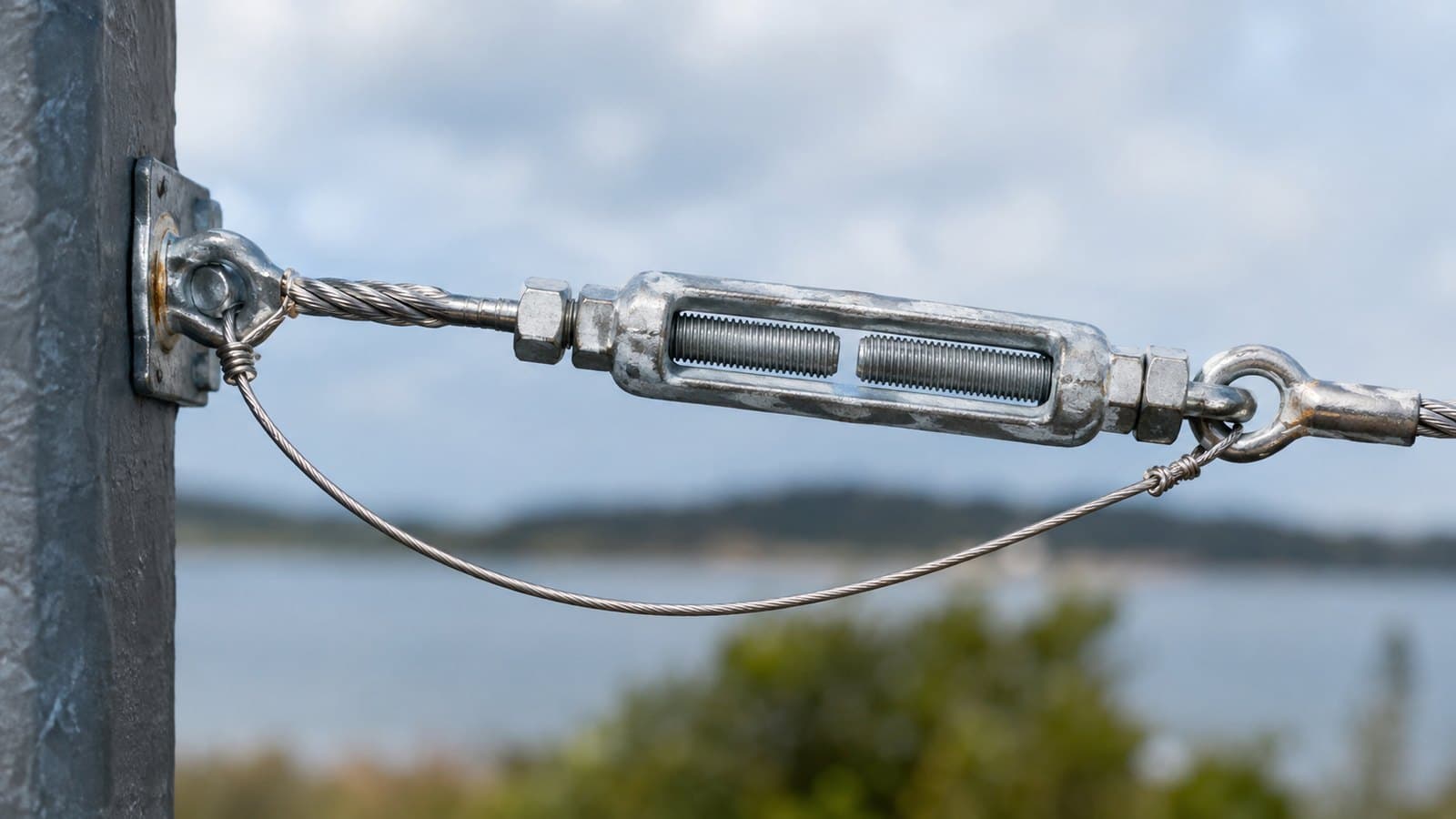
Vibration and wind slowly turn an unlocked turnbuckle. Lock it at final adjustment: tighten jam (lock) nuts against the body where fitted, or pass locking wire through the body and end fittings, or both. Makers say to always use the locking nuts provided and to keep lock nuts compatible with the end threads; for long-term installations the turnbuckle must be secured permanently. Never replace an end fitting with one not designed for that turnbuckle.
/05Inspection and removal.
Inspect visually before use, and periodically — ASME B30.26, as summarised by industry, calls for periodic inspection at least yearly in normal service and more often in severe service. Take a turnbuckle out of service for missing or illegible markings; heat damage or weld spatter; excessive pitting or corrosion; a bent, twisted, stretched, cracked or broken body or end; 10% loss of original dimension; damaged or worn threads; or any unauthorised welding or modification. See lifting gear rejection criteria.
Common questions
- Can turnbuckles be side loaded?
- No. Makers rate turnbuckles for straight, in-line pulls only.
- How do you stop a turnbuckle from loosening?
- Tighten the jam nuts against the body, pass locking wire through the body and end fittings, or both.
- How do you tension a turnbuckle?
- With the threads fully engaged and the line straight, turn the body with a spanner on its flats until the design tension is reached, then lock it.
- Are hook turnbuckles safe for overhead lifting?
- Hook ends are rated lower and many sellers say hook-end turnbuckles are not for overhead lifting. Use eye or jaw ends.
- What replaced FF-T-791?
- The US federal specification was cancelled and replaced by ASTM F1145.
Rated turnbuckles
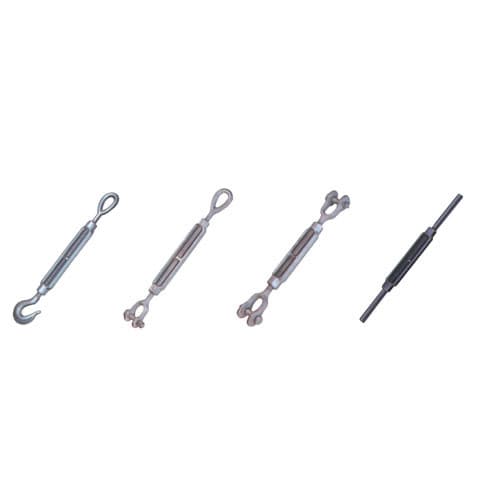 IH-LR-TB-USDrop Forged Turnbuckle — US Type
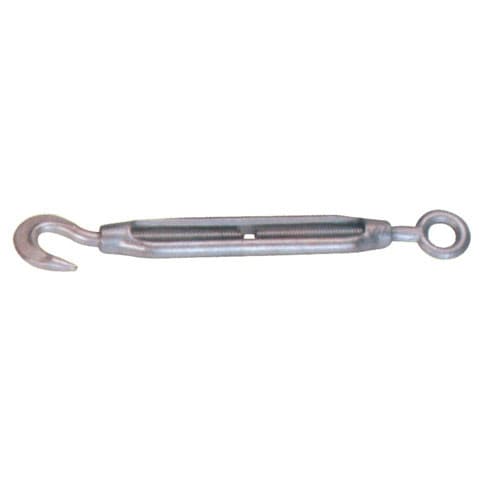 IH-LR-TB-D1480DIN 1480 Turnbuckle
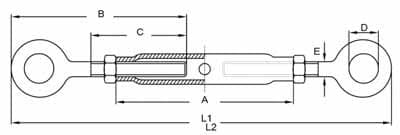 IH-LR-TB-D1478TGDIN 1478 Turnbuckle — Galvanized
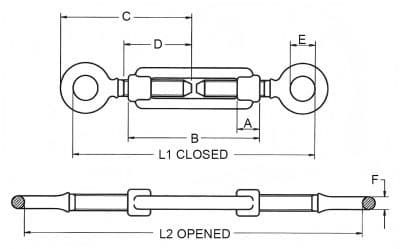 IH-LR-TB-ITTurnbuckle — Italian Type
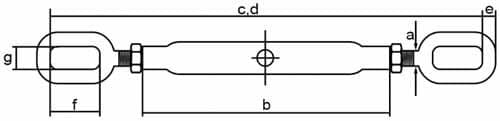 IH-LR-TB-GRSCBGalvanized Rigging Screw, Closed Body
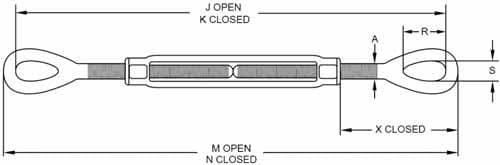 IH-LR-TB-SSDFTUSStainless Steel Drop Forged Turnbuckle — US Type
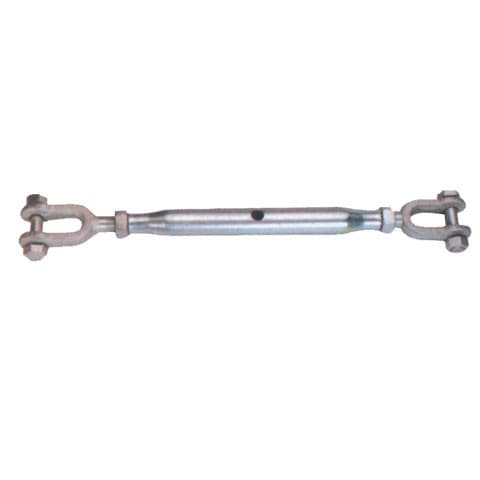 IH-LR-TB-RSJJRigging Screw, Jaw and Jaw
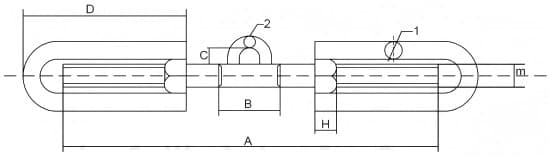 IH-LR-TB-HLTHamburger Lashing Turnbuckle