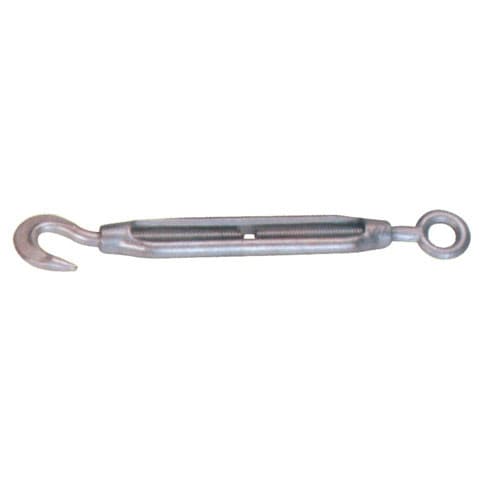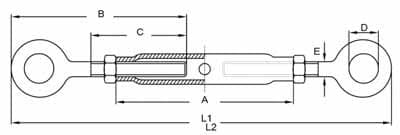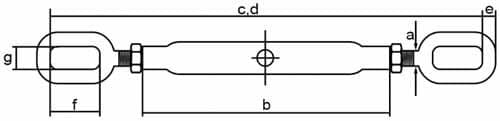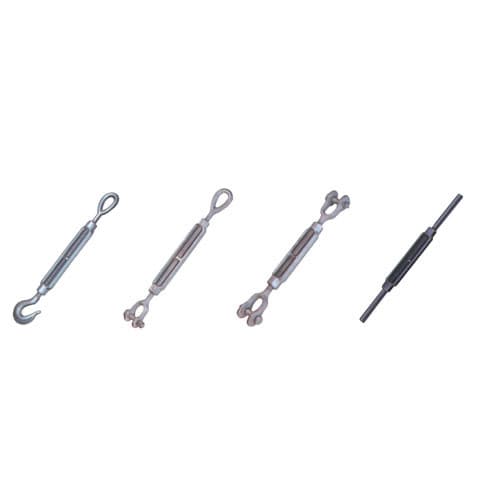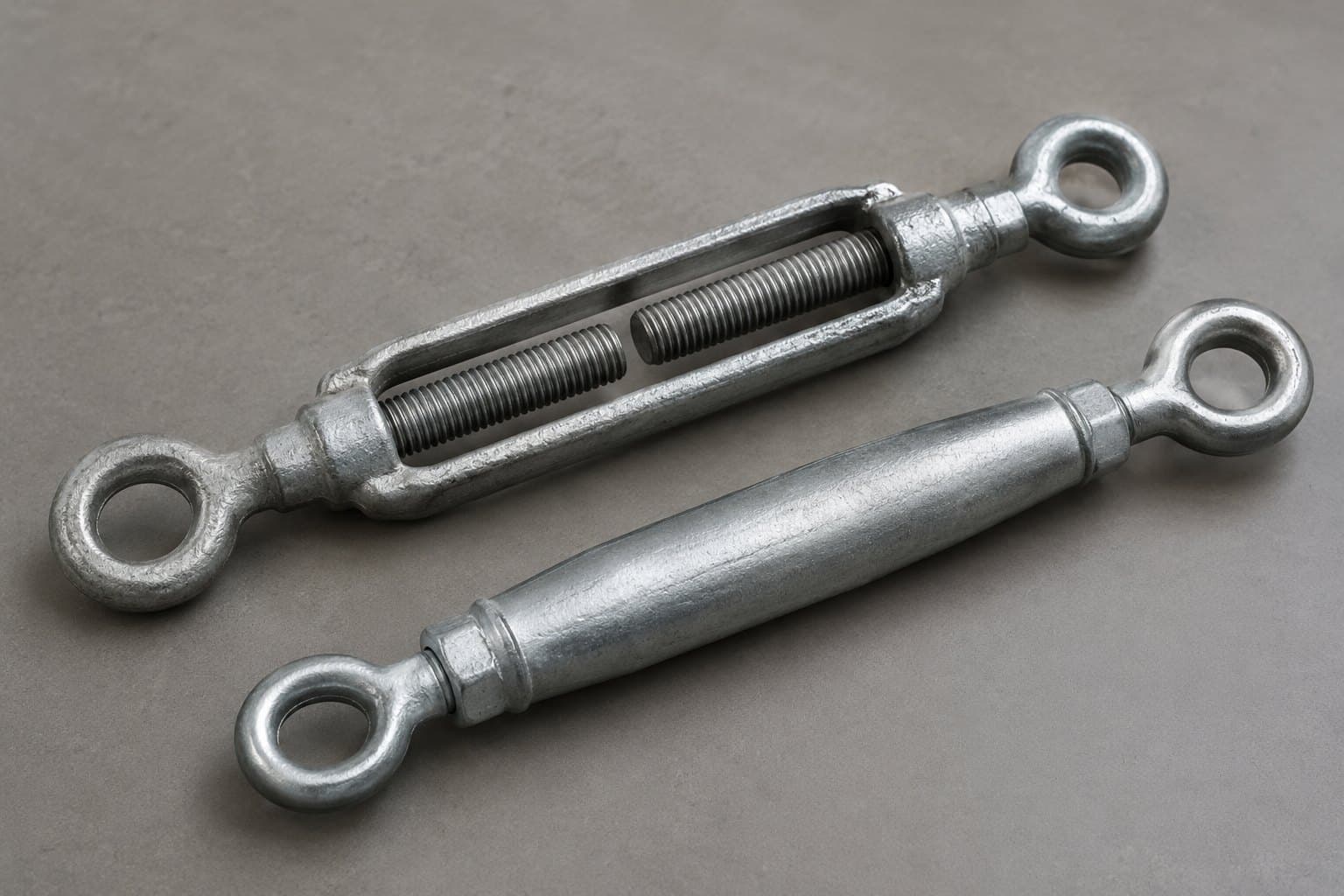
Order “a M20 turnbuckle” in Dubai and you may be asked: 1480 or 1478? The two DIN numbers are the metric world’s common turnbuckle standards. They do the same job — draw two threaded ends together — with different bodies, and the choice matters for inspection, appearance, weight and where the turnbuckle will live. For choosing end fittings, tensioning and locking, see how to choose and tension a turnbuckle.
/01What each standard covers.
| Property | DIN 1480 | DIN 1478 |
|---|---|---|
| Body | Forged, open frame | Closed, from steel tube or round bar |
| Thread range | M6 to M56 | M6 to M80 |
| Materials in the standard | Steel (S235JR) | Steel, or A4 stainless |
| Thread engagementHighlighted | Visible through the frame | Inspection holes added in the 2005 edition |
| Covers end fittings? | No — body only | No — body only |
/02Ratings size for size.
| Thread | DIN 1480 eye and eye | DIN 1478 eye and eye |
|---|---|---|
| M12 | 9.3 kN | 930 kg |
| M20Highlighted | 27 kN | 2,700 kg |
| M24 | 39.2 kN | 3,920 kg |
| M30 | 62.5 kN | 6,250 kg |
In our ranges the two bodies carry similar eye-and-eye ratings at each thread size (1 kN is about 102 kg). The end fittings change things more than the body does: our DIN 1478 M20 is rated 2,700 kg eye-and-eye, 1,650 kg jaw-and-jaw and 730 kg hook-and-eye. That DIN 1478 range is marked not for overhead lifting; use these turnbuckles for tensioning, bracing and lashing. Check each listing’s size table for the exact end fitting you order.
/03Which to choose.
- DIN 1480 open frame — the workhorse for bracing, guying and general tensioning. Thread engagement can be checked at a glance and the frame is easy to turn with a bar or spanner. Some makers position plain DIN 1480 bodies for less demanding uses such as rope railings, and recommend load-rated turnbuckles for rigging.
- DIN 1478 closed body — neater and better protected, so common on architecture, facades, balustrades and anywhere it will be seen; also available in stainless. Use the inspection holes to confirm engagement before loading.
- Stainless — for marine and coastal exposure; our stainless DIN 1480 runs M5 to M20.
- Heavier or lifting-adjacent duty — consider a drop-forged, load-rated turnbuckle; see drop-forged US-type turnbuckles.
Common questions
- Which is stronger, DIN 1480 or DIN 1478?
- In our ranges they carry similar eye-and-eye ratings at the same thread size — for example 27 kN and 2,700 kg at M20. End fittings make the bigger difference.
- Do DIN 1480 and DIN 1478 include the end fittings?
- No. Both standards cover the turnbuckle body; eyes, hooks, jaws and stubs are separate parts.
- How do I check thread engagement on a closed turnbuckle?
- Use the inspection holes in the body, which the 2005 edition of DIN 1478 introduced; the thread should be visible at or past them.
- Are DIN turnbuckles available in stainless steel?
- Yes. DIN 1478 includes A4 stainless, and we supply stainless DIN 1480 from M5 to M20.
- Can DIN 1478 turnbuckles be used for lifting?
- Our DIN 1478 listing is marked not for overhead lifting. Use them for tensioning, bracing and lashing.