Somebody asks for “a hundred-R-nine hose” because the machine had R7 on it and they want something stronger. It is a reasonable-sounding request built on a wrong assumption, and it is the single most common misunderstanding about hydraulic hose specification.
/01The numbers are not a scale.
SAE J517 defines a series of hose specifications, each given a 100R number as it was added. The numbers were allocated in roughly the order the constructions were standardised, which is not the order of anything a buyer cares about — not pressure, not size, not quality, not price. Reading the sequence as a ranking produces exactly the wrong answer.
The clearest demonstration comes from two grades we stock. R6 is a textile-braid hose for return and suction lines. R2AT is a two-wire-braid hose for high-pressure service. R6 has the higher number.
| Designation | Reinforcement | Working pressure | Burst |
|---|---|---|---|
| SAE 100R2ATHighlighted | Two wire braids | 275 bar | 1,100 bar |
| SAE 100R6 | One textile braid | 28 bar | 112 bar |
Ten times the working pressure, four designations lower. The two hoses are not competitors and were never meant to be compared — R6 exists to return oil to tank at low pressure without costing what a wire hose costs. But nothing in the numbering says so.
/02The four families inside the numbering.
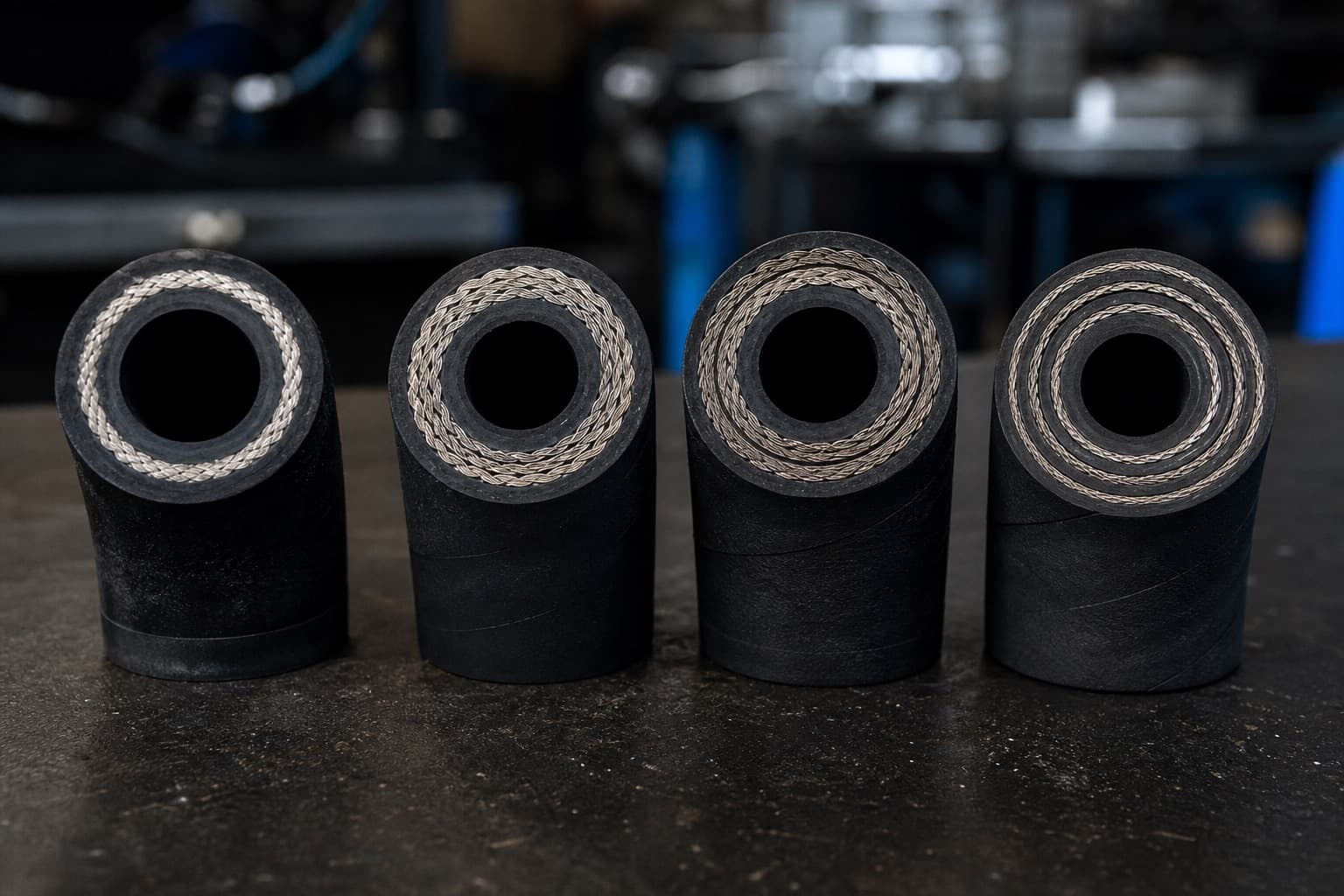
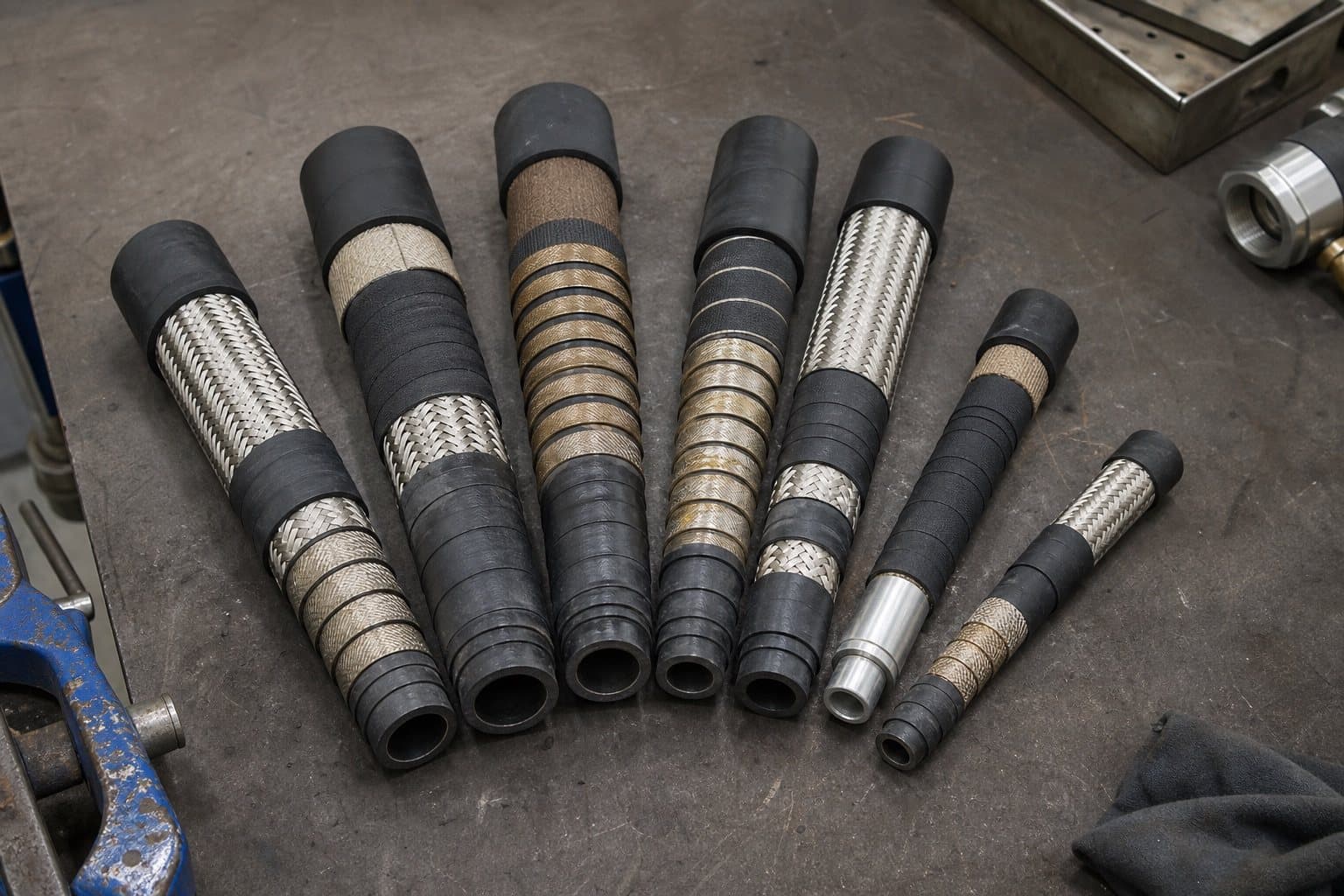
Every 100R designation belongs to one of four reinforcement families, and the family is what actually predicts behaviour — pressure capability, bend radius, weight and price all follow from it.
| Family | How it is built | Grades we stock | What it is for |
|---|---|---|---|
| Wire braid | One or two braided steel layers | R1AT, R2AT | General high-pressure service |
| Wire spiral | Four or six helically wrapped layers | R13, R15 | Large bore at high pressure, impulse duty |
| Textile | Braided fibre, sometimes over one wire braid | R5, R6 | Return, suction, low-pressure lines |
| Thermoplastic / PTFE | Extruded core, fibre or wire reinforced | R7, R14 | Chemical resistance, tight routing, heat |
/03Working pressure for every grade we stock.
Figures are from the Intertraco catalogue for the constructions we carry. Every one is quoted at a stated bore, because a grade does not have a single working pressure — it has one per size, and the spread across a grade is often several-fold.
| Designation | −04 | −08 | −12 | −16 | −24 | −32 |
|---|---|---|---|---|---|---|
| R1AT / EN 853 1SN | 225 | 160 | 105 | 88 | 50 | 40 |
| R2AT / EN 853 2SN | 400 | 275 | 215 | 165 | 90 | 80 |
| R13 (4/6 spiral)Highlighted | — | — | 350 | 350 | 350 | 350 |
| R15 (6 spiral)Highlighted | — | — | 420 | 420 | 420 | 420 |
| Designation | −04 | −06 | −08 | −12 | −16 |
|---|---|---|---|---|---|
| R5 (textile over wire) | 210 | 155 | 140 | 105 | 56 |
| R6 (textile braid) | 28 | 28 | 28 | 21 | 20 |
| R7 (thermoplastic) | 200 | 175 | 140 | 90 | 70 |
| R14 (PTFE) | 175 | 135 | 120 | 90 | 65 |
Read the spiral rows across and the reason spiral construction exists becomes obvious: R13 holds 350 bar at every size it is made in, and R15 holds 420. The braided grades lose four fifths of their rating over the same range. That single difference is why large-bore high-pressure circuits are spiral and why substituting braid at −32 to save money is not a compromise, it is a mistake.
/04The rest of the range.
The 100R series runs well beyond the grades tabulated above, and four more of them are in our range: R3, R8, R12 and R17. They are not in the tables because we do not hold per-bore data for them in the same published form — only a headline figure, which is the very thing this article has spent four sections warning you about.
| Designation | Reinforcement | Headline pressure | Bore range |
|---|---|---|---|
| SAE 100R3 | Two textile braids | 85 bar | 1/4″ – 1.1/2″ |
| SAE 100R8 | Two synthetic-fibre braids | 350 bar | 1/8″ – 1″ |
| SAE 100R12Highlighted | Four alternating spiral wire layers | 280 bar | 3/8″ – 2″ |
| SAE 100R17 | One or two braids, uniform-pressure | 210 bar | 1/4″ – 1″ |
Beyond those, designations such as R9, R10 and R16 exist and are in common use, and we do not carry them. If you are working to one of those, the datasheet for the hose actually being fitted is the only source worth using. Tell us the designation, the bore and the pressure and we will say which construction in our range genuinely matches — and say so plainly when none of them does.
/05How to specify without using the number as a shortcut.
Four questions, in this order
Answer them in sequence. Each one narrows what the next can be.
IfBore is fixed by the flow the circuit needs
Settle the bore before anything else — it decides which grades are even offered.
Several grades do not exist below −10 or above −16. Choosing a designation first can commit you to a bore the circuit does not want.
IfWorking pressure is known at that bore
Compare candidate grades only at that bore, never on headline figures.
A catalogue headline is almost always the value at the smallest size in the range. Two grades quoted at different bores are not comparable numbers.
IfRouting is tighter than the grade’s bend radius
Move to a compact construction rather than forcing the bend.
At −08, EN 857 2SC bends to 90 mm where EN 853 2SN needs 180 mm — the same pressure class in half the space.
IH-HOSE-2SCIfFluid or temperature is out of the ordinary
Tube compound decides this, and it can rule out a grade that passed on pressure.
PTFE and thermoplastic constructions exist for exactly the cases where a nitrile tube will not survive. Gulf ambient counts here as much as fluid temperature.
IH-HOSE-R14
Answer those four and the designation falls out at the end as a result. Start from the designation and you are choosing a hose by the order in which a committee happened to standardise it.
The grades in these tables
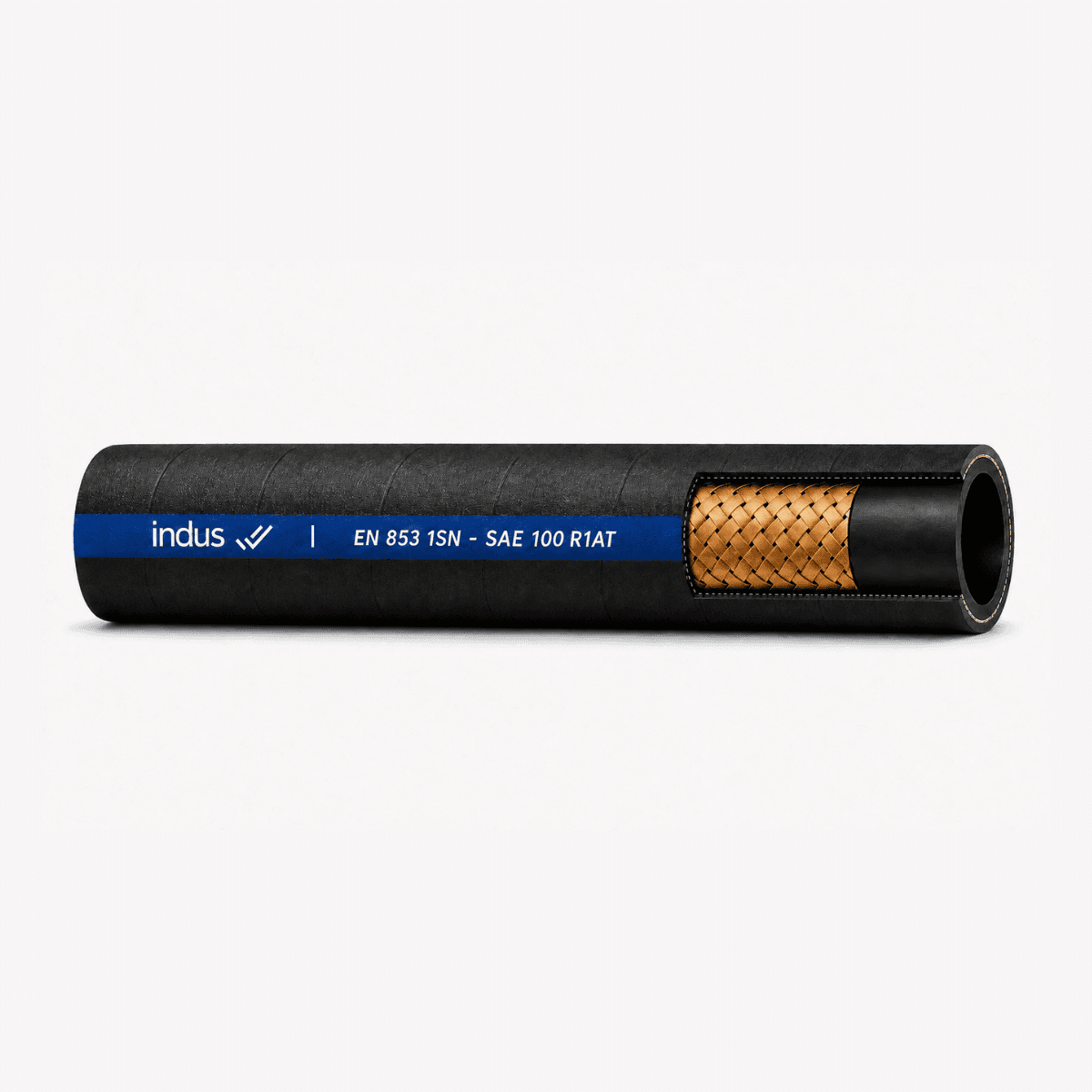 IH-HOSE-R1-1SNR1 1SN Single Wire Braid Hydraulic HoseEaton Winner
 IH-HOSE-R2-2SNR2 2SN Double Wire Braid Hydraulic HoseEaton Winner
 IH-HOSE-R13R13 Multi-Spiral Very-High-Pressure HoseIndus Hydraulics
 IH-HOSE-R15R15 Six-Spiral Ultra-High-Pressure HoseIndus Hydraulics
 IH-HOSE-R5R5 Textile-Cover Single Wire Braid HoseParker Hannifin
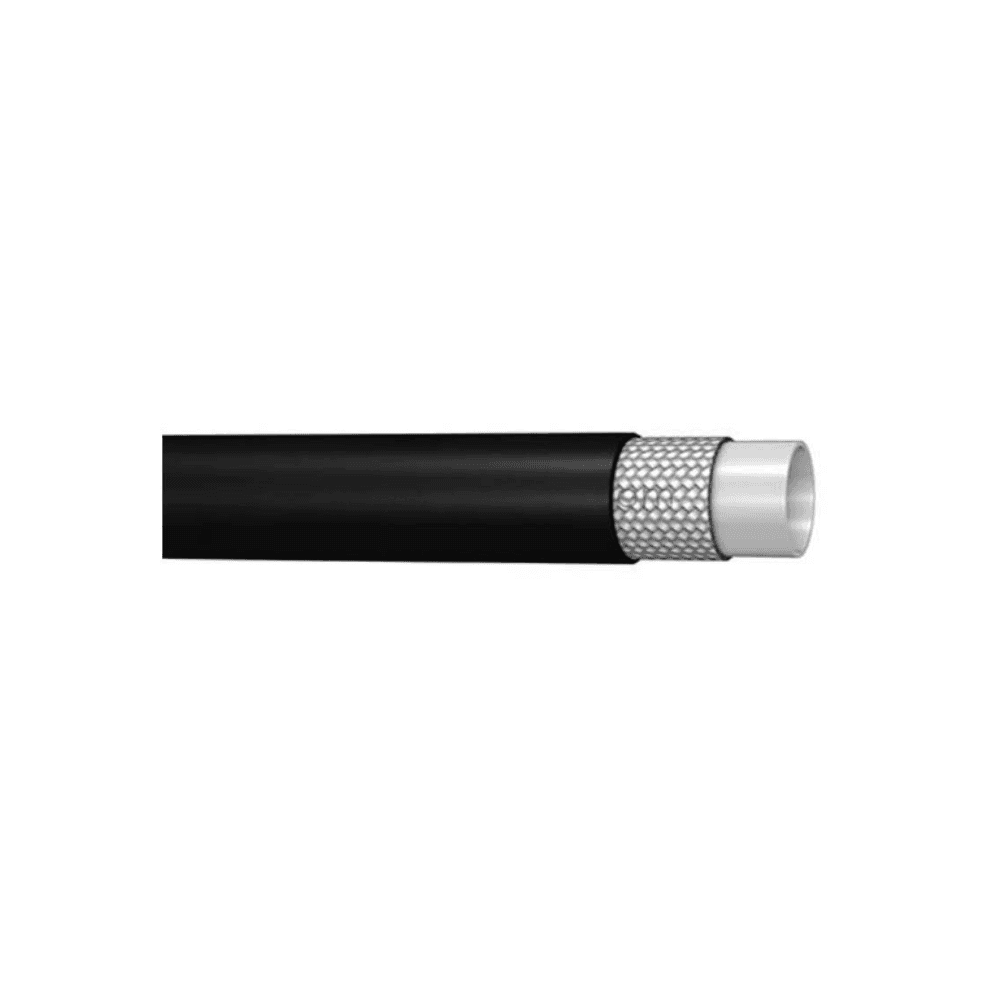 IH-HOSE-R7-TPR7 Thermoplastic Hydraulic HoseParker Hannifin
Also in the range
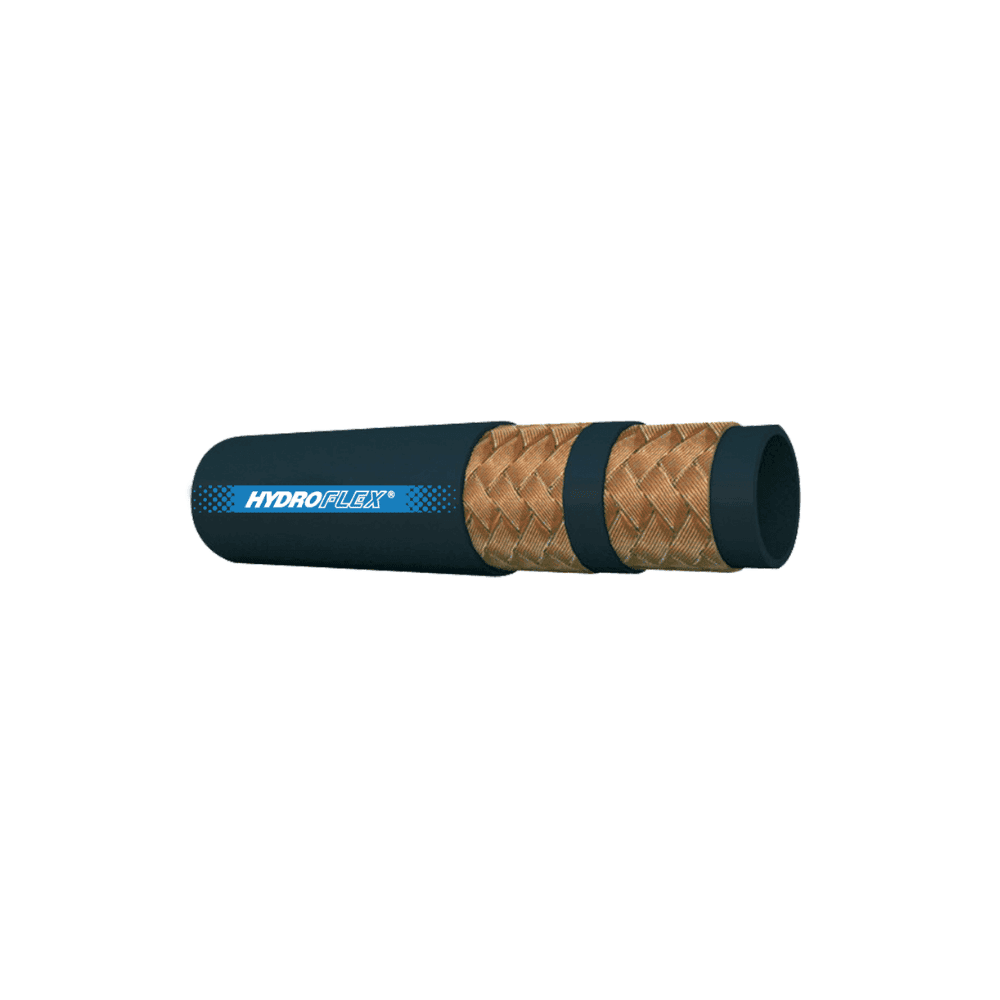 IH-HOSE-R3R3 Two-Fibre Braid Hydraulic HoseEaton Winner
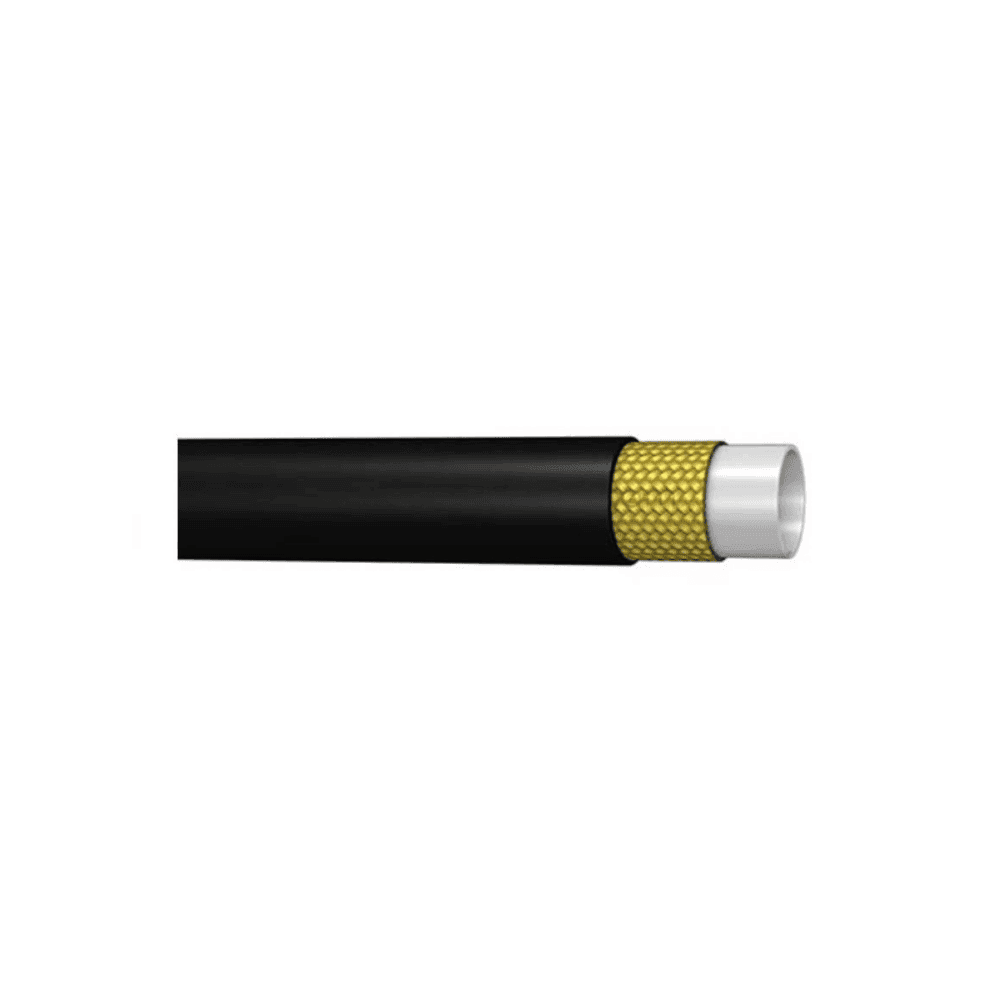 IH-HOSE-R8-TPR8 Thermoplastic Hydraulic HoseParker Hannifin
- IH-HOSE-R12R12 Four-Spiral High-Pressure HoseIndus Hydraulics
- IH-HOSE-R17R17 Compact High-Pressure HoseIndus Hydraulics
Headline pressures only in the table above — ask for the figure at your bore.
Common questions
- What is the difference between SAE 100R1 and SAE 100R1AT?
- Same single wire braid and the same working pressures; R1AT is built to a smaller outside diameter with a thinner cover. The practical differences are ferrule selection, clamp sizing and how much room the hose needs in a bundle.
- Is SAE 100R2AT the same as EN 853 2SN?
- The constructions we stock are certified to both, and the catalogue lists them as one product. They are separate standards published by separate bodies with closely aligned requirements, so a hose can meet both — but "equivalent" is a claim about a specific product, not about the two standards in general.
- Which SAE grade replaces a four-spiral EN 856 4SP hose?
- There is no clean one-to-one swap. 4SP and 4SH are EN 856 constructions; the nearest SAE spiral grades are R12, R13 and R15, and which one fits depends on the bore and pressure you actually need. Compare at the bore, not by designation.
- Why do two suppliers quote different pressures for the same 100R number?
- Because the standard sets a minimum, not a fixed value, and because headline figures are usually quoted at the smallest bore in the range. Check which size the number belongs to before treating two quotes as comparable.