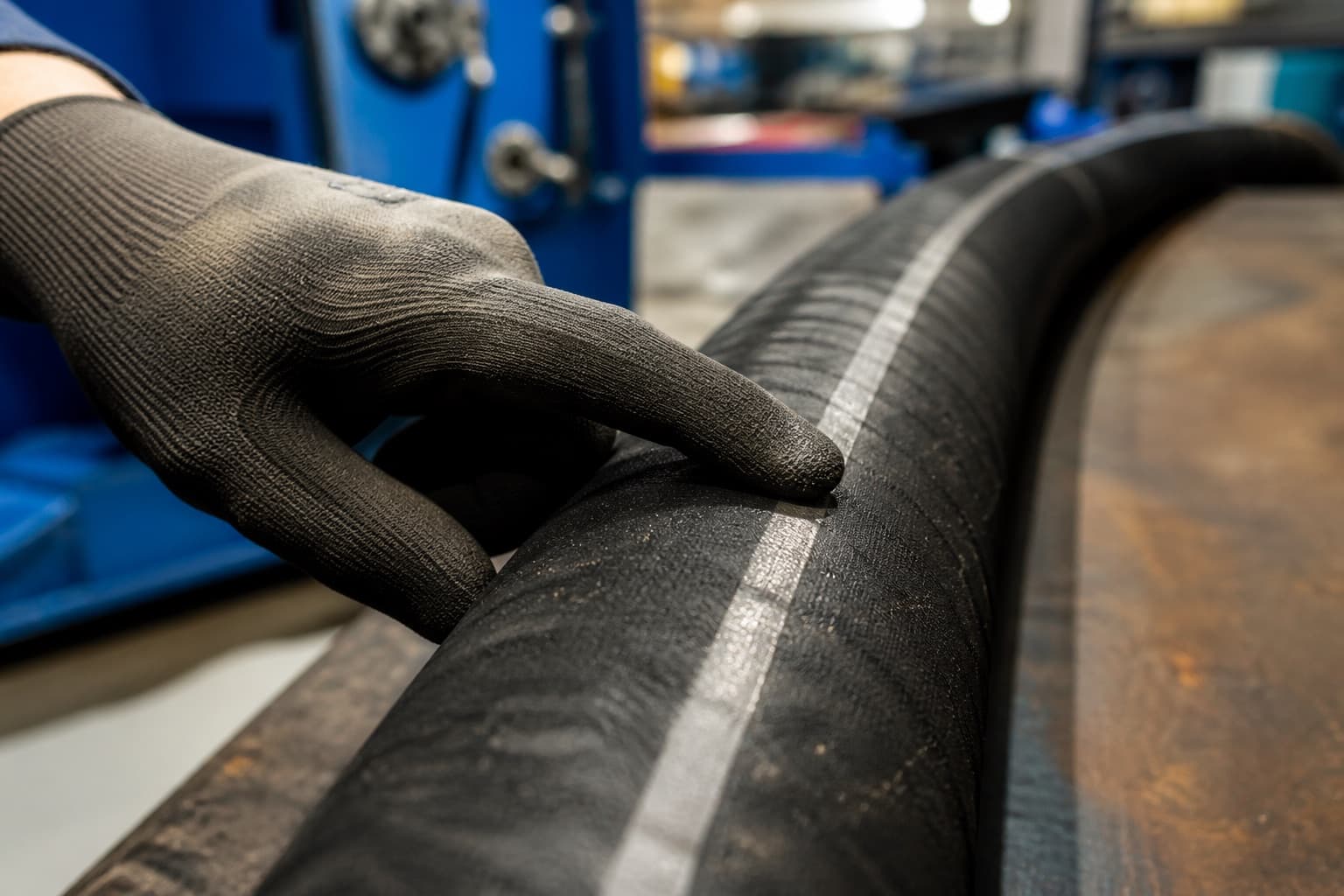
Every hydraulic hose leaves the factory carrying its own specification printed along its side. It is the most useful two seconds of identification available anywhere in the workshop, and it is routinely ignored in favour of measuring the old hose with a tape and guessing at the rest.
/01The five elements.
Exact wording and order vary by manufacturer — there is no standard that dictates the layout of the line itself. What is consistent is the information carried. Read left to right and you will find most or all of the following.
| Element | Looks like | What it settles |
|---|---|---|
| Manufacturer or brand | A company or series name | Whose datasheet governs. Without this the rest is hard to verify. |
| Series or type | A product family name or code | Which specific construction within that maker’s range. |
| Size | A dash number, a DN, or an inch bore | The bore — and therefore the ferrule and fitting dash. |
| Standard designationHighlighted | e.g. EN 853 2SN / SAE 100R2AT | The construction class and its minimum performance. |
| Working pressure | A bar and/or psi figure | The rating at that specific bore — not for the grade generally. |
| Date or lot code | A quarter and year, or a batch number | Age, and traceability back to a production batch. |
/02Why two standards often appear together.
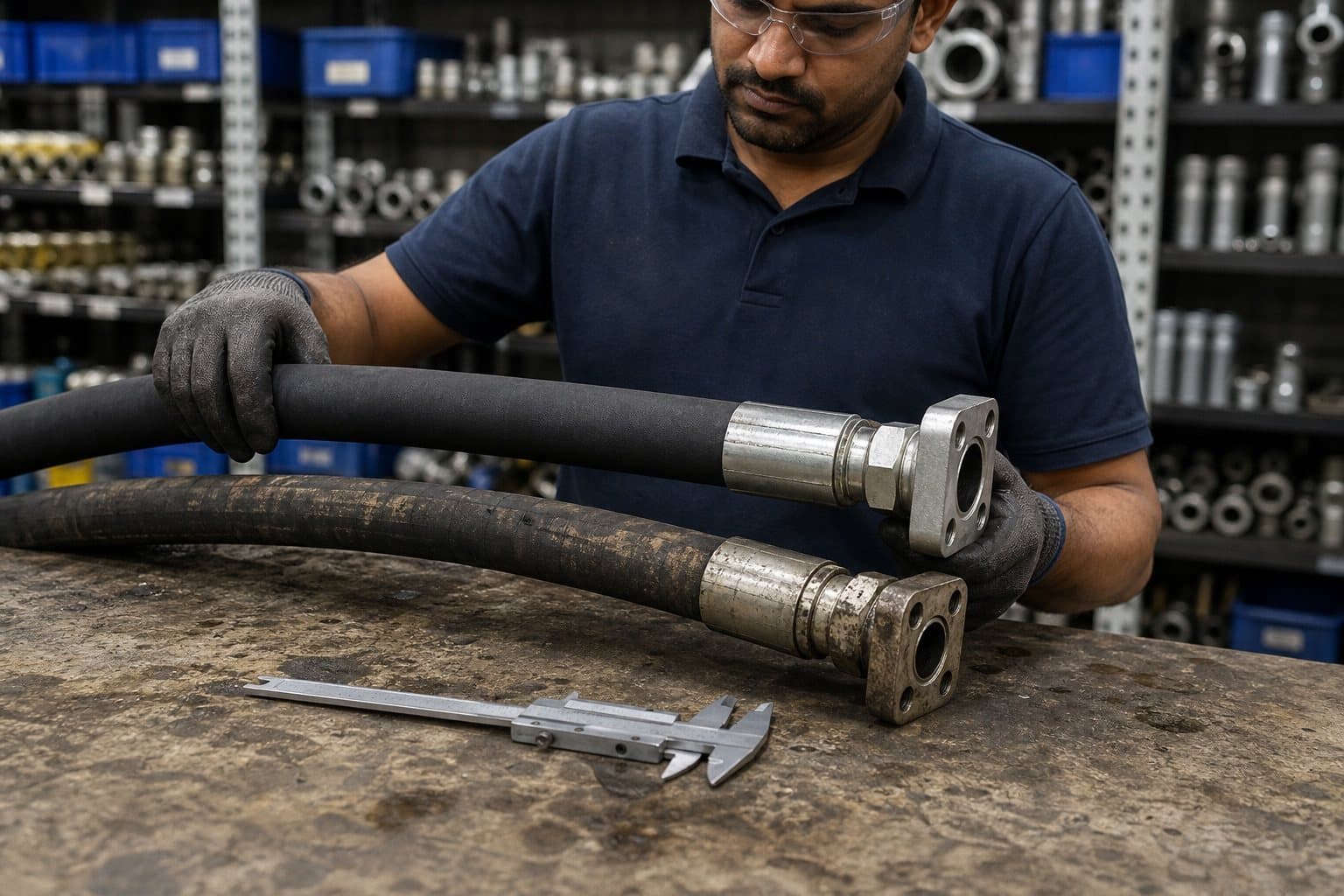
A layline reading EN 853 2SN / SAE 100R2AT is not a hedge or a marketing flourish. It means the hose is certified to both specifications, which manufacturers do because their customers work to different drawings. The wire-braid constructions are the ones where this is routine.
It is also the fastest answer to the cross-reference question. If a drawing calls for one designation and the hose in your hand prints both, the substitution question is already settled — and settled visibly, for whoever inspects the machine afterwards.
| Printed designation | Construction |
|---|---|
| EN 853 1SN / SAE 100R1AT | Single wire braid |
| EN 853 2SN / SAE 100R2AT | Double wire braid |
| EN 857 1SC | Compact single braid — EN only |
| EN 857 2SC | Compact double braid — EN only |
| EN 856 4SP | Four-spiral |
| EN 856 4SH | Four-spiral, heavy duty |
| SAE 100R13 | Spiral — SAE only |
| SAE 100R7 / EN 855 R7 | Thermoplastic |
/03When the printing has gone.
Laylines are ink on rubber. Sun, sand, solvent and any rub point will take them off, and in Gulf conditions a hose on an exposed boom can lose its printing long before it loses its integrity. That leaves you identifying the hose from its physical properties instead. Outside diameter, wire count and cover type will usually narrow it to one construction in our hydraulic hose range.
Identifying a hose with no readable layline
Each step narrows it. Do them in order; the first two are usually enough.
IfCut end is available
Count the reinforcement layers and note whether they are braided or spiral-wrapped.
One braid, two braids, four spirals and six spirals are visually distinct on a clean cut. This alone puts the hose in a construction family.
IfReinforcement is visible but you cannot cut
Measure the outside diameter and the bore with callipers.
Outside diameter and bore together identify the dash size and narrow the grade — at −08 the constructions we stock spread from 17.2 mm to 23.0 mm outside.
IfHose is still on the machine and cannot be removed
Photograph the fitting ends and the routing, and measure outside diameter.
The fitting tells us the termination; the routing tells us the bend radius the replacement has to achieve.
IfA sibling hose on the same machine is readable
Read that one instead.
Machines are usually built with one or two grades throughout. A legible layline elsewhere in the same bundle is strong evidence.
/04Photograph it before you cut it.
The single most useful habit in hose replacement: photograph the layline before the hose comes off the machine. It takes a moment, it survives the hose being cut up, and it turns a specification conversation into a reading exercise.
Shoot along the hose rather than square onto it so the whole line is legible in one frame, and get the fitting ends in a second photograph. Between them, that is enough to build an exact replacement without the machine being measured at all.
Constructions whose designations appear above
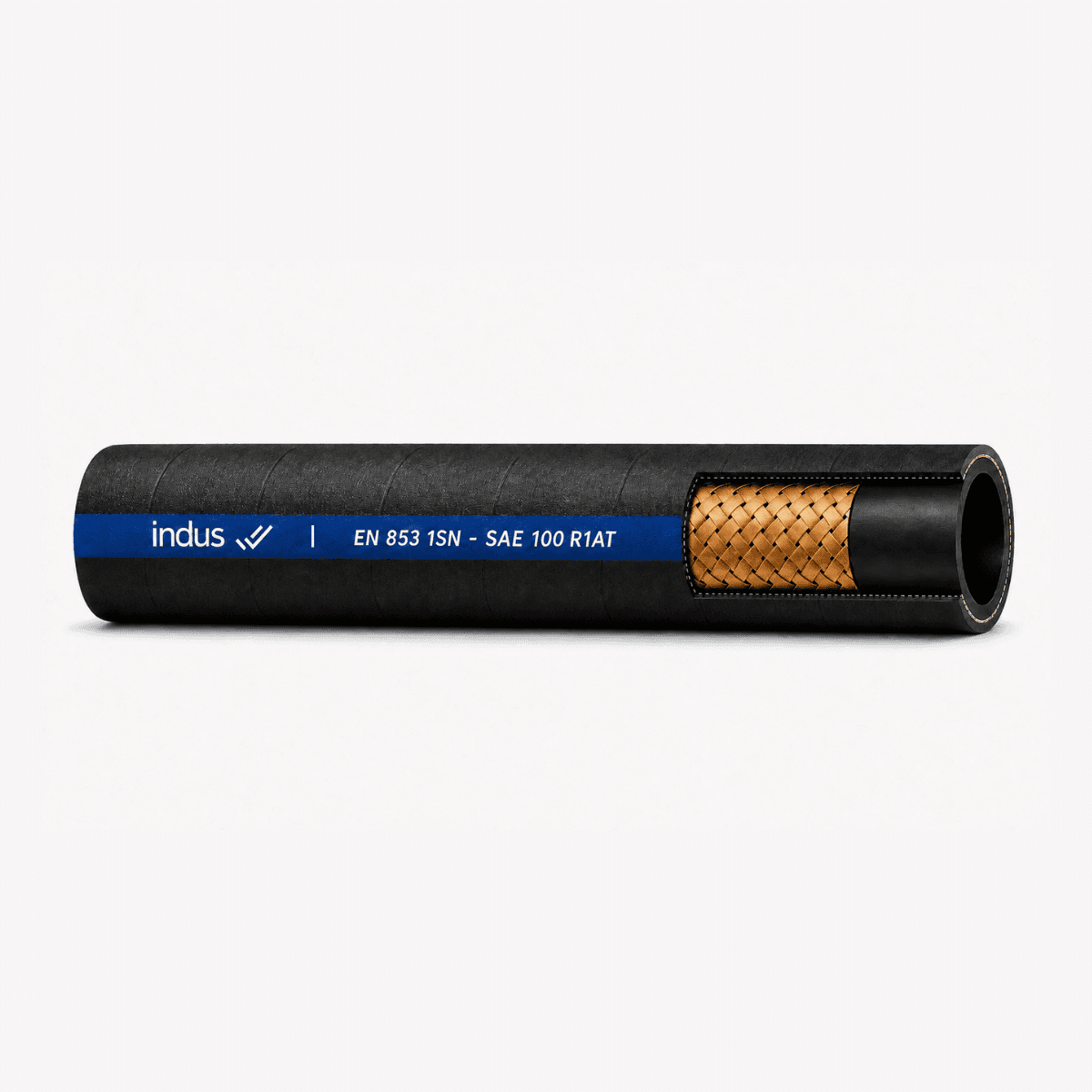 IH-HOSE-R1-1SNR1 1SN Single Wire Braid Hydraulic HoseEaton Winner
 IH-HOSE-R2-2SNR2 2SN Double Wire Braid Hydraulic HoseEaton Winner
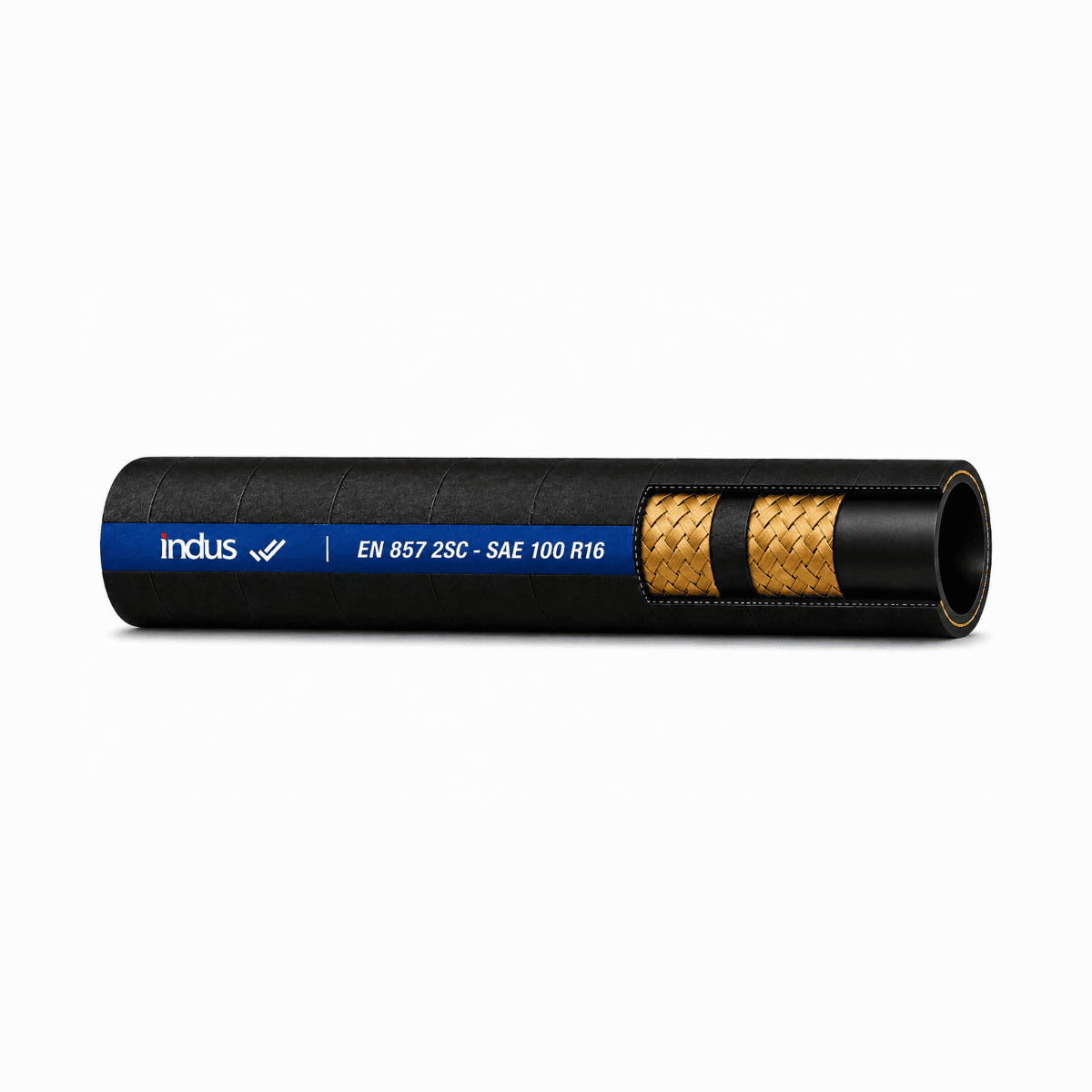 IH-HOSE-2SC2SC Compact Two Wire Braid HoseIndus Hydraulics
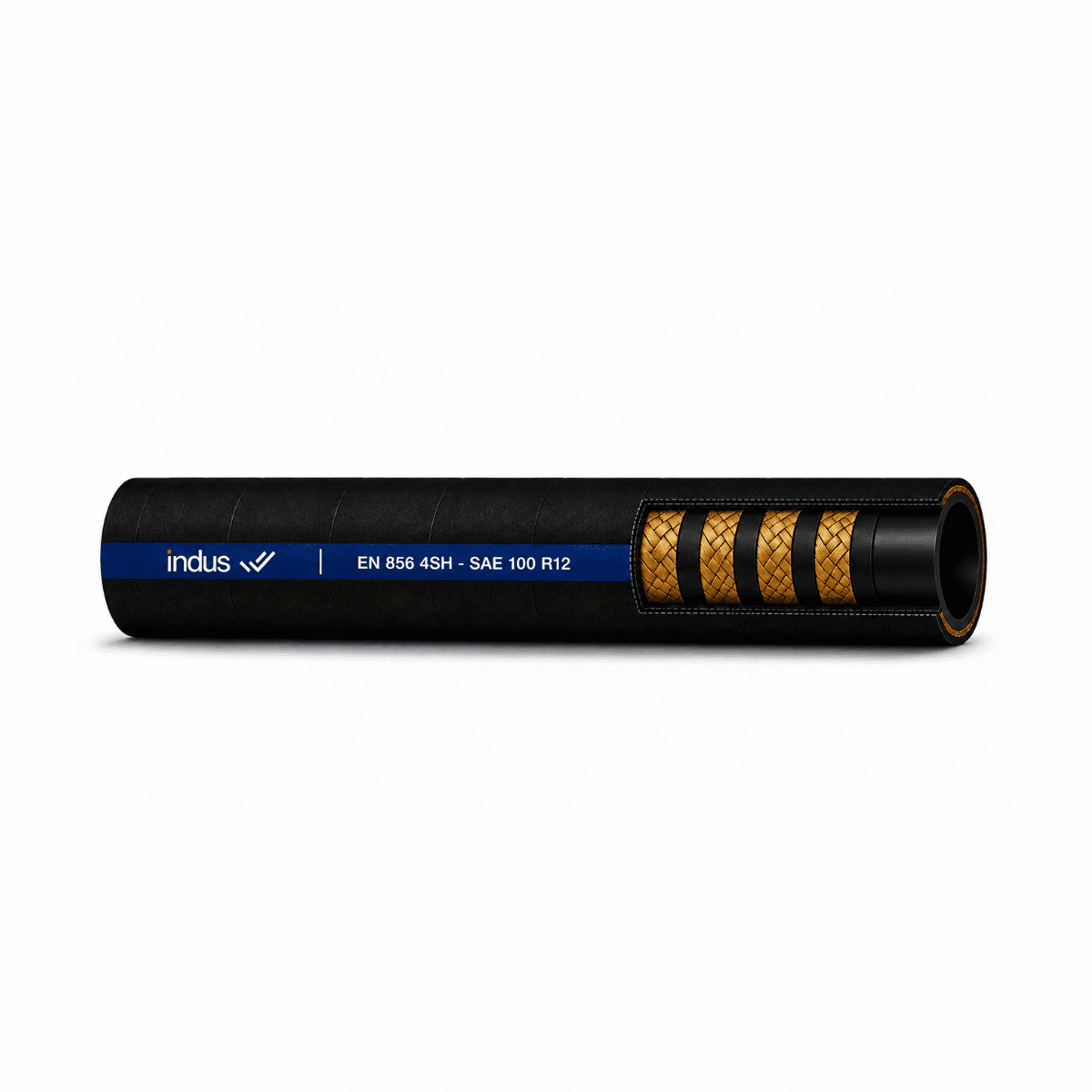 IH-HOSE-4SH4SH Four-Spiral Heavy-Duty Hydraulic HoseIndus Hydraulics
 IH-HOSE-R13R13 Multi-Spiral Very-High-Pressure HoseIndus Hydraulics
Common questions
- Is the layline printed on every hydraulic hose?
- On virtually all wire-reinforced hydraulic hose, yes. Some thermoplastic and PTFE constructions carry it differently, and hose supplied in short pre-made assemblies may have had the printed section cut away — which is one more reason for a tag.
- Can the layline tell me how old the hose is?
- Only if the manufacturer prints a date or lot code, and not all do. Where it is present it is usually a quarter and year. Where it is absent, age has to come from your own records or from a tag applied at build.
- The layline says a pressure lower than my system. Is the hose wrong?
- Possibly, but check the bore first — the printed figure is for that size, and a larger-bore hose of the same grade carries a lower rating. If the figure really is below your working pressure at that bore, stop and have the specification reviewed before running it.
- Two hoses on the same machine print different standards. Is that a problem?
- Not necessarily. Different circuits have different requirements and a well-specified machine may deliberately use a compact grade where routing is tight and a standard braid elsewhere. It becomes a problem when nobody knows why, which is what a hose register is for.