
R14 PTFE Hydraulic Hose
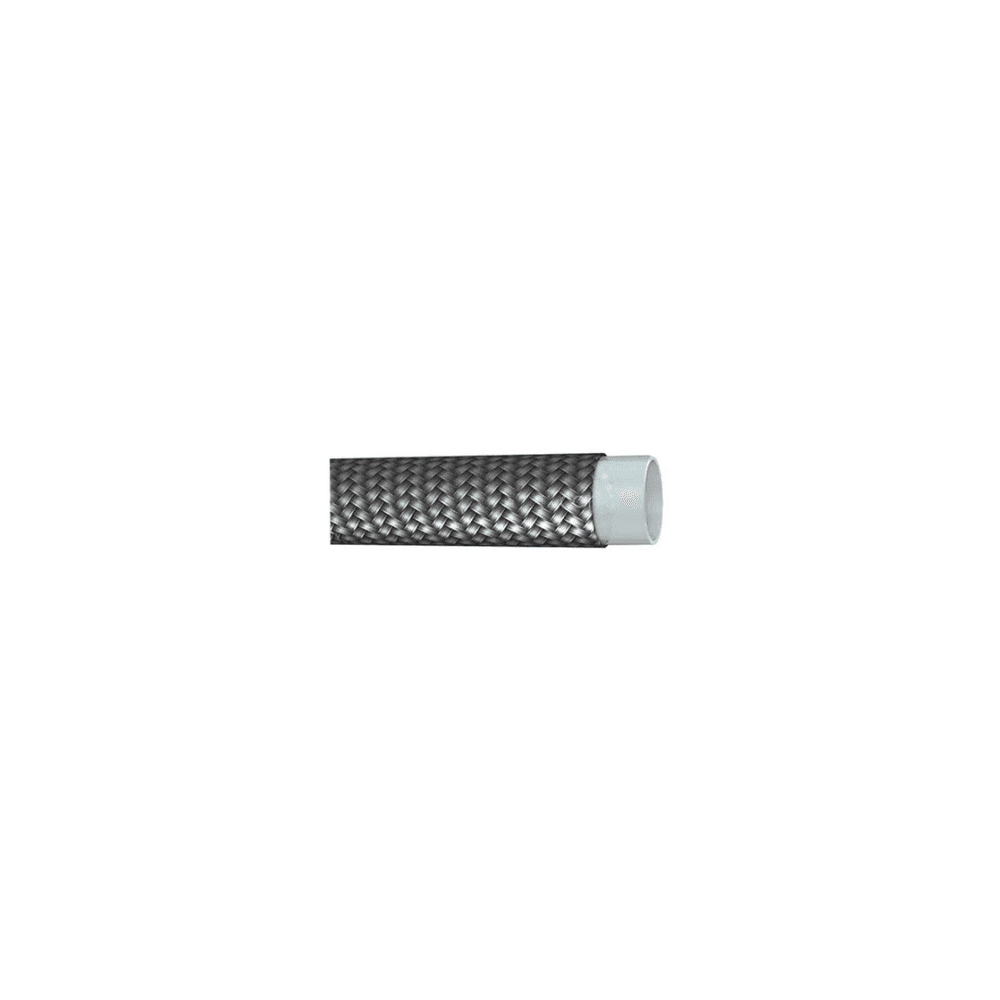
PTFE-tube hose with stainless braid for chemicals, food/beverage, steam, and high-temperature hydraulic service. 3/16" – 1" (DN5 – DN25).
Key features
- Applicable Standard: SAE 100R14
- Construction Type: ptfe-thermoplastic
- Bore Size Range: 3/16" – 1" (DN5 – DN25)
- Max Working Pressure: 200 bar
- Min Burst Pressure: 800 bar
- Min Operating Temperature: -54 °C
- Max Operating Temperature: 204 °C
- Reinforcement: Single layer of stainless-steel braid (Type A) or stainless braid + Aramid (Type B)
- Applicable Standard
- SAE 100R14
- Construction Type
- ptfe-thermoplastic
- Bore Size Range
- 3/16" – 1" (DN5 – DN25)
- Max Working Pressure
- 200 bar
- Min Burst Pressure
- 800 bar
- Min Operating Temperature
- -54 °C
Product description
The R14 PTFE Hydraulic Hose PTFE-tube hose with stainless braid for chemicals, food/beverage, steam, and high-temperature hydraulic service. Conforms to SAE 100R14.
Construction
- Tube: Virgin PTFE (chemically inert)
- Reinforcement: Single layer of stainless-steel braid (Type A) or stainless braid + Aramid (Type B)
- Cover: Stainless-steel braid (exposed) or polyurethane jacket, smooth
Performance
Working pressures up to 200 bar at -03, falling to 65 bar at -16, with a minimum burst of 800 bar (safety factor 4:1). Continuous service from -54°C to 204°C, with the upper limit reduced for aggressive fluids — ask for a fluid compatibility chart if needed.
Applications
- Chemical transfer where PTFE chemical inertness is required
- Steam and high-temperature service to +204°C
- Food, beverage, and pharmaceutical applications (FDA-grade PTFE on request)
- Hydraulic systems with aggressive fluids — phosphate ester, water-glycol
Compliance
- SAE 100R14
Also available in
The same SAE 100R14 grade is stocked in Eaton Aeroquip and Eaton Winner in addition to the Parker Hannifin reference shown here. Tell us your brand preference on the RFQ and we will quote accordingly.
Companion grades
For lower temperatures with similar chemical resistance see R7 / R8 thermoplastic. For higher pressures in steel construction see R12 / R13.
Identification
| Parameter | Value |
|---|---|
| Applicable Standard | SAE 100R14 |
| Construction Type | ptfe-thermoplastic |
Dimensions
| Parameter | Value |
|---|---|
| Bore Size Range | 3/16" – 1" (DN5 – DN25) |
| Min Bend Radius | 35–270 mm by bore (35 mm at -03, 270 mm at -16) |
| Outside Diameter Range | 8–30 mm (-03 to -16) |
Performance
| Parameter | Value |
|---|---|
| Max Working Pressure | 200 bar |
| Min Burst Pressure | 800 bar |
| Safety Factor | 4:1 |
| Working Pressure Range | 200 bar at -03 down to 65 bar at -16 |
| Min Operating Temperature | -54 °C |
| Max Operating Temperature | 204 °C |
Construction
| Parameter | Value |
|---|---|
| Reinforcement | Single layer of stainless-steel braid (Type A) or stainless braid + Aramid (Type B) |
| Tube (Inner) Material | Virgin PTFE (chemically inert) |
| Cover Material | Stainless-steel braid (exposed) or polyurethane jacket |
| Cover Finish | smooth |
Compliance
| Parameter | Value |
|---|---|
| Conductivity | static-dissipative |
Commercial
| Parameter | Value |
|---|---|
| Sold By | per-metre |
Shipping & lead time
What is R14 PTFE Hydraulic Hose used for?▾
Which sizes does R14 PTFE Hydraulic Hose come in?▾
How do I order R14 PTFE Hydraulic Hose by size and length?▾
What is the working pressure of R14 PTFE Hydraulic Hose?▾
What temperatures and fluids can R14 PTFE Hydraulic Hose handle?▾
What standard does R14 PTFE Hydraulic Hose conform to?▾
What end fittings go on R14 PTFE Hydraulic Hose?▾
What is the minimum bend radius of R14 PTFE Hydraulic Hose and how do I route it?▾
What applications is R14 PTFE Hydraulic Hose recommended for?▾
R14 PTFE Hydraulic Hose or R5 Textile-Cover Single Wire Braid Hose: which should I choose?▾
Where does R14 PTFE Hydraulic Hose come from and how is it shipped?▾
Do you stock R14 PTFE Hydraulic Hose in Dubai?▾
Shipped worldwide from our Dubai warehouse. Transit, routes and documentation for 136 destinations
From the blog
Written about this part
Failure analysis
Cracked cover: heat ageing against ozone attack
A cover covered in fine cracks has been cooked, or has been sitting in sunlight and still air. The crack pattern separates them, and only one of the two is fixed by moving the hose.
4 min read
Gulf operating conditions
Salt air at Jebel Ali and Mussafah: the clock runs faster on the coast
The corrosion mechanism is the same everywhere. What changes near the sea is the speed — and because the reinforcement corrodes invisibly, speed is the whole problem.
3 min read
Failure analysis
Swollen or hardened tube: reading fluid incompatibility off the failure
Cut a failed hose open and the tube tells you whether the fluid was wrong. Swollen and soft is one problem, shrunken and brittle is the opposite one, and both mean the hose and the fluid were never suited.
3 min read
Engineers viewing this also looked at

R15 Six-Spiral Ultra-High-Pressure Hose
Indus Hydraulics- R16 Compact Two-Wire Braid Hose
R16 Compact Two-Wire Braid Hose
Indus Hydraulics - R17 Compact High-Pressure Hose
R17 Compact High-Pressure Hose
Indus Hydraulics 
R2 2SN Double Wire Braid Hydraulic Hose
Eaton Winner
R3 Two-Fibre Braid Hydraulic Hose
Eaton Winner
R4 Low-Pressure Suction & Return Hose
Indus Hydraulics
R5 Textile-Cover Single Wire Braid Hose
Parker Hannifin
R6 Single Fibre Braid Low-Pressure Hose
Eaton Winner