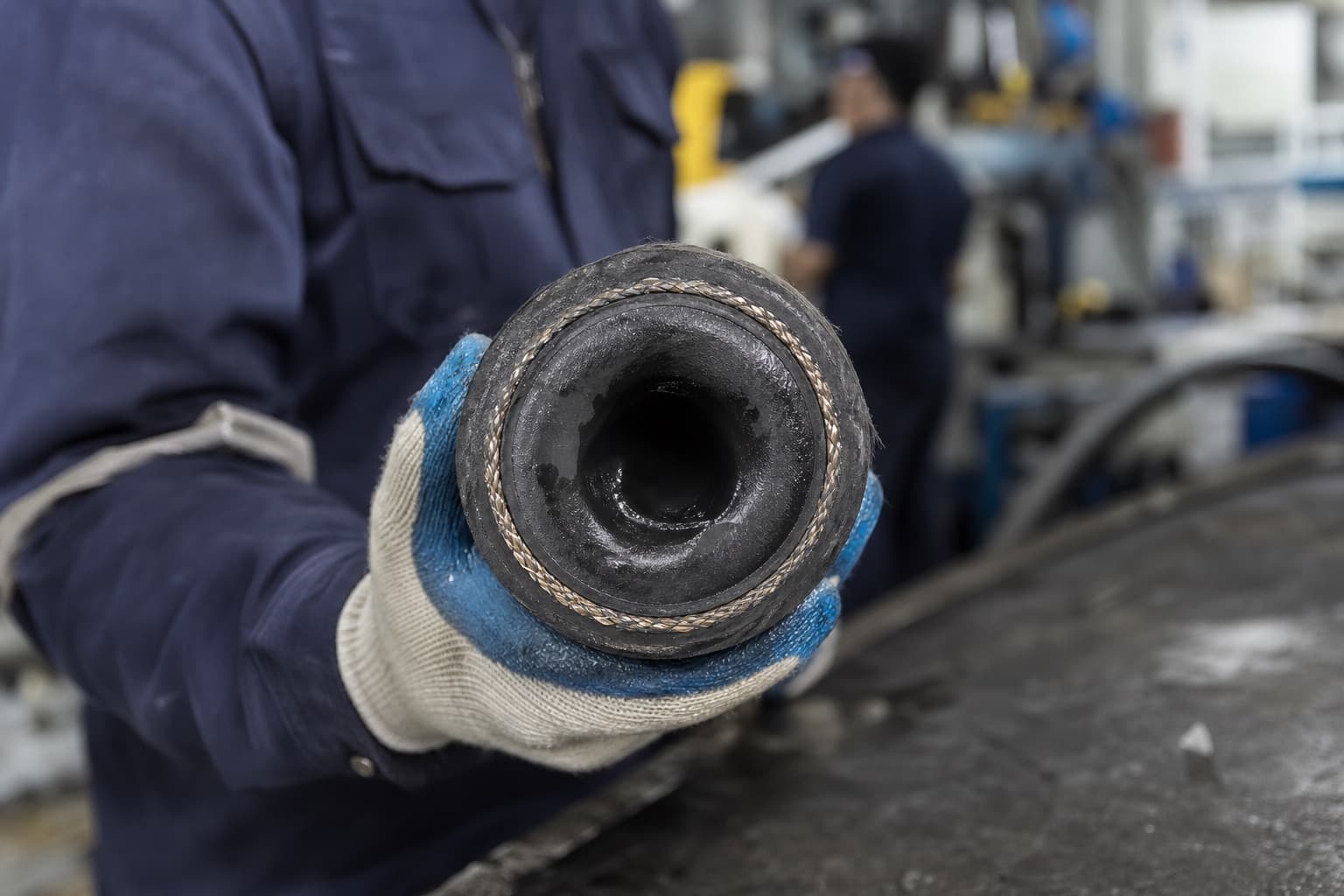
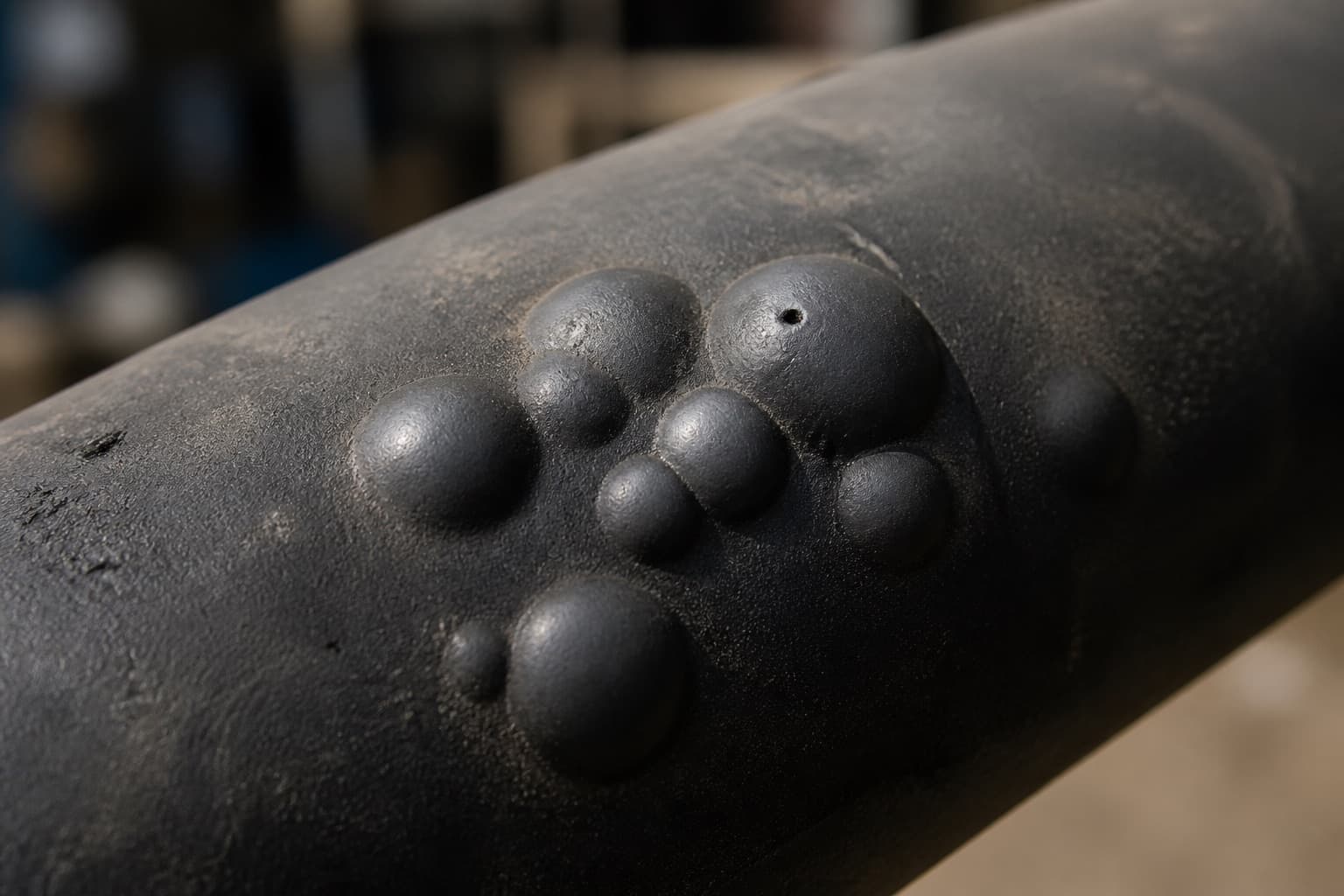
Most hose diagnosis happens from outside. This one cannot: a tube attacked by the fluid it is carrying can sit inside a cover that looks entirely healthy, and the only way to see it is to cut the hose open along its length.
/01The two opposite failures.
| Tube condition | Mechanism | Typical cause |
|---|---|---|
| Swollen, soft, spongy, oversizedHighlighted | Fluid absorbed into the compound, swelling it | A fluid the tube was not selected for |
| Hard, brittle, shrunken, cracked | Plasticisers extracted, leaving the rubber stiff | Aggressive solvent, or sustained heat |
| Tube separated from the reinforcement | Adhesion lost, often after swelling | Advanced incompatibility |
| Tube eroded or thinned, smooth | Mechanical, not chemical — abrasive fluid | Contaminated or particulate-laden fluid |
/02What our hose is actually made of.
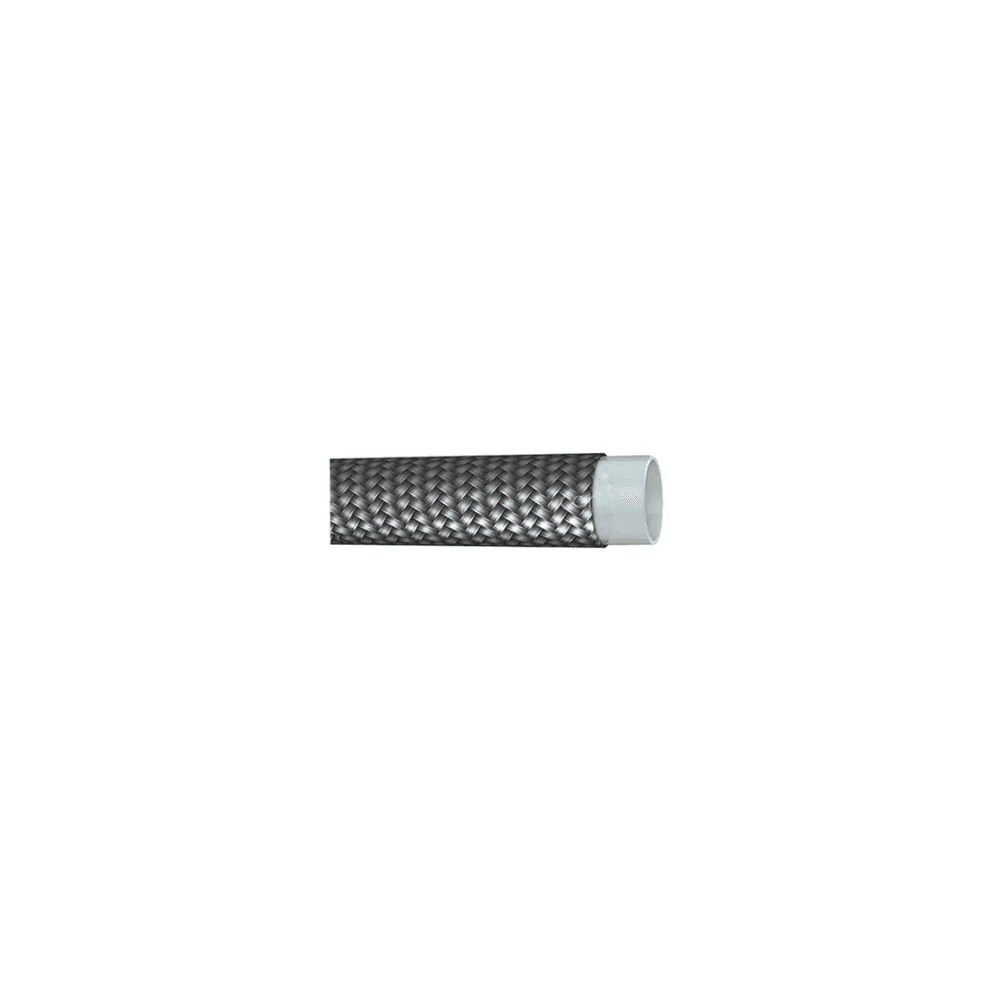
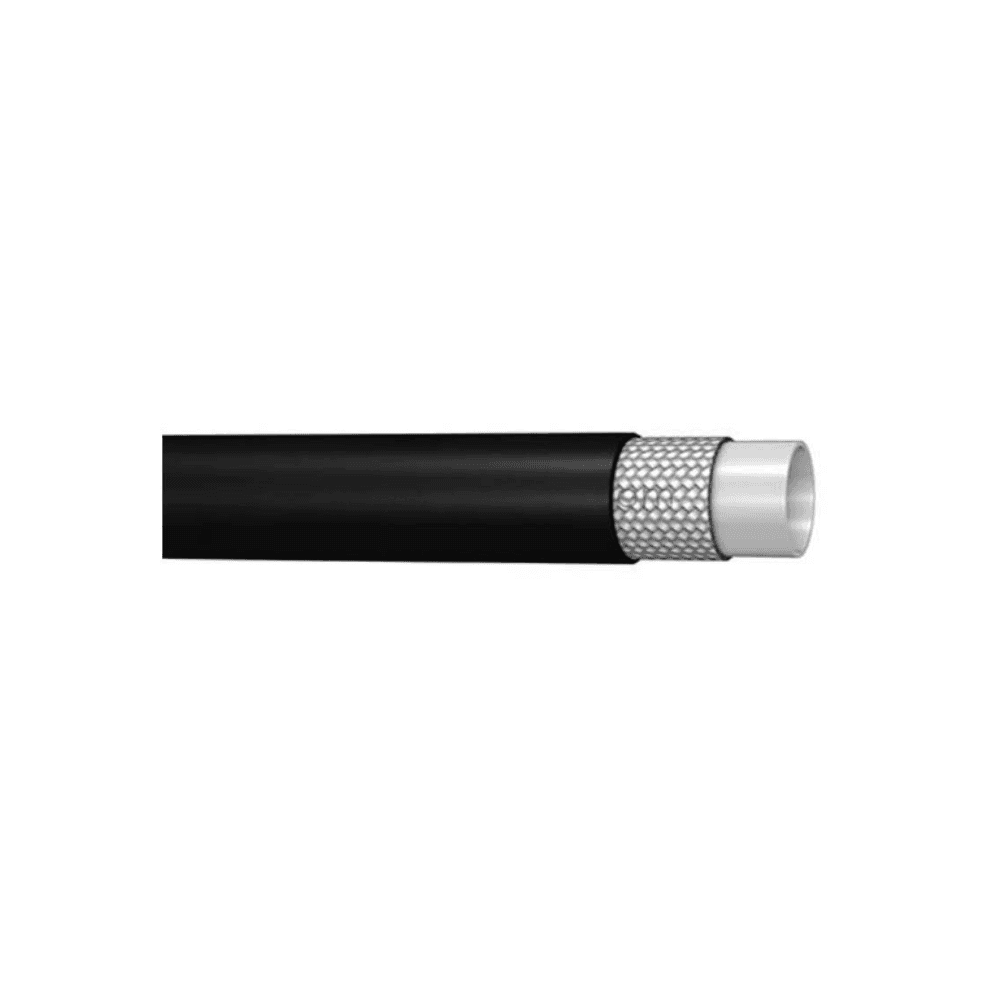
Almost every wire-reinforced hydraulic hose in our range has a nitrile tube. It is the standard choice because it suits mineral hydraulic oil, which is what most systems run. The moment the fluid is not mineral oil, that assumption needs checking. Where it fails the check, R14 PTFE hose is chemically inert, and thermoplastic grades such as R8 use a polyamide tube.
| Tube | Grades | Suits |
|---|---|---|
| Nitrile (NBR) | 1SN, 2SN, 1SC, 2SC, 4SP, 4SH, R5, R6, R13, R15 | Mineral hydraulic oil |
| Polyamide (nylon) | R7, R8 thermoplastic | Hydraulic fluid, tighter routing, lighter weight |
| PTFEHighlighted | R14 | Chemically inert — the answer where nitrile fails |
/03Heat makes everything else worse.
Chemical attack accelerates with temperature. A fluid the tube tolerates at 60 °C can attack it steadily at 100 °C, so a marginal combination that ran for years can start failing when the duty changes — a higher ambient, a hotter summer, a cooler that has silted up.
The grades we stock are rated to 100 °C on most constructions and 121 °C on the spiral and R5 lines, with PTFE at 204 °C. Those are limits for the hose in its intended fluid, not licences to run any fluid up to that temperature.
When the tube compound has to change
Common questions
- We changed to a fire-resistant fluid and hoses started failing. Related?
- Almost certainly. Phosphate-ester fluids in particular are not compatible with the nitrile tube used in standard hydraulic hose. A fluid change is a hose specification change, and it applies to seals and paint as well.
- How do I check compatibility before committing?
- Against the tube compound, at the actual concentration and temperature — not against the hose grade. Tell us the fluid and the running temperature and we will tell you which tube suits it.
- The tube looks fine but the hose keeps leaking at the fittings.
- Check the seals and O-rings in the same fluid. A tube that tolerates a fluid does not guarantee that every elastomer in the circuit does, and the seals usually go first.
- Is PTFE always the safe answer?
- It is chemically inert and handles far higher temperatures, so it solves most compatibility problems. It is more expensive, less flexible in the small sizes and needs different fittings — worth it where nitrile keeps failing, over-specified where it does not.