Dash sizes are the one piece of hydraulic shorthand that genuinely is simple: divide by sixteen and you have the bore in inches. The trouble is that people extend the shorthand to things it was never describing — the outside of the hose, the port thread, and one grade where the number is not measuring the bore at all.
/01The conversion.
Dash size is nominal bore in sixteenths of an inch. Nominal is doing real work in that sentence: it is the size the hose is called, and the actual bore is close to it rather than exactly it. DN is the metric nominal equivalent, and it is the figure European drawings and fittings use.
| Dash | Inch bore | DN | Common name |
|---|---|---|---|
| −03 | 3/16" | DN 5 | Three |
| −04 | 1/4" | DN 6 | Quarter inch |
| −05 | 5/16" | DN 8 | Five |
| −06 | 3/8" | DN 10 | Three-eighths |
| −08 | 1/2" | DN 12 | Half inch |
| −10 | 5/8" | DN 16 | Five-eighths |
| −12 | 3/4" | DN 19 | Three-quarter |
| −16 | 1" | DN 25 | One inch |
| −20 | 1.1/4" | DN 31 | Inch and a quarter |
| −24 | 1.1/2" | DN 38 | Inch and a half |
| −32 | 2" | DN 51 | Two inch |
| −40 | 2.1/2" | DN 63 | Two and a half |
| −48 | 3" | DN 76 | Three inch |
If you only want the conversion, our dash size chart gives it to four decimal places and nothing else. The rest of this page is about the three places where the conversion stops being the answer.
/02The R5 exception.
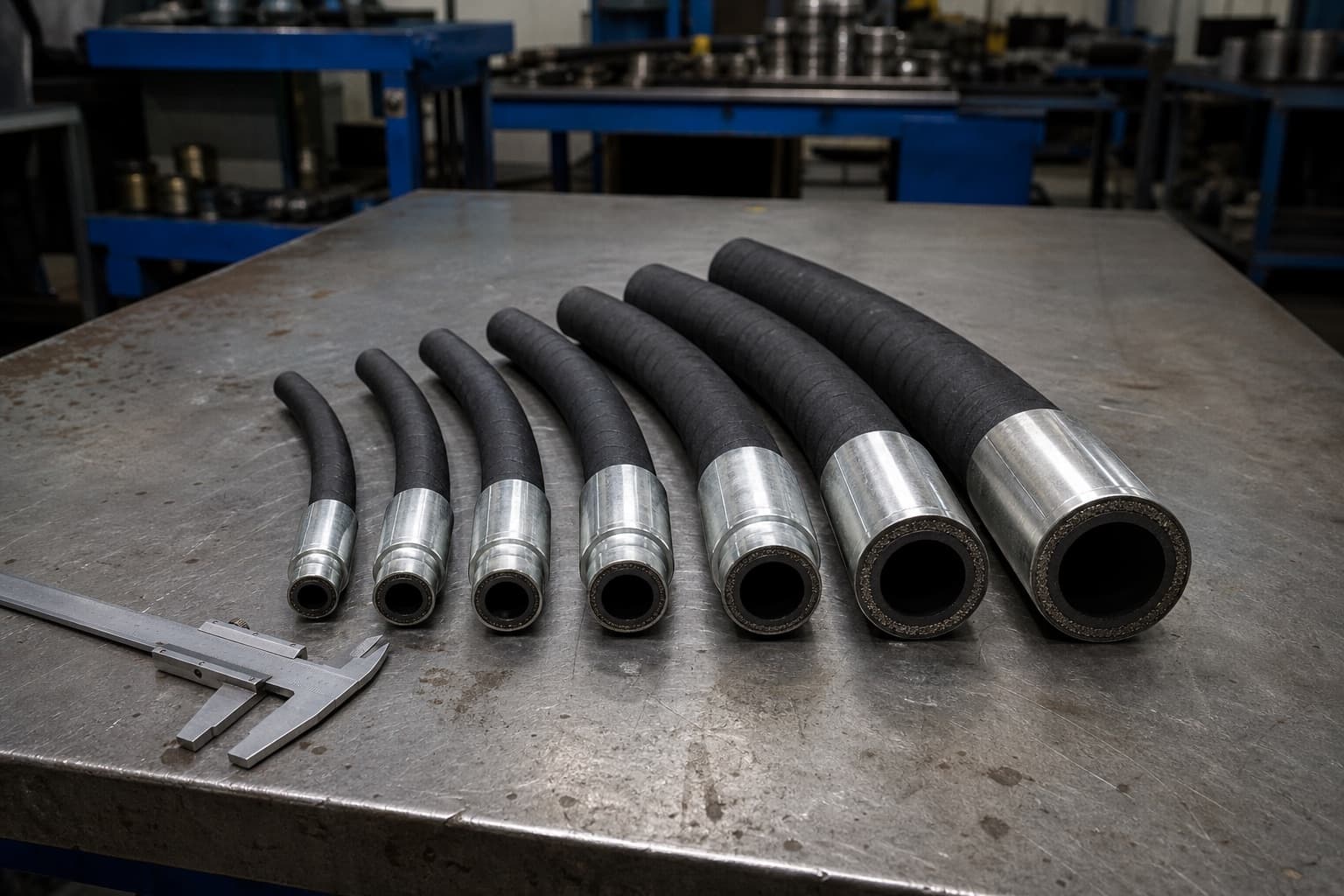
SAE 100R5 does not follow the rule above. It is sized on tube outside diameter — the size of the rigid tube the hose was designed to replace — rather than on its own bore. The result is that an R5 dash number sits one step out from everybody else’s for most of the range.
| Dash | DN on every other grade | DN on SAE 100R5 |
|---|---|---|
| −04 | DN 6 | DN 5 |
| −06 | DN 10 | DN 8 |
| −08Highlighted | DN 12 | DN 10 |
| −10 | DN 16 | DN 12 |
| −12 | DN 19 | DN 16 |
| −16 | DN 25 | DN 22 |
| −20 | DN 31 | DN 28 |
| −24 | DN 38 | DN 35 |
| −32 | DN 51 | DN 46 |
/03What the dash number does not tell you.
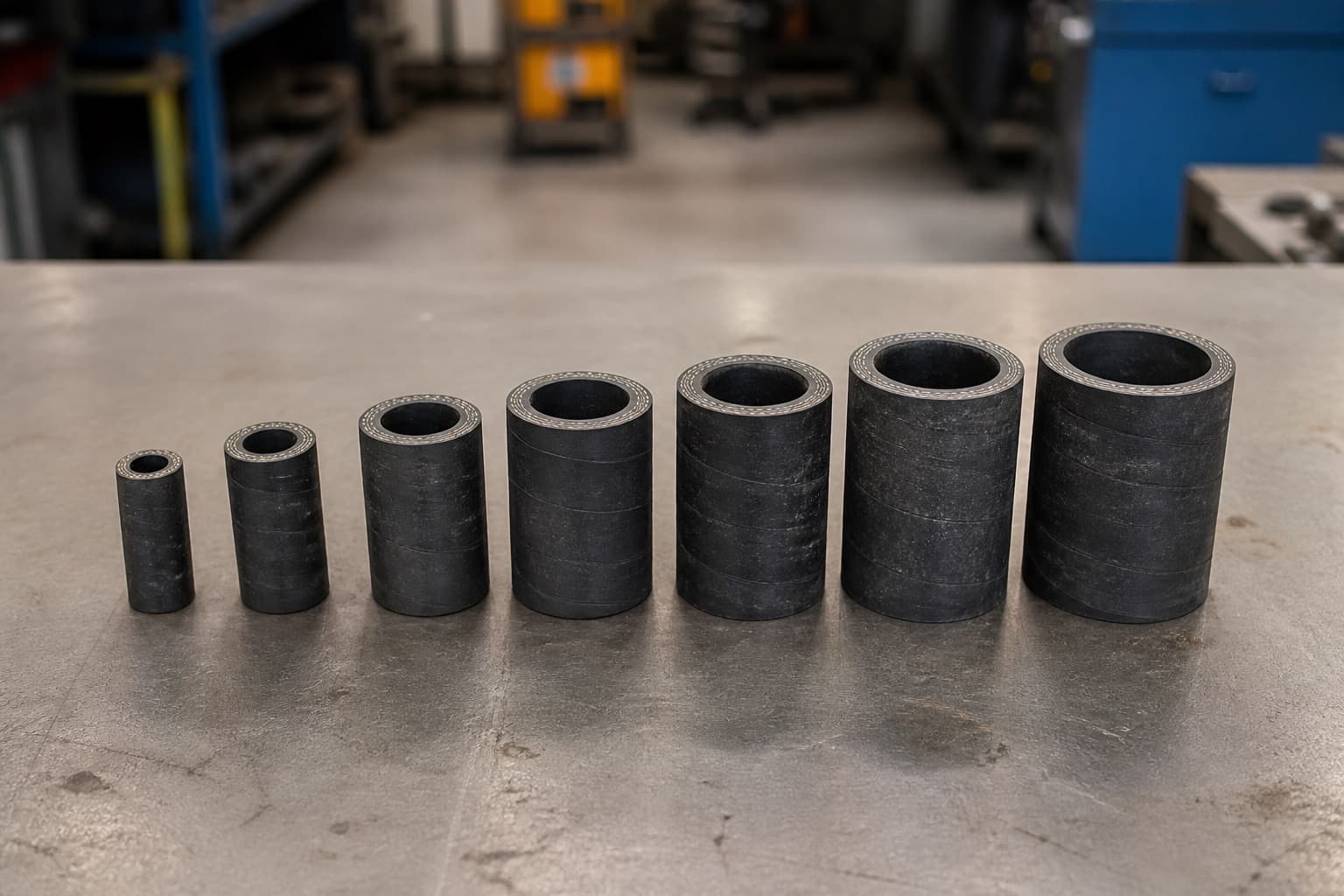
The most consequential misuse of a dash size is treating it as a description of the outside of the hose. It is not, and the spread is wide. Here is the same −08 bore across every construction we stock.
| Construction | Outside diameter |
|---|---|
| SAE 100R14 (PTFE) | 17.2 mm |
| SAE 100R5 | 19.1 mm |
| SAE 100R6 | 19.5 mm |
| EN 857 1SC | 20.0 mm |
| SAE 100R7 | 20.3 mm |
| EN 853 1SN | 20.4 mm |
| EN 857 2SC | 20.8 mm |
| EN 853 2SN | 22.2 mm |
| EN 856 4SPHighlighted | 23.0 mm |
Nearly six millimetres between the slimmest and the fattest at an identical bore. That is the difference between a bundle that fits its clamp and one that does not, and it is invisible if you specify by dash size alone. Anything that touches the outside of the hose — clamps, sleeves, spiral guard, bulkhead penetrations, bundle spacing — has to be sized from the grade’s outside diameter. At −08, for example, 2SC measures 20.8 mm over the cover against 22.2 mm for 2SN — enough to decide whether a bundle fits its clamp.
/04Ordering without ambiguity.
What to state when you order
Four items. Any three of them leaves something for somebody to guess.
IfHose dash size
State it as the dash, not as an inch measurement of the outside.
If you have measured rather than read it, say what you measured — a 22 mm reading is a −08 2SN or a −10 of something slimmer.
IfGrade or construction
This is what fixes the outside diameter and therefore the ferrule.
Two hoses at the same dash take different ferrules if the constructions differ.
IfPort thread at each end
Independent of the hose dash — state it separately, per end.
Both ends, even when they are the same. "Same both ends" written down is worth more than an assumption.
IfOverall length and orientation
Length between sealing faces, plus the angle between the two ends if either is an elbow.
Elbow orientation is the detail most often left out and most often responsible for a remake.
Grades in the tables above
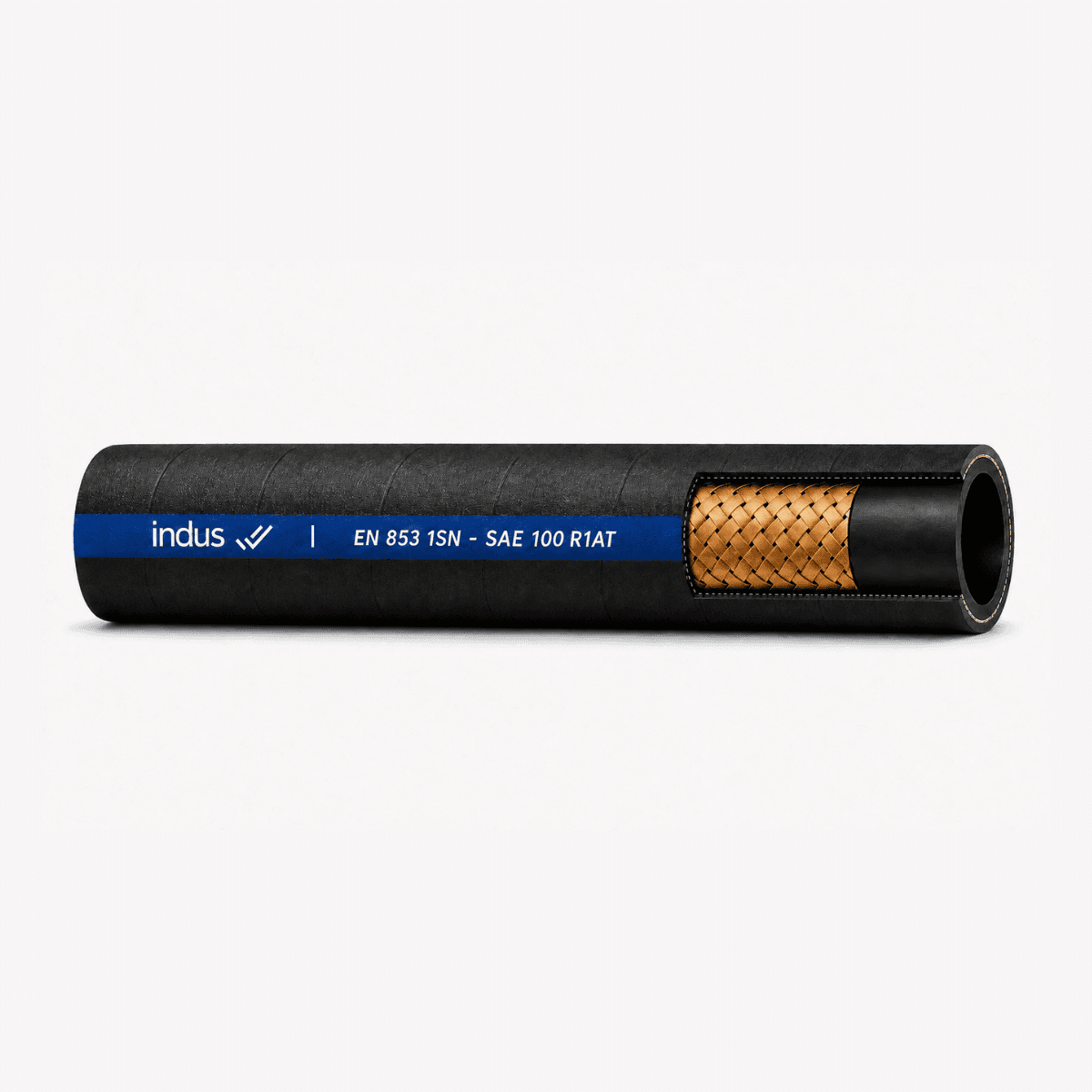 IH-HOSE-R1-1SNR1 1SN Single Wire Braid Hydraulic HoseEaton Winner
 IH-HOSE-R2-2SNR2 2SN Double Wire Braid Hydraulic HoseEaton Winner
 IH-HOSE-R1-1SCR1 1SC Compact Single Wire Braid HoseIndus Hydraulics
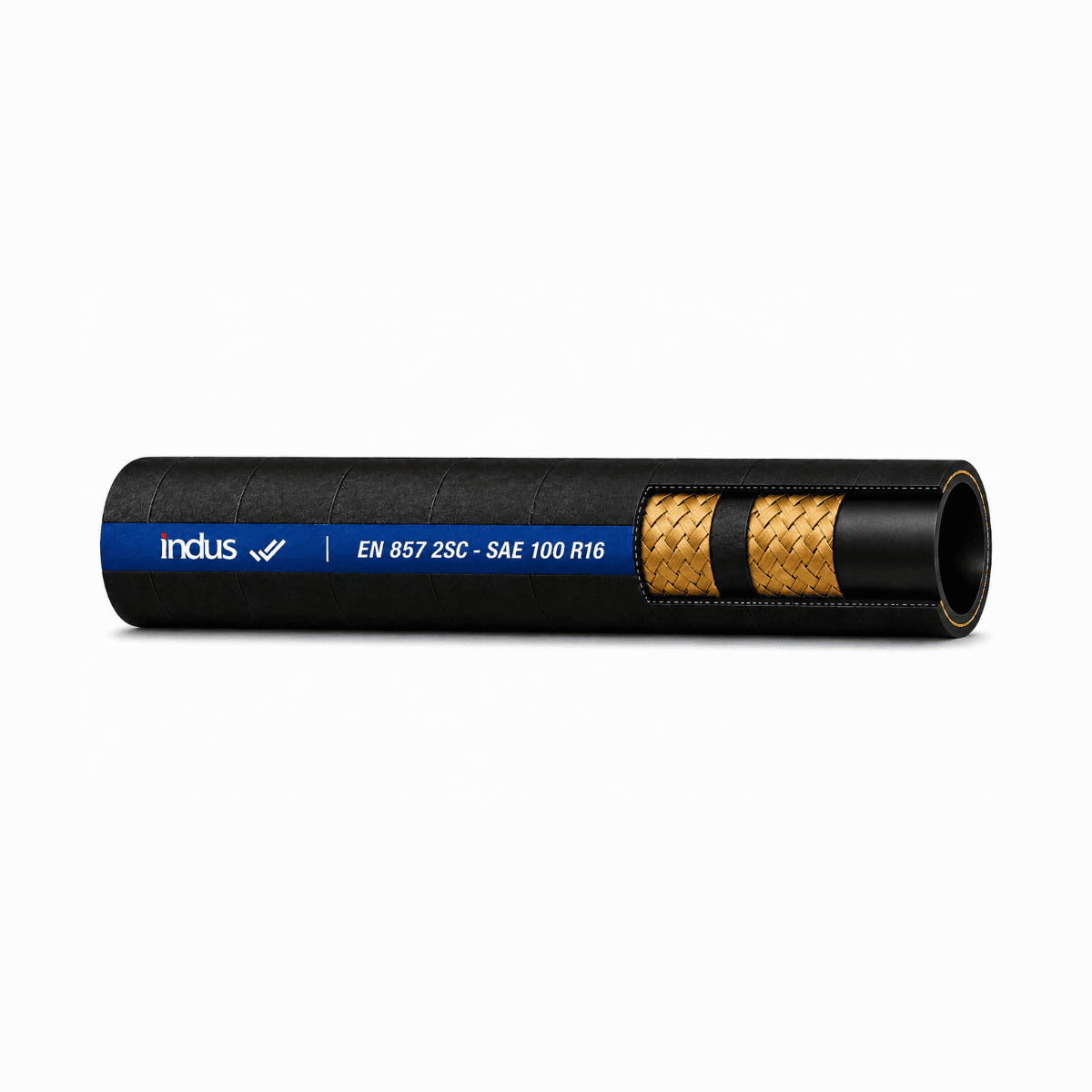 IH-HOSE-2SC2SC Compact Two Wire Braid HoseIndus Hydraulics
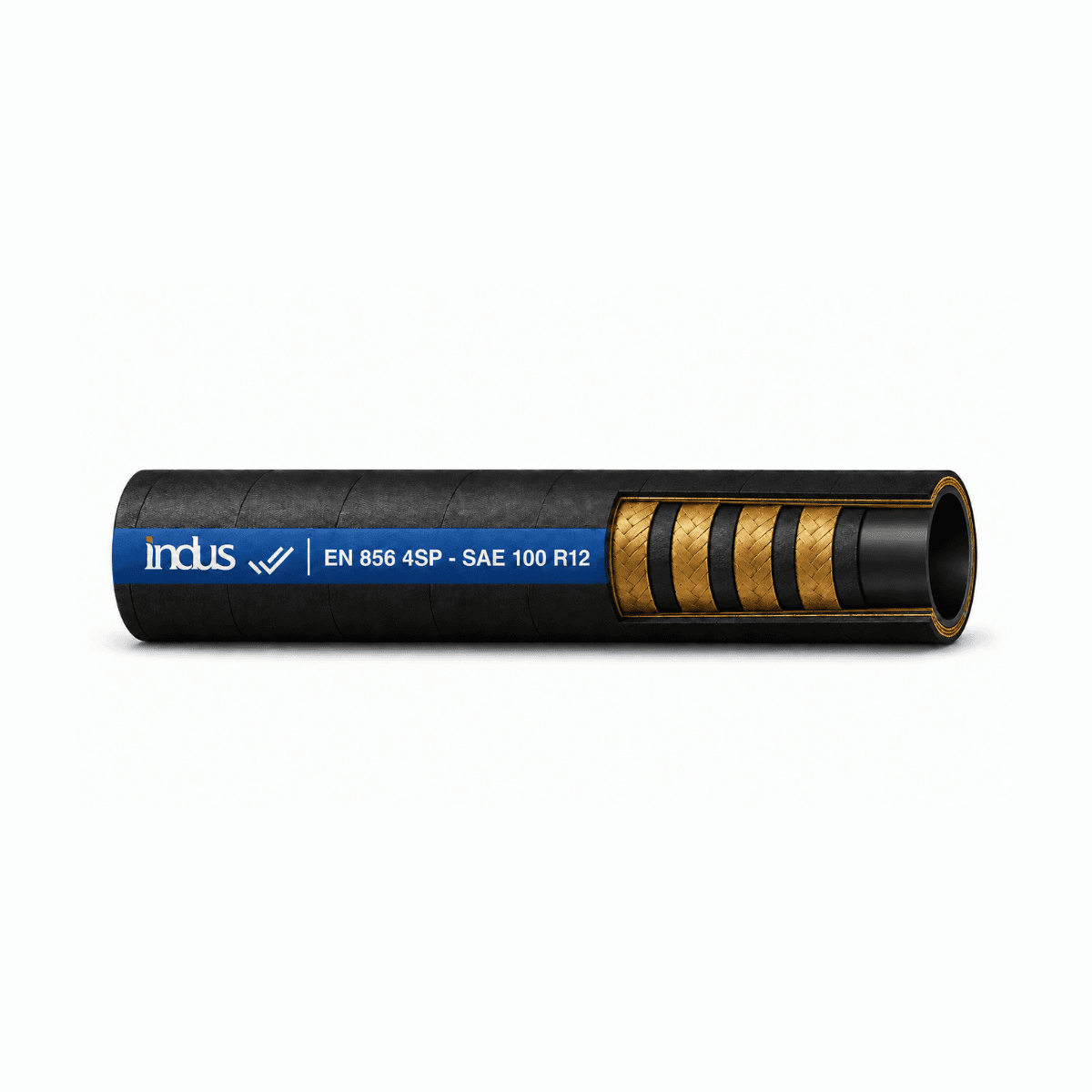 IH-HOSE-4SP4SP Four-Spiral Hydraulic HoseIndus Hydraulics
 IH-HOSE-R5R5 Textile-Cover Single Wire Braid HoseParker Hannifin
Common questions
- Is a −08 hose the same as a 1/2 inch hose?
- Yes on every grade here except SAE 100R5, where −08 is a DN10 bore — closer to 3/8 inch. Everywhere else, −08 is a half-inch nominal bore, DN 12.
- How do I work out the dash size of a hose I already have?
- Read the layline first — it is printed along the cover and usually states the size directly. If the print has worn off, measure the outside diameter and tell us the construction; outside diameter plus grade identifies the dash unambiguously, whereas outside diameter alone does not.
- Does the fitting dash have to match the hose dash?
- Yes. The fitting dash refers to the hose it crimps onto, and it must match the hose. The port thread on the other end of that fitting is a separate selection and frequently a different-sounding size.
- Why is DN 19 called three-quarter inch when 19 mm is not 3/4 of an inch?
- Both are nominal designations rounded for convenience — 3/4 inch is 19.05 mm, which is called DN 19 in the metric series. They are the same size described in two conventions, not two different sizes.