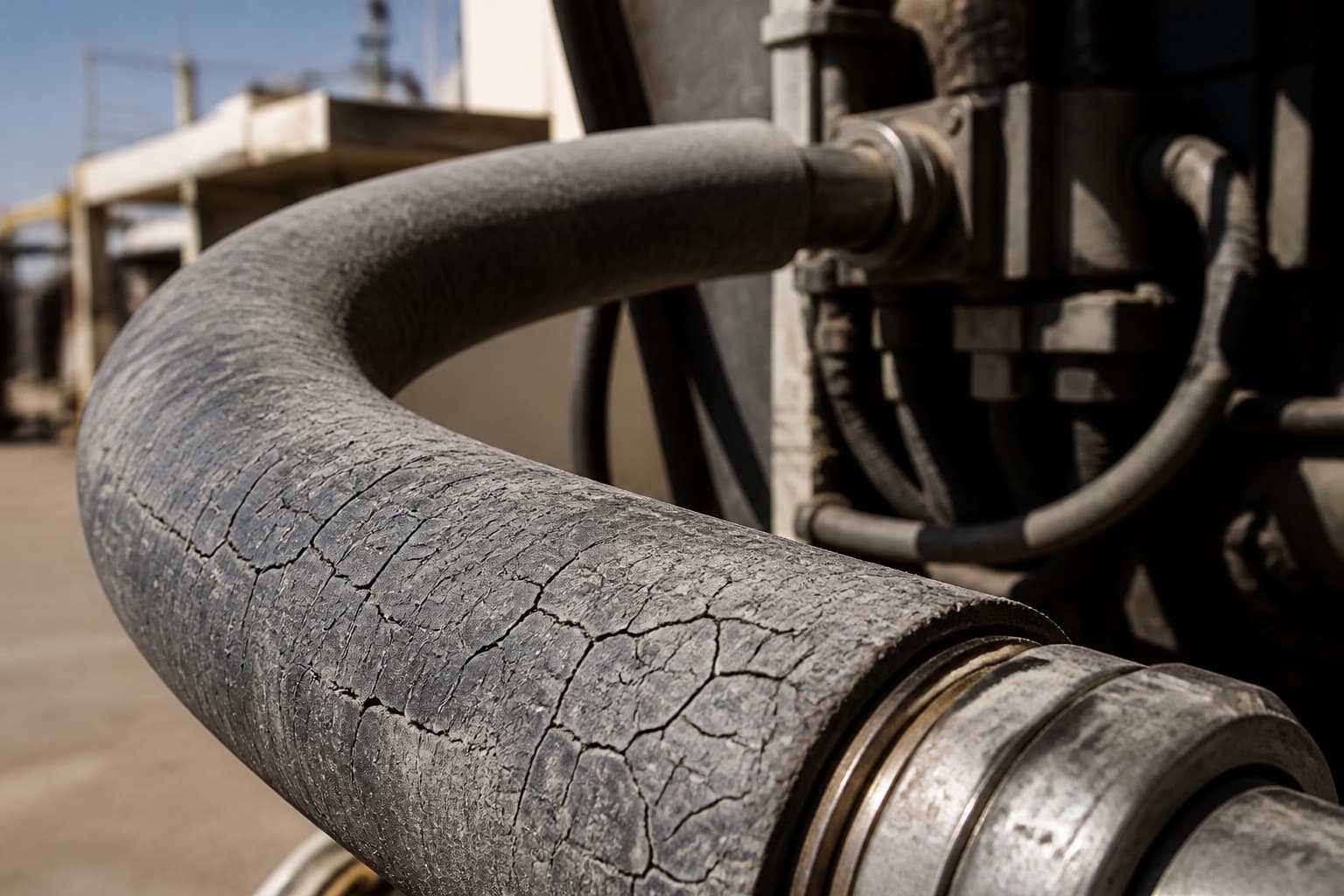
A cover that has gone hard and crazed with fine cracks looks like an old hose, and people treat it as cosmetic ageing. On a wire-reinforced hose it is not cosmetic at all — it is the protective layer failing, and what it was protecting is steel.
/01Reading the crack pattern.
| Pattern | Cause | What fixes it |
|---|---|---|
| Fine crazing over the whole cover, hose hardHighlighted | Heat ageing | Route away from the heat, or shield it |
| Cracks only on the outside of bends | Ozone attacking rubber held in tension | Reduce the bend, improve air movement, weather-resistant cover |
| Cracks on the sun-facing side only | UV exposure | Shade, sleeve, or a cover specified for weather |
| Deep splits after cold starts | Flexing below the hose’s minimum temperature | Warm-up before load; check the rated minimum |
/02Heat is cumulative.
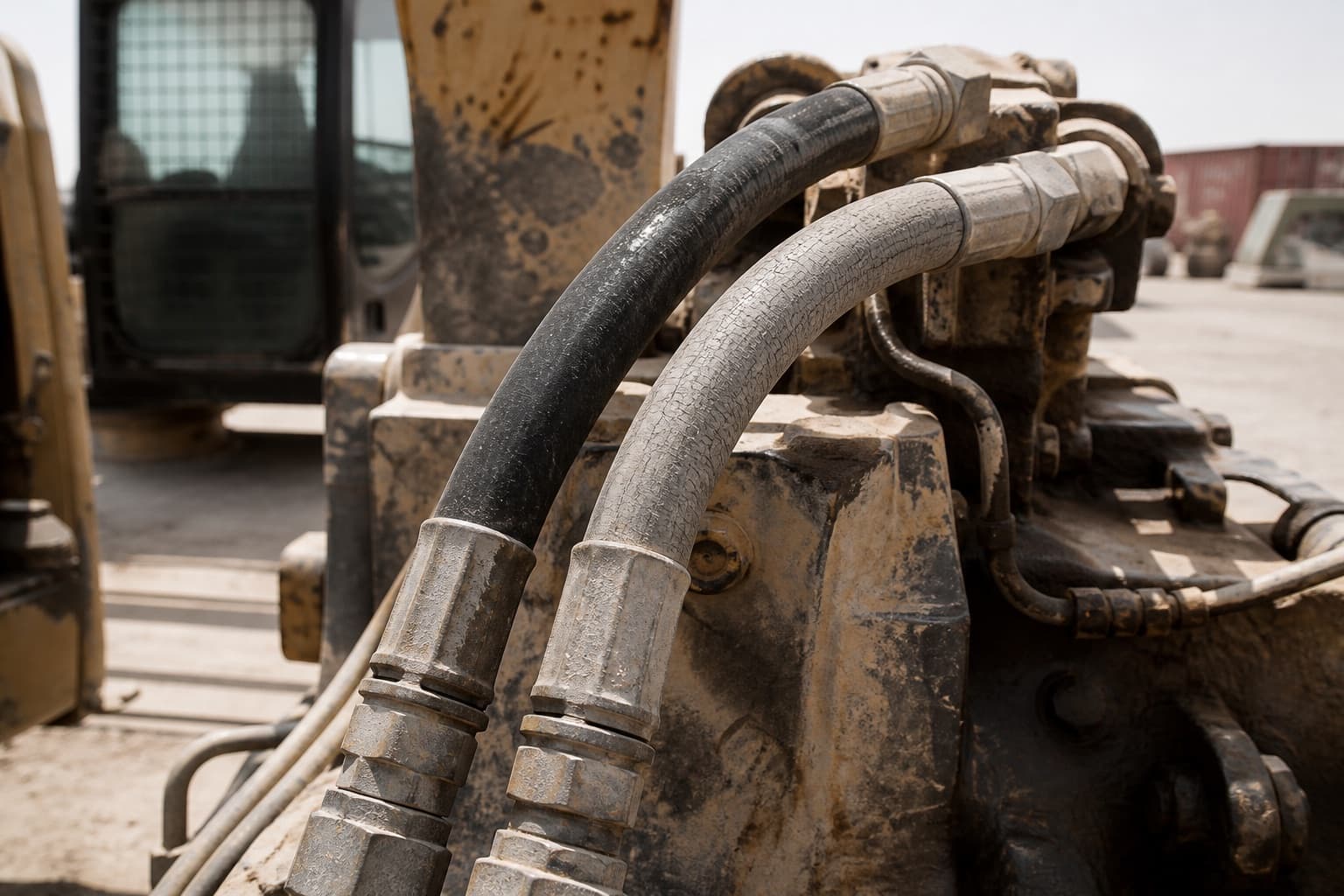
Rubber ageing is a one-way process. Time spent hot is spent; a hose that has run at high temperature for a year has used up part of its life permanently and does not get it back when conditions improve. That is why heat-related failures cluster — hoses in the same hot location all age at the same rate and start failing at around the same time.
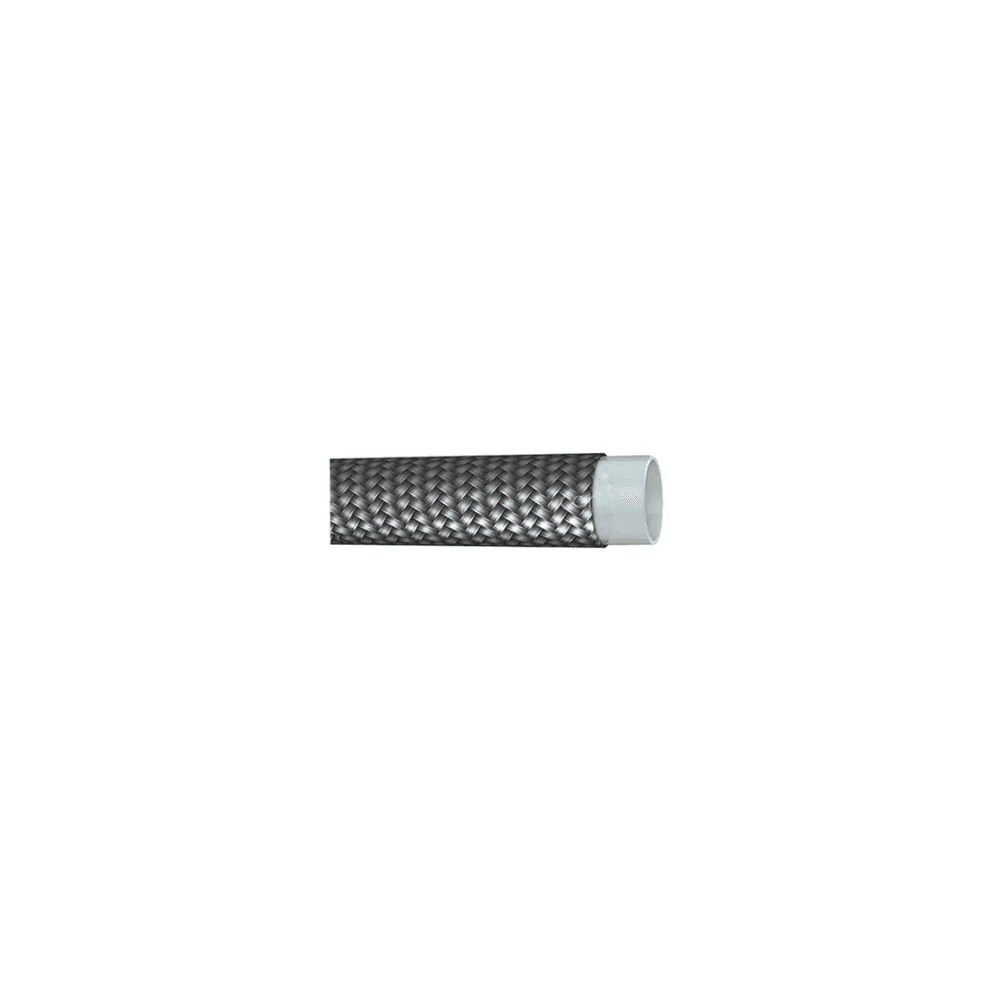
The rated maximum on most of what we stock is 100 °C, rising to 121 °C on the spiral constructions and R5, and 204 °C on PTFE. Those are fluid temperatures. A hose running cool fluid past a hot manifold is being heated from outside, and nothing in the rating accounts for that.
/03Ozone: the one that surprises people.
Ozone attacks rubber that is stretched, which is why the cracks appear on the outside of bends and nowhere else. A hose lying straight in the same air is unaffected. It needs no heat and no sunlight, and it works on hoses that are sitting still — a spare coiled tight on a rack is a textbook case.
/04Cover specification matters.
Covers are not interchangeable. Across the grades we stock some are specified abrasion-resistant, some weather-resistant, and some both. Where a hose is exposed to sun and still air rather than to rubbing, the weather-resistant specification is the one that matters — and choosing on abrasion alone puts the wrong hose in an exposed run. Of the grades we stock, 2SN and 4SH carry covers specified for both abrasion and weather.
Where heat is the constraint

Common questions
- Is a cracked cover a reason to replace the hose?
- On a wire-reinforced hose, yes — the cracks expose the reinforcement to moisture and the resulting corrosion is not inspectable. On a textile hose it is less urgent but still means the rubber has aged.
- Does a cracked cover mean the hose is out of date?
- It means it has aged, which is not quite the same thing. A hose in a hot exposed position ages faster than the calendar suggests, which is exactly why age-based replacement needs the environment factored in.
- Can I use a heat sleeve instead of re-routing?
- Yes where re-routing is impossible, and it is genuinely effective against radiated heat. It is second best: the hose is still in a hot place and the sleeve has to stay in good order for the protection to persist.
- Our spares are cracking on the shelf. Why?
- Ozone, and almost certainly tight coiling. Rubber held in tension cracks whether or not it is in service. Store them loose, out of direct light, and rotate the stock.