
Oilfield fittings and ordinary plant hydraulics arrive on the same site and behave like two different supply chains. A West African oilfield contractor buys two very different things that arrive in the same box: flow-iron and pressure-control ancillaries that carry standards and paperwork, and the ordinary hydraulic hose and adapters that keep cranes, workshops and utility plant running. They have different lead times, different acceptance criteria and different documentation, and the single most common cause of a delayed consignment is that they were ordered as one line.
Two regimes on one site.
| Property | Rig-side flow equipment | General plant hydraulics |
|---|---|---|
| Governing standard | API series, per service | Construction standards — EN, SAE |
| Documentation | Material certificates, test records, conformity statements | Usually the commercial set |
| Lead time driver | The document pack as often as the part | Stock |
| Acceptance | Operator specification, contractually enforced | Fit and function |
The paperwork moves before the goods.
Import regimes across the region are national rather than regional and several of them require registration or verification at origin, before shipment. None of that can be done retrospectively, which is why the part list matters at quotation rather than at order: the certification runs in parallel with picking, or it runs after it and adds its whole duration to the delivery.
Where a destination requires it, the sequence is fixed and the buyer holds one end of it — the importing entity, the bank instrument where one is required, and the customs classification their agent will declare. A supplier can prepare and attest documents; it cannot open the buyer’s side of the process.
Acceptance is contractual, not technical.
On a contractor site, whether an item may be fitted is decided by the operator’s specification. That document names standards, sometimes names manufacturers, and frequently asks for evidence that no standard requires. Read it before pricing rather than before delivering — the clause that adds cost is nearly always deliverable, and nearly always expensive to discover late.
What a workshop on such a site should hold.
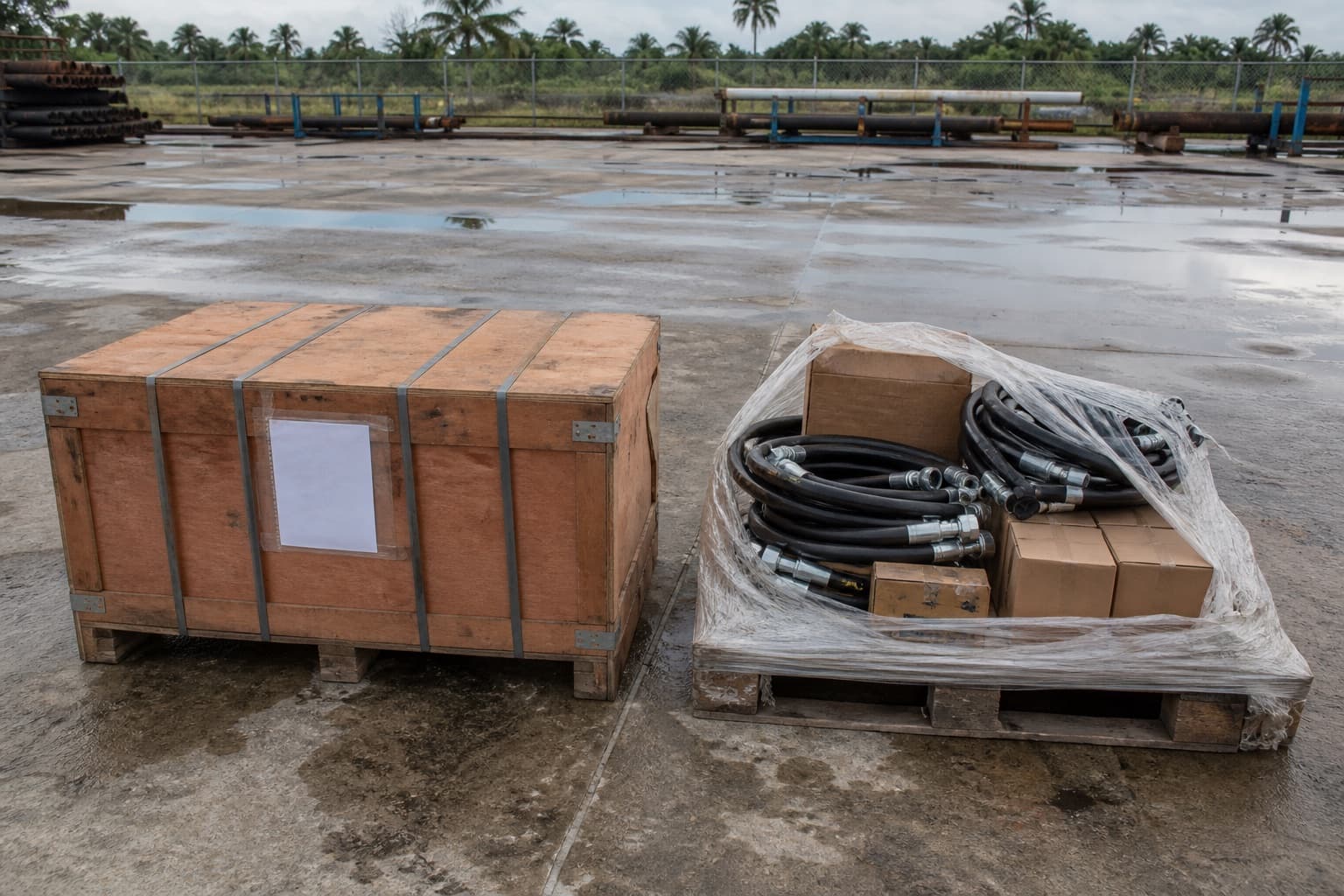
The undocumented half — hose, adapters, seals for cranes, compressors, workshop presses and utility plant — is exactly the population that benefits from ordinary stocking discipline: two or three bores, the families the equipment actually carries, consumables by the box. Keeping that half stocked is also what stops it being appended to a documented order and slowing it down.
Oil & gas hose
Rotary, vibrator, choke and kill, and control-line hose.
Can you supply documented and undocumented items on one order?
We can, and we will usually advise against shipping them as one consignment. Splitting the dispatch means the undocumented half arrives while the certificates for the other half are still being issued.
Who arranges the import documentation?
It is per destination and it is a shared job: the buyer holds the importing entity and, where required, the bank instrument; we prepare and attest what is raised at origin. Tell us the destination at enquiry and we will say which side owns what.
Do you hold operator vendor approvals?
No, and we do not claim any. We supply against the operator’s specification with the documentation the contract requires, which is what most contractor purchasing actually needs.
Export market
Supplying Nigeria from Dubai
Form M, SONCAP and PAAR — the sequence that has to happen before the vessel sails.
Splitting a documented order from a stock one?
Send both lists and the specification clause. We will separate them, quote each against its own regime, and dispatch the stock half without waiting for the certificates on the other.
Plant-down? Call +971 52 2477942 — 24/7