
Agriculture and construction fittings end up in one drawer on most of the yards we supply. Most workshops we supply in East Africa are not specialists. They keep a few tractors, a backhoe or two, a tipper, a generator and whatever the owner has bought since, and they do it with one drawer of parts and one fitter who has learned the fleet by heart. That is a harder stocking problem than a mine has, because the variety is higher and the budget is smaller.
Where the repeat failures actually are.
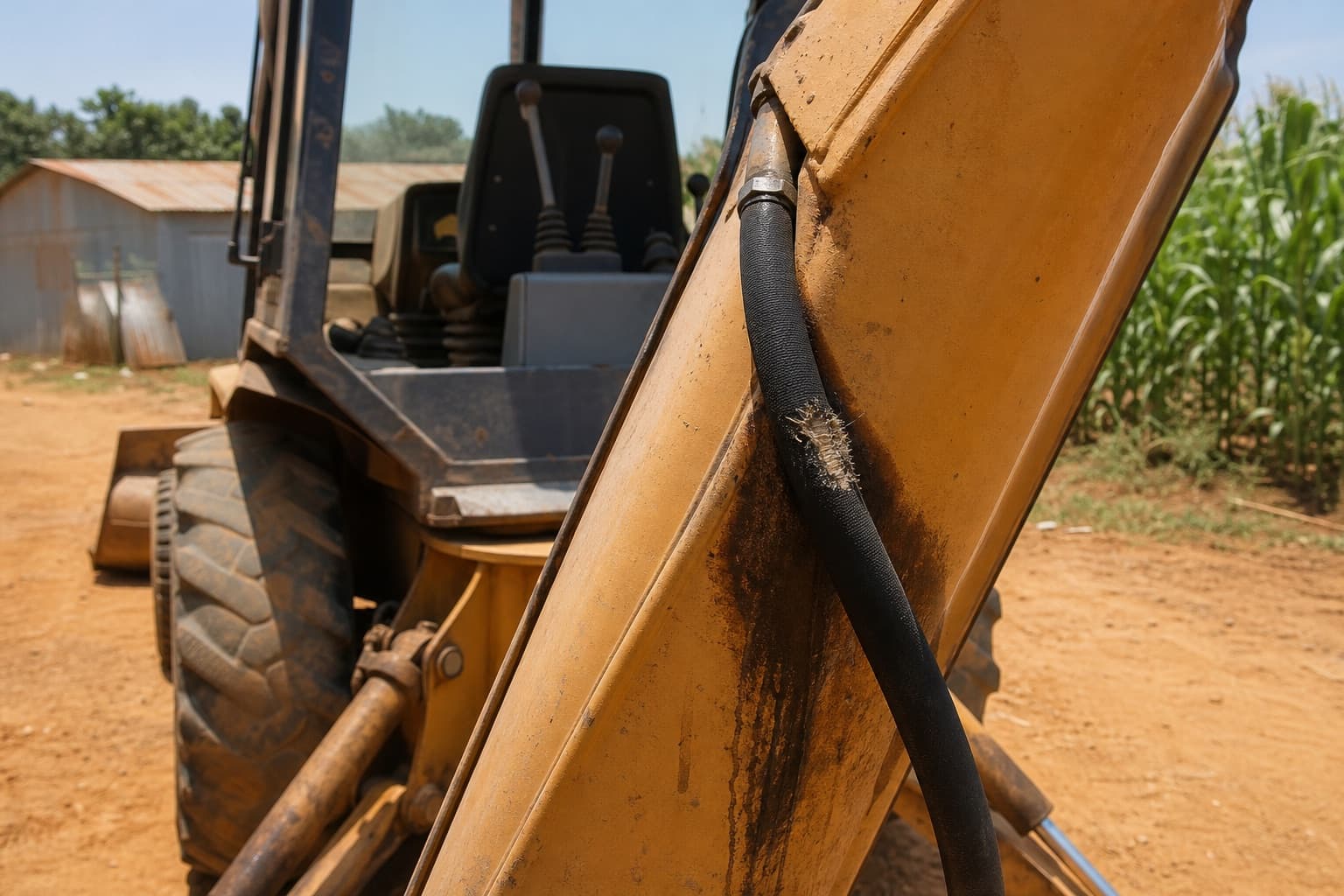
| Position | Why it fails repeatedly |
|---|---|
| Loader lift and tilt lines | Constant articulation, contact against the frame |
| Tipper ram feed | High load, long line, often poorly clamped |
| Implement couplers | Handled daily, dropped, dragged through dirt |
| Return lines near hot components | Heat ageing, and nobody inspects them |
The pattern in that table is that three of the four are installation problems rather than product problems. Before buying a heavier hose for a line that keeps failing, look at what it touches and whether it is clamped — that is a free repair and it usually lasts longer than the upgrade would.
Couplers, and the two families that are not interchangeable.
Implements connect through quick couplers, and agricultural couplers are a separate standardised family from the industrial ones used on excavators and skid steers. Replacing one half with a coupler from the other family produces a connection that works on one implement and fits nothing else in the yard. Buy coupler halves in pairs and keep the dust caps — a capped coupler survives a season, an uncapped one collects the yard.
Quick couplers
Coupler halves, dust caps and seals.
One record, kept somewhere other than a head.
On a small workshop the fleet knowledge is genuinely held by one person, and when that person is away the same identification gets done again from scratch, badly, under time pressure. A page per machine — the ends at the positions that fail, photographed, with the measurements written on it — takes an afternoon and removes that dependency permanently. It is also what turns an order into a line item instead of a conversation.
Buying against a season.
Agricultural work is seasonal and construction is weather-dependent, so demand arrives in bursts and always at the moment when waiting is most expensive. Order the consumables before the season starts rather than during it: seals and bonded washers by the box, coupler halves for each implement type, hose ends in the bores that fail, and caps and plugs so a machine can work on a reduced circuit while a part is in transit.
What is the minimum useful stock for a small mixed workshop?
Hose ends in the two or three bores that actually fail, in the families your machines carry; a box each of bonded seals and O-rings; one spare coupler half per implement type; plugs and caps. Everything else can be ordered against a photograph.
Is it worth having hose made up locally or buying assemblies?
Where a hose shop is within reach, local make-up is fine for standard lines. Where it is not, holding ends and bulk hose — or a small set of tagged assemblies for the critical circuits — is what keeps machines working.
Can you quote a pre-season list?
Yes, and it is the cheapest way to buy for a small fleet. Send the machine and implement list with the ends you replace most and we will build it as one consignment.
Export market
Supplying Kenya from Dubai
Lane, freight modes and the documents that travel with a consignment.
One workshop, several kinds of machine?
Send the fleet list, however rough, and photographs of the ends you replace most. We will build a stock list sized for the failures that repeat, not for the catalogue.
Plant-down? Call +971 52 2477942 — 24/7