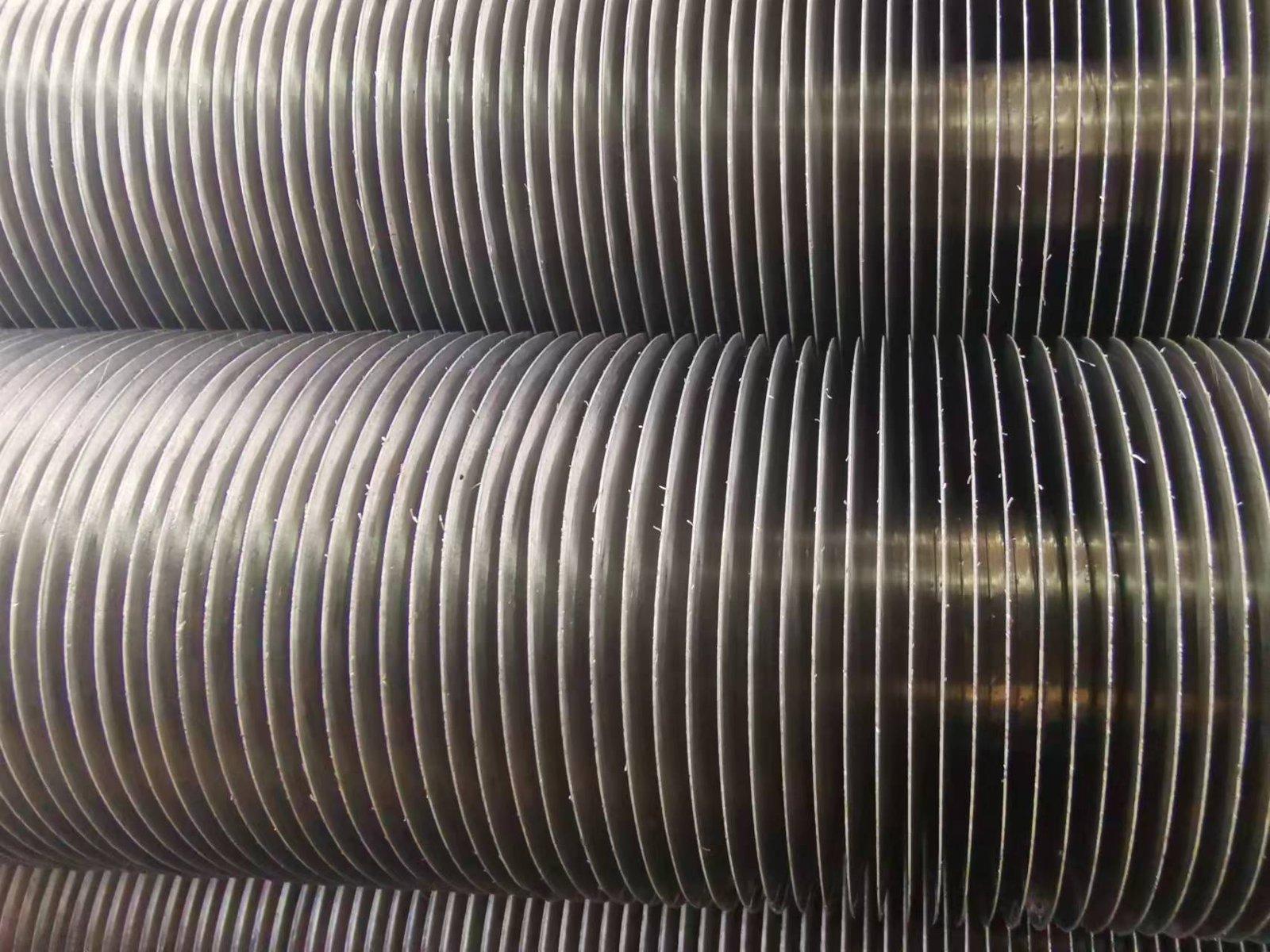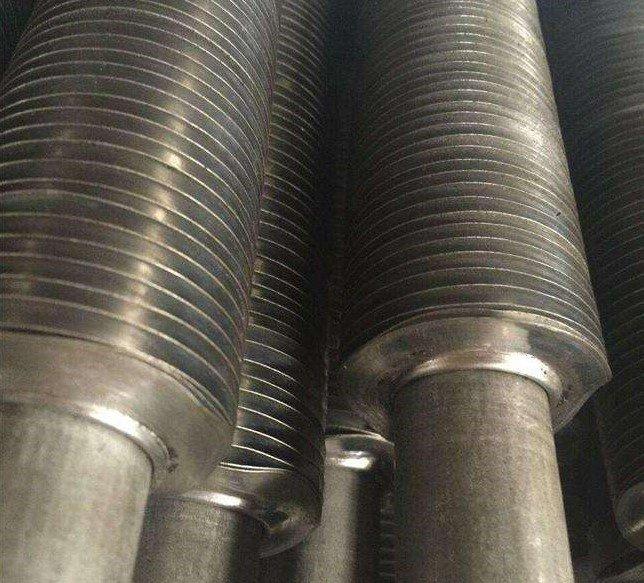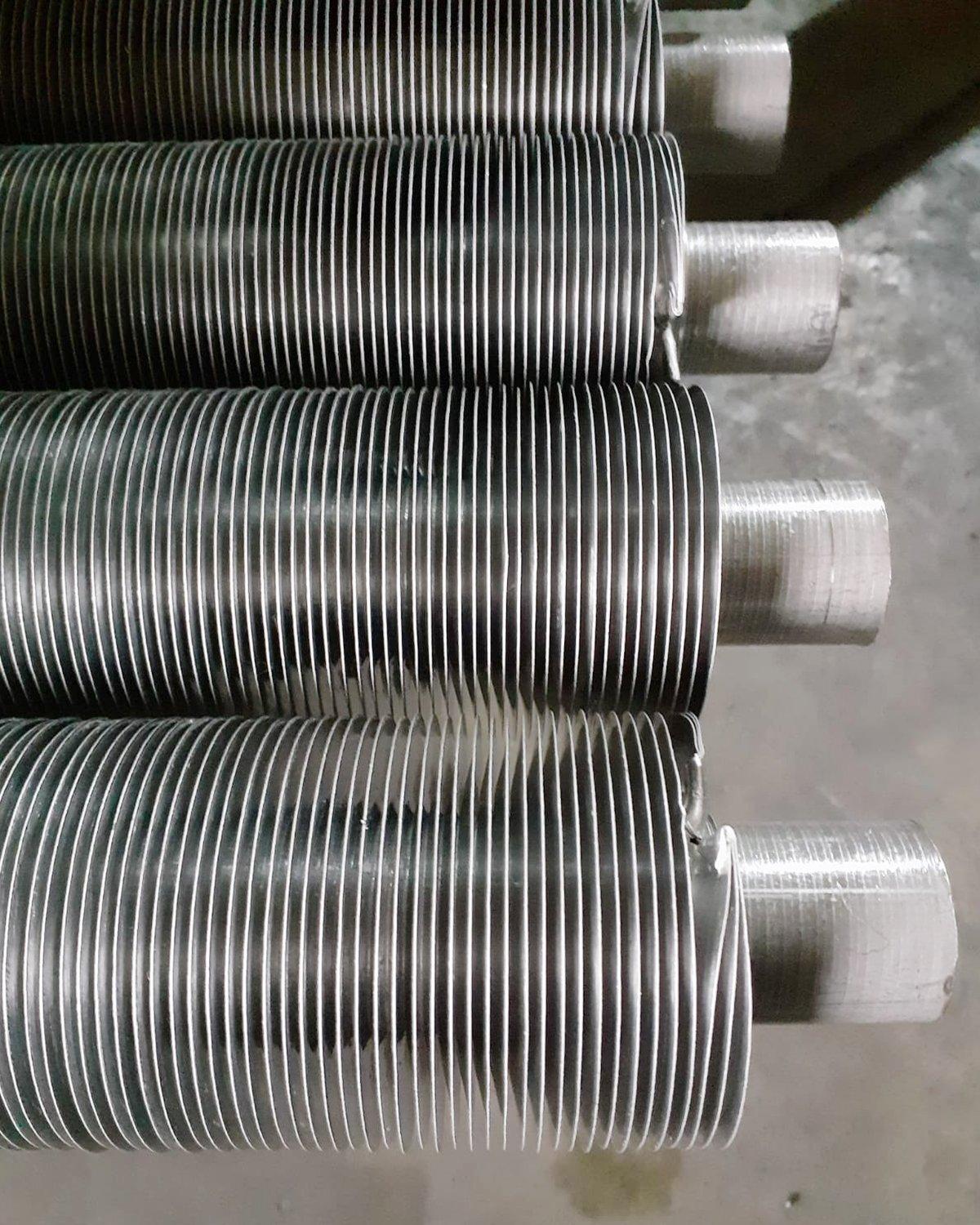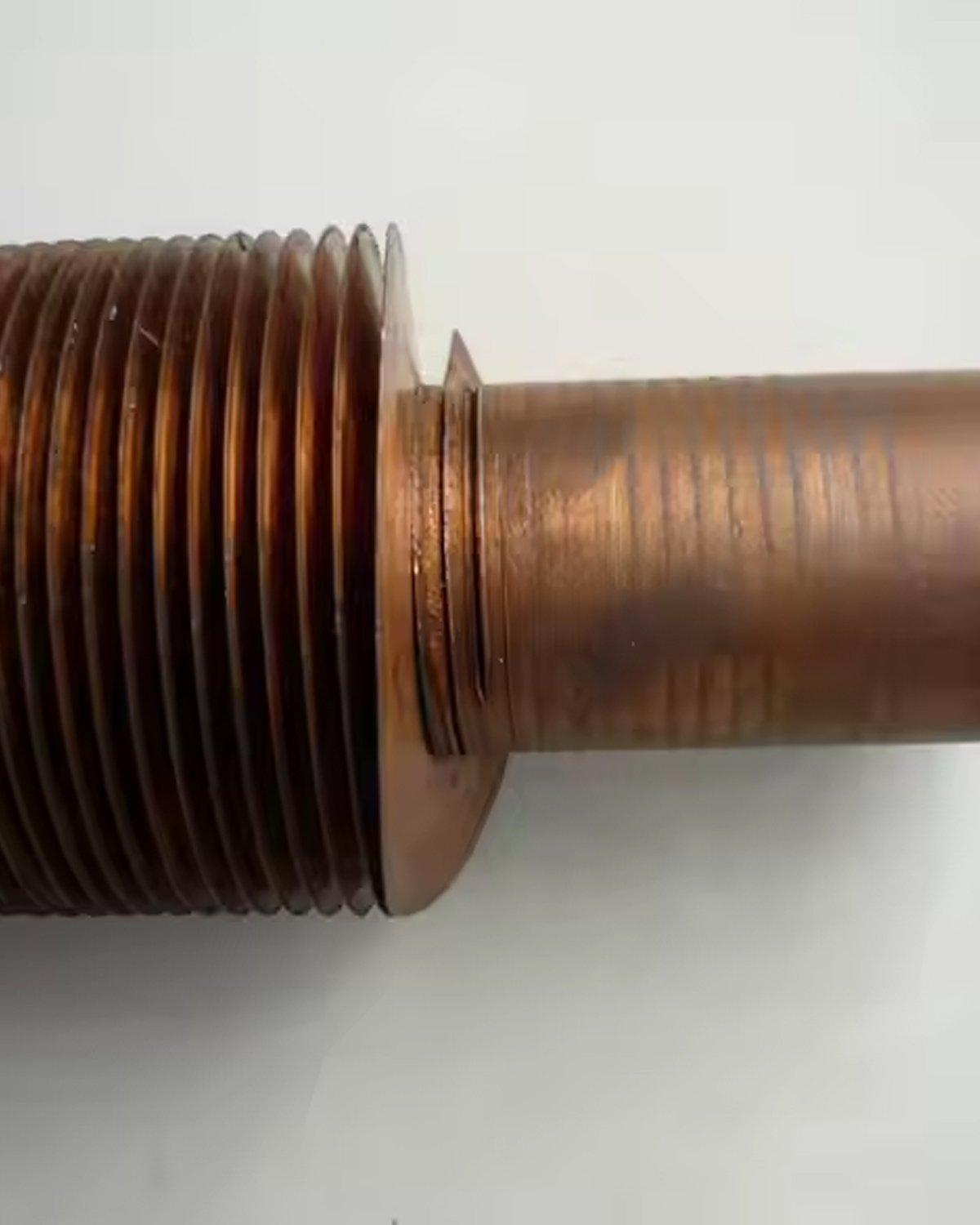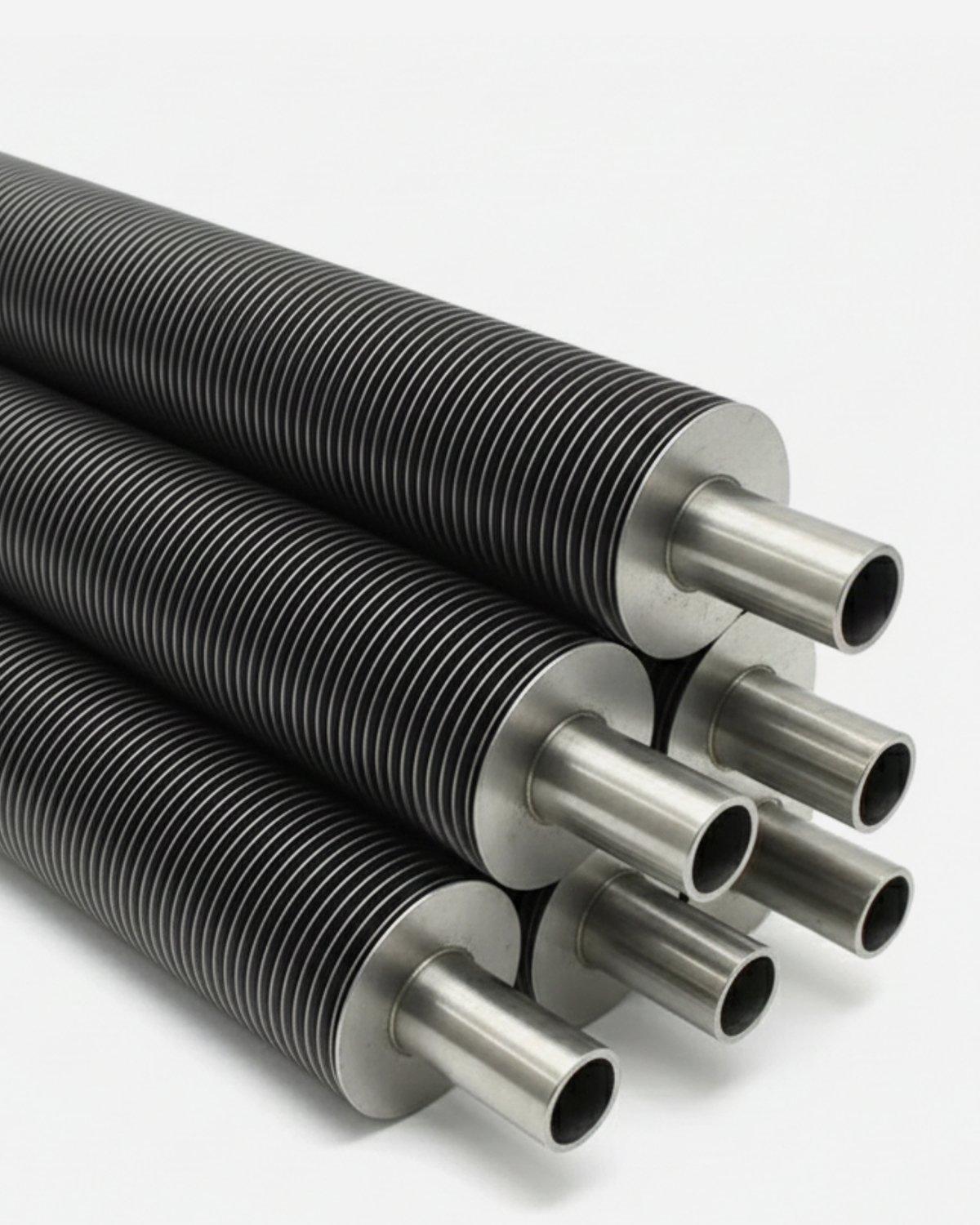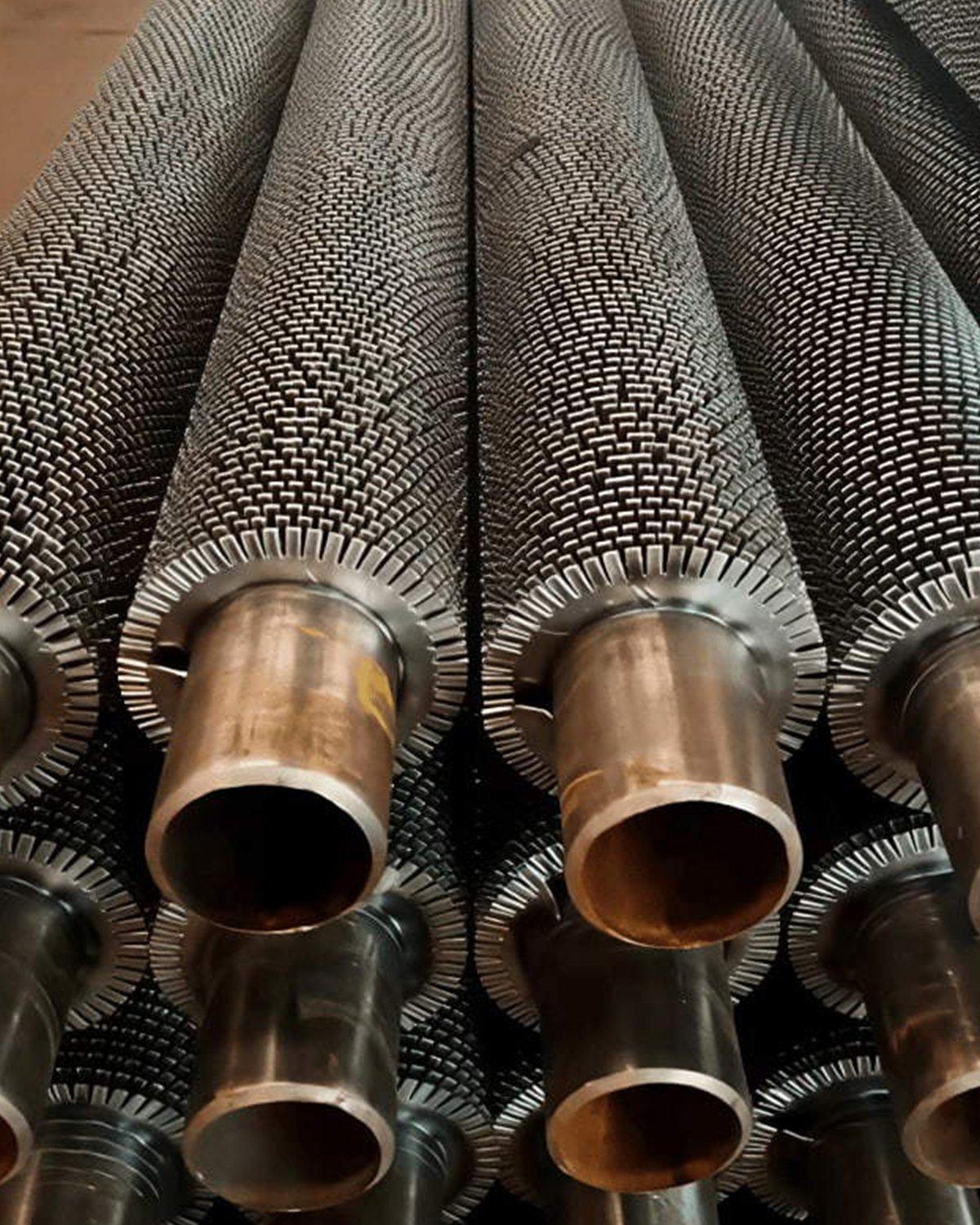
A finned tube is two parts — a base tube that carries the pressure and a fin that carries the heat to the air or gas — and almost everything that matters about it depends on how the two are joined. A fin that loosens loses contact, and a loose fin is just a radiator for nothing. So the first choice is not the fin size but the bond, and the bond is chosen by the temperature of the tube wall and the air around it.
/01The fin types side by side.
| Fin type | Bond | Typical limit | Typical service |
|---|---|---|---|
| L-foot tension-wound | Contact pressure of the L foot | 120 °C conservative; 120–150 °C typical maker limit (bond loosens with thermal cycling) | Low-temperature air coolers, lube-oil and jacket-water coolers, HVAC/enclosure heaters |
| LL overlapped | Contact pressure; feet overlap and cover the tube | 155 °C typical maker limit (published 155–180 °C) | Moderate-temperature air coolers where the foot overlap gives better tube coverage than single L |
| KL knurled | L foot pressed into a knurled tube surface | 260 °C typical maker limit (published 165–260 °C; confirm with maker per order) | ACHE services between L-fin and embedded-fin temperatures |
| Extruded (bimetallic) | Fin rolled out of an aluminium sleeve over the liner tube | 285 °C typical maker limit (published 280–315 °C) | Air-cooled heat exchangers in gas processing, LNG (MR and propane coolers), gas compression stations and refineries |
| Embedded G-fin | Strip wound into a groove, groove edges rolled back | ≈400 °C typical maker limit (published 380–415 °C) | Cyclic-temperature ACHE services where owner specs call for embedded fins |
| HF-welded spiral | High-frequency resistance weld at the fin root | Set by fin material; fired-heater fin-tip limits per API 560: carbon steel 454 °C, 2¼Cr / 5Cr 549 °C, 25Cr-20Ni 982 °C | Fired-heater convection sections in refineries |
| Studded | Each stud arc- or resistance-welded | Set by stud material; fired-heater stud-tip limits per API 560: carbon steel 454 °C, 2¼Cr / 5Cr 549 °C, 25Cr-20Ni 982 °C | Refinery crude, vacuum and reformer heater convection sections firing fuel oil or mixed fuel |
/02Tension-wound: L, LL and KL.
An L-foot fin is an aluminium or copper strip with a foot bent at its root, wound under tension so the foot sits on the tube. Nothing but contact pressure holds it, and that pressure falls as the tube heats and cools, so L fins are kept to low-temperature air coolers, lube-oil and jacket-water coolers — 120 °C is the conservative figure, 120–150 °C the typical maker limit — and the ends are banded so the fin cannot unwind. The LL fin overlaps each foot on the one before, covering the tube completely; that full cover protects the tube from the atmosphere and lifts the typical limit to about 155 °C. The KL fin is wound onto a knurled tube so the foot is pressed into the knurl — a better bond, at about 260 °C typical.
| OD mm | OD in | Fin OD | Fin height | Fin thickness | FPI | Part number |
|---|---|---|---|---|---|---|
| 15.88 | 5/8 | 34.93 | 9.53 | 0.38 | 10 | IH-TF-WF-L-0159 |
| 19.05 | 3/4 | 44.45 | 12.7 | 0.38 | 10 | IH-TF-WF-L-0190 |
| 25.4 | 1 | 50.8 | 12.7 | 0.38 | 10 | IH-TF-WF-L-0254 |
| 25.4 | 1 | 57.15 | 15.88 | 0.38 | 10 | IH-TF-WF-L-0254-B |
| 38.1 | 1 1/2 | 69.85 | 15.88 | 0.38 | 10 | IH-TF-WF-L-0381 |
/03Embedded G-fin.
An embedded G-fin is wound into a helical groove machined in the tube, and the groove edges are rolled back to lock the fin root. The lock survives temperature cycling, so G-fins are used where the inlet passes of an air cooler run hot — typically about 400 °C as a maker limit. The groove removes wall, so the tube must be thicker than for a wrap-on fin; our listing calls for at least 2.11 mm.
| OD mm | OD in | Fin OD | Fin height | Fin thickness | FPI | Part number |
|---|---|---|---|---|---|---|
| 15.88 | 5/8 | 34.93 | 9.53 | 0.41 | 6–12 | IH-TF-GF-GFN-0159 |
| 19.05 | 3/4 | 44.45 | 12.7 | 0.41 | 6–12 | IH-TF-GF-GFN-0190 |
| 25.4 | 1 | 50.8 | 12.7 | 0.41 | 6–12 | IH-TF-GF-GFN-0254 |
| 25.4 | 1 | 57.15 | 15.88 | 0.41 | 6–12 | IH-TF-GF-GFN-0254-B |
| 38.1 | 1 1/2 | 69.85 | 15.88 | 0.41 | 6–12 | IH-TF-GF-GFN-0381 |
/04Extruded fins.
An extruded fin is formed by rolling the fins out of a thick aluminium sleeve pressed over the liner tube. The aluminium covers the liner completely and the bond is tight, which is why extruded tube is chosen for coastal and offshore air coolers — see extruded fin tube for coastal air coolers. The typical maker limit is about 285 °C.
/05Welded fins and studs.
In fired-heater convection sections, HRSGs and economisers the gas is hot and dirty and the fin must be steel, welded to the tube. HF-welded spiral fins come solid or serrated (see serrated vs solid); studded tubes carry individually welded studs for fuel-oil firing. Their limit is set by the fin material: for fired-heater fins API 560 gives tip limits of 454 °C for carbon steel, 549 °C for 2¼Cr and 5Cr, and 982 °C for 25Cr-20Ni.
For dust-laden flue gas, H-fin tubes leave straight gas lanes between flat plates that resist fouling, and longitudinal fins serve double-pipe exchangers and tank heaters. Oval and elliptical fin tubes carry rectangular plate fins for air-cooled steam condensers and dry coolers.
Two variants of the wound fin change the strip rather than the bond: crimped fins, ruffled at the root as they are wound, for economisers and air heaters, and notched and root-serrated fins, which bend round the tube without stretching. Their sizes are confirmed with the quotation.
/06Choosing.
- Find the maximum tube wall temperature, including upsets and steam-out.
- Pick the cheapest fin whose typical limit clears it with margin: L, then LL or KL, then extruded, then embedded G-fin.
- On the coast or offshore, prefer full cover: LL or extruded.
- In flue gas or fired heaters, use welded steel fins or studs, and pick the fin material for the tip temperature.
- Then fix the fin height, thickness and density with the thermal design.
Common questions
- What is the difference between L and LL fin tubes?
- An LL fin’s foot overlaps the previous one, so the tube is fully covered. That protects it from the atmosphere and raises the typical limit slightly, to about 155 °C against 120–150 °C for L.
- Which finned tube is best for high temperature?
- Embedded G-fins (about 400 °C typical) for air coolers; welded spiral fins or studs, limited by the fin material, for fired heaters and flue gas.
- Which fin is best near the sea?
- Extruded or LL fins, because they cover the base tube completely.
- Are these temperatures from API 661?
- No. They are typical maker limits. API 560 tip limits apply only to welded and studded fired-heater fins.
- What fin density is usual?
- Air-cooler fins are commonly 10 fins per inch; aluminium air-cooler fins in our listings run from 4 to 12 FPI, and welded fired-heater fins from 1 to 6.